

Street harassment is defined as any unwanted comment, gesture, or action directed at a person in a public space that causes fear, distress, or humiliation. Stopping street harassment requires more than individual courage. It demands practical strategies, community action, and an understanding of your legal rights. 80% of women have experienced sexual harassment in public spaces, according to a 2026 IPSOS and L’Oréal Paris study. That figure means most people reading this have either experienced harassment on the street or know someone who has. New legislation, proven bystander frameworks like the 5Ds, and reality-based safety training are now giving individuals and communities real tools to push back.

What are the most effective personal strategies for stopping street harassment?
The safest response to harassment in public is the one that gets you out of the situation without escalating it. That principle sounds simple, but it runs counter to what many people instinctively want to do, which is confront the harasser directly. Direct confrontation is a last resort and only appropriate when it does not increase your risk. Your priority is always your own safe exit.
Personal responses fall into three broad categories: disengagement, assertive refusal, and verbal redirection.
- Disengagement means ignoring the harasser entirely, avoiding eye contact, and moving toward a crowded or well-lit area. This is the lowest-risk option in most situations.
- Assertive refusal means stating clearly and calmly, “Do not speak to me,” then walking away. Keep your voice flat and your body language closed. Do not smile or apologize.
- Verbal redirection means responding to the harasser as if they said something mundane. “Sorry, I don’t have the time” breaks the dynamic without engaging the power play.
Street harassment stems from power and entitlement, not from anything the target did or wore. Understanding that shifts the emotional weight off you and onto the harasser where it belongs. Harassers rely on confusion and social pressure to keep targets frozen. Recognising that tactic is itself a form of defence. Streetsafeselfdefence teaches this principle directly: predators use confusion as their first weapon, and awareness breaks that advantage.
After an incident, give yourself time to process what happened. Check in with a friend, write down the details, or simply sit somewhere safe for a few minutes. Checking in after an incident significantly reduces emotional trauma and feelings of isolation, even when the check-in happens well after the event.

Pro Tip: Prepare two or three short phrases in advance, such as “Leave me alone” or “I’m not interested,” so you don’t have to think under pressure. Rehearsing them out loud makes them easier to deliver calmly when you need them.
How can bystanders effectively intervene to stop street harassment?
Bystander intervention is one of the most powerful tools for reducing harassment in public spaces. When bystanders act, they signal to the harasser and the entire community that this behaviour will not be tolerated. Shifting social norms through visible intervention demonstrates that harassment is not acceptable, and that shift accumulates over time.
The 5Ds framework, recommended by the Right To Be advocacy group, gives bystanders five flexible, safety-first options.
- Distract. Create an interruption without acknowledging the harassment. Ask the target for directions, pretend to know them, or drop something nearby. This breaks the harasser’s focus without direct confrontation.
- Delegate. If you are not comfortable acting alone, ask someone nearby to help. Alert a bus driver, security guard, or shop employee. Delegation spreads responsibility and often produces a faster response.
- Document. Record the incident if it is safe to do so. Focus on the harasser’s behaviour, clothing, or vehicle details rather than the target’s face or identity.
- Delay. If you cannot act in the moment, check in with the target afterward. Ask if they are okay, offer to sit with them, or help them contact support. Even delayed intervention provides substantial emotional support and reduces trauma.
- Direct. Address the harasser directly only when it is safe and you judge the risk to be low. Keep it brief: “That’s not okay.” Then redirect your attention to the target.
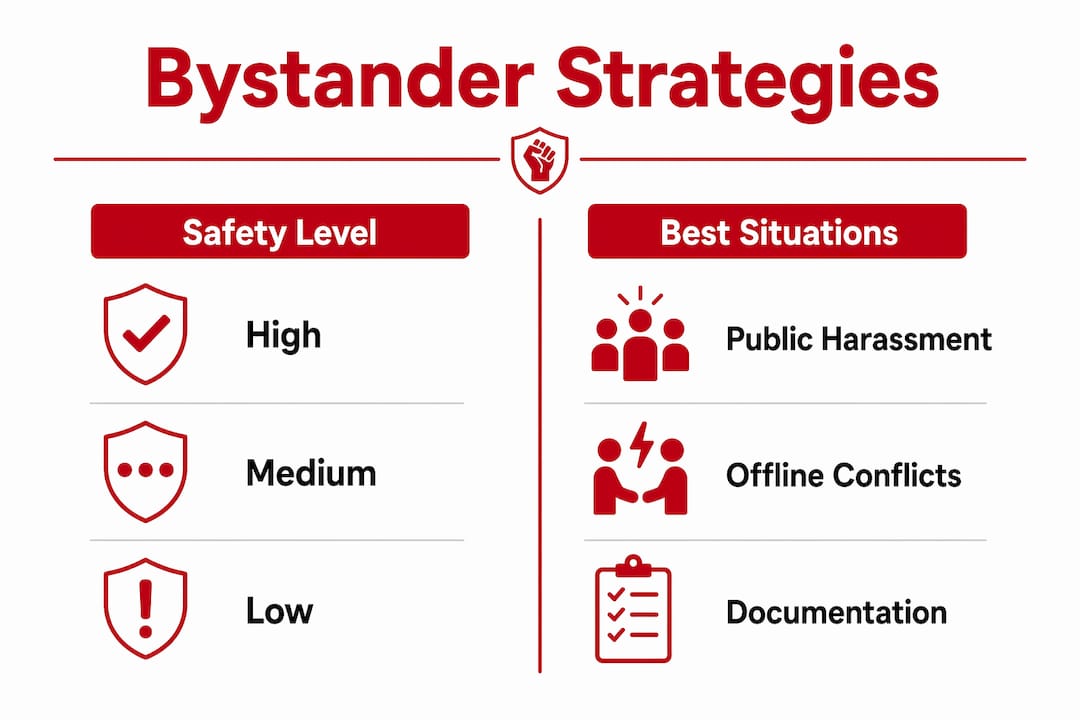
The table below compares each approach by safety level and best-use situation.
| Strategy | Safety level | Best situation |
|---|---|---|
| Distract | High | Ongoing harassment in a public space |
| Delegate | High | When you are alone or feel unsafe acting |
| Document | Medium | When the incident is escalating or ongoing |
| Delay | High | When intervention during the incident was not possible |
| Direct | Lower | Only when risk is minimal and you feel confident |
Pro Tip: When documenting, always ask the target’s permission before sharing any footage or photos. Proper documentation protects victim identity and focuses on harasser behaviour. Sharing without consent can cause further harm.
What legal protections exist for harassment in public spaces?
The legal framework around public harassment has strengthened considerably. In the UK, new legislation effective April 1, 2026 criminalizes public harassment motivated by sex, with penalties of up to two years in prison. Within the first two months of the law taking effect, 26 arrests were recorded. That pace signals that enforcement is active, not symbolic.
Below the criminal threshold, enforcement tools also exist for lower-level harassment.
- Public Space Protection Orders (PSPOs) in areas like Westminster allow authorities to issue £100 on-the-spot fines for catcalling and similar offences. These orders give councils and police a rapid response tool for behaviour that falls short of a criminal charge.
- Police, council officers, and transport security all have authority to enforce these measures depending on the location and nature of the incident.
- Behaviours covered include unwanted sexual comments, persistent following, and intimidating gestures directed at a person because of their sex.
When reporting harassment to authorities, evidence matters. Write down the time, location, and a description of the harasser as soon as possible after the incident. If you have video or photos, note whether you have the target’s consent to share them. A clear, factual account strengthens any report and supports enforcement action.
Pro Tip: Use your phone’s notes app immediately after an incident to record details while they are fresh. Include the time, location, what was said or done, and any witnesses present. This record is far more useful to police than a general description given days later.
What tools and preparations help prevent harassment in public?
Prevention works on two levels: personal preparation and community culture. Both matter and neither replaces the other.
On the personal level, several tools reduce risk and build confidence.
- Personal alarms emit a loud sound that draws attention and can deter a harasser. They are legal, inexpensive, and require no physical training to use.
- Self-defence training builds awareness, confidence, and the ability to respond under pressure. Streetsafeselfdefence delivers reality-based self-defence training directly to clients across Canada, covering real harassment scenarios in as little as five hours.
- Situational awareness means knowing your exits, keeping your phone accessible but not distracting, and trusting your instincts when something feels wrong.
On the community level, education changes what people accept as normal. Schools, workplaces, and community groups that run violence prevention programmes shift the baseline of what bystanders are willing to tolerate. That shift is cumulative. Each person who speaks up or intervenes makes the next intervention slightly easier for someone else.
| Tool | Benefit | Limitation |
|---|---|---|
| Personal alarm | Immediate deterrent, no training needed | Relies on others nearby responding |
| Self-defence training | Builds confidence and physical response skills | Requires time investment upfront |
| Situational awareness | Free, always available, reduces risk proactively | Takes practice to develop consistently |
| Community reporting platforms | Builds data and accountability | Depends on platform uptake and follow-through |
Pro Tip: Choose tools that match your comfort level and daily context. A personal alarm suits most situations. Self-defence training suits anyone who wants deeper preparation. The best tool is the one you will actually use.
Key takeaways
Stopping street harassment requires personal strategies, bystander action, and legal awareness working together, not any single tactic alone.
| Point | Details |
|---|---|
| Personal safety comes first | Prioritise your safe exit over confrontation in every harassment situation. |
| The 5Ds give bystanders options | Distract, Delegate, Document, Delay, and Direct offer flexible, low-risk ways to intervene. |
| New laws carry real penalties | UK legislation from april 2026 criminalises sex-based public harassment with up to two years in prison. |
| Evidence strengthens reports | Record time, location, and harasser details immediately after an incident. |
| Prevention works at two levels | Personal tools and community education both reduce harassment and build safer public spaces. |
What I’ve learned from years of working in this space
Most people who experience harassment in the street freeze. Not because they are weak, but because the brain defaults to confusion when social rules are violated unexpectedly. I’ve seen this pattern repeatedly in training sessions across Canada. The harasser counts on that freeze. It’s the window they exploit.
What changes that is not aggression training. It is repetition and recognition. When you have practised a response, even a simple verbal one, your brain has a path to follow when the freeze hits. That’s the core of what understanding human behaviour offers in real-world safety training. It’s not about learning to fight. It’s about learning to think clearly under pressure.
The bystander piece is where I think most communities underinvest. People overestimate the risk of a Distract or Delay intervention and underestimate how much it means to the person being harassed. Checking in with someone after an incident costs nothing and changes everything for that person. That’s the cultural shift that legal frameworks alone cannot produce.
Stopping harassment is a collective responsibility. Laws set the floor. Training and community action raise the ceiling.
— Rob
Streetsafeselfdefence training: a practical next step
Street harassment is not a problem you have to face without preparation. Streetsafeselfdefence brings mobile self-defence training directly to you, covering real-world harassment scenarios in a format that works for all ages and fitness levels. No gym membership. No prior experience required.
Programmes cover situational awareness, verbal de-escalation, and physical response skills, all grounded in reality-based violence prevention rather than traditional martial arts. Whether you are an individual looking to build confidence or an organisation wanting to protect your people, Streetsafeselfdefence offers training that fits your context. For those wanting to understand the legal side of personal safety in Canada, the self-defence in Canada resource is a strong starting point.
FAQ
What is street harassment?
Street harassment is any unwanted comment, gesture, or action directed at a person in a public space that causes fear, distress, or humiliation. It is a tool of social control rooted in power and entitlement, not a reflection of the target’s behaviour.
How should I respond if I am harassed in public?
Prioritise your safe exit over confrontation. Disengaging, stating a calm refusal, or moving toward a crowded area are the safest first responses. Prepare short phrases in advance so you can deliver them without hesitation.
What are the 5Ds of bystander intervention?
The 5Ds are Distract, Delegate, Document, Delay, and Direct. Recommended by Right To Be, they give bystanders five flexible options to intervene safely without requiring direct confrontation.
Is street harassment illegal in Canada?
Canadian law addresses harassment through the Criminal Code under provisions for criminal harassment, intimidation, and causing a disturbance. Specific enforcement depends on the behaviour and jurisdiction. Streetsafeselfdefence covers the legal context of self-defence in Canada in detail.
How do I document harassment without harming the victim?
Focus your documentation on the harasser’s behaviour, clothing, or vehicle details rather than the target’s face or identity. Always ask for the target’s consent before recording or sharing any footage.
Recommended
Article generated by BabyLoveGrowth
