

By Rob Andress
Violence Prevention Consultant, SAS-AP
Close Quarter Combative Instructor
Pure & Applied Debilitation Instructor
Active Threat Survival Trainer (A.L.I.V.E.)
Street Safe Self Defence Training Company
We need to have an honest conversation about de-escalation.
Because right now, that word is being used everywhere.
By-Law Officers are being told to de-escalate.
Security Officers are being told to de-escalate.
Paramedics are being told to de-escalate.
Firefighters are being told to de-escalate.
Every workplace violence policy seems to include it.
But here is the question nobody seems to be asking:
What exactly are they supposed to de-escalate if they were never trained to recognize that the person’s behaviour was escalating in the first place?
You cannot de-escalate what you never recognized.
It really is that simple.
De-escalation does not begin when someone starts yelling.
It does not begin when the threats start.
It does not begin when the person clenches their fists, moves into your space or refuses to let you leave.
By then, you may already be behind the behaviour.
Real de-escalation begins much earlier.
It begins when you recognize that something has changed.
The person’s language changes.
Their movement changes.
Their attention changes.
Their breathing changes.
They stop responding to questions the same way.
They begin looking around the environment.
They start watching your hands, your equipment, your partners or the exit.
Something is different.
That difference matters.
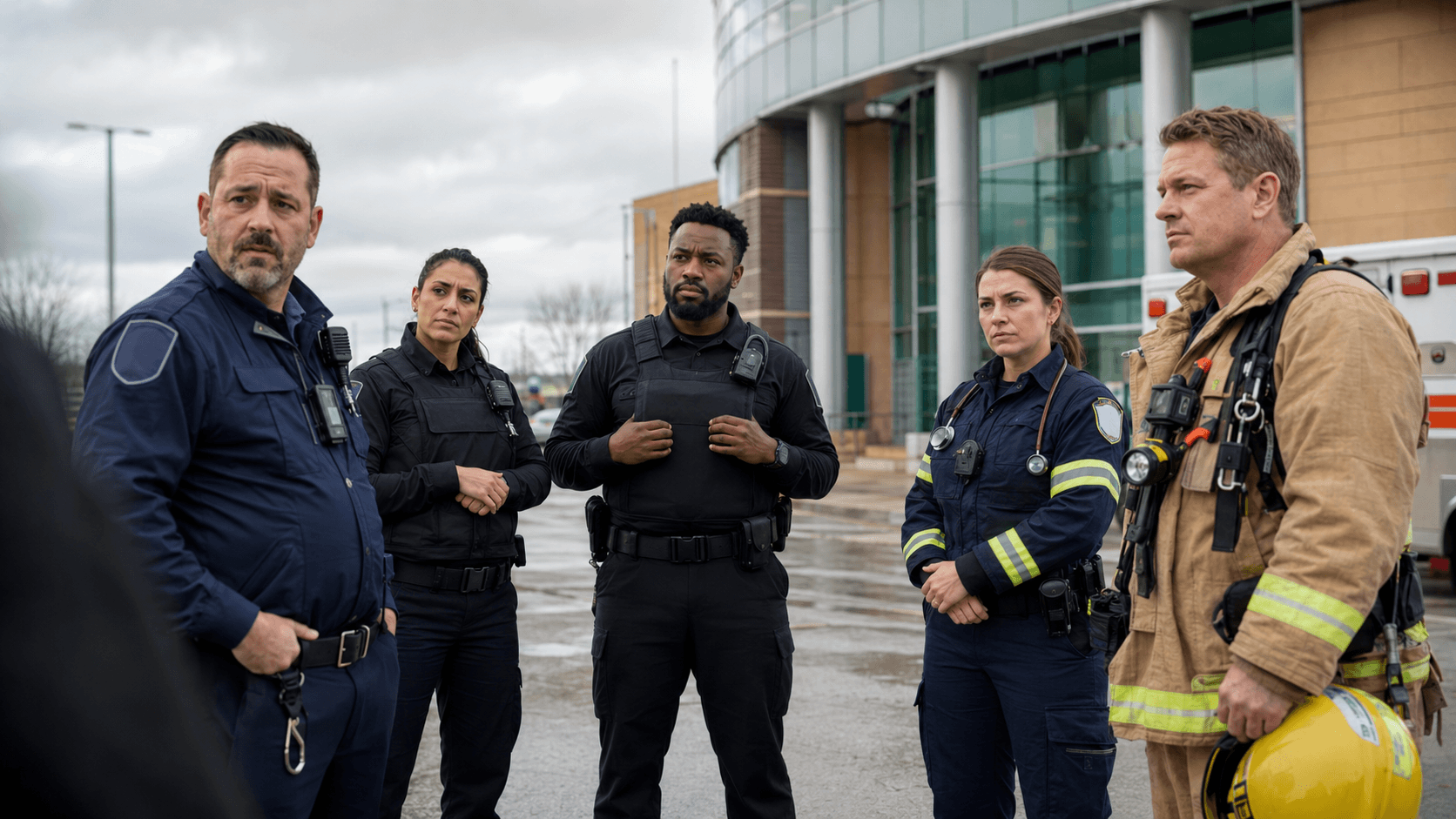
By-Law Officers, Security Officers and Security Teams, Paramedics and Fire Departments. Their jobs may be different, but the behavioural challenges they face are often remarkably similar.
A By-Law Officer may be standing at the front door of someone’s home discussing a complaint.
A Security Officer may be asking someone to leave private property.
A Paramedic may be treating a patient while an angry family member moves around behind them.
A firefighter may enter a residence expecting a medical emergency and find themselves surrounded by intoxication, confusion, fear and aggression.
Different uniforms.
Different responsibilities.
Different levels of authority.
But the same human behaviour.
That is what TRAACS is built around.
TRAACS does not teach people to rely on a handful of polite phrases and hope the situation gets better.
It teaches them to recognize what is happening in front of them, understand what the behaviour may be communicating and make better decisions before the encounter becomes physical.
Because de-escalation is not simply about what you say.
It is about what you recognize before you say it.
De-Escalation Is Not a Script
One of the biggest problems I see with de-escalation training is that it is often taught like a script.
Say this.
Don’t say that.
Keep your voice calm.
Show empathy.
Give the person choices.
Those things can help. I’m not suggesting they don’t.
But human behaviour is not scripted.
The person standing in front of you has not read your policy. They do not know how they are supposed to respond to the phrases you were taught.
And they may have absolutely no interest in calming down.
That is the part we need to understand.
Not every aggressive person is looking for a solution.
Some people want control.
Some want an audience.
Some want to intimidate you.
Some are trying to create enough confusion to get closer.
Others may be intoxicated, emotionally overwhelmed, experiencing a mental-health crisis or completely disconnected from what is happening around them.
You cannot use the same communication strategy with every person and expect the same result.
A By-Law Officer dealing with an angry property owner is not having the same interaction as a Security Officer removing someone from a hospital.
A Paramedic treating an injured patient inside a crowded residence is not working in the same environment as a firefighter responding to a call on the side of a highway.
Every situation has different risks.
The environment matters.
The people standing nearby matter.
The reason you are there matters.
Distance matters.
Your position matters.
Whether you have a safe way out matters.
And the person’s behaviour matters most of all.
This is why we need to stop treating de-escalation as something that happens only through conversation.
You can say all the right words and still be standing too close.
You can have the calmest voice in the room and still allow someone to move between you and the exit.
You can show empathy while completely missing the fact that the person has stopped listening and started preparing.
That is not a communication failure.
That is a recognition failure.
TRAACS teaches professionals to look at the complete interaction.
What is the person saying?
What is their body doing?
Where are their hands?
Who else is present?
What is changing?
And, maybe most importantly, is what you are doing actually working?
Because if the behaviour continues to escalate, repeating the same words with a softer voice is not a strategy.
It is time to change the decision.
The Behaviour Changes Before the Violence Does
This section should explain that violence rarely begins with the physical act. Before that happens, officers and emergency responders may see changes in:
- Language and tone
- Movement and positioning
- Distance and direction
- Attention and eye movement
- Hands and access to objects
- Compliance and cooperation
- Interest in exits, equipment, partners or bystanders
We need to be careful not to turn this into a generic “warning-sign checklist.” The point is not that one clenched fist predicts an assault. The point is that changes, combinations and context matter.
After that, I would take the article through these sections:
The Same Behaviour Appears in Different Uniforms
Give a realistic situation for each profession:
- A By-Law Officer approaching a property
- A Security Officer removing someone from a location
- A security team coordinating during an escalating incident
- A Paramedic treating a patient inside an uncontrolled residence
- A fire crew entering a scene where aggression was never mentioned in the dispatch information
Teams Must Recognize the Same Thing
This is important for security teams and fire departments. One person may recognize a threat while another continues the conversation or moves closer. Teams need shared behavioural language, positioning and decision-making.
Some People Cannot Be De-Escalated
This will be a strong section in your voice. It should explain that disengagement, repositioning, requesting assistance and preparing for violence are not failures. Sometimes they are the safest decisions available.
De-Escalation Must Be Measured by Behaviour
The question is not, “Did I use the approved phrases?”
The question is, “Did the person’s behaviour actually improve?”
If the behaviour is getting worse, the strategy must change.
Where TRAACS Fits
Then we connect everything without turning the article into an advertisement. TRAACS teaches recognition, assessment, communication, positioning, team response, disengagement and physical protection as parts of one decision-making system.
Closing: Recognition Creates Time
We finish with your central philosophy:
The earlier you recognize the change, the more options you have.
The Behaviour Changes Before the Violence Does
Violence rarely begins with the first push, punch or physical threat.
Something usually changes before that happens.
The person’s language may become more personal. Their movements may become more deliberate. They may begin closing distance, looking around the environment or paying more attention to your equipment, your partner or the way out.
Their hands may disappear.
They may stop listening and start repeating themselves.
They may suddenly become quiet after being loud.
None of these behaviours, by themselves, proves that violence is about to occur.
That is not how behavioural recognition works.
We look for changes. We look for combinations. We look at the behaviour within the circumstances unfolding in front of us.
For By-Law Officers, Security Officers and Security Teams, Paramedics and Fire Departments, recognizing that change creates something incredibly valuable:
Time.
Time to create distance.
Time to change position.
Time to bring another team member closer.
Time to disengage or request assistance.
Time to make a better decision.
The earlier you recognize the change, the more options you have.
Different Uniforms. The Same Human Behaviour.
A By-Law Officer may be dealing with an angry property owner who believes they are being targeted.
A Security Officer may be asking someone to leave a hospital, shopping centre or private property.
A Paramedic may be treating a patient while an intoxicated family member becomes increasingly involved.
A fire crew may enter a residence expecting a medical emergency and suddenly find themselves in the middle of a domestic conflict.
The uniforms are different.
The authority is different.
The reason for being there is different.
But the human behaviour is often the same.
Frustration can become anger.
Anger can become intimidation.
Intimidation can become violence.
This is why behavioural training cannot be built entirely around someone’s job title. These professionals need to understand the human behaviour happening in front of them, not simply the policies surrounding their occupation.
TRAACS creates that common understanding.
It gives officers, responders and entire teams a shared way to recognize behaviour, communicate risk and make decisions before the situation gets away from them.
De-Escalation Has Limits
You are Contact First, Enforcement Second: I have worked with many Security Teams and By-Law Officers, and one thing concerns me deeply: the so-called “de-escalation expert” who stands in front of a slideshow and tells these good people that de-escalation will work 100 percent of the time.
That statement is false.
The success of de-escalation changes with the profession. Teachers, for example, are successful with de-escalation close to 90 percent of the time. For By-Law Officers, that number drops to just over 46 percent. For Security Officers, it drops to approximately 33 percent. Ref: National Library of Medicine
This is where reality meets employment.
The environment changes. The authority changes. The reason for the interaction changes. Most importantly, the person’s willingness to cooperate changes.
De-escalation can work.
But it does not work 100 percent of the time.
De-escalation is an option. It is not a guarantee.
Recognition Creates Options
This will be the closing section and the natural place to connect the article to TRAACS.
We’ll explain that TRAACS gives By-Law Officers, Security Officers and Security Teams, Paramedics, and Fire Departments a shared system for recognizing changing behaviour, communicating risk and choosing an appropriate response.
The final message:
The earlier you recognize the change, the more options you have.
You cannot de-escalate what you never recognized.
Recognition Creates Options
This is why TRAACS does not teach de-escalation as a stand-alone communication skill.
By-Law Officers, Security Officers and Security Teams, Paramedics, and Fire Departments need more than a list of phrases.
They need to recognize changing behaviour.
They need to understand how the environment affects the interaction.
They need to know when communication is working, when it is failing and when it is time to make a different decision.
TRAACS brings behavioural recognition, risk assessment, communication, positioning, team response, disengagement and personal protection together within one system.
The goal is not to turn every interaction into a physical confrontation.
The goal is to prevent one.
But prevention begins with recognizing what is actually happening in front of you—not what you hope is happening.
The earlier you recognize the change, the more options you have.
Because you cannot de-escalate what you never recognized.
The Question Every Organization Needs to Answer
So, here is my question for Municipalities, Security Companies and Security Teams, Paramedic Services, and Fire Departments:
Are your employees being taught that de-escalation will work every time—or are they being prepared for the reality of what happens when it doesn’t?
Your employees face unpredictable human behaviour every day.
They deserve more than a slideshow.
They deserve more than a memorized script.
They deserve training built around recognition, decision-making, communication, positioning, disengagement and personal protection.
Your employees deserve T.R.A.A.C.S.
“Stop the Before, So They’ll Never Live The After”
About the Author
Rob Andress is a Violence Prevention Consultant, SAS-AP, Close Quarter Combative Instructor, Pure & Applied Debilitation Instructor, and Active Threat Survival Trainer (A.L.I.V.E.).
Through Street Safe Self Defence Training Company, Rob and his team are highly sought after within the Municipal By-Law, Security and corporate workplace-safety sectors. His training is built around real human behaviour, practical risk recognition and preparing frontline professionals for the realities they may face when de-escalation fails.
Rob is the creator of T.R.A.A.C.S. the Tactical Risk Awareness & Applied Combatives System, a comprehensive workplace violence-prevention program developed for By-Law Officers, Security Officers and Security Teams, Paramedics, Fire Departments and other frontline professionals.