

Open Palm vs Closed Fist: Key Safety Differences
Understanding open palm vs closed fist body language can help people recognize potential danger and prevent conflict.
By Rob Andress
Violence Prevention Specialist
Street Safe Self Defence Training Company
If you asked ten people what the best strike in self-defence is, most would probably say, “Throw a punch.”
Hollywood has taught us that. Boxing has reinforced it. Martial arts have built entire systems around it.
But after years of teaching violence prevention and reality-based self-defence, I think we’ve been asking the wrong question.
The question shouldn’t be, “Which strike hits harder?”
It should be, “Which strike gives me the greatest chance of going home?”
Those are two very different conversations.
At Street Safe Self Defence Training Company, we don’t teach people to win fights. We teach them to recognize danger early, interrupt violence when they have no other option, and create enough opportunity to escape.
Sometimes, that difference comes down to understanding not just how the body works, but how the brain works.
The Goal Isn’t Knocking Someone Out
One of the biggest myths in the open palm vs closed fist discussion is that self-defence requires a knockout punch.
Most people, especially those with little or no striking experience, are unlikely to produce the kind of force needed to instantly incapacitate another person. Even highly trained fighters often need multiple strikes to end an encounter.
Self-defence isn’t about winning a contest. It’s about creating a moment, a second, a disruption… Self Defence is about Time! Creating time to get away.
The Hidden Problem With Punching
When comparing an open palm vs closed fist, a closed fist requires more training and carries a greater risk of hand injury.
It’s designed for people who spend years learning alignment, distance, timing, conditioning, and accuracy. My own experience in learning striking, took seven years, yes seven years to learn how to strike with force, accuracy and safety
The average person doesn’t have that amount of time.
Emergency departments regularly see fractures to the hand after punches. Injuries to the fifth metacarpal, the so called “boxer’s fracture”, are common after striking with a clenched fist, particularly when contact is made with the wrong part of the hand. Now imagine you’ve just injured your hand during the first strike.
Your ability to defend yourself has just dropped dramatically.
Why We Teach the Open Palm
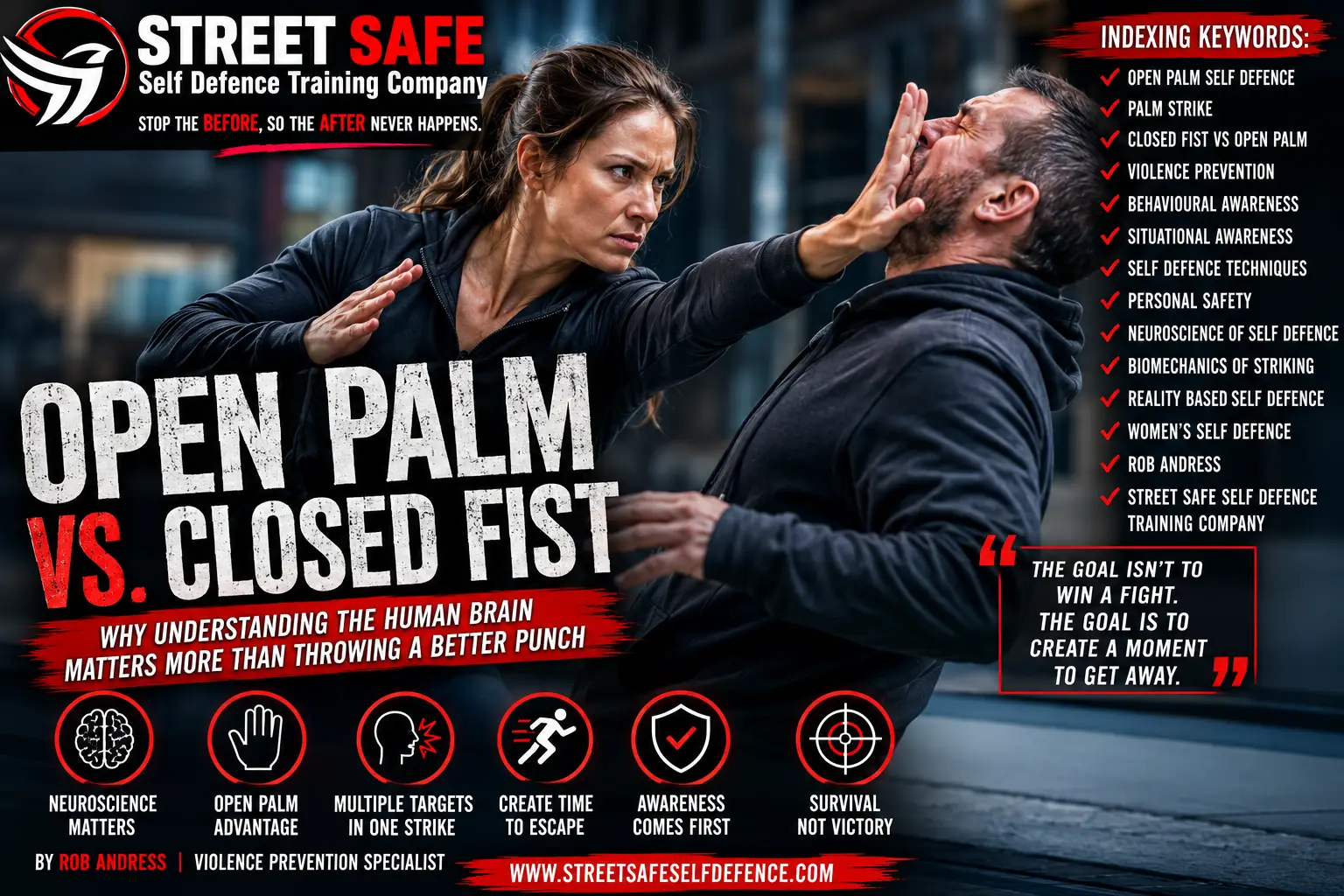
In an open palm vs closed fist comparison, the open palm is not weaker—it is simply different.
The force is distributed across a much larger surface area, reducing the concentration of stress on the small bones of the hand, creating multiple target impact. It also requires less fine motor precision!
Under stress, our heart rate climbs. Adrenaline floods the body. Fine motor skills become harder to perform, while larger gross motor movements remain more reliable.
An open-hand strike works with those natural stress responses rather than fighting against them.
One Strike. Multiple Problems.
This is where the conversation becomes really interesting.
Most people think only about force. I think about information.
Every second, your brain is processing enormous amounts of sensory input. Vision. Balance. Touch. Hearing. Body position.
Normally those systems work together seamlessly.
But under sudden assault, the brain has to prioritize.
When a well-placed open palm strikes the face, several things may happen at once depending on where and how contact occurs:
- The head may rotate rapidly.
- Vision may be disrupted.
- The eyes may reflexively blink.
- Balance can be affected through sudden head movement.
- The person must immediately process unexpected sensory information.
Instead of responding to one problem, the brain suddenly has several.
It has to determine:
“What just happened?”
“Where did it come from?”
“What’s my balance doing?”
“Can I still see?”
That brief period of sensory disruption can create valuable time.
Not to keep fighting.
To leave.
Why Multiple Sensory Systems Matter
The open palm vs closed fist decision also matters under stress, when simple and reliable movements are easier to perform. The person who creates time often creates survival.
When several sensory systems are challenged simultaneously, the brain must rapidly integrate information before it can make effective decisions.
This isn’t “mind control.”, it isn’t magic, it’s human neuroscience.
The brain constantly prioritizes incoming information, especially under stress. Unexpected sensory events can temporarily interrupt efficient processing while the brain reorients to what has just occurred.
In self-defence, fractions of a second matter.
Open Palm Means Options
One of the biggest advantages of an open hand is what happens after contact.
You’re already in position to:
- Frame against the attack.
- Push away.
- Protect your own head.
- Redirect an arm.
- Create distance.
- Control space.
- Escape.
A closed fist often has to reopen before any of those things happen. Again, we’re not talking about fighting, we’re talking about surviving.
Violence Doesn’t Look Like the Movies
Real violence rarely begins with two people standing toe-to-toe, fists raised.
Most assaults happen at conversational distance.
Many involve surprise.
Some involve weapons.
Others involve multiple offenders.
Many are over before anyone realizes a fight has even started.
That’s why Street Safe places such a heavy emphasis on behavioural awareness.
Recognizing violence before it becomes physical will always be safer than relying on striking after it begins.
The Brain Is Your First Weapon
I’ve said this for years.
The body will never go where the mind has not been. You can have the strongest punch in the room, but if you don’t recognize pre-assault behaviour, boundary violations, targeting behaviour, or environmental risk, you may never have the opportunity to use it.
Awareness creates time. Time creates options. Options save lives!
My Experience
After teaching thousands of people from healthcare professionals and REALTORS® to teachers, security teams, municipal workers, and everyday Canadians, I keep seeing the same thing.
People spend far too much time worrying about how hard they can hit.
Very few spend enough time learning when they should move, when they should leave, or how human behaviour predicts violence before the first strike is ever thrown.
That’s where I believe the real advantage lies. The strike is simply one tool, the brain is the weapon that decides when, why, and whether that tool should ever be used.
Final Thoughts
The debate shouldn’t be whether an open palm is better than a closed fist.
The better question is:
Which tool gives you the greatest chance of creating opportunity without creating unnecessary risk?
For many people, the answer isn’t found in throwing a harder punch.
It’s found in understanding biomechanics, human behaviour, stress physiology, and how the brain processes unexpected events.
That’s the difference between fighting and violence prevention.
And that’s exactly what we teach at Street Safe Self Defence Training Company.
Because our goal has never been to help people win fights.
Our goal has always been to help people avoid them, or survive them when avoidance is no longer possible.
Stop the Before, So the After Never Happens.
References
- American Academy of Orthopaedic Surgeons (AAOS). Hand Fractures.
- McGill, S. M. Ultimate Back Fitness and Performance (biomechanics principles).
- LeDoux, J. The Emotional Brain.
- Kahneman, D. Thinking, Fast and Slow.
- Schmidt, R. A., & Lee, T. D. Motor Learning and Performance.
- Grossman, D., & Christensen, L. On Combat.
- National Institute of Justice (NIJ): Research on violent encounters and human performance under stress.
Rob Andress and Beth Andress are the founders of Street Safe Self Defence Training Company, one of Canada’s leaders in evidence-informed violence prevention, behavioural awareness, and reality-based self-defence education. Their programs focus on recognizing violence before it becomes physical, empowering people to make safer decisions through awareness, human behaviour, and practical skills.
Learn More
Street Safe Self Defence Training Company
https://www.streetsafeselfdefence.com
Explore our programs:
- Violence Prevention & Self-Defence
- Women’s Personal Safety
- High School Safety Programs
- REALTOR® Safety Education
- TRAACS – Tactical Risk Awareness & Applied Combative Systems
- CARE – Clinical Awareness & Response to Escalation