

Recognizing unwanted following, avoiding isolation and moving toward safety before the situation becomes physical
If someone follows you into an open parking lot or covered garage, continuing toward your vehicle may increase your isolation. Learn how to recognize connected behaviour, create distance, reach people and obtain help before the situation becomes physical.
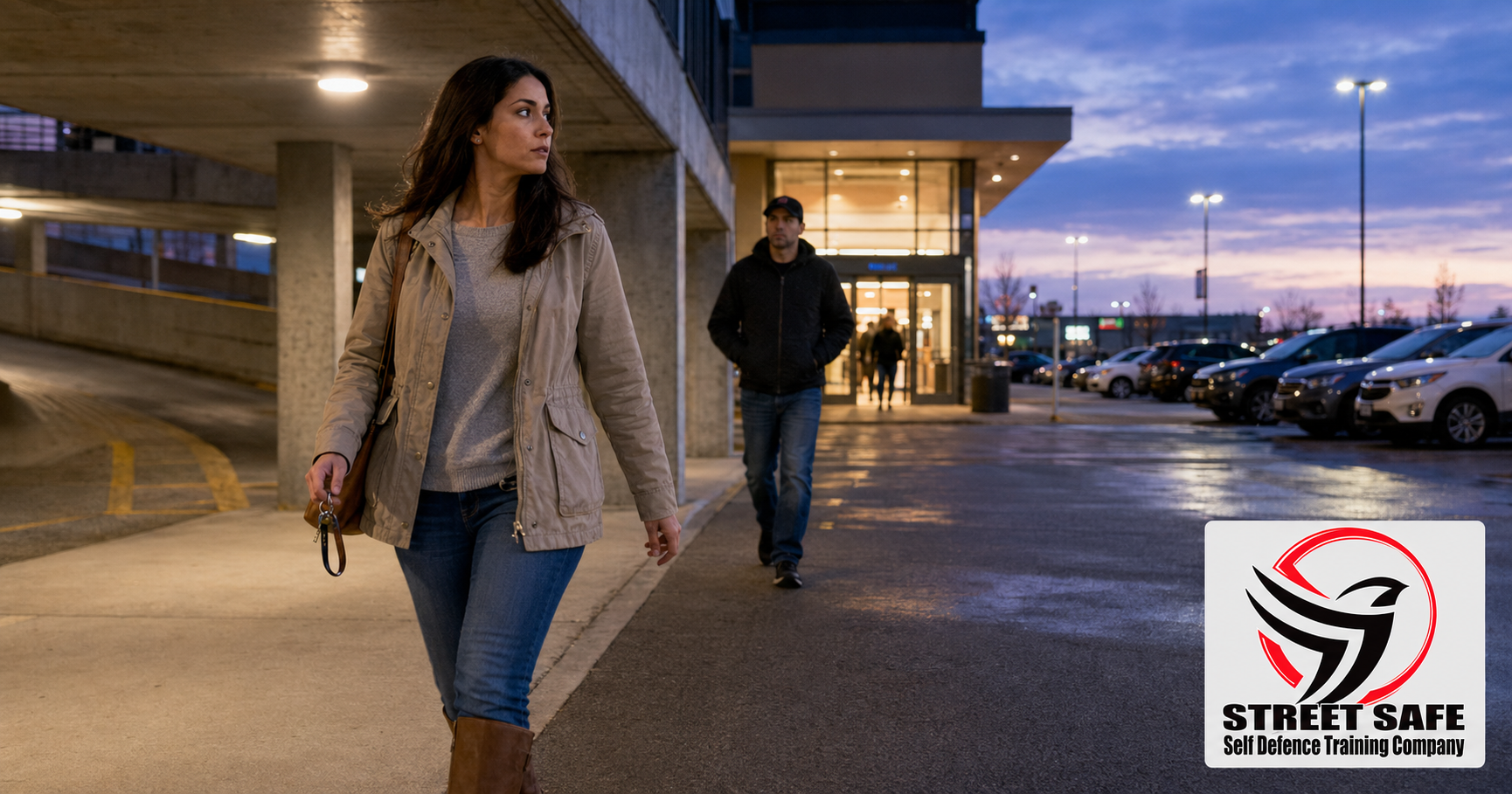
You leave a store, office, hospital or restaurant and begin walking toward your vehicle.
A few moments later, you notice someone behind you.
Maybe they are simply walking in the same direction. Maybe their vehicle is parked near yours. Or maybe their movement is connected to your movement.
You do not have to decide whether this person is dangerous before you do something to protect yourself.
You only need to recognize that something has changed.
Parking lots can create isolation very quickly. Open parking lots contain long rows of vehicles, shopping-cart corrals, landscaped areas and spaces where a person can disappear from public view. Covered parking garages introduce pillars, ramps, blind corners, stairwells, elevators and reduced lighting. Cellular service may also become unreliable as you move underground.
In either environment, continuing toward your vehicle may take you farther away from people, help and visibility.
If you believe someone may be following you, your first objective is not to reach your car.
Your first objective is to avoid becoming isolated.
What Should I Do Immediately?
If you believe someone is following you into an open or covered parking lot, do not continue automatically toward your vehicle.
Turn back toward the store, building entrance, security desk or another populated and staffed location. Move toward people, lighting, cameras and clearly marked exits. Call 911 if the person continues following, closes distance, blocks your movement or makes you believe that you are in immediate danger.
Do not confront the person to find out what they want.
Do not lead them to your vehicle.
Change the environment before the situation has an opportunity to become physical.
Environmental Awareness: Understand the Parking Lot Before You Enter It
Environmental awareness is what you know about the space around you.
In an open parking lot, identify the main entrance, secondary entrances, pedestrian walkways, areas with consistent vehicle and foot traffic, and any security personnel. Notice where lighting, cameras and occupied businesses are located.
In a covered parking garage, identify the vehicle entrance, pedestrian exits, elevators, stairwells, security stations, emergency call buttons and the direction that leads back into the building. Pay attention to pillars, parked vehicles, ramps and corners that restrict your ability to see what is ahead.
An elevator may look like an escape, but it can also place you inside a confined space with the person concerning you. An enclosed stairwell may have fewer witnesses and limited ways out. If someone is following you, returning to a staffed entrance or occupied public area may be safer than entering either one.
Environmental awareness also means noticing the conditions before you leave the building.
Is the parking area dark or nearly empty? Is the garage closing? Is your vehicle parked far from the entrance? Is your phone receiving a signal? Is security available to accompany you?
Thinking about these things before entering the parking lot gives you more choices if something changes.
Situational Awareness: Watch What the Person Does
Seeing someone behind you does not automatically mean that you are being followed.
One behaviour is information. A pattern of connected behaviours creates greater concern.
Does the person change direction when you change direction?
Do they increase their walking speed when you increase yours?
Do they stop when you stop?
Do they pass obvious opportunities to continue toward another destination?
Do they continue moving toward you after you turn back toward the building?
Are they watching you rather than looking for their own vehicle?
Are they using parked vehicles or pillars to conceal their movement?
Are they attempting to intercept you rather than simply walking behind you?
Are they moving in a way that reduces the distance between you?
Now look beyond the person’s face. Watch their hands, body position, direction of travel and relationship to the environment.
Are their hands visible?
Are they reaching inside their clothing?
Are they looking around for witnesses?
Is someone else moving on another side of the vehicle row?
Is an occupied vehicle moving slowly nearby?
Do their words conflict with their behaviour?
A person may say, “I only want to ask you something,” while continuing to follow you after you have moved away. The words may sound harmless, but the behaviour is refusing to allow the interaction to end.
When language and behaviour disagree, give greater weight to the behaviour affecting your safety.
Self-Awareness: Do Not Talk Yourself Out of What You See
Self-awareness is understanding what is happening inside you.
You may notice your walking speed change. Your breathing may become shallow. Your shoulders may tighten. You may feel an immediate need to look behind you.
Then the explanations begin.
Maybe I am imagining it.
Maybe his car is close to mine.
Maybe I am being rude.
Maybe I am overreacting.
Fear does not prove that someone intends to harm you. But you do not need proof before creating distance and moving toward safety.
This is exactly why understanding situational awareness as a practical safety skill matters. Awareness is not about predicting another person’s intentions with certainty. It is about recognizing when circumstances have changed enough that your behaviour should change too.
Turning around is not an accusation.
Returning to the building is not an accusation.
Calling someone, asking for help or requesting a security escort is not an accusation.
You are allowed to respond to uncertainty before that uncertainty becomes danger.
Recognize: Is Their Movement Connected to Yours?
You do not need to perform an elaborate test to determine whether someone is following you.
Do not walk deeper into the parking lot, circle between vehicles or enter an isolated section to see whether the person stays behind you.
Instead, make a safe change.
Turn back toward the building.
Move toward a group of people.
Approach a staffed kiosk or security station.
Cross toward a busier pedestrian route when it is safe.
If the person disengages and continues toward another destination, the situation may resolve itself.
If they also turn, continue following, increase their speed or attempt to intercept you, their behaviour has provided additional information.
That is the moment to stop minimizing what you are seeing.
Decide: Your Vehicle Is Not Automatically Safety
Many people think, “If I can just get to my car, I’ll be safe.”
That may be true if you can enter, lock the doors and drive away before the person reaches you. But walking toward your vehicle can also create several problems.
You may reveal which vehicle belongs to you.
You may become trapped between your vehicle and the one beside it.
You may become distracted while searching for your keys.
You may unlock the vehicle while the person is close enough to reach you.
You may enter the vehicle and remain parked while checking messages, organizing bags or programming your navigation.
In a covered garage, your vehicle may be beside a pillar, wall or blind corner. In an open parking lot, vans, trucks and SUVs may prevent other people from seeing you.
Your vehicle becomes a place of safety only when you can enter it safely, lock the doors and leave. Our article on self-defence and safety inside a vehicle explains why a vehicle should be treated as a way to escape—not a place to remain during a developing threat.
If you are uncertain about reaching your vehicle safely, do not go to it.
Act: Return to People and Bring Someone Into the Situation
Go back inside the building if that option remains available.
Do not stand silently near the entrance. Tell an employee, receptionist or security officer exactly what is happening.
Say:
“That person followed me into the parking lot and continued following when I changed direction. I do not feel safe going to my vehicle. Please contact security and stay with me.”
Direct language helps other people understand that you are not asking for casual assistance.
If no employee is nearby, move toward a group or identify one specific person:
“You in the blue jacket—I believe that person is following me. Please stay with me while I call 911.”
Selecting one person directly can be more effective than generally calling for somebody to help.
If you believe the danger is immediate, call 911. Tell the dispatcher where you are, what level or section of the garage you are on, which entrance you used, what the person looks like and what they are doing.
Do not wait for physical contact before describing an escalating threat.
Establish a Boundary Without Stopping Your Movement
If the person continues moving toward you, establish a clear verbal boundary from a safe distance:
“Stop. Do not come any closer.”
Your voice is not being used to win an argument. It is being used to establish a boundary, attract attention and communicate what is happening to witnesses.
Continue moving toward safety.
A verbal boundary should never require you to remain in place. Our guide to boundary-setting skills for personal safety explains that an effective boundary combines clear language with action.
Place physical obstacles between yourself and the person whenever possible. A row of shopping carts, payment kiosk, parked vehicle, counter or security barrier may make it more difficult for someone to close distance directly.
Do not allow a conversation to stop your movement.
You do not owe the person an explanation for leaving.
If they genuinely need directions or assistance, they can ask someone else. A reasonable person will recognize your boundary and allow you to leave.
Someone who ignores that boundary is giving you more information.
Do Not Let Confusion Hold You in Place
A person may try to stop you with a question, a request for directions, an offer of help, a story about an emergency or a claim that you dropped something.
Some approaches are legitimate.
Others may be used to interrupt your movement, divide your attention or bring someone within physical reach.
The Ottawa Police Service has warned about distraction thefts in parking lots that begin with friendly conversation, requests for directions, offered gifts or attempts to make physical contact. These incidents may also involve more than one person, with one individual creating the distraction while another moves into position.
You are not required to remain in an interaction simply because the person appears friendly.
You can say:
“I can’t help you.”
Then keep moving.
You do not need to determine their true motive before protecting your distance. As we explain in The First Weapon a Predator Uses Isn’t Violence—It’s Confusion, confusion creates hesitation. Hesitation may keep someone engaged when they should already be leaving.
What If I Am Already Beside My Vehicle?
Do not unlock the vehicle simply because you have reached it.
Look at the space around the driver’s door, the vehicle beside you and the area behind you.
In a covered garage, check around pillars, walls and blind corners. In an open lot, look between nearby vehicles and toward the next row.
If the person is too close, keep moving. Return toward the building or another populated location if you can safely do so.
If the area is clear and you decide to enter:
- Have your keys ready.
- Unlock only the door you need if your vehicle provides that option.
- Get inside.
- Lock the doors immediately.
- Start the vehicle and leave.
Do not remain parked to check your phone, arrange purchases or enter an address into your navigation system while the person remains nearby.
If someone approaches after you are inside, do not lower the window or unlock the door. Use your horn to attract attention, call 911 and drive away if you have a clear and safe route.
If another vehicle blocks you in, remain inside with the doors locked. Call 911 and clearly describe your location and what is happening.
Do not get out to confront the driver.
What If There Is Nowhere to Go Back To?
The building may be locked. The parking structure may be detached. You may be standing in a large open parking lot after business hours.
Move toward the safest available combination of people, lighting, visibility and access to help.
That might include:
- An open business
- A staffed parking booth
- A security vehicle
- A busy roadway
- A group of people
- An emergency call station
- A clearly marked and monitored entrance
Call 911 if the person continues closing distance or prevents you from leaving.
Give your location as precisely as possible. Parking garages often use colours, letters, numbers, levels or pillar markings. In an open lot, identify the store entrance, vehicle row, light-standard number or nearby intersection.
If cellular service is poor underground, move toward an emergency call station, staffed booth, building entrance or higher level—provided doing so does not take you toward the person.
If Physical Contact Becomes Imminent
If someone rushes you, grabs you, blocks your movement or attempts to force you toward a vehicle or isolated area, the situation has changed.
Your objective is no longer conversation or social compliance.
Your objective is to disrupt the contact, attract attention, create an opportunity to escape and leave immediately when it is safe.
Use your voice.
Move toward an exit.
Use available barriers.
Fight for movement—not dominance.
Do not allow yourself to be taken to another location.
Physical self-defence must be simple, immediate and directed toward creating an opportunity to escape. In Canada, section 34 of the Criminal Code requires defensive actions to be reasonable in the circumstances. This article provides general safety information and is not legal advice.
This is also why realistic women’s self-defence training must include behaviour recognition, decision-making, environmental awareness, boundary setting and practical physical responses—not physical techniques alone.
After You Reach Safety
Once you are safe, write down what you remember.
Record:
- The person’s physical description
- Their clothing
- Their direction of travel
- The behaviour you observed
- Any vehicle description
- The licence plate, if safely observed
- The time and location
- The parking level, section or row
- The names of witnesses
- Nearby cameras or businesses
Do not follow the person to obtain more information.
The National Research Council of Canada’s emergency-response guidance recommends walking away from an aggressor when immediate danger exists, reporting the incident and documenting relevant details and witnesses.
Report the incident to police and property security when appropriate. According to the Ottawa Police Service’s reporting guidance, a life-threatening emergency or crime in progress should be reported through 911. Incidents that are no longer emergencies can be reported through the appropriate local police non-emergency system.
Even when no physical assault occurs, reporting suspicious behaviour may help identify a repeated pattern involving the same person or location.
Common Parking-Lot Mistakes
People often increase their vulnerability by:
- Continuing toward their vehicle despite growing concern
- Looking down at their phone while walking
- Searching through a purse or bag for keys
- Wearing headphones that prevent them from hearing movement
- Walking between isolated vehicle rows to confirm whether they are being followed
- Entering an elevator or stairwell with the person
- Unlocking the vehicle while the person is close
- Sitting inside an unlocked or stationary vehicle
- Confronting the person to demand an explanation
- Remaining polite when the person refuses to respect distance
The answer is not to live in fear of parking lots.
The answer is to recognize when behaviour changes and give yourself permission to change what you are doing.
The Street Safe Framework
Environmental Awareness: Understand the parking area, its exits, lighting, sightlines, blind spots and available sources of help.
Situational Awareness: Observe behaviour, distance, direction, hands, positioning and changes in movement.
Self-Awareness: Recognize fear, uncertainty and your own tendency to explain away concerning behaviour.
Recognize: Determine whether the person’s actions remain connected to yours.
Decide: Choose safety before reaching your vehicle or becoming isolated.
Act: Return to people, recruit help, establish a boundary and call 911 when necessary.
Leave: Exit the situation as soon as you can do so safely.
These are the same principles behind Street Safe’s reality-based general self-defence training: awareness and prevention come first, while physical self-defence remains the final option when avoidance is no longer possible.
Final Thoughts
If someone follows you into a parking lot, you do not have to know what they intend before changing your behaviour.
You do not have to keep walking toward your vehicle.
You do not have to accept a conversation.
You do not have to sacrifice safety to avoid appearing rude.
Move toward people.
Create distance.
Bring others into the situation.
Call for help when the behaviour continues or escalates.
The goal is not to prove that the person intended to hurt you.
The goal is to prevent them from gaining the isolation, position and opportunity required to do it.
Awareness comes before action.
Understanding comes before technique.
Prevention comes before protection.
Stop the Before, So the After Never Happens.
Frequently Asked Questions
Am I overreacting if I return to the building?
No. Returning to a populated location is a reasonable safety decision. You are not accusing anyone of committing a crime.
Should I go directly to my vehicle?
Not if doing so takes you farther from people or allows the person to learn which vehicle belongs to you. Return to safety and request assistance.
Should I confront the person?
No. You do not need to confront someone to determine whether they are following you. Create distance and move toward help.
Should I enter an elevator or stairwell?
Not if the person may enter with you or the area will leave you isolated. Move toward a staffed or populated location whenever possible.
When should I call 911?
Call 911 when you believe you are in immediate danger, the person continues following after you change direction, rapidly closes distance, blocks your movement, threatens you or attempts physical contact.
What if the person says they only want to ask me something?
They can ask someone else. Continue moving. Their response to your boundary provides more useful information than their explanation.
Can I ask security to escort me to my vehicle?
Yes. Tell security what you observed and ask them to accompany you. Do not return to the parking area alone while the person remains nearby.
About the Author
Rob Andress is a Canadian violence-prevention consultant and reality-based self-defence instructor. As co-founder of Street Safe Self Defence Training Company, he works with municipalities, By-Law Officers, security professionals, schools, women, youth, healthcare employees and Indigenous communities across Canada.
His teaching focuses on recognizing the behavioural and environmental conditions that allow violence to develop, making informed decisions under pressure and responding effectively when personal safety is threatened.
Rob’s approach is based on a simple belief:
Violence is patterned, predictable and often preventable.
Rob Andress
Violence Prevention Consultant, SAS-AP
Close Quarter Combative Instructor
Pure & Applied Debilitation Instructor
Active Threat Survival Trainer (A.L.I.V.E.)
Street Safe Self Defence Training Company