


Say “I’m not available for that” and step back one full pace. That single move, a clear verbal statement paired with deliberate physical distance, is the foundation of every boundary setting skill you will practise. Cleveland Clinic guidance confirms that communicating clear limits protects your time, energy, and emotional well-being. Streetsafeselfdefence and therapist Annie Wright both reinforce the same point: a boundary is a statement of what you will do, not a demand that someone else change.
Three ready-to-use examples:
- Stranger: “Please don’t come closer. I need space.” Step back and angle toward an exit.
- Acquaintance: “I’m not comfortable with that. I’m going to step away now.”
- Workplace: “I’m not available for that conversation right now. Let’s schedule a time.”
Pro Tip: Deliver your statement at slightly above conversational volume, steady and flat, then name the consequence you will actually follow through on: “If you continue, I will leave.”
Table of Contents
- What do boundary setting skills actually mean for safety?
- Why clear boundaries make you safer
- Short scripts you can use right now
- Non-verbal signals that reinforce your words
- What to do when a boundary is tested or violated
- How long does it take to build real confidence?
- How do you recognise boundary-testing before it escalates?
- Adjustments for people with trauma histories
- Streetsafeselfdefence brings boundary training to you
- Key takeaways
- Why short, practised boundaries are your first-line safety tool
- Useful sources and Canadian emergency contacts
What do boundary setting skills actually mean for safety?
A boundary is a statement of what you will accept and what you will do if that limit is crossed. It is about your response, not the other person’s compliance. That distinction matters for safety: you control your actions, not theirs.
Four boundary types relevant to personal safety:
- Verbal: “Stop. I said no.” Used when someone persists after a clear refusal.
- Physical: Maintaining arm’s-length personal space; stepping back when someone closes distance uninvited.
- Environmental: Positioning yourself near exits, in well-lit areas, or within sight of other people.
- Digital: Limiting when and how someone can contact you; blocking or muting accounts that escalate pressure.
Multiple boundary categories apply to safety situations, and digital boundaries are increasingly the first to collapse under pressure. Knowing which type you are dealing with helps you choose the right response quickly.

Why clear boundaries make you safer
Clear boundaries change how situations unfold because they reduce ambiguity and create predictable responses. When you state a limit plainly and move, you signal to the other person and to any bystanders that you are in control of the interaction.
“Communicating clear limits helps protect your time, energy and emotional well-being; knowing your boundaries gives you clarity about what you are comfortable with.”
— Cleveland Clinic
Practically, a stated boundary plus movement does three things at once: it increases your physical space, buys you seconds to assess the situation, and signals to third parties that something is wrong. Therapist Annie Wright notes that people raised in environments where expressing needs was punished often experience self-assertion as physically dangerous. Naming that nervous-system response, the racing heart, the urge to freeze, normalises the discomfort and helps you push through it.
- Reduces ambiguity for both parties
- Creates physical space and time to assess
- Signals assertiveness to bystanders
- Activates your own decision-making rather than freeze response
Short scripts you can use right now
A clear, concise boundary statement is a complete sentence. No rationale required. Over-explaining invites negotiation.
Strangers and harassment:
- “Back up, please.”
- “Don’t touch me.”
- “I’m not interested. Please leave me alone.”
Social acquaintances:
- “That doesn’t work for me.”
- “I’m going to head out now.”
- “I’m not comfortable with this conversation.”
Colleagues and clients:
- “I’m not available for that.”
- “Let’s keep this professional.”
- “I’ll need to end this meeting if this continues.”
Intimate or family settings:
- “If you keep raising your voice, I’m leaving the room.”
- “I need you to stop. I mean it.”
- “This conversation is over for now.”
Three role-play prompts to practise delivery:
- Stand in front of a mirror. Say your chosen script at full volume, maintain eye contact with your reflection, then physically step back. Repeat five times.
- Ask a trusted friend to approach you slowly while you deliver the script and step away. Debrief: did your voice stay steady? Did you follow through on the movement?
- Practise the escalation: deliver the boundary, pause two seconds, repeat it once, then physically leave the space. Time yourself.
Pro Tip: Rehearse with a firm, neutral tone rather than anger. Anger signals emotional engagement; neutral signals resolve.
Non-verbal signals that reinforce your words
The most effective non-verbal signal is an open-but-firm posture combined with deliberate movement away. Your body communicates before you speak.
- Feet: Shoulder-width apart for stability and mobility, not locked together.
- Hands: Visible and relaxed at chest height, palms slightly forward. This signals non-aggression while protecting your centreline.
- Posture: Chest open, head up, weight slightly forward on the balls of your feet.
- Eye contact: Steady and neutral, not a stare-down. Look at the bridge of the nose if direct eye contact feels too intense.
- Distance: Maintain at least arm’s length. A two-step buffer gives you reaction time.
Use your environment deliberately. Position yourself near exits and within sightlines of other people. Moving toward a public area or a third party changes the dynamic immediately. Understanding micro-expression cues can help you read whether a situation is escalating before it becomes physical.
Pro Tip: Practise tone drills separately from scripts: count to five out loud, slightly louder than normal conversation, keeping your voice flat and even. That vocal control is what you want under stress.
What to do when a boundary is tested or violated
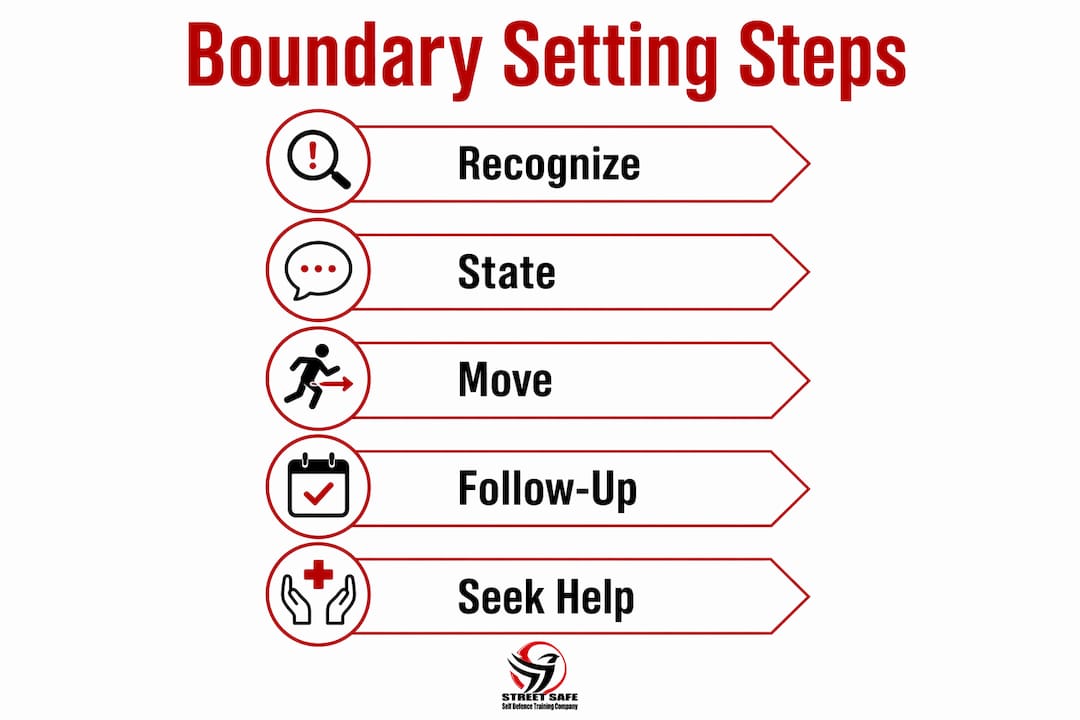
Assert, move, escalate. That is the full plan.
- State the boundary once, clearly. “Stop. I said no.”
- Repeat it once if ignored, then move. Step back or sideways toward an exit or public area.
- Leave the immediate space. Walk to a populated area, a shop, a building lobby.
- Enlist a bystander if needed. Make direct eye contact with one person: “Can you help me? Please call 911.”
- Call 911 if you feel physically threatened, are being followed, or cannot safely leave. Tell the dispatcher your location, what is happening, and a brief description of the person.
When to act at each stage:
- Repeat the boundary only once. A second refusal is your signal to move, not to explain further.
- Failing to follow through teaches the other person that your limits are negotiable. Move when you say you will.
- For workplace escalation, document the incident immediately and report to HR or a supervisor.
How long does it take to build real confidence?
Ten to fifteen minutes of daily scripted practice plus two brief role-plays per week builds usable confidence in roughly 4–6 weeks, according to practice research combining scripted repetition with incremental role-play. That timeline varies by starting point.
A simple daily routine:
- Two minutes of vocal warm-up: count aloud, vary volume, keep tone flat.
- Five scripted repetitions of your chosen boundary phrase, standing and stepping back each time.
- One timed role-play with a partner or mirror: deliver, pause, repeat once, exit.
- One brief written note: what felt steady, what felt shaky.
Timeline estimates:
- No prior experience: 4–6 weeks of daily practice to feel confident in low-stakes situations.
- Prior trauma history: Allow 8–12 weeks with smaller steps; comfort matters more than speed.
- Some assertiveness background: 2–3 weeks to sharpen delivery and follow-through.
Log your practice. Progress is easier to see when it is written down, and gaps become visible before they become habits. Pairing this with beginner self-defence techniques gives you physical options to back up your verbal boundaries.
How do you recognise boundary-testing before it escalates?
Common red flags appear before a situation turns physical. People who genuinely respect you will adjust when you state a limit clearly. Persistent pushing is the signal.
Verbal red flags:
- Repeating the same request after a clear refusal
- Minimising your response (“You’re overreacting,” “I’m just joking”)
- Asking you to justify or explain your boundary
Non-verbal red flags:
- Closing physical distance after you have stepped back
- Blocking your path or positioning between you and an exit
- Sustained, unbroken eye contact combined with stillness
The difference between testing and serious threat: testing is repetition and badgering. A serious threat involves physical contact, blocking exits, or attempts to isolate you from other people. Recognising early threat cues is the skill that lets you act before the situation forces your hand. When you see blocking or isolation, move immediately to step three of the escalation plan.
Adjustments for people with trauma histories
Trauma-informed boundary work is paced, optional, and keeps the learner in control at every step. There is no timeline to meet and no performance to pass.
Practical adjustments:
- Start with low-stakes scripts in safe settings, not high-pressure scenarios.
- Use a trusted support person as your practice partner before working with strangers.
- Prepare a scripted exit phrase you can use to pause a practice session: “I need a break.”
- Arrange a safe word with your practice partner so you can stop without explanation.
Pro Tip: Do not force loud projection or sustained eye contact if those trigger panic. A quiet, firm “No” with a single step back is a real boundary. Build intensity gradually over weeks, not days.
Those who grew up in environments where expressing needs met negative reactions often experience self-assertion as physically dangerous. That response is a nervous-system pattern, not a character flaw. When practice consistently triggers distress rather than manageable discomfort, trauma-informed therapy or a structured programme like Streetsafeselfdefence’s trauma-informed training is the right next step.
Streetsafeselfdefence brings boundary training to you
Instructor-led practice gives you something solo rehearsal cannot: realistic role-play, live feedback, and safe escalation drills with a trained partner. Reading scripts helps; practising them under mild pressure is what makes them automatic.
Streetsafeselfdefence delivers mobile, trauma-informed self-defence training directly to your location across Canada, with no gym membership or martial arts background required. Courses are tailored for individuals, women, teens, corporate teams, and professionals, and the curriculum covers verbal boundary skills, physical distancing, and real-world escalation scenarios. The programme is built for all fitness levels and ages, and the trauma-informed approach means survivors can participate at their own pace. To start building these skills with an instructor who provides immediate, specific feedback, book a session through the self-defence training at home page and get a programme designed around your situation.
Key takeaways
Strong boundary setting skills combine a short verbal statement, deliberate physical movement, and consistent follow-through on consequences, practised regularly until the response becomes automatic.
| Point | Details |
|---|---|
| Use short, firm scripts | “I’m not available for that” is a complete sentence; no explanation needed. |
| Move when you speak | Step back or toward an exit every time you state a boundary to reinforce the message physically. |
| Follow through every time | A boundary without a consequence becomes negotiable; act on what you say. |
| Practise daily with scripted repetition plus two role-plays per week to build usable confidence over time, with progress varying by individual. | |
| Streetsafeselfdefence | Mobile, trauma-informed training across Canada provides realistic drills and instructor feedback. |
Why short, practised boundaries are your first-line safety tool
Most people wait too long to assert a boundary because they are hoping the situation will resolve itself. It rarely does. The research and the real-world evidence both point the same direction: a short, early statement paired with movement stops most situations from escalating. Waiting for certainty before you act is the habit that costs you options.
The scripts in this article are not polite suggestions. They are tools. A boundary stated once, backed by movement and a consequence you will actually apply, communicates more than a lengthy explanation ever could. That is what reality-based safety training has always shown: clarity and decisiveness, not aggression, are what change outcomes.
Start with one script. Practise it today. Add the step-back. That is enough for day one.
Useful sources and Canadian emergency contacts
Key references:
- How to set boundaries in healthy ways — Cleveland Clinic
- Setting boundaries: what psychologists actually mean — Simply Psychology
- How to set healthy boundaries in relationships — Simply Psychology
- Boundaries: a complete therapist’s guide — Annie Wright
- Trauma-informed self-defence guide — Streetsafeselfdefence
- The role of boundaries in toddler development — Baby Bare Essentials (developmental context for early boundary habits)
Canadian emergency contacts:
- Emergency services: Call 911 for immediate physical threat. State your location first, then describe what is happening and the person involved.
- Non-emergency police: Contact your local police service’s non-emergency line to report harassment or repeated boundary violations.
- Crisis support: Crisis Services Canada — 1-833-456-4566, available 24/7.
| Resource | Type | Access |
|---|---|---|
| 911 | Emergency response | Call from any phone |
| Local police non-emergency | Harassment reporting | Search your city’s number |
| Crisis Services Canada | Mental health crisis | 1-833-456-4566 |
| Streetsafeselfdefence | Trauma-informed training | streetsafeselfdefence.com |
For trauma-informed therapists in Canada, search the Canadian Counselling and Psychotherapy Association directory and filter by trauma specialisation.