

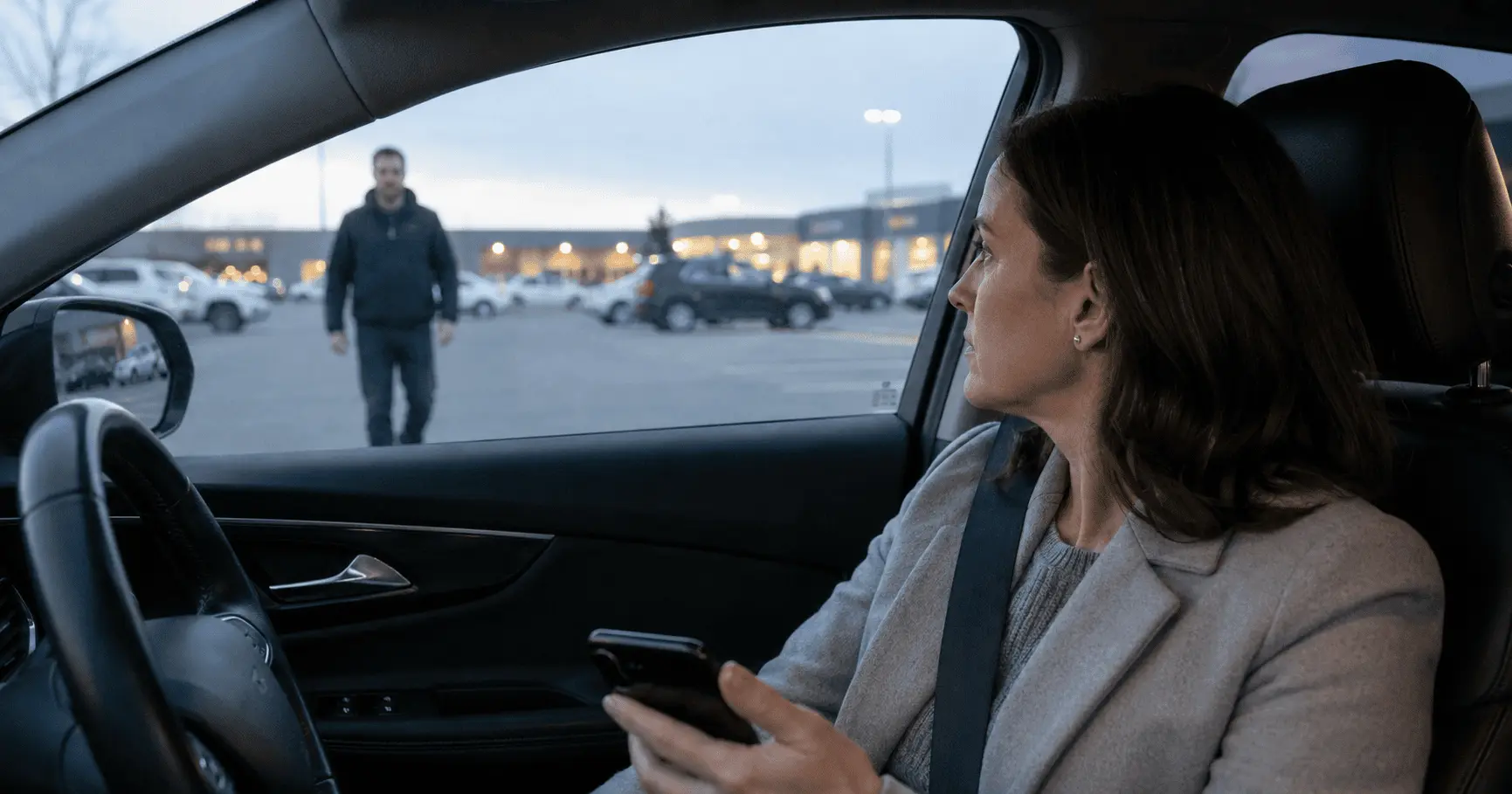
If someone approaches your car while you are sitting inside, keep the doors locked and remain alert.

Your vehicle can give you distance, protection and a way to leave, but only if you recognize the problem before someone gains access to you.
If someone approaches you while you are sitting in your car, keep the doors locked and the windows closed. Watch their behaviour, check whether anyone else is approaching and leave if your route is clear. You do not have to lower your window, unlock the door or wait for proof that the person is dangerous.
Someone approaching your parked car is not automatically a threat, but their behaviour matters. Learn how to recognize warning signs, protect your space, make safer decisions and leave before the situation escalates.
You have just finished shopping. You walk to your car, put your bags on the passenger seat, close the door and pull out your phone. Maybe you are answering a message, checking a receipt or entering an address into your GPS.
Then you hear it.
Tap. Tap. Tap.
Someone is standing beside your window.
What do you do?
Let’s begin with the obvious. Someone approaching your vehicle is not automatically a predator. They may want directions, they may be trying to tell you that you dropped something, or they may have noticed a problem with your vehicle.
But you do not have to wait until you completely understand their intentions before making yourself safer. Their approach is information. What they do next will tell you considerably more.
Your First Decision Happens Before You Enter the Car
When I teach environmental and situational awareness, I explain that the safest decisions often happen before the person ever reaches us.
As you walk toward your car, look beyond the vehicle—not only at it. Who is standing nearby? Is anyone sitting in the vehicle parked beside yours? Is someone moving in your direction? Is another vehicle positioned in a way that could make it difficult for you to leave?
Look at the type of environment you are entering. An open parking lot gives you different sightlines and escape options than a covered structure or underground garage. A busy area creates potential witnesses, while an isolated corner may provide someone with privacy and time.
This is what walking with purpose and awareness actually means. It does not mean walking quickly while staring straight ahead and pretending to be confident. It means seeing the environment, recognizing movement and making decisions before someone reaches your space.
Have your keys ready. Get inside, close the door and lock it before arranging your bags, checking your phone or searching through your purse.
People often feel safe the moment the car door closes. But your vehicle is not secure simply because you are sitting inside it. It becomes safer when the doors are locked, the windows are closed and you remain aware of what is happening around you.
Don’t Disappear Into Your Phone
One of the easiest places to lose situational awareness is inside a parked car.
The door closes, and psychologically we feel as though we have entered a private space. We start scrolling, texting or answering emails. Our vision narrows, our attention moves completely inside the vehicle, and the outside environment disappears.
Meanwhile, someone can cross a parking lot and reach the driver’s door before we notice them.
Before you look at your phone, scan around the vehicle and check your mirrors. If you have to remain parked for several minutes, look up regularly and stay aware of movement around you.
Your car should never become a waiting room where your awareness switches off.
Understand the Position You Are In
Think about how your vehicle affects your ability to move.
You are seated. Your hips are fixed. The steering wheel is in front of you, the centre console limits movement in one direction, and the driver’s door limits it in the other. If your seatbelt is fastened, your upper body movement is restricted.
If someone opens your door, you cannot simply step backwards and create distance. You are already inside a confined space.
However, the vehicle also gives you advantages. A locked door provides a barrier. The window creates separation. Your mirrors allow you to see behind and around you. The horn and alarm can attract attention. Most importantly, if the vehicle is operational and your route is clear, it can take you away from the problem.
Know how your vehicle works. Some vehicles automatically unlock the doors when placed in park or when the ignition is turned off. Know where the locks, horn, hazard lights and panic alarm are without having to search for them.
The body will never go where the mind has not been. Think about these decisions now—not when someone is already pulling on the handle.
Watch What the Person Does—Not What They Look Like
Do not decide whether someone is dangerous based on their clothing, age, race, gender or general appearance. Watch their behaviour.
A person with an innocent reason to speak to you will usually respect distance. They may wave, point toward something or try to speak without pressing their body against the window. If you indicate that you cannot help them or that you are leaving, most reasonable people will accept that.
The behaviour becomes more concerning when someone walks directly toward your door, moves quickly after seeing you enter the vehicle, looks into the back seat or continues closing distance after you have noticed them.
Pay attention if they pull on the handle, motion aggressively for you to lower the window or refuse to step back. Watch for someone moving with your vehicle when you try to leave, or positioning themselves in front of or behind it.
Most importantly, do not allow one person to control all your attention. Check the passenger side and your mirrors. One person may be standing at your window while someone else approaches from another direction.
One behaviour may not establish intent. However, a pattern of pressure, proximity and refusal to respect your boundary should immediately change your decisions.
Confusion May Be Part of the Approach
Someone may tell you that you dropped something. They may point toward one of your tires or claim there is damage at the back of your vehicle. They may say there has been an accident, that someone is injured or that they desperately need help.
Any of those things could be true.
They could also be used to get you to lower the window, unlock the door or step out of the vehicle.
As I explain in The First Weapon a Predator Uses Isn’t Violence—It’s Confusion, confusion interferes with decision-making. While your brain is trying to understand what is happening, the other person may be closing distance, gaining access or moving between you and your safest way out.
A resource predator may want your phone, purse, vehicle or something else they can take. A process predator may want access to you. At that moment, you do not need to determine which one is standing outside your window.
You simply need to prevent access.
You do not have to accuse the person of lying, and you do not have to prove that their story is false. You only need to keep control of the situation.
You Do Not Have to Lower the Window
People lower the window because they want to hear what is being said. They do not want to appear rude, frightened or unreasonable.
That social conditioning matters because some people deliberately use our desire to be polite against us.
You can communicate through a closed window. If you decide to lower it, lower it only enough to hear—never far enough for someone to reach inside, grab you or access the door lock.
Keep your words short and clear: “I can’t help you.” “Please step away from my vehicle.” “I’m leaving now.”
Do not become trapped in a long conversation. Do not argue about whether your concern is justified, and do not try to convince the person that you have the right to leave.
You already have that right.
If Your Intuition Fires, Leave
If you are uncomfortable, your route is clear and the vehicle can be moved safely, leave before the person reaches the door.
You do not need proof that they intend to harm you. You do not have to wait until they touch the handle, threaten you or display a weapon. You are allowed to make a safety decision while you still have choices.
This is where self-awareness becomes important. What is your body telling you? Did you suddenly feel trapped? Did something about the person’s speed, direction, hands, eye movement or refusal to respect distance feel wrong?
Intuition is not magic. It is often your brain recognizing something that does not fit the expected pattern of normal social behaviour.
The safest people are not those who perfectly predict who is dangerous. They are the people who give themselves permission to leave uncertainty.
If you leave and the person was harmless, you have lost almost nothing. If you remain because you are afraid of appearing rude, you may lose the easiest opportunity you had to protect yourself.
What If They Say Something Is Wrong With Your Car?
If someone tells you that your tire is flat, your taillight is broken or something is hanging from the vehicle, stay inside and keep the doors locked.
Use your mirrors and cameras if they allow you to see the problem. If you cannot determine whether the car is safe to move, call roadside assistance or police from inside the locked vehicle.
If you believe the vehicle can be moved safely, drive to a well-lit, populated location before getting out to inspect it. Do not allow a stranger to rush you into stepping out beside them.
A legitimate warning does not require you to surrender control of the situation.
What If They Claim There Is an Emergency?
Someone may tell you that they need help or that another person is injured. You can still help without opening the door.
Call 911 and tell the person that emergency services are on the way. If the emergency is genuine, trained help is now coming. If the story was being used to manipulate you, you have not given the person access.
You can care about another person without placing yourself in an unsafe position.
What If They Knock on the Window?
Keep the doors locked. Before focusing completely on the person, check your mirrors and look toward the passenger side. Is this one person trying to communicate, or is someone else moving closer while your attention is being pulled toward the driver’s window?
Look at the person’s hands, body position and distance from your door. If you decide to respond, speak through the glass and tell them to step back.
Their reaction matters.
A reasonable person may be confused or even slightly offended, but they will usually respect your boundary. Someone who becomes angry, continues demanding that you open the door or begins pulling on the handle is no longer simply trying to communicate.
They are attempting to remove your boundary.
What If They Block the Vehicle?
Do not get out to confront them.
Keep the doors locked and the windows closed. Use the horn or panic alarm to attract attention and turn on the hazard lights. If there is a clear and safe route away, take it.
Before moving, check around the entire vehicle. Do not drive at someone or force your way through a person when doing so could injure them or another bystander. Your objective is to escape safely—not turn one dangerous situation into another.
If you cannot leave and the person is threatening you, trying to enter the vehicle or deliberately preventing you from leaving, call 911. The RCMP advises calling 911 when someone’s life, safety or property is in immediate jeopardy or when a crime is in progress.
Tell the operator exactly where you are, what the person is doing and whether you can see a weapon. Give a description of the person and any other people or vehicles involved. Stay on the line until the operator tells you to hang up.
What If They Try to Enter the Car?
The moment someone begins pulling aggressively on the handle, striking the glass or trying to break into your vehicle, this is no longer an uncomfortable social interaction. It is an immediate threat.
Use the horn. Activate the alarm. Call 911 if you can. If there is a clear and safe route, drive away.
Do not lower the window to argue with them. Do not unlock the door to confront them, and do not reach through a partially opened window to grab or fight with them. That gives them the access they are trying to create.
If the glass breaks, protect your head and eyes and move away from the opening. If the car cannot be moved but you have a safe route through another door, leaving on foot may become necessary. Before opening another door, look carefully and make sure you are not moving directly toward another person involved in the approach.
Your decision must be based on which option gives you the safest opportunity to break contact and leave.
Recognize. Decide. Act. Leave.
Recognize the approach and the environment surrounding it. Decide whether the person’s behaviour is normal, unusual or threatening. Act before they gain control of your movement or access to your vehicle. Leave when you have a safe opportunity.
That is what reality-based self-defence training should teach. It should not begin with how to fight someone through a car window. It should begin with how to recognize behaviour, preserve your options and make decisions before physical violence becomes necessary.
You are not obligated to lower the window, unlock the door or investigate a stranger’s story. You are not obligated to remain where you are because leaving might appear rude.
Your vehicle gives you a physical barrier, distance and mobility. Use those advantages while you still have them.
You can leave simply because something does not feel right.
That is not paranoia. That is a decision made while you still have choices.
Stop the Before, So the After Never Happens.
What should I do if a stranger approaches my parked car?
Keep the doors locked and the windows closed. Watch the person’s behaviour, check whether anyone else is approaching and leave if you have a clear, safe route. You do not need to wait until the person proves they are dangerous.
Should I lower my window to speak to someone?
You can communicate through a closed window. If you choose to lower it, open it only slightly—never far enough for someone to reach inside, grab you or access the door lock.
What if someone says something is wrong with my car?
Remain inside with the doors locked. Use your mirrors or cameras to look for the problem. Call roadside assistance if you are unsure whether the vehicle is safe to move. If it can be moved safely, drive to a populated location before getting out.
What if the person claims there is an emergency?
Call 911 for them without opening your door. If the emergency is genuine, trained help will be sent. You can assist another person without giving them access to you.
When should I call 911?
Call 911 if the person is threatening you, attempting to enter your vehicle, deliberately preventing you from leaving or creating an immediate danger to you or someone else.
Rob Andress
Violence Prevention Consultant, SAS-AP
Close Quarter Combative Instructor
Pure & Applied Debilitation Instructor
Active Threat Survival Trainer (A.L.I.V.E.)
Street Safe Self Defence Training Company