

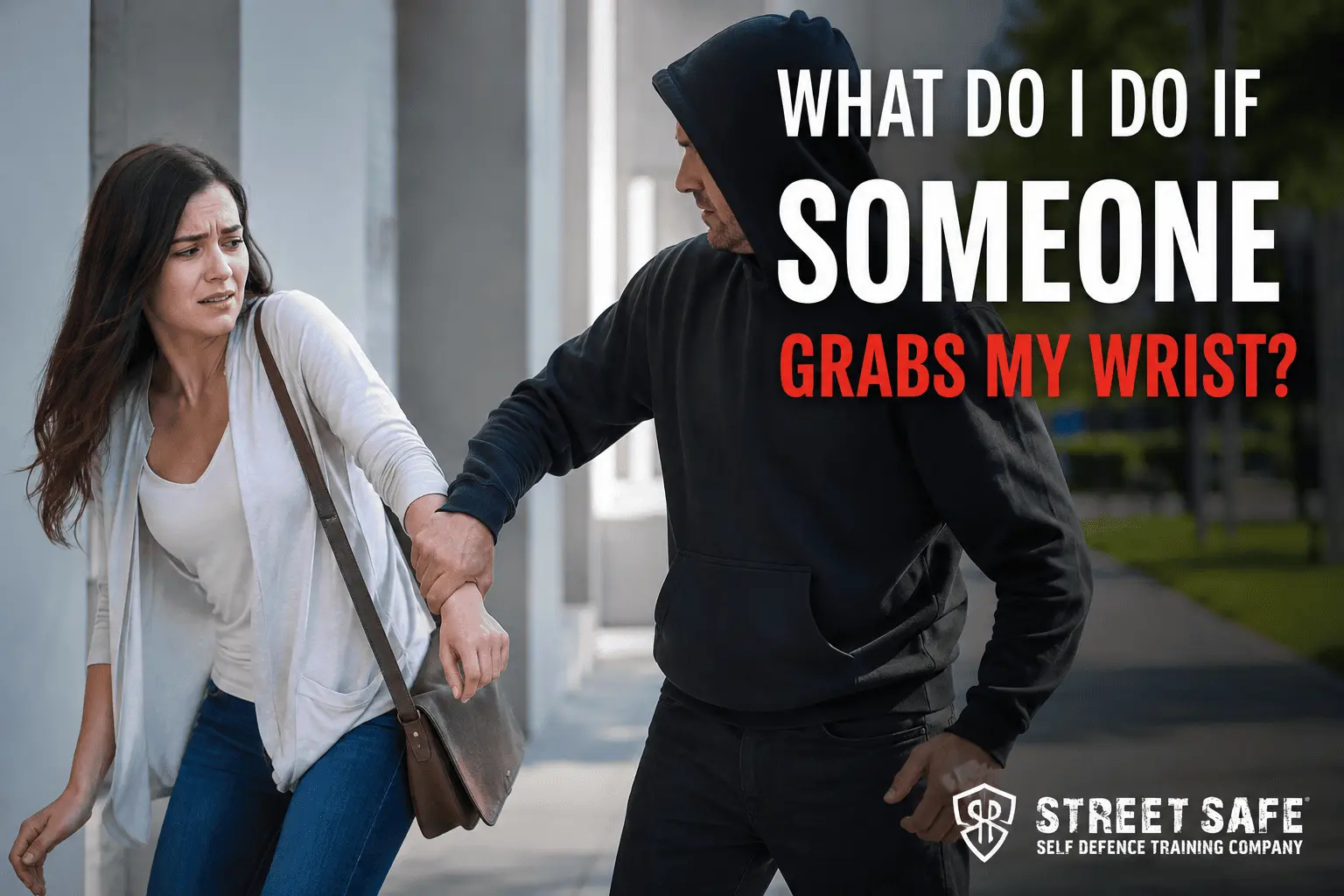
What Do I Do If Someone Grabs My Wrist?
A wrist grab is not the problem. What the person intends to do next is the problem.
Someone grabs your wrist.
What do you do?
If you have taken a traditional self-defence class, there is a good chance you were taught a technique.
Turn your wrist toward the thumb.
Circle your hand.
Step this way.
Grab their hand with your other hand.
Maybe perform some type of wrist lock.
I spent decades in martial arts. I understand why these techniques are taught, and I also understand why they fail most of the time.
But if someone grabs your wrist in real life, I don’t want your first thought to be about a technique.
I want you thinking about the person who just grabbed you.
Why did they grab you?
What are they trying to make you do?
Where are they trying to move you?
What is their other hand doing?
Who else is around you?
And most importantly:
What opportunity do you have right now to break contact and leave?
Because the wrist grab itself may only be the beginning of what they intend to do.
This is why environmental and situational awareness matters before physical contact ever begins. The earlier you recognize changing behaviour, movement, positioning and your environment, the more choices you may still have.
First, Understand What Just Changed
There is a significant difference between someone standing too close to you and someone physically grabbing you.
A boundary has now been crossed.
Another person has deliberately taken physical control of part of your body.
That doesn’t automatically tell us everything about their intention.
Context matters.
Someone you know may grab your wrist during an argument. A stranger may grab you because they want your phone or purse. Someone may be trying to stop you from leaving. Another person may be attempting to pull you somewhere.
The grab may be part of social violence—an argument or confrontation that has escalated.
Or it may be part of something considerably more dangerous.
What matters now is recognizing that the situation has changed.
You are no longer dealing only with words, proximity or uncomfortable behaviour. Physical contact has occurred.
Your decisions need to change with it.
Don’t Stare at the Hand
This is one of the first things I want people to understand.
When someone grabs your wrist, your attention will naturally go directly to where you are being grabbed.
That’s normal.
But don’t allow that hand to become your entire world.
Look at the person.
What is their other hand doing?
Are they reaching toward a pocket?
Are they trying to strike you?
Are they pulling you?
Are they pushing you?
Are they looking toward somewhere they want to move you?
Is another person approaching?
Is there a vehicle nearby?
Where is your safest way out?
The hand holding your wrist matters.
Everything happening around that hand may matter more.
This is situational awareness under pressure.
Ask Yourself: What Are They Trying to Accomplish?
This is where intent and behaviour come together.
A wrist grab is an action.
But that action usually has a purpose.
They may be trying to stop you from leaving.
They may be trying to control your movement.
They may be trying to pull you toward another location.
They may be creating an opportunity to strike you.
They may be attempting to take something from you.
They may be testing whether you will resist.
Or they may be attempting to gain greater physical control over you.
You may not know exactly what they intend.
You don’t need to.
You need enough information to recognize that someone’s behaviour is creating danger and make a decision before their control increases.
This is something we repeatedly teach at Street Safe:
You do not need certainty before you protect yourself.
As I explain in Permission to Leave Uncertainty, waiting for absolute proof that someone intends to hurt you can mean waiting until they have already gained greater control of the situation.
Confusion Can Cost You Time
There may also be a moment when your brain is trying to understand what is happening.
Why did they grab me?
Are they serious?
Do I know this person?
Are they joking?
Did I misunderstand what just happened?
Should I say something?
Am I overreacting?
Those questions can consume valuable decision-making time.
As I explain in The First Weapon a Predator Uses Isn’t Violence—It’s Confusion, confusion can interfere with our ability to make decisions while another person continues closing distance, applying pressure or gaining control.
You don’t have to perfectly understand someone’s motivation before responding to their behaviour.
If someone is physically controlling you and you want that contact to stop, that matters.
Where Are They Trying to Take You?
This question can become critically important.
If someone grabs your wrist and begins pulling you toward a vehicle, doorway, stairwell, isolated room, alley, wooded area or another location where you will have fewer witnesses and fewer escape options, the situation has changed dramatically.
Your objective should not be to obediently move with them while waiting for a better opportunity.
Every step toward greater isolation may reduce your options.
This is where situational awareness becomes critical even after physical contact has occurred.
You are no longer simply asking:
“How do I get my wrist free?”
You should also be asking:
“Where am I?”
“Where are they trying to move me?”
“Where are other people?”
“Where is my safest way out?”
Do not become so focused on escaping the wrist grab that you fail to recognize where the person is trying to move your entire body.
Why Wrist-Grab Techniques Can Fail
This is where reality needs to enter the conversation.
Many wrist-grab escapes are taught under ideal conditions.
Your training partner stands in front of you.
They grab the correct wrist.
They use predictable pressure.
They remain relatively stationary.
You know the grab is coming.
You know which technique you are supposed to perform.
And often, once you perform it correctly, your training partner lets go.
Real violence doesn’t necessarily give you those conditions.
Someone may be considerably stronger than you.
They may grab with tremendous force.
They may pull violently while you are trying to perform the technique.
They may use both hands.
They may strike you with the other hand.
They may drive you into a wall, vehicle or the ground.
And your own stress response may dramatically affect your ability to perform a movement requiring precision.
This is particularly important when teaching women.
If a much stronger person has taken hold of you, I don’t want your entire survival strategy dependent upon delicate finger movements, perfect wrist rotation or remembering a sequence you practised several months ago.
Keep it simple. Open the hand, spread fingers, and target the center of the face, continue striking hard until the hand is released. BUT…. YOUR JOB IS NOT DONE YET!
This is one of the fundamental differences between martial arts techniques and reality-based self-defence training.
The objective is not to demonstrate that you can perform a wrist release.
The objective is to recognize danger, respond appropriately, break physical control when necessary and create an opportunity to leave.
Don’t Turn It Into a Strength Contest
Trying to simply pull your arm straight backward against someone significantly stronger than you may not solve the problem.
Now you’re playing tug-of-war.
And the stronger person may win.
Instead, your response needs to be based on the total situation.
Movement.
Balance.
Body position.
Available targets.
Environmental barriers.
Noise.
Other people.
And the earliest opportunity to break their control and leave.
There isn’t one magical wrist escape that works against every person, every grip and every situation.
That’s precisely why reality-based self-defence cannot simply be a collection of techniques.
Your Voice Is Part of Your Response
If someone grabs you, your voice matters.
“LET GO OF ME.”
“DON’T TOUCH ME.”
“BACK OFF.”
Clear.
Direct.
Loud.
You are establishing a boundary, attracting attention and potentially interrupting what the person expected you to do.
You are also giving people around you information.
There is a major difference between bystanders hearing an argument and hearing someone yell:
“LET GO OF ME!”
Now they understand something physical is happening.
Your voice is not guaranteed to stop violence.
But it is another tool available to you.
Use it.
If You Can Break Contact, Leave
This is important.
If you get free, don’t stay there.
Don’t stand in front of the person and argue.
Don’t demand an explanation.
Don’t wait to see whether they will try again.
Don’t turn the situation into a fight that no longer needs to happen.
Your objective was never to defeat them.
Your objective was to create an opportunity to leave.
Move toward safety.
Move toward people.
Enter a business.
Get behind a locked door.
If you reach your vehicle, get inside, lock the doors and leave if you safely can. If the person continues approaching or attempts to gain access to you, the decisions change again. In What Do I Do If Someone Approaches Me While I’m Sitting in My Car?, I explain how your vehicle can provide a barrier, distance and mobility while you still have those advantages.
If you are facing an immediate threat or a crime is in progress, contact emergency services when you safely can.
Breaking the grip is not the end of the problem. Breaking contact is.
What If They Grab You Again?
Now you have additional information.
The first grab may have left some uncertainty about their intentions.
But if you break away, clearly tell them not to touch you and they deliberately grab you again, their behaviour is telling you considerably more.
They are refusing your boundary.
They are attempting to re-establish physical control.
Your response may need to become more immediate and more forceful depending on what they are doing and the danger you reasonably perceive.
Self-defence isn’t about punishing someone.
It is about protecting yourself and creating an opportunity to escape.
What If They Are Pulling You Toward a Vehicle?
This is not the time to worry about being polite.
Make noise.
Create attention.
Resist being moved toward greater isolation when you reasonably can.
Look for opportunities to move behind barriers, toward other people or away from the direction they are trying to take you.
If physical resistance becomes necessary, your goal remains the same:
Create the opportunity to break contact and leave.
Not to stand there and exchange techniques.
Not to prove you can fight.
Not to win.
Leave.
This is also why learning to recognize danger before physical contact occurs is such an important part of Street Safe Self Defence.
We don’t want your first decision happening after someone has already grabbed you.
The earlier you recognize changing behaviour, unwanted proximity, boundary testing or movement toward isolation, the more options you may have available.
Recognize. Decide. Act. Leave.
Someone grabbing your wrist is not simply a self-defence technique waiting to happen.
It is information.
Recognize that someone has crossed from verbal or behavioural pressure into physical control.
Decide what they appear to be trying to accomplish, what is happening around you and where your safest opportunity lies.
Act before they gain greater control over your body or move you somewhere more dangerous.
Leave the moment you have a safe opportunity.
This is why we teach environmental awareness, situational awareness and self-awareness before we ever start talking about physical self-defence.
Because your hand may be what they grabbed.
But you are what they are trying to control.
Don’t become obsessed with the grip.
Recognize the behaviour.
Recognize the objective.
Protect yourself.
Create your opportunity.
And leave.
That is reality-based self-defence.
Stop the Before, So the After Never Happens.
Frequently Asked Questions
What should I do first if someone grabs my wrist?
Look beyond the hand. Determine what the person is doing with their other hand, whether they are trying to move you, whether anyone else is involved and where your safest escape opportunity is. Your goal is to break contact and leave, not simply perform a particular technique.
Should I just pull my arm away?
That depends on the grip, the person’s strength, your position and what is happening around you. Pulling directly against a much stronger person’s grip can become a strength contest. Your response should consider movement, body position, the environment and your opportunity to escape.
Should I yell if someone grabs me?
If circumstances allow, use a clear, loud command such as “LET GO OF ME” or “DON’T TOUCH ME.” This establishes your boundary, can attract attention and tells people nearby that unwanted physical contact is occurring.
What if someone grabs my wrist and pulls me toward a car?
Treat attempts to move you toward greater isolation seriously. Make noise, attract attention, resist being moved when you reasonably can and look for opportunities to break contact and move toward people or safety. If you are facing an immediate threat, call 911 as soon as you safely can.
What should I do after I escape the grip?
Leave. Move toward a safer location rather than remaining to argue or confront the person. If there is an immediate threat, a crime in progress or you believe you remain in danger, contact emergency services.
Rob Andress
Violence Prevention Consultant, SAS-AP
Close Quarter Combative Instructor
Pure & Applied Debilitation Instructor
Active Threat Survival Trainer (A.L.I.V.E.)
Street Safe Self Defence Training Company