

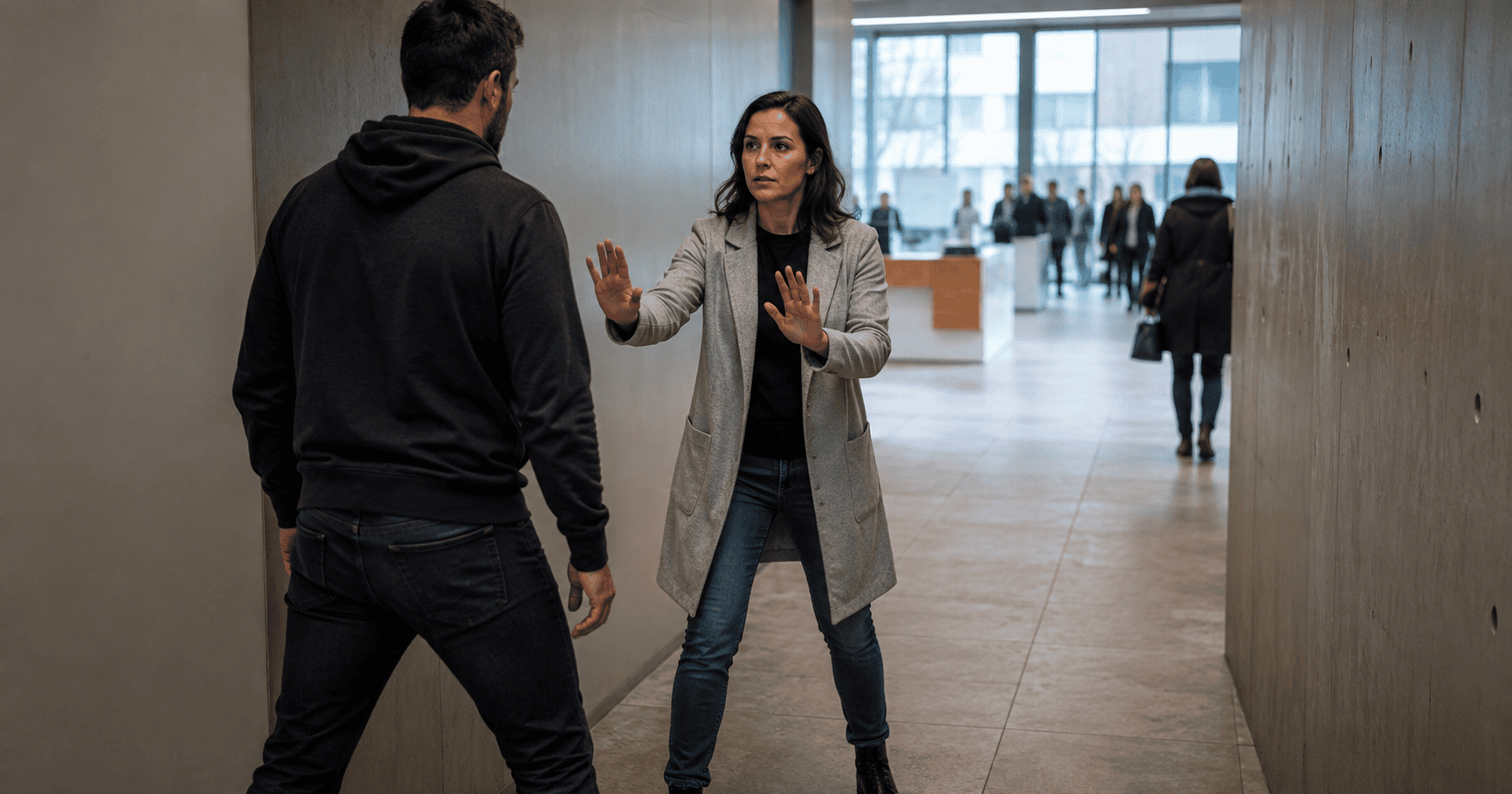
How to recognize deliberate path-blocking, set a clear boundary and leave safely
If someone blocks your way, your first objective is not to determine exactly what they want. Your first objective is to protect your movement, maintain distance and preserve a safe way out.
Sometimes people block a doorway, hallway or sidewalk without realizing it. Sometimes the behaviour is deliberate.
The difference is often revealed by what the person does after you change direction, create distance or clearly tell them to move.
If they step aside, the situation may be over. If they move with you, close the distance or continue preventing you from leaving, the behaviour has changed, and your response should change with it.
This article is part of Street Safe Self Defence’s “What Do I Do If…” series, providing practical, behaviour-based answers to real personal-safety questions. Like our articles about a stranger who will not leave you alone and someone following you into a parking lot, the goal is to recognize changing behaviour before physical violence begins.
What Should I Do Immediately If Someone Blocks My Way?
Stop before moving closer.
Do not continue walking directly toward the person and allow them to control the remaining distance. Look around, identify another safe route and move toward people, staff, security, an occupied business or a protected location.
Use a clear voice:
“Excuse me. I need to get through.”
If the person does not move, make the boundary stronger:
“Move away from me.”
“You are blocking my way.”
“I have told you to let me leave.”
You do not need to insult them, threaten them or provide a long explanation. A boundary should be short, direct and connected to action.
If you need to move, move.
If you need help, ask for it.
If you believe you are in immediate danger, call 911.
How Can I Tell Whether the Person Is Blocking Me Deliberately?
Watch the behaviour, not the person’s appearance.
Someone may unknowingly stand in a doorway, narrow aisle or hallway. Your first movement or verbal request gives them an opportunity to recognize the problem and step aside.
What happens next gives you more information.
Ask yourself:
- Did the person move when I asked?
- Did they step in front of me again?
- Did they mirror my change in direction?
- Did they move closer instead of creating space?
- Are they watching me or watching the environment?
- Are their hands visible?
- Are they attempting to move me toward another location?
- Are their words different from their behaviour?
- Are they refusing to accept that I want the interaction to end?
One behaviour may mean very little.
A cluster of connected behaviours changes the risk.
That is the foundation of practical situational awareness. You are not trying to read someone’s mind. You are recognizing when their behaviour begins limiting your choices.
Why Is Someone Blocking Your Path a Safety Concern?
Blocking is not automatically violence.
But deliberately preventing someone from moving can be a form of control, intimidation or boundary testing. It reduces distance, restricts access to exits and forces the other person to make a decision under pressure.
That matters.
The person may be trying to make you stop, listen, answer a question, give them something or move in a particular direction. They may be attempting to isolate you, intimidate you or create the opportunity for physical contact.
You may not know their objective yet.
You do not need to know.
If someone refuses to let you pass after you have clearly communicated that you want to leave, the behaviour itself is enough to justify changing your position, seeking help and ending the interaction.
Protective action is not an accusation.
Creating distance does not mean you have declared someone dangerous. It means you have recognized that your movement is being restricted and you are taking that seriously.
Do Not Let Politeness Trap You
Many people remain in uncomfortable situations because they do not want to appear rude.
They worry about overreacting. They smile, apologize and try to move around the person without creating a scene.
That social conditioning can work against you.
A reasonable person will normally respond to your discomfort by stepping aside or creating space. Someone with harmful intentions may laugh, dismiss your concern, blame you for being paranoid or continue blocking you while pretending it is harmless.
Your safety is more important than protecting that person from embarrassment.
Effective boundary-setting for personal safety is not about finding the perfect words. It is about communicating clearly, watching the response and acting when the boundary is ignored.
A boundary without action becomes a conversation.
You are not required to debate your right to leave.
Where Should I Move If My Intended Route Is Blocked?
Do not automatically turn and move deeper into isolation.
Before changing direction, look at the environment.
Where are the people?
Where are the exits?
Is there a staffed counter, open business, reception desk, security station, occupied vehicle or locked door nearby?
Can you place a table, counter, shopping cart, bench, vehicle or other physical barrier between yourself and the person?
Your goal is not simply to get around them. Your goal is to improve your position.
If the person is blocking the path toward your vehicle, do not allow reaching the vehicle to become your only plan. As we explain in our parking-lot safety article, your car is not automatically safety. Walking toward it may reveal which vehicle belongs to you or trap you between parked vehicles.
If this occurs near an elevator, do not step inside simply to get away. An elevator can place you in a confined environment with limited movement and normally only one exit. Our article on what to do if you feel uncomfortable in an elevator explains how decisions made before the doors close can preserve your options.
Move toward safety—not simply away from the person.
How Should I Position My Body?
Avoid standing directly in front of the person with your feet together and your hands at your sides.
Angle your body slightly. Keep enough space to move and maintain awareness of the person’s hands, position and direction of travel.
If they continue closing the distance, bring your hands up in an open, non-threatening position.
This is not a fighting stance.
Open hands support your verbal boundary, protect your personal space and place you in a better position if the person suddenly reaches for you.
At Street Safe, we teach a simple principle:
You are contact first.
That does not mean you immediately put your hands on someone who has done nothing physical. It means you understand that if contact becomes unavoidable, your hands should already be available to protect you, manage the distance and prevent the other person from gaining immediate control.
Should I Try to De-Escalate the Situation?
If the situation appears social and the person is still communicating, calm and direct language may help end it.
Keep your statements short:
“I don’t want any trouble.”
“I am leaving.”
“Give me space.”
“Do not touch me.”
De-escalation does not mean surrendering your safety, remaining within reach or allowing someone to control where you go.
Your words and movement must work together.
If you say you are leaving, begin moving toward safety. If you tell the person to give you space, reposition yourself so they cannot easily trap you against a wall, vehicle or closed door.
If the person continues advancing, ignores every boundary or attempts to prevent your movement, stop depending on conversation to solve the problem.
You cannot de-escalate someone who has no interest in being de-escalated.
How Do I Get Other People to Help?
Use your voice for more than communicating with the person blocking you.
Use it to bring other people into the situation.
Do not rely only on a general call for help. Identify a specific person and give them a clear direction:
“You in the blue jacket—call security.”
“Please stay here. This person will not let me leave.”
“Call 911. He is blocking the door.”
Clear language tells witnesses what is happening. It also makes it harder for the person to disguise their behaviour as a misunderstanding or harmless conversation.
Move toward the person you have identified rather than waiting for them to approach you.
When Should I Call 911?
Call 911 when you believe you or someone else is in immediate danger.
That may include situations where the person:
- Continues preventing you from leaving
- Threatens you
- Reaches for you
- Displays or suggests they have a weapon
- Attempts to force you toward another location
- Follows you when you change direction
- Tries to move you into a vehicle, room or isolated area
- Becomes physically violent
The Government of Ontario advises people who are in immediate danger to call 911 or their local police.
Tell the dispatcher where you are, what the person is doing, what they look like, whether you can see a weapon and which direction you are moving.
Do not become so focused on your phone that you stop watching the person or your environment.
What If the Person Grabs Me or Becomes Violent?
If the person grabs you, strikes you or attempts to force you into another location, the situation is no longer only about boundary-setting.
Your objective becomes creating the safest available opportunity to break contact and escape.
This is not the time to prove that you can fight.
It is not about punishing the person, teaching them a lesson or remaining there after you have an opportunity to leave.
Protect yourself.
Create an opening.
Break contact.
Leave.
Section 34 of the Criminal Code of Canada addresses the defence of a person. Canadian law considers whether a person reasonably believed force or a threat of force was being used and whether the defensive response was reasonable under the circumstances.
Every situation is different. This article provides general safety education and is not legal advice.
Street Safe’s reality-based approach to self-defence in Canada emphasizes avoidance, awareness and escape whenever those options remain safely available. Physical self-defence becomes necessary when the threat is immediate and the earlier options are gone.
What Should I Do After I Reach Safety?
Move behind a secured door, into an occupied business, toward security or to another protected location.
Call police and explain exactly what happened. Describe the person’s behaviour rather than trying to diagnose their intentions.
Write down:
- What the person said
- How they blocked you
- Whether they followed or touched you
- Their physical description and clothing
- Whether you saw a weapon
- Which direction they travelled
- The names of any witnesses
- Whether cameras may have recorded the incident
Small details disappear quickly after a frightening encounter. Record them while they are still fresh.
Do Not Wait for Certainty
The biggest mistake is waiting for the person to prove beyond all doubt that they intend to hurt you.
By the time that proof arrives, they may already control the distance, your movement and the environment.
You do not need certainty to change direction.
You do not need permission to create distance.
You do not need to remain polite when someone refuses to let you leave.
Someone deliberately blocking your path is communicating through behaviour. Recognize it, improve your position, establish your boundary and act before the person takes away more of your choices.
Self-defence does not begin when violence starts.
It begins with understanding people.
Recognize. Decide. Act. Leave.
Stop the Before, So the After Never Happens.
Frequently Asked Questions
What should I do if a stranger blocks my way?
Stop before moving within reach, maintain distance and clearly tell the person you need to pass. Look for another safe route and move toward people, staff or security. Call 911 if the person continues preventing you from leaving or you believe you are in immediate danger.
How do I know whether someone is deliberately blocking me?
Change direction or clearly ask them to move. If they mirror your movement, step in front of you again, close the distance or refuse to let you pass, the behaviour may be deliberate. You do not need to determine their exact intentions before taking protective action.
Should I push someone who is blocking my path?
Physical force should not be your first response to someone who is merely standing in your way. Use distance, movement, clear communication and available exits first. If the person uses or threatens force and you must physically protect yourself, your response must be reasonable under the circumstances.
What should I say when someone refuses to let me pass?
Use short, direct statements such as, “Move away from me,” “You are blocking my way,” or “I have told you to let me leave.” Avoid arguing or providing unnecessary explanations.
Should I go around the person?
Only if doing so moves you toward a safer position and does not bring you within reach. Do not allow the person to direct you toward an isolated room, stairwell, parking area or vehicle.
When should I call the police?
Call 911 when the danger is immediate, including when the person threatens you, reaches for you, displays a weapon, follows you, attempts to force you elsewhere or continues physically preventing you from leaving.
About the Author
Rob Andress is a Violence Prevention Specialist and co-founder of Street Safe Self Defence Training Company. He provides reality-based violence prevention and self-defence education to women, students, workplaces, municipalities, security professionals, healthcare workers, REALTORS® and Indigenous communities across Canada.
Rob’s training focuses on understanding human behaviour, recognizing developing danger, making better decisions under pressure and responding effectively when avoidance is no longer possible.
Rob Andress
Violence Prevention Consultant, SAS-AP
Close Quarter Combative Instructor
Pure & Applied Debilitation Instructor
Active Threat Survival Trainer (A.L.I.V.E.)
Street Safe Self Defence Training Company