

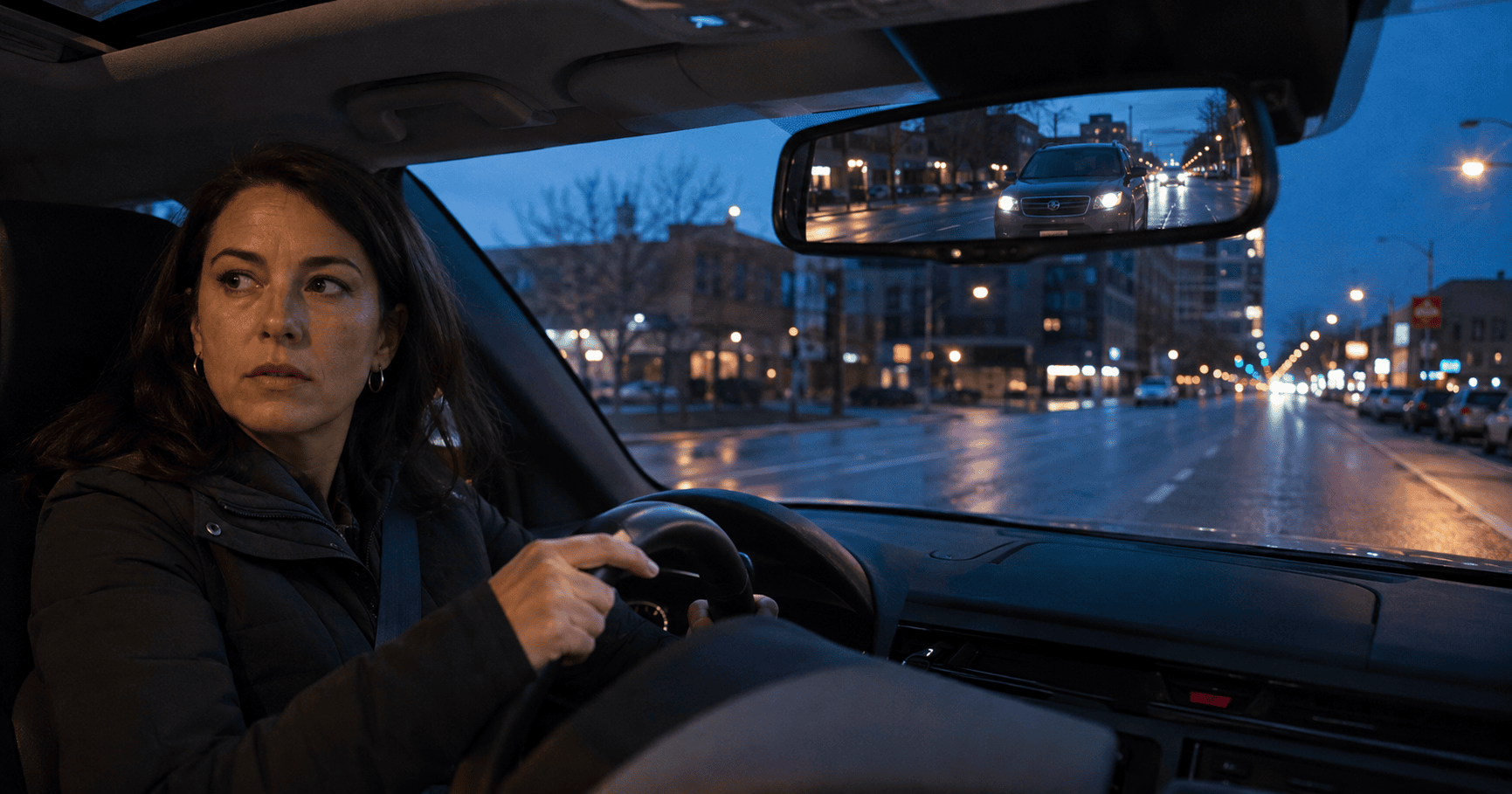
Most people believe they would know immediately if another vehicle were following them.
You probably won’t.
If you believe someone is following you while driving, do not drive home, stop or confront them. Keep your doors locked, windows closed and vehicle moving. Drive toward an occupied police station, hospital or busy, well-lit public location. Call 911 if you believe the situation presents an immediate threat.
At first, it will look like nothing more than another driver travelling in the same direction. They make the same turn. They change lanes when you change lanes. They remain behind you longer than expected.
You tell yourself it is probably a coincidence.
And it might be.
But personal safety does not depend on proving what another person intends to do. It depends on recognizing when the behaviour around you has changed and making decisions that give you time, distance and options.
Your first responsibility is not to prove you are being followed.
Your first responsibility is to avoid being trapped.
Pay Attention to the Pattern
One turn means nothing.
Two turns may mean nothing.
What matters is the developing pattern.
Does the vehicle continue matching changes in your route? Does it change lanes when you change lanes? Does it slow down when you slow down? Does it remain close after several reasonable opportunities to pass or continue in another direction?
One behaviour rarely tells the whole story. A cluster of behaviours begins to provide information.
This is the same principle behind situational awareness and violence prevention. Awareness is not about assuming everyone is dangerous. It is about recognizing when behaviour falls outside what you would normally expect within that environment.
Do not become so focused on the vehicle that you stop paying attention to the road. Check your mirrors normally, continue driving safely and begin moving toward a safer location.
You do not need absolute proof before making a safer decision.
Do Not Drive Home
This is the most important decision you will make.
Do not lead the vehicle to your home.
Your home tells them where you live. It may also place your partner, children or anyone else inside that home at risk.
Do not drive to a friend’s house or family member’s home for the same reason.
Keep moving. Stay on familiar, populated roads and begin driving toward an occupied police station, fire station, hospital emergency entrance or busy, well-lit business with people inside.
The Calgary Police Service advises drivers who believe they are being followed to drive to a well-lit public location, such as a gas station or restaurant, and contact police.
But the location itself is not enough.
The people at that location matter.
An empty parking lot outside a closed police station is still an empty parking lot. If the area is isolated or the building is closed, remain in your locked vehicle and keep moving if you safely can.
Do Not Stop to Find Out What They Want
Do not pull over.
Do not get out of your vehicle.
Do not lower your window to speak with them.
Do not drive into an isolated parking lot believing you can turn around and confront them.
Your vehicle gives you two important advantages: a physical barrier and mobility.
You lose both the moment you get out.
People often believe they can settle the situation by talking. That thinking comes from social conflict, where two angry people may still follow some basic rules.
You do not know who is inside the other vehicle. You do not know what they want, what emotional state they are in or whether they have a weapon.
This is not the time to prove you are right.
This is the time to leave.
Do Not Try to Lose Them
Fear and ego can create a second danger.
Do not start speeding, weaving through traffic, running red lights or making sudden illegal turns.
Do not brake-check the other vehicle.
Do not challenge the driver with gestures, eye contact or yelling.
You are not in a movie, and you have no idea how the other person will respond.
Trying to outrun them can cause a collision, escalate road rage or leave you stranded somewhere unfamiliar.
The goal is not to lose them through aggressive driving.
The goal is to stay mobile while moving toward help.
Keep Your Doors Locked and Your Windows Up
Your doors should already be locked while you are driving. If they are not, lock them now.
Keep your windows closed far enough that someone cannot reach inside.
When stopped in traffic, leave enough space between your vehicle and the vehicle in front of you to move around it if necessary. Pulling tightly against the bumper ahead removes your ability to leave.
Always give yourself an exit.
Your vehicle is not an impenetrable safe room, but a locked vehicle with room to move provides far more protection than standing beside it.
If the person leaves their vehicle and begins approaching yours, do not unlock the door or lower the window to hear what they have to say. The situation has now changed from someone following you to someone attempting to gain physical access to you.
Our article, What Do I Do If Someone Approaches Me While I’m Sitting in My Car?, explains how quickly a seemingly simple approach can change once distance, movement and access are lost.
Call Police
If you believe the situation presents an immediate threat, call 911.
Tell the dispatcher where you are, your direction of travel and where you are heading. Describe the vehicle, including its colour, make, model and licence plate. Even a partial plate may be helpful.
Tell them how many people appear to be inside and what behaviour caused you to believe you were being followed.
Do not put yourself or other drivers at risk trying to take photographs or type information into your phone. If someone else is in your vehicle, have them make the call and record the information.
Use hands-free calling or voice activation when available. Ontario’s distracted-driving guidance permits emergency calls to 911 but advises drivers to pull off the road in a safe area when making a call. If stopping would place you closer to the person following you, use hands-free calling where possible and follow the dispatcher’s instructions.
In Ontario, the Ontario Provincial Police can be reached by calling 911 for an emergency or 1-888-310-1122 for non-emergency assistance.
Do not threaten the other driver by holding up your phone or shouting that you are calling police.
Just make the call.
What If This Started as Road Rage?
Maybe you changed lanes and the other driver became angry.
Maybe they believe you cut them off.
Maybe they are following closely, flashing their lights or trying to pull alongside you.
Do not participate.
No gestures.
No yelling.
No brake-checking.
No pulling over to settle it.
Road rage is often driven by emotion, ego and the need to be right. Your participation gives the other driver something else to react to.
You cannot control their emotional state, but you can control whether you become part of the argument.
Your job is to remove yourself from the interaction, not win it.
Being legally right will not protect you from an emotionally unstable person.
What If They Block My Vehicle?
Stay inside your vehicle with the doors locked and windows closed.
Call 911.
Use your horn and lights to attract attention.
If there is a safe route to move your vehicle away from the threat, take it. Do not remain politely trapped because you are afraid of making a scene.
If another vehicle has deliberately blocked you, someone is trying to open your door or you see a weapon, the situation has moved beyond suspicion.
You are now dealing with an immediate threat.
Create distance and leave as soon as a safe route becomes available, if you must, create that route with your vehicle.
What If They Stop Following Me?
Do not immediately drive home.
Continue to a safe, populated location and take a few minutes to determine whether the vehicle returns.
Once you are safely parked, write down everything you remember. Include the time, location, vehicle description, licence plate or partial plate, number of occupants, direction of travel and any gestures, words or threats.
Save dashcam footage if you have it.
If this has happened before, report the pattern to police. One event may appear unimportant when viewed alone. Repeated behaviour tells a much different story.
Under section 264 of Canada’s Criminal Code, repeatedly following someone from place to place may form part of criminal harassment when the behaviour causes that person to reasonably fear for their safety or the safety of someone known to them.
You do not have to decide whether a crime has occurred before reporting the behaviour.
That is the job of police.
Your job is to document what happened accurately.
Confusion Creates Delay
One of the first things people do when behaviour changes is try to explain it.
Maybe they live nearby.
Maybe they are lost.
Maybe I am overreacting.
Maybe it is nothing.
This is how confusion creates delay.
As I explain in The First Weapon a Predator Uses Isn’t Violence. It’s Confusion, the brain wants normal explanations for behaviour that no longer feels normal.
You do not need to accuse anyone.
You do not need to panic.
You simply need to make the safer decision.
Driving toward a populated location and contacting police does not harm an innocent driver who happens to be travelling in the same direction.
Ignoring a developing pattern can harm you.
Prepare Before It Happens
Know where the police stations, hospitals and 24-hour businesses are in the areas where you regularly drive.
Keep enough fuel in your vehicle that you are not forced to stop.
Keep your phone charged and accessible.
Set up voice activation and emergency calling before you need them.
If you are a REALTOR®, healthcare worker, community employee or anyone else whose work requires travelling alone or meeting people you do not know, include vehicle safety in your professional safety plan. Street Safe’s REALTOR® Safety and Violence Prevention Program teaches professionals to recognize targeting, luring and predatorial behaviour before physical violence begins.
Your emergency plan should not begin after someone starts following you.
The body will never go where the mind has not been.
Think through these decisions now, while you are calm, so your brain has somewhere to go when the situation is real.
You Do Not Need Certainty to Choose Safety
People become trapped because they wait for certainty.
They want one more turn.
One more lane change.
One more piece of proof.
By the time they become completely certain, they may already be sitting in their driveway with the garage door open.
You do not need certainty to choose safety.
Do not drive home.
Do not stop.
Do not confront them.
Stay mobile.
Move toward people and help.
Call police.
The goal was never to prove that someone was following you.
The goal was always to make sure they never controlled where the situation ended.
Stop the Before, So the After Never Happens.
Frequently Asked Questions
Should I make four right turns to confirm I am being followed?
Not if doing so takes you into quiet or unfamiliar streets. You do not need to perform a test before moving toward safety. Watch for a developing pattern while continuing toward a populated location.
Should I drive directly to a police station?
An occupied police station is a strong option. If the station is closed or its parking area is isolated, remain in your locked vehicle, keep moving if possible and call police for instructions.
Should I pull over and let the vehicle pass?
Not if you genuinely believe you are being followed. Pulling over removes your mobility and may give the other driver access to you.
Can I take a picture of the vehicle?
Only if a passenger can do it safely. Do not become distracted or cause a collision trying to collect evidence.
What if I know the person following me?
Familiarity does not reduce the risk created by threatening behaviour. Do not drive home or agree to meet them. Move toward a safe location, contact police and document the behaviour.
About the Author
Rob Andress
Violence Prevention Consultant, SAS-AP
Close Quarter Combative Instructor
Pure & Applied Debilitation Instructor
Active Threat Survival Trainer (A.L.I.V.E.)
Street Safe Self Defence Training Company
Rob Andress is a Violence Prevention Specialist and co-founder of Street Safe Self Defence Training Company with Beth Andress. Together, they provide reality-based violence prevention, behavioural awareness, situational awareness, conflict management, de-escalation and self-defence education to schools, municipalities, healthcare professionals, corporations, security teams, REALTORS® and communities across Canada.