

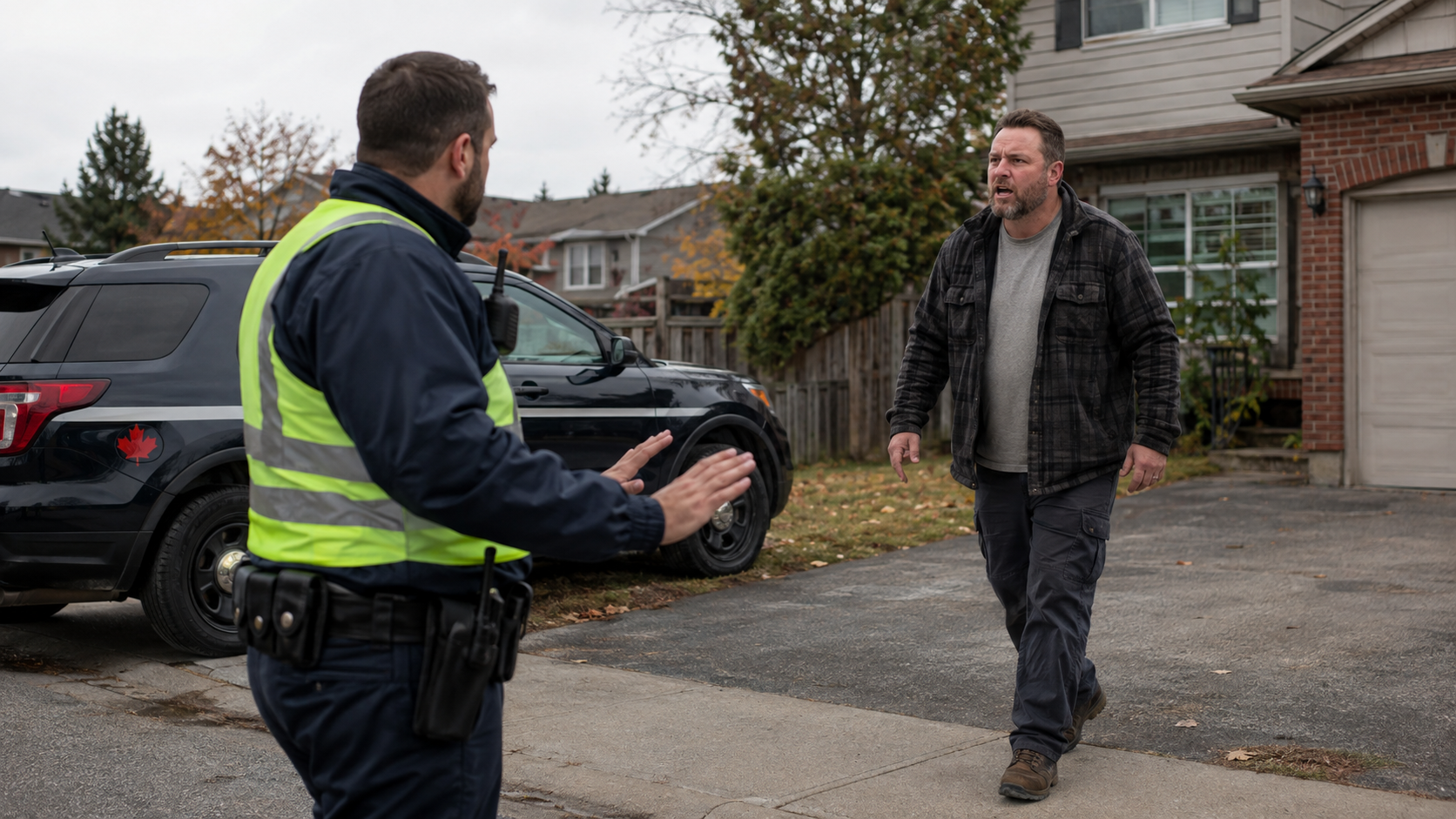
A municipality will train a By-Law Officer to understand legislation; Canada gives By-Law Officers authority, then fails to prepare them for the human being standing in front of them.
By-Law Officer safety training in Canada has failed to keep pace with the human and physical risks officers now face while enforcing municipal laws.
It will teach that officer how to interpret a by-law, take notes, gather evidence, issue an order, write a ticket, prepare a prosecution brief and testify in court.
Then it will send that officer, often alone, to the home, business, vehicle or property of a complete stranger who does not want them there.
That is where the training gap becomes dangerous.
The officer may be investigating an unsafe property, an aggressive dog, an illegal business, a zoning violation, a noise complaint or a vehicle someone refuses to move.
Whatever the complaint, that officer is arriving to interfere with something the person values.
Their property.
Their money.
Their business.
Their animal.
Their pride.
Their perceived right to do whatever they want.
This is not ordinary customer service.
This is enforcement contact.
Enforcement removes choice, restricts behaviour or creates a consequence. That can produce embarrassment, financial pressure, anger, defiance and, in some cases, violence.
Yet municipalities continue to confuse knowing the law with knowing how to safely deal with the human being who does not want that law enforced.
Knowing the law is essential.
It is not enough.
The Assaults Are Real
Canada does not have a readily accessible national database separating assaults against municipal By-Law Officers from the broader categories of assaults against peace officers, public officers and other enforcement personnel.
That should concern every municipality.
We cannot properly measure a problem we refuse to separately count.
But the Canadian evidence we do have is impossible to ignore.
By-Law and municipal enforcement officers have been punched, shoved, spat on, threatened with weapons, attacked with knives, struck with vehicles, assaulted by groups, seriously injured and killed.
These are not imagined risks.
These are documented incidents.
Rod Lazenby Was Killed Responding to a Dog Complaint
On August 10, 2012, Community Peace Officer Rod Lazenby attended a rural Alberta property regarding dogs.
It was the type of call people describe as routine.
It was his last call.
Lazenby was violently attacked and killed. An autopsy found that he had been strangled and suffered 56 cuts and bruises to his face, head, neck, body and back, along with numerous internal injuries.
The person responsible was found not criminally responsible because of a mental disorder.
The Alberta government subsequently conducted a public fatality inquiry into Rod Lazenby’s death.
The inquiry produced recommendations concerning officer-safety training, defensive tactics, communication with dispatchers, identifying high-risk properties and preventing officers from attending known threats alone.
Following the inquiry, Alberta introduced training enhancements, restrictions on attending risky calls alone and improved officer-monitoring systems. The City of Calgary later described how Lazenby’s death led to significant changes in the way community peace officers were monitored and supported.
An experienced officer went to investigate a complaint about dogs and never came home.
How many municipalities still call that a low-risk complaint?
Half of the B.C. Officers Surveyed Reported Being Physically Assaulted
A 2024 risk analysis conducted for the Local Government Compliance and Enforcement Association of British Columbia provides one of the clearest Canadian examinations of violence against municipal enforcement personnel.
Among the 52 officers responding to its primary survey:
- 96 percent reported experiencing confrontational behaviour
- 50 percent reported having been physically assaulted
- 90 percent believed the risk associated with their work had increased
- 54 percent did not believe they were adequately trained to perform every aspect of their job as safely as possible
- 73 percent did not believe their local policies and procedures adequately allowed them to perform their jobs as safely as possible
A related province-wide survey included 101 responses concerning officers’ perceptions of safety. Fifty-five percent indicated that they did not feel entirely safe while conducting their duties.
The 2024 LGCEA Risk Analysis Report contains accounts from officers who had been punched, pushed, shoved, spat on, threatened, followed, cornered and struck with objects.
One officer reported a person pulling a machete during patrol.
Another described being threatened with a tire iron and having a vehicle deliberately accelerated toward them.
Another was attacked without warning by someone who walked up and began punching.
Officers described having objects thrown at them, phones struck from their hands, paths blocked, vehicles followed and weapons displayed around encampments.
The report also found that some officers who felt adequately prepared credited skills acquired through previous work in policing or corrections, or through outside training such as martial arts.
They did not feel prepared because of the training supplied by their current employer.
They felt prepared because of skills they brought with them.
The municipality benefited from training it never provided.
What happens to the officer who does not arrive with that experience?
Toronto Parking Enforcement Officers Experienced a 206.7 Percent Increase in Assaults
Toronto recorded six assaults against Parking Enforcement Officers in 2021.
That increased to 15 in 2022.
In 2023, it reached 46.
That is a 206.7 percent increase in a single year.
By July 18, 2024, another 27 officers had already been assaulted. Toronto Police Chief Myron Demkiw stated that most of the assaults occurred while officers were serving parking tickets. CityNews reported the figures during Toronto’s public-awareness campaign.
A parking ticket.
Not an arrest.
Not a weapons seizure.
Not a violent-crime investigation.
A parking ticket.
In August 2026, Toronto Police announced another arrest after a Parking Enforcement Officer was allegedly assaulted while attempting to complete a penalty notice. Toronto Police published the details of that investigation.
The seriousness of the original violation does not determine the seriousness of the human response.
An Ottawa By-Law Officer Suffered a Broken Leg
In October 2024, an Ottawa By-Law and Regulatory Services Officer was issuing a ticket when the driver returned.
According to Ottawa Police, the driver was uncooperative and attempted to speed away. The vehicle struck the officer, breaking the officer’s leg.
The driver was charged with aggravated assault, assault with a weapon, dangerous operation and mischief to property. The Ottawa incident was reported by CityNews.
The enforcement activity was issuing a ticket.
The outcome was a broken leg.
A Caledon Officer Was Assaulted by a Group
In November 2024, Ontario Provincial Police responded after a Town of Caledon Municipal Law Enforcement Officer was reportedly assaulted by a group of people in Southfields Village.
The OPP Major Crime Unit assisted with the investigation. The officer was taken to hospital with injuries. The Caledon assault was reported here.
This was not a customer-service complaint.
It was a group assault requiring a major-crime investigation and hospital treatment.
A Bradford Officer Was Struck With a Pickup-Truck Door
In March 2025, By-Law Officers in Bradford West Gwillimbury asked drivers to move vehicles parked in no-stopping areas near a school crosswalk.
When some vehicles remained, the officers began issuing tickets.
South Simcoe Police alleged that one driver swore at an officer and struck the officer with the door of a pickup truck before leaving the area.
A 47-year-old man was later charged with assaulting a peace officer. The allegation had not been tested in court at the time of reporting. NewmarketToday reported the police account.
Once again, the original issue was a parking violation.
Once again, the contact became physical.
A B.C. Community Safety Officer Was Attacked With a Knife
In October 2023, a Community Safety Officer working for the City of Grand Forks, British Columbia, reported being attacked with a knife in a downtown park.
When the attack was unsuccessful, the attacker damaged the officer’s work vehicle. Additional charges, including assault with a weapon and possession of a weapon for a dangerous purpose, were later approved. The archived RCMP release documents the case.
The person convicted in the attack subsequently received a three-year sentence.
Punches.
Vehicles.
Knives.
Groups.
Threats.
Broken bones.
And death.
How much more evidence do municipalities require before they recognize that By-Law enforcement is a human-risk occupation?
The Uniform Is Not a Force Field
Under Ontario’s Community Safety and Policing Act, municipalities may appoint people to enforce municipal by-laws. Once appointed, those officers are peace officers for the purpose of enforcing those by-laws.
That appointment provides legal authority.
It does not provide control.
It does not teach an officer to recognize when frustration becomes fixation.
It does not teach them to identify target glancing, sudden silence, concealment, predatory movement or the deliberate closing of distance.
It does not prepare their nervous system for the moment someone stops arguing and decides to attack.
A title does not change human behaviour.
A badge does not create compliance.
A uniform does not prevent violence.
A radio does not stop the first strike.
Lawful authority means very little to a person who has already decided that the officer standing in front of them is the enemy.
Authority is not control.
We Prepare Officers for the Courtroom—After Failing to Prepare Them for the Driveway
The Municipal Law Enforcement Officers’ Association of Ontario Part I Foundations course covers important subjects, including legislation, legal terminology, ethics, note-taking, evidence, prosecution briefs, the Provincial Offences Act, rights of entry and Administrative Monetary Penalty Systems.
Every one of those subjects is necessary.
Officers must understand their authority.
They must recognize its limits.
They must gather evidence correctly.
They must write defensible reports.
They must respect procedural fairness.
The problem is not that this education is unnecessary.
The problem is believing it is enough.
Situational awareness appears in the curriculum. But situational awareness is not a phrase, a policy or a presentation slide.
It is a continuous process of recognizing behaviour, assessing the environment, anticipating change and making decisions before the officer loses control of the contact.
If an officer can explain the Provincial Offences Act but cannot recognize that the person in front of them has shifted from emotional escalation to assaultive intent, we have not fully prepared that officer.
If they can write a prosecution brief but do not know where to stand at a doorway, we have not fully prepared that officer.
If they can issue an order but do not recognize that they are being moved away from their vehicle, we have not fully prepared that officer.
If they know exactly what to say in court but freeze when someone suddenly closes distance, we have not fully prepared that officer.
We have trained them to explain the enforcement afterward.
We have not necessarily trained them to survive the contact.
Authority Without Ability Creates False Ego
There is another part of this conversation that municipalities may not want to hear.
What happens when we give someone authority but fail to provide the knowledge, confidence and practical ability required to exercise it?
Ego fills the gap.
Not always because the officer is a bad person.
Often because the officer is uncertain, frightened or feels their authority slipping away.
The officer has been told they are in charge.
They have been given a uniform, identification, an appointment and the authority to issue consequences.
Then someone looks at them and says:
“No.”
Now what?
If the officer has not been trained to understand human behaviour, resistance and emotional escalation, they may interpret non-compliance as a personal challenge.
The contact stops being about gaining lawful compliance.
It becomes about winning.
The officer repeats the demand more forcefully.
The person resists more aggressively.
The officer moves closer.
Voices rise.
Body language changes.
Neither person wants to be the one who backs down.
The original violation disappears beneath ego, status and control.
Research into psychological reactance shows that people can experience anger and resistance when they believe their freedom is being threatened. Forceful and controlling language can increase that perceived threat.
That does not mean officers should surrender their authority.
It means they must understand the human response their authority can create.
Research into procedural justice has also found that people are more likely to cooperate when they believe authorities are fair, respectful and neutral. When they feel mistreated, they may become less willing to comply and more likely to challenge the officer.
That challenge can cause an underprepared officer to become tougher, louder and more forceful, creating an escalation loop. The National Institute of Justice describes the connection between treatment, legitimacy, cooperation and officer safety.
This is not about being soft.
It is about being effective.
An officer should never have to rely on volume, posturing, humiliation or intimidation to establish their authority.
That is not officer presence.
That is false ego.
The louder an officer becomes, the less control they may actually possess.
The more personal they make the contact, the more personal the other person’s response may become.
A confident, properly trained officer does not have to prove their authority.
They use it.
Calmly.
Legally.
Safely.
Municipalities must therefore address two separate dangers:
The undertrained officer who cannot recognize the violence developing in front of them.
And:
The undertrained officer whose ego, language or behaviour unintentionally helps create the escalation.
Ignoring either side is dishonest.
YOU ARE CONTACT FIRST—NOT ENFORCEMENT
Before an officer explains the violation, issues an order or begins enforcement, they must safely establish contact with the human being in front of them.
That means recognizing:
- The person’s emotional and behavioural state
- Changes in voice, language, posture and movement
- The difference between frustration and predatory intent
- Pre-attack indicators
- The presence and movement of additional people
- Animals, tools, weapons and environmental hazards
- Distance, positioning and available exits
- Whether the officer is being surrounded, distracted or deliberately moved
- Whether communication is reducing tension or feeding it
- When to disengage
- When to request assistance
- When safety must take priority over completing the enforcement action
This is not teaching officers to fear the public.
It is teaching them to understand the public.
Most people who disagree with an officer will never become violent.
But officers must recognize the person who is moving beyond disagreement.
That requires behavioural training.
Not assumptions.
Not fear.
Not ego.
“Just De-Escalate” Is Not a Safety Plan
De-escalation matters.
But de-escalation is not magic.
It is not a scripted list of polite phrases.
It is not endlessly repeating the same demand while an aggressive person continues closing distance.
It is not lowering your voice while ignoring everything their body is telling you.
And it is not accepting abuse until the person becomes tired of delivering it.
Real de-escalation begins with recognition.
Why is this person escalating?
Is it fear?
Frustration?
Embarrassment?
Confusion?
Intoxication?
Mental illness?
A challenge to status?
Or is the person using aggression deliberately because aggression has worked for them before?
These are not the same behaviours.
They do not present the same risks.
They should not produce the same response.
An emotionally escalated person may still be reachable.
A resource predator may use anger, threats, confusion and physical movement to create hesitation and gain advantage.
If officers are taught that every aggressive person can be talked down, we create hesitation at the exact moment decisive action may be required.
You cannot de-escalate what you never recognized.
Workplace-Violence Compliance Is Not Violence Preparation
Ontario’s Occupational Health and Safety Act requires employers to assess workplace-violence risks and provide workers with appropriate information and instruction. The province’s workplace-violence guidance explains those responsibilities.
But compliance can become a paperwork exercise.
A policy is written.
An online module is completed.
An officer signs an attendance sheet.
A procedure explains how to report an assault.
Everyone is now considered trained.
Until that officer is alone in a driveway with an enraged property owner standing between them and their vehicle.
A workplace policy may tell the officer which form to complete after being assaulted.
Reality-based training must prepare that officer to recognize and stop the escalation before the assault occurs.
The objective cannot simply be proving that training was delivered.
The objective must be giving the officer usable skills that remain available under stress.
This Is Why T.R.A.A.C.S. Exists
Street Safe developed T.R.A.A.C.S.—Tactical Risk Awareness & Applied Combatives System to address the human part of enforcement that conventional training too often leaves behind.
T.R.A.A.C.S. does not replace MLEOA education, municipal orientation, property-standards training, the Provincial Offences Act or court preparation.
It completes the training.
The law tells officers what authority they possess.
T.R.A.A.C.S. teaches them how to safely exercise that authority with another human being standing in front of them.
The program focuses on:
- Situational, behavioural and environmental awareness
- Contact-first thinking
- Social and a-social violence
- Emotional escalation versus predatory aggression
- Pre-attack indicators
- Safe positioning and distance
- Reality-based de-escalation
- Force de-escalation
- Working-alone risks
- Officer presence without ego
- Disengagement and tactical withdrawal
- Decision-making under pressure
- Close-quarter personal protection when communication fails
- Legally and occupationally defensible responses
T.R.A.A.C.S. is not martial arts.
It is not use-of-force training disguised as employee safety.
It is not about teaching By-Law Officers to fight the public.
It is about preventing the confrontation whenever possible.
It is about recognizing whether de-escalation is working.
It is about recognizing when it is not.
And it is about ensuring an officer is not left helpless when the contact becomes physical.
The program is built around one essential understanding:
YOU ARE CONTACT FIRST—NOT ENFORCEMENT.
The officer must first manage the human contact.
Enforcement comes after.
Stop Training for the Report Instead of the Reality
By-Law Officers represent the municipality at the exact point where policy collides with human emotion.
They knock on the door.
They walk onto the property.
They deliver the decision.
They say no.
They issue the ticket.
They order compliance.
They become the visible human target for a decision they may not have made and a by-law they did not write.
Canada has already seen By-Law and municipal enforcement officers punched, struck with vehicles, attacked with knives, assaulted by groups, seriously injured and killed.
Knowing the law is essential.
Knowing how to investigate is essential.
Knowing how to document the incident is essential.
Knowing how to testify afterward is essential.
But the officer must first survive the contact.
Train the law.
Train the procedure.
Train the documentation.
Eliminate the ego.
Train the human being.
And train for the reality as if the officer’s life depends on it.
Because Canada already knows that it can.
Frequently Asked Questions About By-Law Officer Safety and Training
Are By-Law Officers Being Assaulted in Canada?
Yes.
Canadian By-Law and municipal enforcement officers have been punched, shoved, spat on, struck by vehicles, attacked with knives, assaulted by groups and threatened with serious violence.
Toronto recorded six assaults against Parking Enforcement Officers in 2021, 15 in 2022 and 46 in 2023. A British Columbia risk analysis found that 50 percent of responding local-government compliance and enforcement officers reported having been physically assaulted.
Canada has also experienced the on-duty killing of Community Peace Officer Rod Lazenby while he was responding to a dog complaint.
Are Ontario By-Law Officers Considered Peace Officers?
Under Ontario’s Community Safety and Policing Act, Municipal By-Law Enforcement Officers appointed by a municipality are peace officers for the purpose of enforcing municipal by-laws.
That appointment provides legal authority within the scope of their duties. It does not make them police constables, nor does it automatically provide the behavioural, tactical or personal-safety skills needed to manage a violent encounter.
What Training Do Ontario By-Law Officers Normally Receive?
Conventional By-Law Officer education generally concentrates on:
- Municipal legislation
- Provincial Offences Act procedures
- Legal terminology
- Note-taking
- Evidence collection
- Rights of entry
- Administrative Monetary Penalty Systems
- Prosecution briefs
- Court preparation
- Municipal policies and procedures
These are essential enforcement skills. However, they do not constitute complete preparation for recognizing, preventing and responding to human aggression.
Why Is Conventional By-Law Training Not Enough?
An officer can understand municipal legislation and still be unprepared for the person affected by that legislation.
Public contact requires officers to recognize behavioural changes, emotional escalation, intimidation, predatory movement, concealment, pre-attack indicators and environmental dangers.
They must know when communication is reducing tension, when it is increasing resistance and when it has stopped working.
Legal knowledge tells an officer what they may do.
Behavioural and reality-based training helps them determine how to do it safely.
How Can an Officer’s Ego Escalate an Enforcement Contact?
Authority without confidence or practical ability can create false ego.
When an officer has been told they are in charge but has not been trained to manage resistance, non-compliance may feel like a personal challenge. The officer can become louder, move closer or repeat demands more aggressively.
The member of the public pushes back.
The officer pushes harder.
The contact becomes a contest over status and control.
Professional officer presence does not require ego. A properly trained officer can maintain authority without turning enforcement into a personal battle.
Can Every Aggressive Person Be De-Escalated?
No.
Some people are emotionally escalated because they are frightened, embarrassed, confused, intoxicated or overwhelmed. Skilled communication may help lower that emotional state.
Other people use aggression deliberately. Threats, intimidation and physical movement may be tools used to create fear, hesitation or compliance.
Effective de-escalation requires the officer to recognize who they are dealing with, why the person is escalating and whether communication is actually changing the behaviour.
Continuing to talk while someone prepares to attack is not de-escalation.
What Is T.R.A.A.C.S.?
T.R.A.A.C.S.—Tactical Risk Awareness & Applied Combatives System is Street Safe’s reality-based training and certification program for By-Law Officers, security personnel and other public-facing enforcement professionals.
It addresses the gap between legal enforcement knowledge and safe human contact.
T.R.A.A.C.S. develops behavioural recognition, situational awareness, safe contact, de-escalation, force de-escalation, officer positioning, working-alone awareness, decision-making under stress and close-quarter personal protection.
It is not about teaching officers to fight the public.
It is about helping them stop preventable violence and survive the violence that cannot be prevented.
Does T.R.A.A.C.S. Replace MLEOA, OAPSO or Municipal Training?
No.
MLEOA, OAPSO and municipal training provide essential education in legislation, property standards, investigations, enforcement procedures, documentation and court preparation.
T.R.A.A.C.S. provides the human-contact and officer-safety layer.
The law tells officers what authority they possess.
T.R.A.A.C.S. prepares them to safely exercise that authority.
Legal competence without human-contact competence is incomplete training.
What Should Municipalities Provide Before Sending Officers Into the Field?
Municipalities should provide training and systems that reflect the actual risks their officers face, including:
- Applicable legislation and municipal by-laws
- Investigation and documentation
- Behavioural recognition
- Reality-based de-escalation
- Pre-contact risk assessment
- Working-alone procedures
- Access to property and subject-risk information
- Reliable communication and officer monitoring
- Clear backup and police-assistance protocols
- Scenario-based decision-making
- Personal-protection skills
- Post-incident reporting and support
A policy, an online awareness module and an incident-reporting form do not prove that an officer is prepared for violence.
The real test is whether the training remains usable when the human being standing in front of that officer suddenly decides not to comply.