

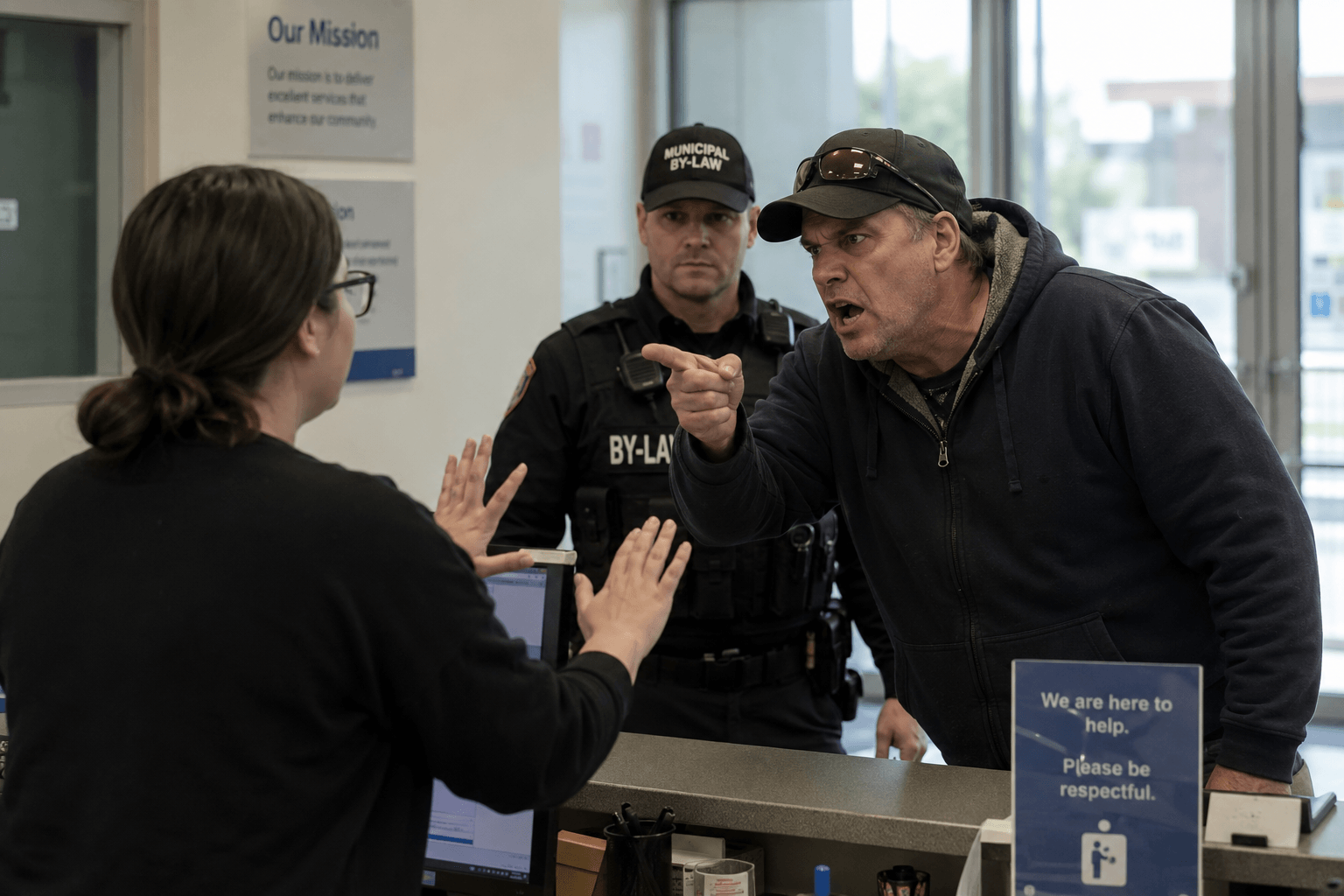
A Better Approach to Violence Prevention Training for By-Law Officers, Firefighters, Paramedics and Security Professionals
By Rob Andress
Close Quarter Combative Instructor
Pure & Applied Debilitation Instructor
Active Threat Survival Trainer (A.L.I.V.E.)
Street Safe Self Defence Training Company
“Use of Force prepares professionals for the moment violence begins. TRAACS™ prepares professionals for everything that happens before, during and after violence.”
Every municipality in Canada is talking about workplace violence.
That’s a good thing.
For years, workplace violence was often viewed as something that happened somewhere else, to someone else. Today, municipalities recognize that violence can affect every department, every employee, and every member of the public they serve.
We’re seeing stronger workplace violence legislation.
More reporting.
More investigations.
More concern for employee safety.
That’s progress.
But after years of working with, and educating on the reality of violence prevention across Canada, I believe the conversation still isn’t asking the most important question.
Are we training municipal employees for the work they actually do, or are we training them for situations that rarely reflect their reality?
That question is what led us to develop TRAACS™ — Tactical Risk Awareness & Applied Combatives System.
Not because existing Use of Force programs are wrong.
But because they were designed for a different profession.
Different Jobs Require Different Training
Let’s be clear.
Police officers need Use of Force training.
Their responsibilities include making arrests, taking people into custody, conducting searches, controlling violent offenders and enforcing the Criminal Code.
That is their role.
Municipal By-Law Officers have a different role.
Paramedics have a different role.
Firefighters have a different role.
Most Security Professionals have a different role.
These professionals aren’t looking to control people.
They’re trying to solve problems.
They’re trying to calm situations.
They’re trying to provide service.
They’re trying to protect themselves while continuing to help the public.
Those are very different objectives.
So why would we assume the same training model should apply equally to everyone?
The Goal Should Never Be Physical Control
One of the biggest differences between TRAACS™ and traditional Use of Force thinking is the objective.
Use of Force often focuses on managing resistance once physical confrontation has already begun.
TRAACS™ begins much earlier.
It asks a different question.
How do we recognize increasing risk before physical intervention becomes necessary?
That’s a completely different mindset.
Because violence rarely begins with violence.
It begins with behaviour.
Changes in communication.
Changes in body language.
Changes in emotional regulation.
Changes in personal space.
Changes in decision-making.
Long before someone throws a punch, they’re often communicating that something is changing.
Those behavioural changes create opportunities.
Opportunities to reposition.
Opportunities to communicate differently.
Opportunities to request assistance.
Opportunities to leave.
And when those options aren’t available, opportunities to prepare.
That is where workplace violence prevention truly begins.
Behaviour Is the First Warning System
One of the things I’ve said for years is this:
People usually tell us they’re becoming dangerous.
They just don’t use words.
They use behaviour.
That’s one of the foundations of TRAACS™.
We teach professionals how to recognize behavioural change, understand what it may indicate, and make better decisions before a situation becomes physical.
That’s very different from waiting until someone is actively assaulting you before your training becomes relevant.
If the first time your training applies is after you’ve been attacked, you’ve already lost valuable time.
Municipal Employees Don’t Need More Fighting Skills
This is probably where some people expect me to start talking about strikes, defensive tactics or restraint techniques.
I’m not going to.
Because that’s not what TRAACS™ is really about.
TRAACS™ is about improving judgement.
Improving observation.
Improving positioning.
Improving communication.
Improving decision-making under stress.
Those skills protect people long before physical survival skills become necessary.
When physical intervention cannot be avoided, it should be simple, reasonable, legally defensible and immediately followed by creating distance and getting to safety.
That’s a very different philosophy than trying to dominate another person.
Why We Built TRAACS™
We didn’t develop TRAACS™ because Canada needed another defensive tactics program.
Canada has plenty of those.
We developed TRAACS™ because municipalities needed a workplace violence system designed around the people they employ.
A system that recognizes human behaviour.
A system that understands occupational risk.
A system that prepares people to think before they have to react.
A system that recognizes the best physical confrontation is often the one that never happens.
That’s why we believe TRAACS™ makes sense for municipal By-Law Officers, Paramedics, Firefighters, Security Professionals and other frontline employees.
It reflects their reality.
Not someone else’s.
The Conversation Needs to Continue
Municipalities have made tremendous progress recognizing workplace violence as a serious occupational health and safety issue.
The next step is ensuring the training reflects the realities of today’s frontline professionals.
Not every employee needs Use of Force training.
Every employee does need the ability to recognize escalating behaviour, assess risk, make sound decisions under pressure and protect themselves when circumstances demand it.
That’s exactly what TRAACS™ was built to do.
Because preventing violence will always be better than simply responding to it.
And that’s a conversation every municipality in Canada should be having.
We Didn’t Build TRAACS™ Around Use of Force. We Built It Around Human Behaviour.
One of the questions I’m asked all the time is,
“Is TRAACS™ a Use of Force program?”
The answer is no.
And it was never intended to be.
That doesn’t mean Use of Force training isn’t valuable. It absolutely is. Police officers have legal authorities, responsibilities and operational demands that require them to understand force options, arrest procedures, subject control and public safety.
That’s their job.
But let’s look at a Municipal By-Law Officer.
Or a Firefighter.
Or a Paramedic.
Or a Security Professional working inside a municipal building.
Their job is completely different.
Most aren’t making arrests.
Most aren’t looking to physically control people.
Most don’t want to fight anyone.
They’re trying to solve problems while keeping themselves and the public safe.
So why would we build their training around the moment physical force becomes necessary?
That’s like teaching someone how to survive a car crash without ever teaching them how to avoid one.
That’s where TRAACS™ takes a completely different path.
Violence Doesn’t Start With Force
For years, we’ve been conditioned to think violence begins with physical contact.
It doesn’t.
Violence begins with behaviour.
It begins with frustration.
Fear.
Humiliation.
Emotional dysregulation.
Mental illness.
Substance abuse.
Perceived loss of control.
Territorial behaviour.
Changes in body language.
Changes in communication.
Changes in movement.
Every one of those behaviours is information.
Unfortunately, many frontline professionals have never been taught how to interpret it.
Instead, they’re taught what to do after someone becomes assaultive.
By then, valuable opportunities have already been lost.
TRAACS™ teaches people to recognize those behavioural changes while there is still time to influence the outcome.
Sometimes that means changing your communication.
Sometimes it means changing your position.
Sometimes it means calling for assistance sooner.
Sometimes it means creating distance.
And sometimes it means recognizing that de-escalation has stopped working and it’s time to think about your own safety.
That’s not Use of Force.
That’s good judgement.
The Objective Is Different
Traditional Use of Force asks,
“How do I control this person?”
TRAACS™ asks,
“How do I keep everyone as safe as possible?”
Those sound similar.
They’re not.
One focuses primarily on managing resistance.
The other focuses on understanding human behaviour, reducing unnecessary risk and making better decisions throughout the entire encounter.
That’s why TRAACS™ begins long before physical intervention and continues long after the incident is over.
Because every decision leading up to an incident influences how that incident unfolds.
We Train People to Think, Not Just React
One of the biggest mistakes in workplace violence training is assuming physical skills are the answer.
They’re not.
Good judgement is.
Observation is.
Positioning is.
Understanding behavioural escalation is.
Recognizing pre-attack indicators is.
Knowing when someone has moved beyond reason is.
Knowing when to disengage is.
Physical skills matter.
But if they’re the first thing your training teaches, I would argue they’re being taught too early in the conversation.
The best workplace violence programs don’t begin with force.
They begin with understanding people.
That’s exactly what TRAACS™ was designed to do.
“Use of Force teaches professionals how to use force to manage violence. TRAACS™ teaches professionals how to recognize, understand, avoid, influence and, only when absolutely necessary, survive violence.”
Why Use of Force Isn’t the Right Foundation for Most Municipal Employees
Before anyone misunderstands what I’m saying, let me be clear.
Police officers need Use of Force training.
Their profession demands it.
They have authorities under the Criminal Code. They make arrests. They take people into custody. They intervene when people have already become violent.
Use of Force gives them a framework for making lawful decisions during those encounters.
That’s exactly what it was designed to do.
But now let’s look at a Municipal By-Law Officer.
Or a Firefighter.
Or a Paramedic.
Or a Municipal Security Professional.
They’re not responding with the intention of arresting someone.
They’re not trying to physically control every difficult person they meet.
In fact, if physical force becomes necessary, something has already gone wrong.
Their objective isn’t enforcement.
Their objective is to resolve the situation, complete their job safely, and go home at the end of their shift.
That’s a completely different mission.
So why would we build their entire training philosophy around the moment everything has already failed?
That’s the question we asked ourselves when we began developing TRAACS™.
We Believe Workplace Violence Is an Occupational Health and Safety Issue
This is probably the biggest difference between TRAACS™ and traditional thinking.
We don’t see workplace violence as a Use of Force problem.
We see it as an Occupational Health and Safety problem.
That’s an important distinction.
If someone slips on an icy sidewalk, we don’t ask how well they fell.
We ask why the ice was there in the first place.
If a worker is exposed to hazardous chemicals, we don’t wait until they’re injured before talking about prevention.
We identify the hazard.
We reduce the risk.
We create safer systems.
So why should violence be any different?
Violence is a workplace hazard.
Like every other workplace hazard, it should be identified, assessed, reduced and managed long before someone gets hurt.
That’s exactly what TRAACS™ is built to do.
The Best Decision Is Usually Made Before the Crisis
Think about that for a moment.
The most important decision during a violent encounter is often made long before anyone becomes violent.
Where you positioned yourself.
Whether you recognized behavioural change.
Whether you noticed pre-attack indicators.
Whether you allowed someone into your personal space.
Whether you requested another employee.
Whether you chose to continue the conversation.
Whether you recognized that communication had stopped working.
Those aren’t physical skills.
Those are judgement skills.
Those are decision-making skills.
Those are survival skills.
Unfortunately, they’re often missing from traditional workplace violence training because so much attention is placed on what happens after violence begins.
TRAACS™ flips that model upside down.
We spend far more time helping people recognize the pathway to violence than we do teaching them how to survive the final few seconds of it.
Because if we can influence the outcome earlier, everyone benefits.
The employee.
The municipality.
The person in crisis.
The public.
We Don’t Teach People How to Win Fights
This sometimes surprises people.
TRAACS™ isn’t about winning.
It isn’t about overpowering another person.
It isn’t about proving who’s tougher.
It’s about making good decisions under pressure.
Sometimes the safest decision is to continue talking.
Sometimes it’s to step back.
Sometimes it’s to reposition.
Sometimes it’s to call for help.
Sometimes it’s to leave.
And sometimes, despite doing everything right, violence still happens.
When it does, people need simple, effective, legally defensible skills that work under extreme stress.
But those physical skills are only one part of the system.
The real strength of TRAACS™ is everything that happens before that moment ever arrives.
Because preventing violence will always be a better outcome than surviving it.
TRAACS™ Starts With One Simple Question
When I teach TRAACS™, I don’t begin by asking participants what they would do if someone attacked them.
I ask a much different question.
What are you seeing?
That question changes everything.
Because before you can make a good decision, you have to understand what’s happening in front of you.
Is this person frustrated?
Are they afraid?
Are they confused?
Are they emotionally overwhelmed?
Are they under the influence of drugs or alcohol?
Are they suffering from a mental health crisis?
Or are they intentionally using aggression to control the situation?
Those aren’t the same problem.
So why would we expect the same response to work for all of them?
One of the biggest mistakes we make in workplace violence prevention is treating every confrontation as though it’s the same.
It isn’t.
Every situation has its own dynamics.
Every person has their own motivations.
Every interaction requires observation before action.
That’s why the first skill we teach isn’t physical.
It’s assessment.
Good Decisions Come From Good Observations
I’ve always believed that behaviour is information.
People are constantly communicating.
Sometimes they’re using words.
Sometimes they’re using body language.
Sometimes they’re using silence.
Sometimes they’re using distance.
Sometimes they’re using emotion.
The question isn’t whether they’re communicating.
The question is whether we’re paying attention.
TRAACS™ teaches people to slow the situation down mentally, even when events are unfolding quickly around them.
Not to hesitate.
Not to freeze.
But to observe with purpose.
Because once you begin to recognize behavioural patterns, your decision-making improves.
You stop reacting to isolated events.
You start responding to the whole picture.
That’s where better judgement comes from.
Every Decision Creates the Next Decision
One of the concepts we spend a lot of time discussing during training is this:
Every decision you make influences the decision you’ll have to make next.
If you allow someone to close the distance unnecessarily…
…your options change.
If you ignore behavioural escalation…
…your options change.
If you continue trying to reason with someone who has stopped listening…
…your options change.
If you fail to recognize that someone has shifted from emotional behaviour to predatory behaviour…
…your options change.
Violence rarely arrives without warning.
More often, we miss the warning signs because we weren’t taught what they look like.
TRAACS™ is about recognizing those changes while there is still time to make better decisions.
That’s not a fighting skill.
That’s a professional skill.
We Train the Mind Before We Train the Body
People often assume self-defence begins with physical techniques.
I don’t believe it does.
The body simply carries out the decisions the mind has already made.
If your observations are poor…
Your decisions will probably be poor.
If your decisions are poor…
Your physical response is already behind.
That’s why TRAACS™ places so much emphasis on human behaviour, situational awareness, communication, positioning and judgement.
Because the best physical technique in the world cannot fix a bad decision that was made thirty seconds earlier.
The more I teach across Canada, the more convinced I become that workplace violence prevention isn’t primarily about physical ability.
It’s about understanding people.
And once you understand people, you begin making better decisions long before violence becomes unavoidable.
That’s where safer outcomes begin.
One of the Biggest Myths in Workplace Violence Prevention Is That De-escalation Always Works
Before I say anything else, let me be clear.
I believe in de-escalation.
In fact, I think every frontline municipal employee should be trained to communicate effectively, reduce conflict whenever possible and treat people with dignity and respect.
Those skills matter.
They prevent countless incidents from becoming something much worse.
But here’s the problem.
Somewhere along the way, many organizations began treating de-escalation as though it was the answer to workplace violence.
It isn’t.
It’s one of the answers.
There’s a difference.
You Can’t De-escalate Someone Who Has Already Made Their Decision
This is where understanding human behaviour becomes critical.
Most people can be reasoned with.
Most people calm down.
Most people simply want to be heard.
But not everyone.
Some people arrive emotionally committed to the outcome they want.
Some are experiencing a mental health crisis that prevents rational conversation.
Some are heavily impaired by drugs or alcohol.
Some have already decided they’re going to use violence if they don’t get what they want.
Some aren’t looking for a conversation.
They’re looking for control.
At that point, communication hasn’t failed because you used the wrong words.
Communication has failed because the other person is no longer making decisions based on reason.
Recognizing that change is one of the most important skills any frontline professional can develop.
Behaviour Tells You When the Conversation Is Changing
One of the things we teach in TRAACS™ is that behaviour often tells you when communication is beginning to fail.
The voice changes.
The body changes.
The pace changes.
Personal space changes.
Eye contact changes.
Movement changes.
Decision-making changes.
Sometimes people become louder.
Sometimes they become quieter.
Sometimes they suddenly stop listening altogether.
Those behavioural changes aren’t random.
They’re information.
If you’re paying attention, they tell you the situation is evolving.
And as the situation changes, your decisions should change with it.
That’s why TRAACS™ is built around continuous assessment.
Not because we expect every encounter to become violent.
Because we recognize that every encounter can change.
Good Communication Includes Knowing Its Limits
I often tell participants that one of the most professional decisions they can make is recognizing when the conversation they’re having is no longer the conversation the other person is having.
That’s a difficult thing to accept.
We naturally want to keep talking.
Keep explaining.
Keep trying to calm the situation.
Sometimes that’s exactly the right decision.
Sometimes it isn’t.
Professional judgement means recognizing the difference.
It means understanding when communication is reducing risk…
…and when communication is simply delaying the inevitable.
Those are two very different situations.
TRAACS™ prepares people for both.
Preparing for Reality
The objective of TRAACS™ has never been to replace communication.
It’s to support it.
The objective has never been to replace de-escalation.
It’s to recognize when de-escalation is working, when it’s beginning to fail and when the situation requires a different decision.
That’s why TRAACS™ doesn’t teach employees to rely on one skill.
It teaches them to think.
To observe.
To assess.
To adapt.
Because workplace violence is unpredictable.
Human behaviour is constantly changing.
And the professionals protecting our communities deserve training that prepares them for the reality they’ll face—not the reality we wish existed.
Why Municipalities Can’t Afford to Train in Silos
One of the things I’ve noticed over the years working with municipalities is that training is often organized by department.
The Fire Department has its training.
Paramedics have theirs.
By-Law Officers attend different programs.
Security has another approach.
Public Works, Housing, Recreation and frontline customer service staff often receive something else entirely.
On paper, that makes sense.
After all, every department has different responsibilities.
But here’s the question I keep asking.
Are they really dealing with different people?
I don’t believe they are.
They’re dealing with the same communities.
The same neighbourhoods.
The same social challenges.
The same mental health crises.
The same addictions.
The same emotionally dysregulated individuals.
The same frustrated citizens.
The same unpredictable human behaviour.
The uniform changes.
The behaviour doesn’t.
That’s why I’ve always believed municipalities need more than department-specific training.
They need a common understanding of violence, risk and human behaviour.
A Shared Language Creates Better Decisions
Imagine a By-Law Officer calling for assistance.
A Fire Captain arrives moments later.
Municipal Security is already on scene.
Paramedics are responding.
Each person has a different role.
But every one of them is observing the same individual.
If each profession has been taught a different way to assess behaviour, communicate risk and recognize escalation, they may interpret the situation differently.
That can create hesitation.
Confusion.
Missed warning signs.
Or conflicting decisions at the very moment everyone needs to work together.
TRAACS™ was designed to reduce that gap.
Not by making every department do the same job.
But by giving every department the same behavioural foundation.
When everyone understands how human behaviour changes under stress…
When everyone recognizes the same indicators of escalating risk…
When everyone understands when communication is helping and when it is no longer influencing the outcome…
Decision-making becomes more consistent.
Communication improves.
Coordination becomes easier.
That’s exactly what a workplace violence prevention system should accomplish.
Workplace Violence Doesn’t Respect Department Boundaries
Violence doesn’t stop at the entrance to City Hall.
It doesn’t avoid recreation centres.
It doesn’t ignore libraries.
It doesn’t wait outside a fire station.
It doesn’t recognize whether you’re wearing a Fire Department badge, a By-Law uniform, a Security patch or a municipal identification card.
It simply presents itself wherever people interact with people.
That’s why I believe municipalities should stop thinking about workplace violence as a departmental issue.
It’s an organizational issue.
And organizational problems deserve organizational solutions.
One Philosophy. Many Roles.
TRAACS™ doesn’t ask every municipal employee to become an enforcement officer.
It doesn’t ask firefighters to think like police officers.
It doesn’t ask paramedics to think like security guards.
It asks every professional to develop the same core abilities:
Observe behaviour.
Assess risk.
Recognize change.
Communicate effectively.
Make sound decisions.
Protect yourself and others when prevention is no longer enough.
Those principles apply whether you’re inspecting a property, responding to a medical emergency, entering a public building or assisting a resident at a service counter.
The role may change.
Human behaviour doesn’t.
That’s why I believe municipalities can no longer afford to train in silos.
When departments share a common understanding of workplace violence, they don’t just improve individual performance.
They strengthen the entire organization.
The Future of Workplace Violence Prevention Starts With a Different Conversation
For years, municipalities have invested in policies.
They’ve invested in reporting procedures.
They’ve invested in investigations.
They’ve invested in de-escalation training.
Those investments have been important, and they have helped move workplace violence prevention in the right direction.
But I believe the next evolution isn’t another policy.
It isn’t another checklist.
It isn’t another reporting form.
It’s a different way of thinking.
If we’re serious about protecting the people who serve our communities, then we have to begin preparing them for the reality they face every day.
That means understanding that violence is rarely spontaneous.
It means recognizing that behaviour provides information long before physical violence occurs.
It means accepting that communication is one of our most valuable tools, but not our only tool.
And it means giving frontline professionals the confidence to recognize risk, make sound decisions, and protect themselves when prevention is no longer enough.
That’s why we developed TRAACS™.
Not to replace Use of Force training.
Not to compete with defensive tactics programs.
And certainly not to teach people how to fight.
We developed TRAACS™ because we believed municipalities deserved a workplace violence prevention system built around the realities of today’s frontline professionals.
A system built on observation before reaction.
Assessment before action.
Decision-making before physical intervention.
And prevention whenever possible.
After more than twenty years working with municipal employees across Canada, I remain convinced of one thing.
People don’t rise to the occasion during a crisis.
They fall back on the quality of their training.
If that training begins only after violence starts, we’ve already missed our greatest opportunity.
But if that training begins with understanding human behaviour, recognizing risk, improving judgement and preparing people to make better decisions, we’ve already changed the outcome before the first act of violence ever occurs.
I believe that’s where the future of workplace violence prevention is heading.
And I believe municipalities that embrace that philosophy today will build safer workplaces, better prepared employees and stronger communities tomorrow.
The conversation has already begun.
Now it’s time to change how we prepare for it.
Rob Andress
Violence Prevention Consultant, SAS-AP
Close Quarter Combative Instructor
Pure & Applied Debilitation Instructor
Active Threat Survival Trainer (A.L.I.V.E.)
Street Safe Self Defence Training Company
TRAACS™ – Tactical Risk Awareness & Applied Combatives System
“Stop the Before, so the After Never Happens.”
TRAACS™ – Tactical Risk Awareness & Applied Combatives System
Workplace Violence Prevention Training
Healthcare Workplace Violence Prevention
Violence Prevention and Self-Defence Across Canada
Reality-Based Women’s Self Defence Training
Digital Risk & Fraud Awareness Training
Your Digital Self Defense Academy
Canadian Centre for Occupational Health and Safety (CCOHS)
Ontario Ministry of Labour – Workplace Violence and Workplace Harassment
Public Services Health and Safety Association (PSHSA)