

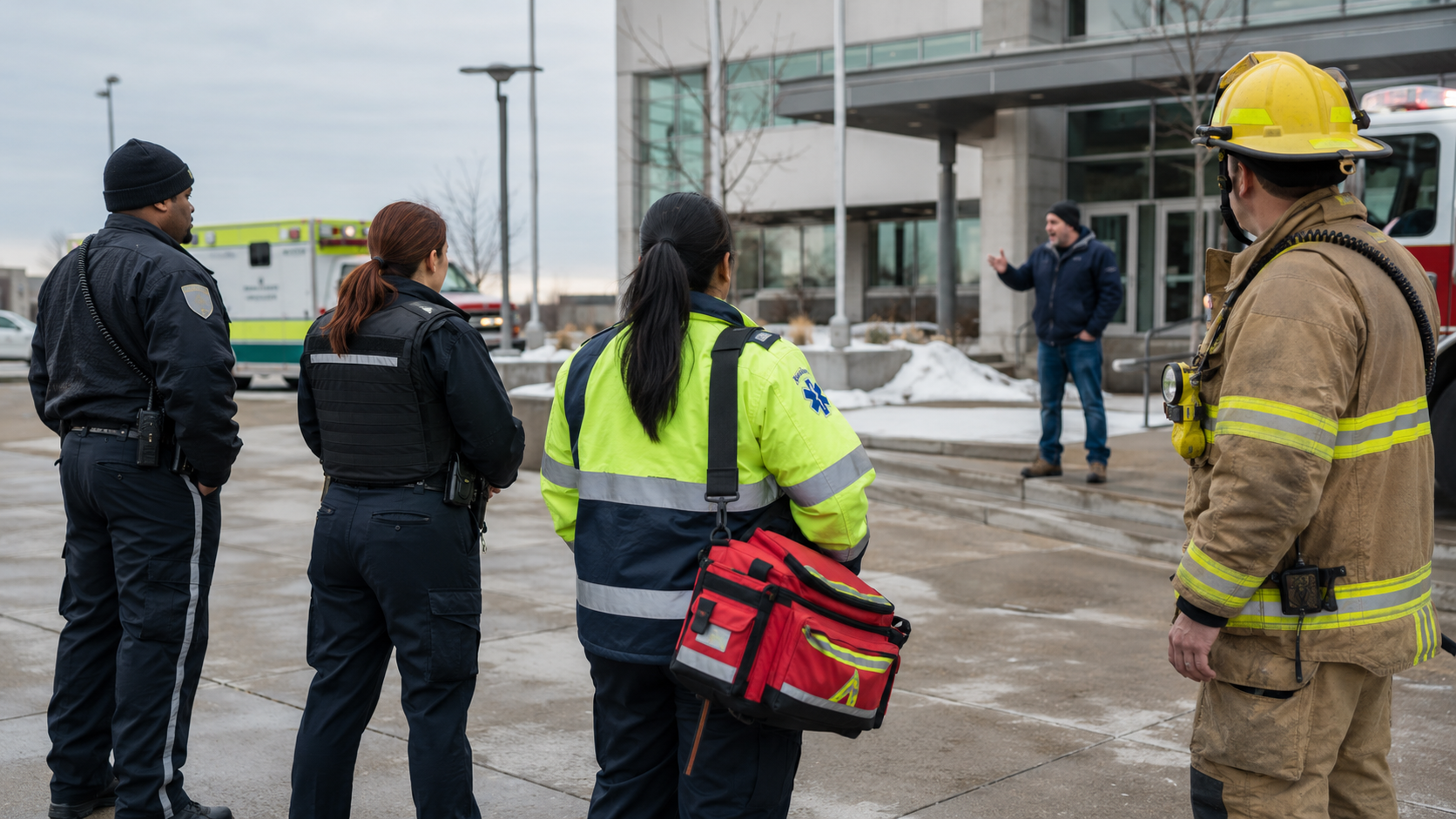
One Municipality. Five Front Lines. One Dangerous Training Gap.
Why T.R.A.A.C.S. Is So Valuable for Municipalities
The public does not separate municipal workers into neat departmental boxes.
The angry property owner confronting a By-Law Officer may be the same person Security encounters at City Hall.
The intoxicated individual removed from a municipal facility may become the person Paramedics are called to assist twenty minutes later.
The family screaming at Firefighters during an emergency may be frightened, emotionally overwhelmed, under the influence, or deliberately aggressive.
Different uniforms.
Different responsibilities.
The same human behaviour.
Yet municipalities continue to train these departments as if the risks have nothing in common.
That is the gap T.R.A.A.C.S. was built to close.
What is T.R.A.A.C.S.?
T.R.A.A.C.S.—Tactical Risk Awareness & Applied Control System—is a behaviour-first workplace violence-prevention program developed for professionals who may encounter aggression or violence but are not police officers.
It prepares Security Officers, By-Law Officers, municipal frontline workers, Paramedics and Firefighters to:
- Recognize behavioural change before an incident becomes physical.
- Assess the person, environment and available exit options.
- Understand the difference between conflict and attack behaviour.
- Communicate with purpose.
- Use de-escalation when de-escalation remains possible.
- Recognize when communication is no longer controlling the risk.
- Protect themselves at close quarters when physical contact becomes unavoidable.
- Disengage and leave when it becomes safe to do so.
- Explain and document the decisions they made.
T.R.A.A.C.S. is not another police Use of Force program.
It is not martial arts dressed up as workplace safety.
It is not built around teaching municipal workers how to overpower, restrain or “win” against members of the public.
It is built around helping employees recognize risk earlier, make better decisions under pressure and get home safely.
Municipal workers are already operating inside known violence-risk factors
The Canadian Centre for Occupational Health and Safety identifies several work activities that increase exposure to workplace violence.
They include:
- Working directly with the public.
- Conducting inspections or enforcement.
- Providing care or emergency services.
- Working with volatile individuals.
- Working alone or in isolated locations.
- Entering community-based environments.
- Working from a mobile workplace.
- Handling disputes involving services, money, property or authority.
That is not a random list.
It is a description of municipal frontline work.
A By-Law Officer conducting a property inspection is exposed to several of these factors at once.
A Security Officer working alone at a municipal building may be required to address trespassing, intoxication, threats, disorderly behaviour and people in crisis.
A Paramedic may enter an unfamiliar residence with limited information while drugs, weapons, family conflict or an aggressive subject are already present.
Firefighters may arrive at scenes involving panic, impairment, emotional overload, crowds and people who refuse to follow safety directions.
Customer-service, housing, parking, transit, recreation and public-works employees can also become the target of public anger simply because they represent the municipality.
These are not hypothetical risks.
They are foreseeable occupational hazards.
Policy is necessary. Policy is not preparation.
Every municipality should have a workplace violence policy.
Employees need reporting procedures, communication systems, emergency assistance, supervisor support and clear post-incident protocols.
But a policy sitting on a municipal server cannot read the person standing three feet away.
It cannot notice that someone has stopped responding to reason.
It cannot see a concealed hand.
It cannot recognize deliberate positioning near an exit.
It cannot create distance.
It cannot decide whether to continue communicating, call for assistance, disengage or protect against an immediate assault.
Only the employee standing there can do that.
In Ontario, an employer’s workplace violence program must include measures and procedures to control the risks identified through the required risk assessment. The province’s guide to workplace violence requirements under the Occupational Health and Safety Act also addresses summoning immediate assistance and providing workers with appropriate information and instruction.
Requirements vary across Canada, but the principle does not. The CCOHS summary of Canadian workplace violence legislation shows that violence prevention, risk assessment, worker instruction and workplace procedures are addressed across Canadian jurisdictions.
Training must turn written procedures into decisions an employee can make under stress.
That is where T.R.A.A.C.S. becomes valuable.
One shared language across multiple municipal departments
Municipalities often purchase separate training for Security, By-Law, Paramedics, Fire and other frontline employees.
Some separation is necessary. Each department has a different role, authority, environment and standard operating procedure.
But human behaviour does not change because the department name changed.
T.R.A.A.C.S. gives municipal teams a shared violence-prevention language without pretending their jobs are identical.
Employees learn to understand:
- Baseline behaviour.
- Behavioural anomalies.
- Risk behaviour clusters.
- Environmental and positional risk.
- Boundary testing.
- Escalation and emotional overload.
- Social violence and asocial violence.
- Pre-attack indicators.
- De-escalation failure.
- Safe disengagement.
- Close-quarter personal protection.
- Post-incident communication and documentation.
A single behaviour does not prove that someone intends to become violent. Context matters. What changes the risk is a combination of behaviours, environmental conditions and the person’s response to boundaries.
This is why we teach employees to recognize risk behaviour clusters instead of making decisions based on stereotypes, appearance or fear.
When employees across departments understand the same behavioural concepts, information can move more clearly between them.
Security can provide better information to responding Paramedics.
By-Law can communicate behavioural concerns more accurately when requesting assistance.
Supervisors can review incidents using more than vague statements such as, “The person suddenly became aggressive.”
The behaviour did not suddenly become aggressive.
Something changed.
The employee either recognized it, or recognized it after the incident was already underway.
Security and By-Law Officers need more than authority
A uniform creates visibility.
It may also create resistance.
Security and By-Law Officers regularly deal with people who do not accept their authority, do not agree with an order or believe they have nothing to lose by becoming confrontational.
This is where many training programs make a dangerous mistake.
They teach the officer what they are authorized to do without adequately preparing them for how a human being may react when that authority is exercised.
Authority is not control.
A ticket, notice, trespass direction or municipal order may be completely lawful and still trigger anger, defiance, posturing or violence.
T.R.A.A.C.S. teaches officers to pay attention to what the person is doing while the officer is speaking.
Are they listening?
Are they looking for an audience?
Are they attempting to embarrass or challenge the officer?
Are they closing distance?
Are their hands visible?
Has their language changed?
Have they stopped arguing and become unusually quiet?
Are they positioning the officer against a wall, vehicle, doorway or other restricted space?
The first five seconds of an encounter often provide information that determines how safely the rest of the contact unfolds.
T.R.A.A.C.S. trains the officer to recognize that information before authority and ego turn a manageable interaction into an unnecessary physical confrontation.
Paramedics and Firefighters face a different type of contact
Paramedics and Firefighters are not normally arriving to enforce a municipal rule.
They are arriving to help.
That does not guarantee a safe reception.
People may be injured, terrified, confused, impaired, experiencing trauma or unable to understand what is happening. Family members may interfere with care. Crowds may become hostile. A patient’s behaviour may change because of fear, pain, drugs, alcohol or a medical condition.
These circumstances require professional judgment, not assumptions.
T.R.A.A.C.S. helps emergency personnel recognize the difference between a person who cannot immediately comply, a person who is emotionally escalating and a person whose behaviour indicates a developing physical threat.
That difference matters.
Employees should not treat every frightened, confused or non-compliant person as dangerous.
They also should not explain away clear threat indicators because they arrived in a helping role.
T.R.A.A.C.S. creates the space between those two mistakes.
It teaches personnel to assess behaviour, create safer positioning, preserve access to an exit, communicate with purpose and recognize when the scene is no longer safe enough to continue.
De-escalation is a tool. It is not a guarantee.
De-escalation is an important part of workplace violence prevention.
It can reduce emotional pressure, clarify boundaries, create cooperation and prevent some confrontations from becoming physical.
But it does not work on everyone.
It does not work every time.
It does not work simply because the employee used the correct words.
De-escalation requires some level of participation from the other person. When that person is no longer processing information, has committed to violence or is using conversation to close distance, repeating the same script can place the employee in greater danger.
Municipalities must answer one honest question:
When de-escalation fails, what exactly have we trained our employees to do next?
If the answer is “call for help,” what should the employee do during the minutes—or seconds—before help arrives?
If the answer is “disengage,” have they been taught how to recognize the opportunity, position themselves and move without creating additional risk?
If the person grabs, traps or strikes them, have they practised a simple response under controlled pressure?
When de-escalation fails, training cannot fail with it.
Why conventional self-defence training does not solve the problem
Municipal employees do not need a collection of complicated martial-arts techniques.
They do not need to stand in a gym and trade punches.
They do not need skills that depend on speed, size, strength or years of repetition.
They need responses that reflect:
- Confined spaces.
- Vehicles.
- Desks and counters.
- Stairwells and hallways.
- Outdoor inspections.
- Unfamiliar homes.
- Medical equipment.
- Protective clothing.
- Poor footing.
- Limited movement.
- Sudden close-quarter contact.
- The legal and professional requirement to use only what is necessary.
The goal is not to turn employees into fighters.
The goal is to help them protect themselves long enough to create an exit.
That is why T.R.A.A.C.S. uses simple, reality-based protective responses and workplace-specific scenario training rather than cooperative demonstrations that only work when the attacker behaves like a training partner.
The municipal value goes beyond the training day
A valuable violence-prevention program should improve more than physical skill.
It should improve how the municipality identifies, discusses and manages risk.
T.R.A.A.C.S. can help municipalities:
Create consistency
Employees across departments begin using the same language for behaviour, escalation, distance, positioning and disengagement.
Improve incident reporting
Employees learn to describe observable behaviour rather than relying on labels such as “crazy,” “aggressive” or “out of control.”
Identify operational gaps
Scenario work can expose problems involving communication, staffing, facility design, equipment, dispatch information, backup procedures and lone-worker protocols.
Support better supervision
Supervisors can review what the employee perceived, what changed, what decisions were made and whether municipal procedures supported those decisions.
Strengthen due diligence
According to the CCOHS guidance on occupational health and safety due diligence, due diligence is demonstrated through the reasonable precautions taken before an incident—not through promises made after someone is injured.
Training alone does not establish due diligence. Neither does a written policy by itself.
A defensible violence-prevention system combines hazard identification, appropriate controls, employee instruction, reporting, supervision, incident review and ongoing improvement.
T.R.A.A.C.S. becomes the human-performance layer inside that larger system.
T.R.A.A.C.S. is not about teaching employees to use force
This distinction matters.
Police officers require Use of Force training because their duties may include arrest, detention, search, restraint and the lawful control of violent individuals.
That is not the role of most municipal employees.
T.R.A.A.C.S. does not teach frontline employees to remain in a confrontation so they can dominate another person.
It teaches them to prevent violence when possible, recognize when prevention is failing, protect themselves when necessary and leave when it becomes safe.
The objective is not control of the other person.
The objective is control of the employee’s decisions.
Municipal workplace violence training must reflect municipal reality
A generic online course can explain a policy.
It cannot recreate the pressure of a hostile property owner closing distance during an inspection.
A de-escalation slideshow can provide useful language.
It cannot teach a Security Officer what to do when someone ignores every boundary and reaches for them.
A martial-arts class can teach techniques.
It cannot automatically make those techniques appropriate for a Paramedic working beside a stretcher or a Firefighter operating in protective equipment.
Municipalities need training that connects policy to behaviour, behaviour to decisions and decisions to safe action.
That is the value of T.R.A.A.C.S.
One municipality.
Multiple frontline departments.
Different responsibilities.
A shared understanding of human behaviour and workplace violence.
Because the goal was never to win a fight.
The goal was to recognize the risk early enough that a fight never had to happen—and to make sure the employee had a realistic answer if it did.
Frequently Asked Questions
What does T.R.A.A.C.S. stand for?
T.R.A.A.C.S. stands for Tactical Risk Awareness & Applied Combatives System. It is a behaviour-first workplace violence-prevention program for professionals who may encounter aggression or violence but are not police officers.
Who should receive T.R.A.A.C.S. training?
The program is designed for Municipal Security Officers, By-Law Officers, property and housing inspectors, public-facing municipal employees, Paramedics, Firefighters and other frontline professionals who may encounter aggressive or unpredictable behaviour.
Is T.R.A.A.C.S. a Use of Force program?
No. T.R.A.A.C.S. does not train municipal employees to arrest, restrain or control members of the public. It focuses on behavioural recognition, threat and environmental awareness, communication, de-escalation, positioning, disengagement and personal protection when physical contact becomes unavoidable.
Does T.R.A.A.C.S. replace workplace violence policies?
No. Training is one part of a complete workplace violence-prevention system. Municipalities still require risk assessments, policies, reporting procedures, emergency assistance, supervision, incident investigation and ongoing review.
Why is de-escalation alone not enough?
De-escalation requires some level of participation from the other person. It may fail when someone is unable or unwilling to process communication, has committed to violence or is using conversation to move closer. Employees need training that helps them recognize that change and respond safely.
Can T.R.A.A.C.S. be customized for different municipal departments?
Yes. The core behavioural and violence-prevention principles remain consistent, while scenarios, procedures and physical environments can be adapted to the responsibilities of Security, By-Law, Paramedic, Fire and other municipal teams.
How can a municipality bring in T.R.A.A.C.S. training?
Municipal leaders, health and safety professionals, fire and paramedic services, Security departments and By-Law managers can contact Street Safe Self Defence Training Company to discuss department-specific risks, training objectives and delivery options.