

CORNERSTONE ARTICLE

By Rob Andress
Violence Prevention Specialist
Street Safe Self Defence Training Company
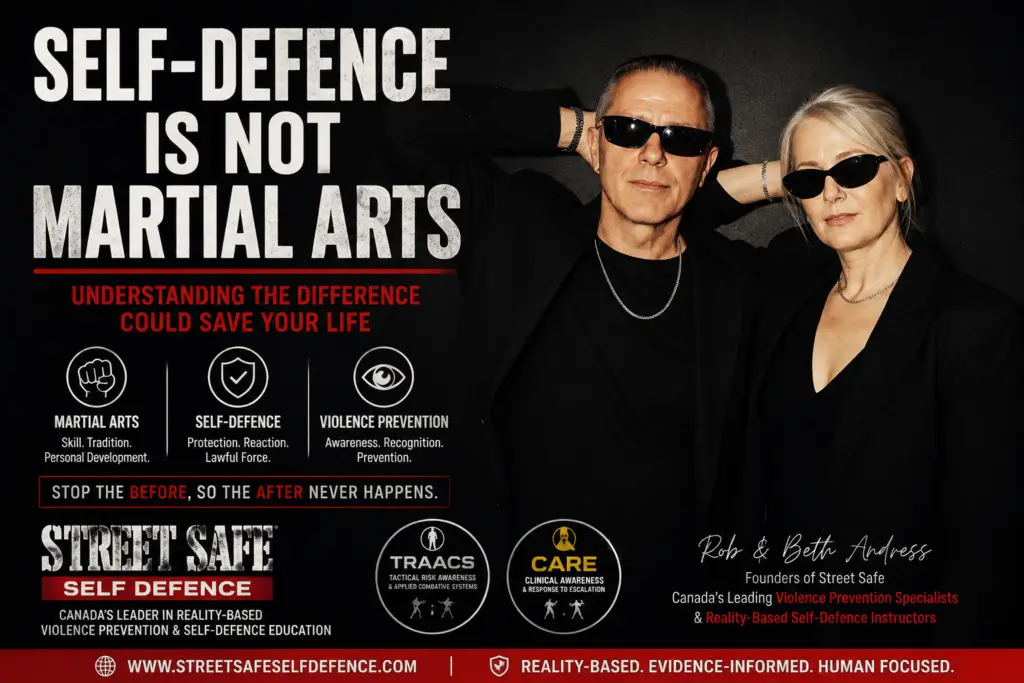
Every once in a while, I’ll hear someone ask, “What’s the best martial art for self-defence?”
Actually, I’ve been asked this questions for years.
And for most of those years, I answered it the way most martial artists would. I’d talk about styles and strengths.
Weaknesses, what worked for me, and what didn’t
Looking back now… I don’t think I was answering the right question. Because I don’t think martial arts and self-defence are trying to solve the same problem.
That’s a conclusion I never expected to reach.
Martial Arts Changed My Life
Before I go any further, I want to be clear about something. Martial arts have given me more than I could ever repay.
They taught me discipline when I needed discipline. Humility when I needed humility. Confidence when I lacked confidence.
I competed, I taught, I became a Sensei. Some of the best people I’ve ever met came into my life because of martial arts.
I’ll always be grateful for that.
So this isn’t an article written by someone standing on the outside throwing stones.
This is written by someone who spent decades inside that world. Which is exactly why I think this conversation matters!
Somewhere Along the Way, My Thinking Changed
It wasn’t one event, it wasn’t one class, it wasn’t one student, it happened slowly.
Beth and I started teaching more women.
Then high school students.
Then young women heading off to university.
Then REALTORS®.
Healthcare workers.
Teachers.
Municipal employees.
Security professionals.
Police officers.
And something kept happening. People weren’t telling us they wished they knew another arm lock, or a better kick, or a different escape.
They kept saying things like…
“I knew something felt wrong.”
“I didn’t want to be rude.”
“I thought I was overreacting.”
“I ignored my instincts.”
Those words hit me harder than any punch ever could.
Because none of those are technique problems. They’re human behaviour problems!
That’s when I realized I’d spent years studying fighting…
when I should have been spending more time studying violence.
Those are two very different subjects.
Fighting Isn’t Violence
Movies have done us no favours.
Two people square up.
They exchange words.
Everybody knows what’s coming.
Then the fight starts.
Real violence doesn’t usually look like that.
Predators don’t send invitations.
They don’t bow.
They don’t touch gloves.
Most of the people Beth and I have worked with over the years never saw the assault beginning. Because they were looking for violence…instead of looking for the behaviours that always seem to come before it.
Boundary testing.
Ignoring the word “no.”
Closing distance without permission.
Isolation.
Manipulation.
Charm.
Control.
None of those are punches. But they’re often the beginning of violence. That’s what changed my thinking.
The Biggest Difference
People sometimes ask me,
“So what makes Street Safe different?”
The answer is actually pretty simple. We’re not trying to create better fighters, we’re trying to create better decision-makers.
If someone leaves one of our programs with a better understanding of human behaviour…
If they recognize manipulation sooner…
If they trust their instincts instead of explaining them away…
If they leave a situation before it becomes dangerous…
We’ve done our job.
In my opinion, that’s success. Not because they won a fight, because they never had to have one.
Human Behaviour Is the Missing Piece
Over the years, Beth and I have had the privilege of working with more than 30,000 high school and university women.
We’ve listened to thousands of stories.
We’ve worked with professionals who face conflict every single day.
One lesson keeps repeating itself.
Violence almost always announces itself through behaviour before it announces itself through action.
The problem is…Most people have never been taught what those behaviours look like.
They’ve been taught how to punch.
How to kick.
How to block.
Very few have been taught how to recognize the person who should never have been allowed close enough to require any of those things.
To me, that’s backwards.
This Isn’t About Belts
I honestly don’t care what colour belt someone wears. My own Sensei today will often share with me that a belt colour means nothing, we only use them to keep our Gi tied
I’ve known incredible martial artists. I’ve also known martial artists who would struggle in a real act of predatory violence because they’d never been taught how predators actually think.
That’s not a criticism. It’s simply recognizing that martial arts and violence prevention have different educational objectives.
Martial arts build discipline.
Fitness.
Timing.
Confidence.
Character.
Violence prevention teaches something else.
It teaches awareness.
Human behaviour.
Decision-making.
Threat recognition.
Boundary setting.
Victim selection.
Social Violence versus A-Social Violence.
Understanding fear.
Understanding trauma.
Understanding Canadian law.
They’re not competing with one another. The problem begins when we pretend they’re the same thing.
If I Could Only Teach One Thing…
People are often surprised when I say this.
If I had five hours with your daughter before she left for university…
I wouldn’t spend the first four hours teaching her how to strike. I’d spend them teaching her how to recognize danger while she still has choices.
How predators test boundaries.
How coercive control develops.
How manipulation works.
How to trust behaviour instead of excuses.
How to understand fear.
How to leave early instead of fighting late.
Because if she learns those lessons…
There’s a good chance she’ll never need the physical skills. And isn’t that the goal?
One Final Thought
I still love martial arts, always will.
But today, I think we need to stop asking,
“What’s the best martial art for self-defence?”
Instead, let’s ask something that might actually save lives.
Who’s teaching people how violence really begins?
Because my years of teaching, researching, and listening…I’ve come to believe the greatest self-defence skill you’ll ever develop isn’t a punch.
It isn’t a kick.
It isn’t a choke.
It isn’t a throw.
It’s understanding human behaviour, because everything else comes after that.
That’s what Beth and I have dedicated our lives to at Street Safe Self Defence Training Company.
Because our mission has never been to help people win fights.
It’s been to help them avoid becoming victims.
Stop the Before, So the After Never Happens.
The Problem Was Never Martial Arts
I want to make sure I’m saying this the right way.
The problem was never martial arts. The problem was expecting martial arts to answer questions it was never designed to answer.
Think about it for a minute. If I wanted to learn how to swim, I wouldn’t go to a driving instructor.
If I wanted to become a pilot, I wouldn’t hire a hockey coach.
Not because they’re bad at what they do.
Because they teach something different.
Somewhere along the way, we’ve convinced ourselves that martial arts, self-defence and violence prevention all belong in the same conversation.
I don’t think they do. At least not in the way we’ve been talking about them.
Martial arts have a purpose.
A very important purpose.
They build confidence.
Discipline.
Fitness.
Respect.
Character.
They teach timing, balance and body mechanics.
Those are incredible life skills.
But here’s the question I’ve been asking myself more and more over the years.
When was the last time a sexual predator challenged someone to a fair fight?
When was the last time an abusive partner bowed before an assault?
When did a stalker announce what they were about to do?
They don’t.
That’s because predatory violence doesn’t follow the rules we’ve become comfortable teaching.
It doesn’t care about fairness.
It doesn’t care about honour.
It cares about opportunity.
The more Beth and I travelled across Canada, the more obvious that became.
Whether we were standing in front of a room full of Grade 11 students…
Working with healthcare professionals…
Teaching REALTORS®…
Training municipal workers…
Or spending time with women preparing to leave for university…
The stories were remarkably similar.
Different people.
Different cities.
Different occupations.
The same human behaviour.
Someone ignored boundaries.
Someone kept pushing after hearing “no.”
Someone used charm to lower someone’s guard.
Someone relied on politeness.
Someone counted on the other person not wanting to make a scene.
That isn’t coincidence.
That’s behaviour.
And behaviour leaves clues.
I’ve spent years studying those clues.
Not because I wanted to become a better fighter.
Because I wanted to understand why good people end up in bad situations.
That’s a very different question.
The more I studied it, the more one truth kept coming back to me.
Violence is rarely spontaneous.
People often call it “random violence.”
I don’t.
Random to the victim?
Sometimes.
Random to the offender?
Rarely.
Most acts of violence involve decisions long before they involve actions.
Testing.
Watching.
Choosing.
Manipulating.
Closing distance.
Creating trust.
Finding isolation.
Looking for hesitation.
Waiting for compliance.
Those aren’t martial arts problems.
They’re human behaviour problems.
And once you begin seeing violence through that lens…You stop asking, “How do I beat this person?”
You start asking, “Why is this behaviour happening?”
That single change in thinking transformed the way Beth and I teach.
Today, before we ever talk about striking…
We talk about people.
Because people are where violence begins.
Not fists.
Not knives.
Not techniques.
People.
I’ve often said that violence is patterned, predictable and preventable.
Some people think that’s just a slogan. It isn’t.
It’s what decades of teaching, listening and learning have convinced me is true.
Will we prevent every act of violence? Of course not.
No honest instructor should ever promise that. But can we recognize more of it before it reaches the point of no return?
I believe we can.
I’ve seen it happen.
I’ve watched students come back months or years later and tell Beth and me,
“I remembered what you said about behaviour.”
“I left.”
“I trusted my instincts.”
“Nothing happened because I got out early.”
Those are my favourite success stories.
Not because someone won a fight.
Because they never had to be in one.
To me, that’s what real self-defence has always been about.
Not proving you can fight.
Proving you understood enough about human behaviour that fighting never became your only option.
The Day I Stopped Studying Fighting and Started Studying People
People sometimes ask me if there was one moment that changed everything for me.
One class, one incident, one assault.
The truth is…No.
It happened slowly. Looking back, I don’t think my education in violence really began in the dojo.
It began when I started listening. Really listening.
For years, I had been studying how people fight.
Then Beth and I started meeting people who had actually lived through violence.
Women who had survived sexual assaults.
Teenagers trying to make sense of abusive relationships.
Healthcare workers who had been attacked by patients.
REALTORS® who suddenly realized the smiling stranger standing in the kitchen wasn’t interested in buying a house.
Police officers.
Teachers.
Security professionals.
Municipal workers.
The stories were different, the people were different. But the patterns…The patterns were almost always the same.
Nobody talked about techniques.
Nobody ever said,
“Rob, I wish I’d known another arm lock.” Or… “If only my side kick had been a little faster.”
That’s not what stayed with them.
What stayed with them was what happened before the violence.
“Something felt off.”
“I remember thinking this wasn’t normal.”
“I didn’t want to embarrass them.”
“I didn’t want people to think I was overreacting.”
“I kept talking myself out of leaving.”
I can’t tell you how many times I’ve heard those words. Thousands. Maybe tens of thousands.
After a while, I realized something that completely changed the way I looked at self-defence.
The biggest mistakes people were making weren’t physical. They were behavioural.
They weren’t missing opportunities to throw punches.
They were missing opportunities to recognize danger.
That’s a very different problem, and it deserves a different education.
That’s when I stopped asking,
“How do I help someone win a fight?”
Instead, I started asking,
“How do I help someone avoid becoming part of one?”
Those questions led Beth and me down a completely different path.
We started studying behavioural science.
Victimology.
Trauma.
Fear.
Human performance under stress.
Pre-attack indicators.
Criminal behaviour.
Coercive control.
Stalking.
Grooming.
Not because we had lost faith in martial arts.
Because we realized violence had far more to do with people than it did with punches.
That might sound obvious.
But think about how most self-defence is marketed.
Learn this strike.
Escape this hold.
Block this attack.
Practise this technique.
There’s nothing wrong with those skills.
The question is…
What happens if you never recognize the attack coming?
What happens if you mistake manipulation for kindness?
What happens if you explain away every warning sign because you’ve been taught that being polite is more important than trusting your instincts?
Those are the questions that kept me awake.
They’re also the questions that transformed Street Safe.
Today, when people attend one of our programs, they usually expect us to start by teaching them how to hit.
Instead…We start by teaching them how to think.
How to observe.
How to recognize behaviour.
How to understand intent.
Because in my experience, behaviour is the first weapon used in almost every act of violence.
Long before a fist is ever raised…
Someone has already made a decision.
And if we can recognize that decision while we still have choices…
We’ve already changed the outcome.
To me…
That’s where real self-defence begins.
Violence Doesn’t Start With a Punch. It Starts With a Person.
Here’s something I’ve come to believe, we’ve been looking for the wrong beginning.
Ask most people when violence starts and they’ll usually describe the physical assault.
“The punch.”
“The grab.”
“The shove.”
“The knife.”
I don’t see it that way anymore. By the time any of those things happen, violence has already been unfolding for minutes, hours, days, and sometimes even months.
The assault is simply the moment everyone finally recognizes it. The violence started long before that.
It started when someone ignored a boundary.
When they refused to accept the word “no.”
When they kept asking personal questions after they could see you were uncomfortable.
When they closed the distance between you after you’d already stepped back.
When they isolated you from other people.
When they manipulated your emotions.
When they made you feel guilty for protecting yourself.
Those aren’t random moments.
They’re decisions.
And decisions create patterns.
That’s why I often tell people that violence is patterned, predictable and preventable. Not because every assault can be stopped, it can’t.
Anyone who promises that isn’t being honest. But many acts of violence give us information before they ever become physical.
The problem is, most of us have never been taught how to recognize that information.
We’ve been taught to recognize punches.
Not people.
That’s a huge difference.
One of the first questions I ask people in our programs is this.
“When do you think a predator starts choosing a victim?”
Most people point to the attack.
The research, and years of listening to offenders, victims, investigators and frontline professionals, suggests something very different. Victim selection often begins long before the victim realizes they’re being evaluated.
Predators watch.
They test.
They adapt.
They look for hesitation.
Compliance.
Distraction.
Isolation.
They’re gathering information.
The sad part is…
Most of us are gathering information too.
We’re just looking at completely different things.
We’re asking ourselves,
“Do they seem nice?”
“Am I overreacting?”
“I don’t want to be rude.”
Meanwhile, they’re asking,
“Can I control this person?”
“Will they challenge me?”
“Can I get them alone?”
Those are two completely different conversations happening at the same time.
One person is trying to be socially appropriate.
The other person is deciding whether the opportunity is worth taking.
That’s why I don’t believe awareness is simply looking around.
Real awareness is understanding behaviour.
It’s noticing when someone’s actions don’t match the situation.
It’s recognizing that your discomfort isn’t something to apologize for.
It’s understanding that your intuition isn’t magic.
Your brain is processing thousands of pieces of information every second.
Sometimes it recognizes a pattern before you can explain it with words.
I’ve heard people say,
“I don’t know why, Rob… I just knew.”
I believe them.
Not because intuition is supernatural.
Because human beings are remarkably good at recognizing behavioural patterns, even when we can’t immediately explain what we’re seeing.
The problem is, we’ve been taught to talk ourselves out of those feelings.
We’ve been taught that being polite is more important than being safe.
We’ve been taught not to judge people.
I understand why.
But there’s a difference between judging a person……and judging behaviour.
Behaviour is observable.
Behaviour can be measured.
Behaviour tells a story.
And if we’re willing to pay attention to it, behaviour often gives us the opportunity to make a decision while we still have choices.
To me, that’s where violence prevention begins.
Not with fear.
Not with suspicion.
With understanding.
Because once you understand people…
You stop waiting for the punch.
You start recognizing everything that comes before it.
Fighting and Violence Are Not the Same Thing
This was probably the biggest shift in my thinking.
For years, I used the words “fighting” and “violence” as if they meant the same thing.
Most people do. The truth is, they’re completely different.
A fight usually involves two people who both know they’re in a fight.
There might be anger.
There might be ego.
There might be yelling, pushing, posturing or even punches.
It’s emotional.
It’s reactive.
Sometimes it escalates.
Sometimes it doesn’t.
Violence is different.
Violence often begins long before anyone throws a punch.
In fact, the physical assault is usually the end of the process…..not the beginning.
Think about a sexual assault, do you think it starts with the assault? Of course it doesn’t.
It starts with grooming.
Trust.
Testing boundaries.
Isolation.
Control.
Manipulation.
The assault is simply the final act in a series of behaviours that may have started days, weeks or even months earlier.
Domestic violence isn’t usually one sudden explosion, it often begins with control.
Who you can talk to.
Where you can go.
Who you’re allowed to see.
How you dress.
How you spend money.
It starts by slowly changing what’s considered “normal.”
By the time physical violence appears, the victim has often been living with violence for a long time.
It just wasn’t physical yet.
The same thing happens in the workplace.
Someone starts making inappropriate comments.
Then they invade personal space.
Then they ignore boundaries.
Then they become intimidating.
The behaviours change long before the assault does.
That’s why I say violence doesn’t start with a punch.
It starts with a person making decisions.
And every one of those decisions leaves clues.
Once I understood that…
I stopped asking,
“How do I teach someone to fight?”
Instead, I started asking,
“How do I teach someone to recognize the clues?”
That’s a completely different way of looking at self-defence.
When Beth and I teach, we spend a lot of time talking about behaviour because behaviour is where violence lives.
The punch is only one moment.
Behaviour is the entire story.
That’s why I sometimes smile when someone asks me if we teach self-defence. We do, but probably not in the way they’re expecting.
Before we ever talk about striking…
We talk about people, because people create violence.
People make decisions.
People leak intent.
People reveal emotion.
People test boundaries.
People manipulate.
People choose victims.
If you understand people…You’ve already taken a huge step toward understanding violence.
That’s why I believe behavioural awareness is the foundation of real self-defence.
Not because physical skills don’t matter, they absolutely do.
But physical skills answer the question,
“What do I do now?”
Behaviour answers a much more important question.
“How do I stop myself from ever getting there?”
For me…
That’s the difference between preparing for a fight…
…and preparing for violence.
It’s also the moment I realized that what Beth and I were teaching at Street Safe wasn’t simply self-defence.
We were teaching violence prevention.
And those are two very different professions.
Not Everyone Wants the Same Thing
This is probably one of the biggest lessons Beth and I teach, and it’s one of the least understood. Not everyone who becomes violent wants the same outcome. That might sound obvious, but think about how most people are taught self-defence.
Someone grabs you…
Do this.
Someone punches you…
Do that.
Someone chokes you…
Here’s the escape.
The problem with teaching that way is it assumes every act of violence has the same purpose.
It doesn’t.
One of the first things we teach at Street Safe is that there are two very different types of violence.
Social Violence…and A-Social Violence.
Understanding the difference changed the way I looked at every confrontation I’ve ever been involved in.
Social Violence
Social violence is usually about emotion.
Ego.
Respect.
Status.
Pride.
Someone feels embarrassed.
Disrespected.
Rejected.
Challenged.
They’re trying to prove something. Sometimes to you. Sometimes to the people watching.
If you’ve ever seen two people arguing in a bar, chest puffed out, voices getting louder, neither one wanting to back down…
You’ve probably seen social violence.
Can it become dangerous?
Absolutely.
Can people be seriously hurt?
Without question.
But the motivation is different.
The behaviour is different.
And because it’s different…
Our response can often be different too.
This is where communication, emotional control, distance management and de-escalation can make an enormous difference.
Not always, but often.
A-Social Violence
Predatory violence is different.
It isn’t about winning an argument.
It isn’t about saving face.
It isn’t about proving who’s tougher.
It’s about achieving an objective.
Robbery.
Sexual assault.
Abduction.
Control.
Revenge.
The predator doesn’t need you to lose your temper, in many cases, they actually prefer that you don’t.
They don’t want a fair fight. They want compliance!
That’s why predatory offenders often use deception before they ever use force.
They’ll appear friendly.
Helpful.
Charming.
Non-threatening.
They’ll manufacture trust because trust gets them closer than intimidation ever could.
That’s why I’ve said for years that one of the most dangerous people you’ll ever meet may be the one who makes you feel comfortable too quickly.
Why This Matters
If you mistake predatory violence for social violence…
You may keep trying to calm someone who was never emotionally upset in the first place.
You may keep explaining.
Negotiating.
Trying to reason.
Meanwhile…
They’re simply waiting for the opportunity they’ve already decided to create.
That’s why Beth and I spend so much time teaching people to identify intent instead of reacting only to actions.
Behaviour tells us where the interaction may be heading.
Intent tells us why.
When you understand both…
Your decisions become better.
Your timing improves.
And sometimes…
You leave before the situation ever reaches the point where self-defence becomes necessary.
To me, that’s success.
Not because you proved you could handle yourself.
Because you recognized what you were really dealing with.
The Goal Was Never to Win the Fight
People sometimes ask me what the best self-defence technique is. They’re usually surprised by my answer.
I don’t start with a technique, I start with a question.
“What is this person trying to accomplish?”
Until I understand that…I don’t really understand the problem.
And if I don’t understand the problem…How can I possibly choose the right solution?
That’s why Street Safe has never been about collecting more techniques.
It’s about learning to ask better questions.
Because when you understand the motive behind the behaviour…
You stop seeing every confrontation as the same.
And that’s when your ability to make good decisions really begins.
That’s also when self-defence starts becoming what I believe it was always meant to be.
Not a collection of physical skills…
But an understanding of people.
Your First Weapon Was Never Your Hands. It Was Always Your Brain.
One of the biggest myths in self-defence is that if someone shows you enough techniques, you’ll automatically be able to use them when violence happens. This is not true. Not because the techniques are wrong, because they assume your brain is going to perform the same way under extreme stress as it does in a classroom.
It won’t. And that’s not an opinion, it’s biology.
Over the years, I’ve watched thousands of people walk into one of our programs.
They’re intelligent.
Successful.
Confident.
They solve problems every day.
Then we start talking about what happens when someone suddenly becomes violent.
The room gets quiet.
Because almost everyone has had that moment where something unexpected happened and their mind just…paused.
People often describe it as freezing.
I don’t like that word, it makes it sound like the brain failed. I don’t think it failed at all, I think it did exactly what it was designed to do.
When your brain suddenly believes your safety is at risk, it doesn’t immediately start searching for the perfect self-defence technique.
Its first job is much simpler.
“What is happening?”
“Is this really a threat?”
“How serious is it?”
“What are my options?”
Your brain is trying to answer those questions while your body is already reacting.
Heart rate climbs.
Breathing changes.
Vision narrows.
Your hearing can change.
Time can seem to slow down…or speed up.
That’s not Hollywood.
That’s human physiology.
I’ve seen people beat themselves up afterwards because they didn’t react the way they thought they would.
“I should have done something.”
“I don’t know why I just stood there.”
“I knew the technique, but I couldn’t make it happen.”
Every time I hear that, I tell them the same thing.
You weren’t weak.
You were human.
That’s one of the reasons Beth and I spend so much time teaching people what fear actually does. Fear isn’t the enemy, confusion is.
The human brain doesn’t like uncertainty.
When something happens that doesn’t match what we expected, the brain has to catch up.
That takes time, sometimes only a second or two, sometimes longer.
In violence, those seconds matter.
That’s why we don’t start by teaching punches.
We start by teaching recognition.
The sooner your brain recognizes what’s happening…
The sooner it can stop asking questions and start making decisions.
That’s one of the reasons we spend so much time talking about behavioural awareness.
When you recognize the behaviours that often come before violence, your brain isn’t caught completely by surprise.
You’ve already started processing what’s happening.
You’ve already begun making decisions.
You haven’t eliminated fear.
You’ve reduced confusion.
There’s a big difference.
People sometimes ask me why I spend so much time talking about the brain in a self-defence course.
My answer is simple. Because your brain will always make the first decision.
Your hands don’t decide to move, your brain tells them to.
Your feet don’t decide to leave, your brain tells them to.
Your voice doesn’t suddenly become firm, your brain decides that it’s time.
Everything starts there.
That’s why I’ve come to believe the brain is the first weapon you’ll ever use in self-defence.
Everything physical comes after that.
If we spend all of our time training the body but never train the mind to recognize danger…
We’re asking the body to solve a problem the brain never had a chance to understand.
To me, that’s backwards.
Real self-defence starts by preparing the mind.
Because when the mind recognizes danger early…
The body has more options.
And in my experience, having more options is one of the greatest advantages you can ever have.
That’s why, at Street Safe, we don’t just teach people how to respond to violence.
We teach them how to recognize it while they still have choices.
Because once your brain understands what’s really happening…
Everything else becomes possible.
So…What Is Self-Defence?
After everything I’ve shared so far, you might be wondering…
“So Rob, if self-defence isn’t martial arts…then what is it?” That’s a fair question.
And to be honest, I don’t think there’s a simple answer. At least not anymore.
Years ago, I probably would have told you self-defence was learning how to protect yourself physically.
Today…I think it’s much bigger than that.
I think self-defence starts the moment you decide your safety is more important than someone else’s opinion of you.
Think about that for a second.
How many people have stayed in a conversation because they didn’t want to seem rude?
How many have ignored their instincts because they didn’t want to offend someone?
How many have explained away behaviour they knew wasn’t right because they were worried about being judged?
I’ve heard those stories more times than I can count. And every time I do, I think the same thing.
We’ve taught people to defend themselves physically…But we haven’t always given them permission to defend themselves emotionally.
Or socially.
Or psychologically.
Sometimes the most important act of self-defence isn’t throwing a strike.
It’s saying, “No.” And meaning it!
Sometimes it’s walking away.
Sometimes it’s refusing to answer another question.
Sometimes it’s ending a relationship.
Sometimes it’s reporting the behaviour everyone else keeps making excuses for.
Sometimes it’s trusting that feeling in your stomach, even when you can’t yet explain it.
That’s self-defence too.
One of the biggest misconceptions I see is the belief that self-defence begins when violence begins.
I don’t believe that anymore. I think self-defence begins with everyday decisions.
Who you trust.
Who you let into your life.
Who you agree to meet.
Where you choose to park.
Whether you ignore behaviour or pay attention to it.
Whether you set boundaries…..or keep moving them because someone else doesn’t like hearing the word “no.”
Those aren’t little decisions.
Those decisions shape outcomes.
That’s why I often tell people that every act of self-defence starts long before anyone realizes they’re defending themselves.
The decision to leave early…That’s self-defence.
Choosing not to go somewhere that doesn’t feel right…That’s self-defence.
Refusing to let someone isolate you…That’s self-defence.
Teaching your daughter that she never has to apologize for protecting herself…That’s self-defence.
Everything physical comes later. If it comes at all, that’s the goal.
Because despite what television has taught us, success isn’t measured by winning a fight.
Success is measured by getting home safely.
Nobody ever says,
“I hope I get the chance to use everything I learned.”
They say,
“I hope I never need it.”
I agree.
Beth and I hope you never need it too.
But hope isn’t a strategy.
Preparation is.
That’s why our programs don’t begin with punching.
They begin with understanding people.
Because people create violence.
People choose victims.
People manipulate.
People groom.
People test boundaries.
People reveal intent through behaviour.
When you understand people…
You start making different decisions.
And different decisions often create different outcomes. To me, that’s what self-defence has become.
Not a collection of techniques.
Not a belt.
Not a title.
Not proving how tough you are.
It’s the ability to recognize danger…
Trust yourself…
Make good decisions…
And, if every other option has failed, protect yourself within the law.
Everything else is built on that foundation.
That’s the self-defence Beth and I believe in.
And it’s the self-defence we’ve dedicated our lives to teaching.
Violence Prevention Is a Profession
Over the last few chapters, I’ve probably challenged the way some people think about self-defence.
That wasn’t my goal. My goal was to challenge the way we define it, because words matter.
When we use the words martial arts, self-defence, and violence prevention as though they all mean the same thing, we unintentionally confuse people looking for help.
And sometimes, that confusion has consequences.
Let me explain what I mean.
If someone walks into a martial arts school wanting to improve their fitness, confidence, discipline and physical skills, they’ve made a great choice.
Martial arts has been doing that exceptionally well for generations.
If someone wants to learn how to physically defend themselves when every other option has failed, self-defence training has an important role to play.
But if someone wants to understand how violence develops…
How predators select victims…
How fear changes the way the brain thinks…
How to recognize coercive control…
How to identify pre-attack indicators…
How to understand Social Violence and A-Social Violence…
How trauma affects behaviour…
How to make legally sound decisions under stress…
They’re looking for something else.
They’re looking for violence prevention.
And I believe violence prevention deserves to be recognized as its own profession.
Not because it’s better than martial arts.
Not because it’s more important than self-defence.
Because it’s trying to answer different questions.
When Beth and I developed Street Safe, we weren’t trying to create another martial arts program. We weren’t trying to create another self-defence course either. We were trying to solve a problem we kept seeing everywhere we went.
People were learning what to do after violence started, very few were being taught how to recognize it before it happened.
That’s a completely different educational objective.
Over the years, we’ve had the privilege of working with schools, hospitals, municipalities, REALTORS®, law enforcement, security professionals, healthcare workers and thousands of women across Canada.
One thing has become incredibly clear. The first skill they need isn’t a strike, iIt’s understanding people.
How people communicate.
How people manipulate.
How people behave under stress.
How offenders think differently from someone who’s simply angry.
How fear influences our decisions.
How our own behaviour can either reduce or increase risk.
Those aren’t martial arts lessons, they’re human behaviour lessons. And that’s what violence prevention is built on.
I sometimes smile when someone asks me, “So…do you teach fighting?” I usually answer, “No.
I teach people how to avoid needing one.” Does that mean we ignore physical skills? Not at all.
If someone has no choice but to defend themselves, they need practical, effective skills they can perform under stress.
That’s reality.
But physical response should never be the foundation. It should be the backup plan!
The foundation is awareness.
Decision-making.
Boundaries.
Communication.
Behaviour.
Because if we build the foundation properly…Many people will never need the roof.
That’s the way Beth and I have always looked at it.
I don’t measure success by how well someone fights. I measure success by how many fights never happen because they recognized the danger early enough to make a different decision.
To me, that’s what violence prevention is.
It’s not teaching people to become fearless.
It’s teaching them to become aware, it’s giving them permission to trust what they see.
To trust what they feel, to understand that behaviour tells a story.
And that if they’re willing to pay attention to that story…They often have more time, more options and more control than they realize.
That’s not martial arts.
That’s not traditional self-defence.
That’s violence prevention.
And I believe it’s time we recognized it as a profession in its own right.
To My Friends in the Martial Arts Community
If you’ve stayed with me this far, I hope you’ve realized something. This article was never meant to criticize martial arts.
In fact, it’s quite the opposite. Without martial arts, I wouldn’t be the person I am today.
The dojo gave me discipline when I needed discipline.
It gave me confidence when I had very little.
It taught me respect, humility and perseverance.
It introduced me to mentors I’ll never forget.
It gave me lifelong friendships.
It shaped the way I looked at commitment and personal responsibility.
For all of that… I’ll always be grateful.
So if you’re a martial arts instructor reading this, please understand where I’m coming from.
I’m not questioning your commitment, I’m not questioning your integrity, and I’m certainly not questioning the value of what you teach. I’m simply asking all of us to think about something.
What if we’ve accidentally been using the same words to describe very different professions?
That’s not a criticism.
It’s an observation.
When someone joins your dojo, what are you hoping they leave with?
Confidence?
Discipline?
Better fitness?
Respect?
Character?
The ability to defend themselves physically if they absolutely have to?
Those are incredible goals.
They’re goals I still believe in.
But if someone walks into your dojo because they’re terrified their daughter is leaving for university…
Or because they’re trying to understand coercive control.
Or because they’ve survived domestic violence.
Or because they’re worried about stalking.
Or because they’re a REALTOR® who meets complete strangers in vacant homes.
Or because they’re a nurse who’s been assaulted by patients.
Are they looking for martial arts?
Or are they looking for answers to questions that belong somewhere else?
I don’t think that’s an attack on martial arts. I think it’s respecting martial arts enough to recognize what it does exceptionally well.
Every profession has a purpose.
Police officers aren’t firefighters.
Firefighters aren’t paramedics.
Paramedics aren’t emergency physicians.
All of them save lives.
They simply do it in different ways.
I believe the same thing is true here.
Martial arts has its place.
Self-defence has its place.
Violence prevention has its place.
The problem isn’t that one is better than another.
The problem is that we’ve allowed the public to believe they’re all the same thing. They’re not!
And I honestly believe everyone benefits when we’re clear about that.
Martial arts instructors benefit because expectations become realistic.
Students benefit because they choose training that matches the problem they’re trying to solve.
Parents benefit because they can make informed decisions for their children.
Professionals benefit because they receive education designed for the environments they actually work in.
Most importantly…The people we’re trying to protect benefit.
That’s what this has always been about for me.
Not proving anyone wrong, helping more people find the education that’s right for them.
I still smile when I walk into a dojo. It still feels familiar, it still feels like home…..And it always will.
But today, when someone asks me what I do…I don’t tell them I’m a martial artist.
I tell them I study violence. More importantly…I study people.
Because after all these years, that’s where I believe the real answers have always been.
If this article starts a conversation within the martial arts community…
I hope it’s a respectful one.
Not about who’s right.
But about how we can better prepare people for the realities of the world they’re living in today.
I think that’s a conversation worth having.
And I think it’s one we’re all capable of having together.
It’s Time We Changed the Conversation
When I look back over the years, I realize something. I didn’t spend my life searching for a better punch.
I spent my life searching for a better answer.
At first, I thought the answer was technique, then I thought it was experience. Then I thought it was teaching more classes.
The older I’ve become, the more I’ve realized the answer was never found in any one technique, it was found in understanding people.
I’ve been fortunate.
Martial arts gave me a foundation that shaped the rest of my life, it taught me lessons I’ll carry with me forever.
But it also gave me the curiosity to keep asking questions, and one question kept coming back.
“Why do good people become victims?”
Not because I wanted to know how to win more fights.
Because I wanted fewer people to need one.
That question led Beth and me down a path we never expected.
It led us into schools, hospitals, boardrooms, police services, municipalities and communities across Canada.
It led us to conversations with survivors who trusted us enough to tell us their stories.
It led us to professionals who face conflict every day simply because of the work they do.
And every one of those conversations taught us something.
Violence has a language.
It speaks long before it ever becomes physical.
It speaks through behaviour.
Through manipulation.
Through boundary testing.
Through intimidation.
Through isolation.
Through control.
The problem is…
Most people have never been taught that language. We’ve taught people how to recognize punches.
We haven’t spent nearly enough time teaching them how to recognize the person who’s getting ready to throw one.
To me, that’s where the conversation needs to change.
If you’re looking for confidence…Martial arts is an incredible journey.
If you’re looking for fitness…Martial arts will challenge you.
If you’re looking for discipline…You’ll find it there.
If you’re looking for character…You’ll build it there.
Those things matter, they’ve always mattered.
But if your goal is to understand how violence develops…
How predators think.
How fear affects the brain.
How behaviour reveals intent.
How to recognize danger while you still have choices.
Then I believe you’re looking for something different.
You’re looking for violence prevention.
And I think it’s time we stopped treating that as a branch of something else. It deserves to stand on its own.
Not because it’s better, because it’s different.
As I sit here writing this, I find myself thinking about every parent who’s ever asked me,
“What’s the best self-defence class for my daughter?”
Today, my answer is different than it would have been years ago.
I’d tell them to find someone who teaches her to understand people before they teach her to fight them.
Teach her that “no” is a complete sentence. Teach her that her intuition deserves to be listened to, not apologized for.
Teach her that boundaries aren’t rude. They’re healthy!
Teach her that she doesn’t owe anyone her time, her attention or her trust simply because they seem nice.
Teach her how violence actually develops.
Teach her how to recognize behaviour that doesn’t match the situation.
Then…If she ever has no other choice…
Teach her how to defend herself physically. Notice I said then, not first.
Because I’ve come to believe that real self-defence begins long before the first strike.
It begins with awareness.
It grows through knowledge.
It strengthens through confidence.
And only when every other option has failed does it become physical.
That’s the journey Beth and I have been on.
It’s the journey that became Street Safe.
Not because we wanted to create another self-defence program.
Because we wanted to create something that helped people understand violence before violence understood them.
If this article changes the way even one person thinks…
If one parent asks a different question…
If one instructor begins talking more about behaviour…
If one young woman trusts her instincts and walks away…
If one professional recognizes the warning signs early enough to change the outcome…
Then every word I’ve written has been worth it.
Because at the end of the day, I don’t want to be remembered for teaching people how to fight.
I’d rather be remembered for helping people understand why they shouldn’t have to.
To me…
That’s what real self-defence has always been.
Rob Andress Street Safe Self Defence Training Company
Rob Andress is the founder of Street Safe Self Defence Training Company and is recognized as one of Canada’s leading Violence Prevention Specialists and a Reality-Based Self-Defence Instructors.
Rob has dedicated his career to understanding violence, not just how to respond to it, but how to recognize, prevent, and manage it before it becomes physical. His work has evolved from traditional martial arts instruction to evidence-informed violence prevention education, focusing on human behaviour, behavioural awareness, fear management, trauma-informed practice, and practical decision-making under stress.
Together with his wife and business partner, Beth Andress, Rob has educated tens of thousands of Canadians, including high school and university students, healthcare professionals, REALTORS®, educators, municipal employees, security professionals, law enforcement personnel, and corporate teams.
Rob is the creator of TRAACS (Tactical Risk Awareness & Applied Combative Systems) and CARE (Clinical Awareness & Response to Escalation), two innovative Canadian programs designed to help professionals recognize risk, understand human behaviour, de-escalate conflict, and respond lawfully and effectively when violence cannot be avoided.
His work is built on a simple but powerful belief:
Violence is patterned. Violence is predictable. Violence is preventable.
Through Street Safe, Rob continues to advocate for a broader understanding of self-defence, one that extends beyond physical techniques to include behavioural awareness, victim selection, pre-attack indicators, Canadian self-defence law, trauma-informed practice, and the science of violence prevention.
Today, Street Safe Self Defence Training Company is recognized as a Canadian leader in reality-based violence prevention and self-defence education, helping individuals, workplaces, schools, healthcare organizations, municipalities, and professional associations develop the knowledge and confidence to recognize danger before it becomes violence.
Rob’s philosophy remains at the heart of every program he teaches:
“Stop the Before, So the After Never Happens.”
Learn more:
🌐 www.streetsafeselfdefence.com
