

Self-awareness before self-defence is essential because recognizing danger early can help you avoid or respond to threatening situations.

By Rob Andress
Most people think self-defence starts with learning how to punch, kick, or escape a grab.
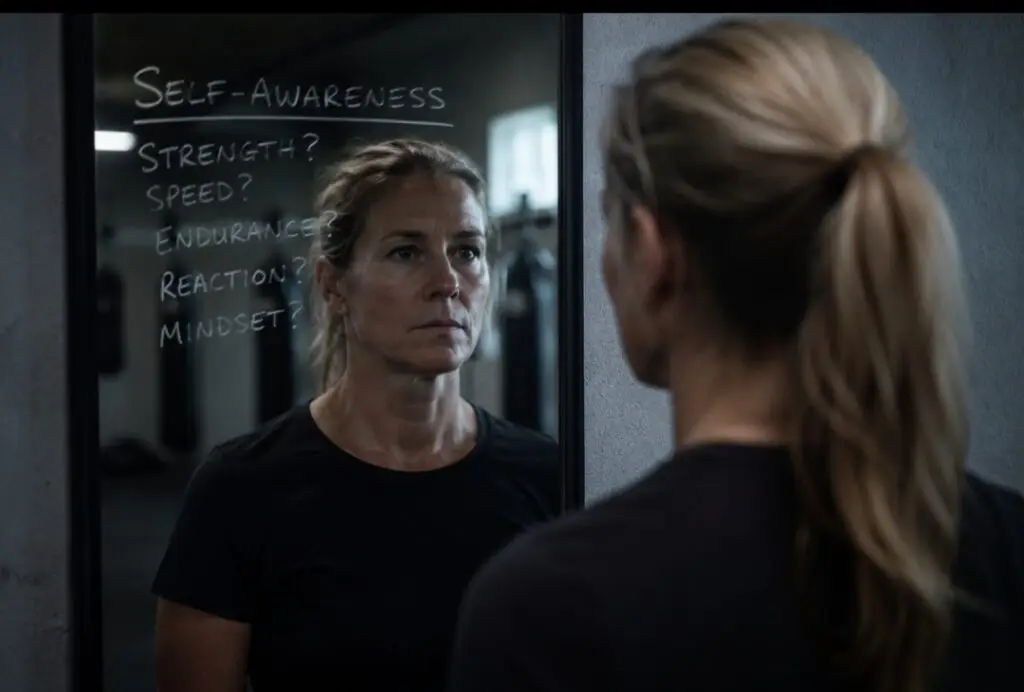
I don’t. In my experience, the most important awareness you’ll ever develop isn’t situational awareness.
It isn’t behavioural awareness. It isn’t environmental awareness. It’s self-awareness!
Because if you don’t understand yourself, your own abilities, your own limitations, your own reactions under stress, every other form of awareness becomes distorted.
I’ve taught thousands of people across Canada. Healthcare workers. Police. Security. REALTORS®. Teachers. Young women. High school students. One thing I’ve learned is this:
The people who overestimate themselves are often the ones who place themselves in the greatest danger.
The Ego Problem
Hollywood has done an incredible job of entertaining us. It has also done an incredible job of convincing people that violence looks nothing like it actually does.
Watch enough action movies and everyone starts believing they’re John Wick.
They’re not. Just because you’ve watched John Wick doesn’t make you John Wick.
Real violence isn’t choreographed, it isn’t fair. It doesn’t pause while you think, it doesn’t care how many martial arts classes you’ve taken if you’ve never experienced genuine fear, chaos, pain, or adrenal stress.
Your ego doesn’t make you safer. It often makes you take risks your actual abilities can’t support! Never allow your ego to confuse your ability…
Know Your Strength. Know Your Weakness.
Self-awareness means being honest.
How fast are you really?
How strong are you really?
How fit are you?
How quickly do you process information under stress?
How do you react when someone suddenly invades your space?
Do you freeze?
Do you become emotional?
Do you become angry?
These aren’t criticisms.
They’re realities.
And reality is always safer than fantasy.
Understanding Human Performance
At Street Safe Self Defence Training Company, we spend far more time helping people understand human behaviour than teaching complicated physical techniques.
Because behaviour predicts violence.
Ego ignores it.
People often tell me,
“I’d fight.”
Maybe.
Maybe not.
Research into human performance under acute stress has shown that people often experience reduced fine motor skills, tunnel vision, auditory exclusion, memory disruption, and slower decision-making during high-threat events.
That’s biology.
Not weakness.
The people who understand this prepare differently.
Social Media Has Created False Confidence
Today we consume violence as entertainment.
Thirty-second fight clips.
Knockout videos.
Influencers teaching “secret” self-defence moves.
What people don’t see are the thousands of failed attempts.
The criminal charges.
The permanent injuries.
Or the funerals.
Violence isn’t content it’s chaos.
Confidence Should Come From Competence
Real confidence is quiet, it doesn’t need to prove itself. It doesn’t seek confrontation, it understands risk.
The most dangerous person in the room is often the one who has absolutely no idea how dangerous they actually aren’t.
That’s not confidence.
That’s ignorance wearing confidence’s clothes.
Self-Awareness Saves Lives
The strongest people I’ve ever met weren’t the ones who believed they could beat everyone.
They were the ones who understood exactly what they could and couldn’t do.
They recognized fear.
They recognized stress.
They recognized ego.
And because they understood themselves, they made better decisions before violence ever started.
That’s why I believe self-awareness is the foundation of every other form of awareness.
Because if you can’t accurately assess yourself, you’ll never accurately assess the situation around you.
Takeaway
Before you work on becoming stronger…
Become more honest.
Understand your strengths.
Accept your limitations.
Question your ego.
Because the most important awareness you will ever develop isn’t awareness of everyone else.
It’s awareness of yourself.
Rob Andress
Violence Prevention Specialist
Street Safe Self Defence Training Company
Street Safe Self Defence Training Company
https://www.streetsafeselfdefence.com/
Street Safe Women’s Violence Prevention Programs
https://www.streetsafeselfdefence.com/
CARE – Clinical Awareness & Response to Escalation
https://www.streetsafeselfdefence.com/
TRAACS – Tactical Risk Awareness & Applied Combative Systems
https://www.streetsafeselfdefence.com/
External Reference Links
American Psychological Association – Stress Effects on the Brain and Behaviour
https://www.apa.org/
National Institute of Justice – Understanding Violent Crime and Prevention
https://nij.ojp.gov/
National Center for Biotechnology Information (NCBI) – Effects of Acute Stress on Human Performance
https://www.ncbi.nlm.nih.gov/
World Health Organization – Violence Prevention
https://www.who.int/teams/social-determinants-of-health/violence-prevention
Government of Canada – Crime Prevention Centre
https://www.publicsafety.gc.ca/
Centers for Disease Control and Prevention – Violence Prevention
https://www.cdc.gov/violenceprevention/
Suggested “Further Reading” Section
If you enjoyed this article, you may also like:
- Has Canada Changed the Way It Looks at Self-Defence? I Think It Has… Just Not the Way Most People Think.
- TRAACS: Why Understanding Human Behaviour Matters More Than Learning Another Takedown
- Fear Doesn’t Create Respect. It Creates Survival.
- Sexual Assault in Martial Arts: The Conversation Too Many Dojos Still Avoid
- Micro Expressions: What They Can—and Can’t—Tell Us About Human Behaviour
