

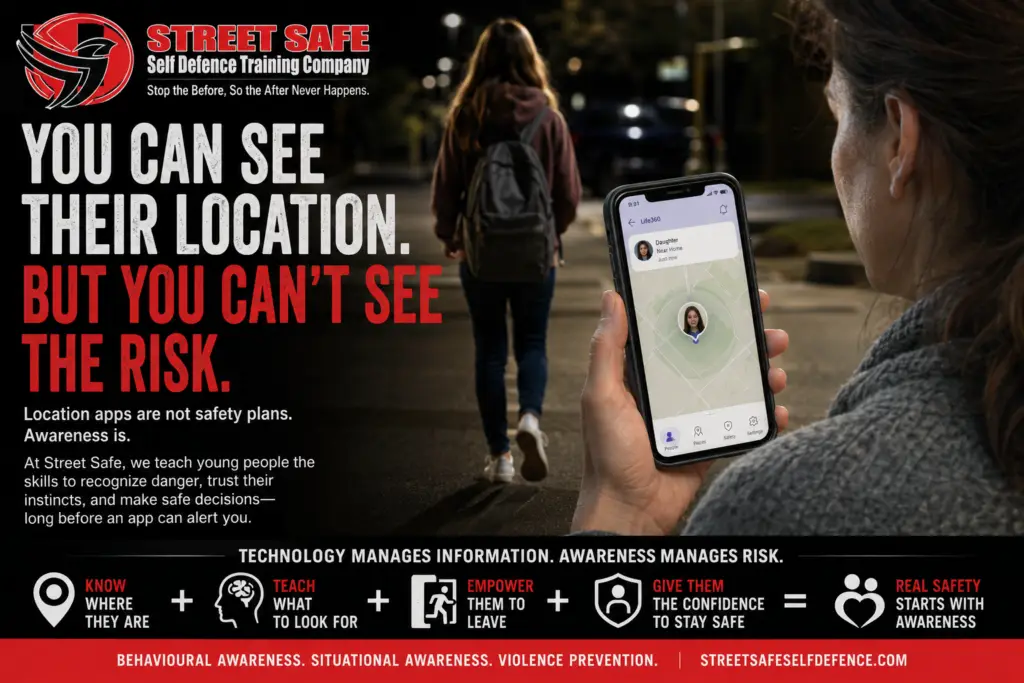
Child location sharing safety involves more than seeing your child’s position on a phone—it requires awareness and danger recognition.
By Rob Andress
Violence Prevention Specialist
Street Safe Self Defence Training Company
If you’re a parent, let me ask you a question. When your son or daughter leaves the house, what actually makes you feel they’re safe?
For many parents today, the answer is simple.
“They’re on Life360.”
Or Find My iPhone. Or Google Family Link. Or one of the dozens of location-sharing apps available today.
I understand why.
As a parent, knowing where your child is can provide reassurance. If they’re running late, you can see they’re still at school. If they’re driving home, you know they’ve started the trip. These apps are useful family communication tools.
But here’s where I think we’ve made a dangerous mistake. Somewhere along the way, we’ve started treating location-sharing as though it’s violence prevention. It isn’t.
At Street Safe Self Defence Training Company, Beth and I teach one principle above almost everything else:
Technology manages information. Awareness manages risk.
Those are two very different things.
A Dot on a Map Doesn’t Tell You the Story
A location app answers one question.
Where is my child?
It doesn’t answer the questions that matter most.
Are they being manipulated? Are they uncomfortable but afraid to leave? Has someone isolated them from their friends?
Are they being pressured into a car? Has a trusted adult crossed a boundary? Has a date suddenly changed from awkward to dangerous?
The app doesn’t know. Because violence isn’t a GPS problem. It’s a human behaviour problem.
Most Violence Doesn’t Begin With Violence
One of the biggest misconceptions I see is that people imagine violence starts with an attack.
In reality, that’s usually the last stage.
Before violence comes manipulation.
Before manipulation comes trust.
Before trust often comes grooming, testing boundaries, creating confusion, exploiting politeness, or convincing someone that saying “no” would be rude.
Predators don’t generally begin with force.
They begin with psychology.
If we only teach our children how to react once something has become obvious, we’ve already missed the earliest opportunities to stay safe.
The False Sense of Security
I’ve spoken with parents who tell me, “I’m not worried. I always know where my daughter is.”
My response is always respectful.
Knowing where she is isn’t the same as knowing whether she’s safe.
A phone can be left in a locker.
It can run out of battery.
It can lose signal.
It can be turned off.
It can be taken.
Even when it’s working perfectly, it cannot interpret human behaviour.
A location app might show your child is still at a friend’s house.
It cannot tell you whether they’re feeling trapped, pressured, frightened, or too embarrassed to call home.
That’s the gap many people don’t see.
We Cannot Outsource Safety to Technology
Technology should support parenting.
It should never replace it.
Some of the most important safety conversations have nothing to do with GPS.
Can your child recognize manipulation?
Do they understand that someone who seems “nice” can still be unsafe?
Do they know they don’t need proof to leave a situation that doesn’t feel right?
Can they recognize controlling behaviour before it becomes abuse?
Do they know it’s okay to disappoint someone if it keeps them safe?
Those conversations build judgement.
Judgement is what keeps people safe long before an emergency notification ever appears.
The World Has Changed
Today’s young people are growing up in a world that previous generations never experienced.
Online friendships become in-person meetings.
Ride-sharing is routine.
Dating begins through apps.
Social media creates constant access.
Offenders exploit technology, but they still rely on the same human vulnerabilities they’ve always relied on: trust, isolation, compliance, embarrassment, and confusion.
That’s why behavioural awareness matters more today than ever before.
What I See in Training
Over the years, I’ve worked with thousands of students, parents, teachers, healthcare workers, REALTORS®, municipal employees, and security professionals.
One lesson comes up again and again.
The people who avoid violence most successfully are rarely the strongest.
They’re the ones who recognize that something isn’t right while they still have options.
They notice behaviour before everyone else does.
They leave before everyone else thinks it’s necessary.
They trust their observations instead of waiting for certainty.
That’s not paranoia.
That’s prevention.
What Parents Can Do Instead
Keep the location-sharing app. It’s useful.
But don’t confuse communication with protection!
Spend at least as much time teaching your children how to:
- Recognize manipulation and grooming behaviours.
- Understand the difference between social pressure and genuine danger.
- Trust discomfort before they can explain it.
- Leave situations without feeling guilty.
- Say “no” without apologizing.
- Call home without fear of getting into trouble.
- Understand that their safety will always be more important than someone else’s opinion.
Those are life skills. And unlike an app, they stay with them wherever they go.
My Takeaway
As a Violence Prevention Specialist, I don’t believe technology makes people safe.
I believe educated people use technology wisely.
Location-sharing apps are excellent tools. They’re just not safety systems.
Your child isn’t safest because you know where they are.
They’re safest because they know how to recognize danger before danger recognizes them.
That’s the difference between monitoring someone’s location…
…and preparing them for the world.
At Street Safe Self Defence Training Company, that’s what we’ve dedicated our careers to teaching.
Stop the Before, So the After Never Happens.
Rob Andress is the founder of Street Safe Self Defence Training Company and one of Canada’s Leading Violence Prevention Specialist who has spent decades teaching behavioural awareness, situational awareness, and violence prevention to schools, healthcare organizations, municipalities, corporations, security professionals, and real estate professionals across Canada. Together with co-founder Beth Andress, he advocates for evidence-informed education that helps people recognize and avoid violence before it occurs.
Suggested References
- Public Safety Canada – Crime Prevention: https://www.publicsafety.gc.ca/
- Canadian Centre for Child Protection: https://www.protectchildren.ca/
- Statistics Canada – Victimization Surveys: https://www.statcan.gc.ca/
- Centers for Disease Control and Prevention – Violence Prevention: https://www.cdc.gov/violenceprevention/
- National Center for Missing & Exploited Children: https://www.missingkids.org/
This article explains why location-sharing applications such as Life360 should be viewed as communication tools rather than violence prevention tools. Rob Andress of Street Safe Self Defence Training Company discusses how behavioural awareness, recognizing manipulation, trusting discomfort, and understanding human behaviour provide stronger protection than relying solely on GPS technology. The article emphasizes evidence-informed violence prevention strategies for parents and youth.
