

The safest, most practical self defence for seniors combines prevention first, a handful of low-risk natural-weapon techniques, and short, accessible training built around real mobility and strength. Personal alarms, situational awareness, and simple open palm or finger strikes go further than any complex martial art. Street Safe Self Defence offers a five-hour trauma-informed course built for exactly this. Start today by picking up a loud personal alarm or booking a short assessment session.
TL;DR:
- Seniors should focus on low-risk techniques like palm-heel strikes, elbow, and knee hits that use sturdy joints and minimize injury risk.
- Building awareness habits, such as scanning surroundings and using loud alarms, can often prevent confrontations before physical defense is needed.
- Mobility aids like canes or wheelchairs can be used effectively for defense by blocking approaches and creating space with controlled strikes.
- Legal self-defence tools should be non-lethal, loud alarms and tactical flashlights, with safety and balance considered alongside their use.
- Short, trauma-informed self-defence courses are most effective when tailored to individual mobility, with practice emphasizing confidence and situational instincts.
Table of Contents
- What does self defence for seniors actually look like in practice?
- How can seniors reduce risk before a confrontation starts?
- Can you defend yourself with a cane, walker, or wheelchair?
- What self-defence tools are actually legal for seniors to carry?
- How do you find a self-defence class that fits your body and pace?
- What does Street Safe Self Defence offer seniors specifically?
- An instructor’s take: start small, start now
- Ready to start? Here’s how to book a session
- Sources
What does self defence for seniors actually look like in practice?
Forget the roundhouse kicks and joint locks you see in movies. Self defence for seniors works best when it uses the body’s strongest, most durable parts and asks for the least range of motion.
Closed-fist punches put small, brittle hand bones at risk, and osteoporosis makes that worse with age. Palms, elbows, and knees distribute force across sturdier joints and don’t require the grip strength or wrist stability a punch demands. These are the techniques most senior-focused instruction builds around, according to guidance from C2 Martial Arts, which structures early lessons around mindset and awareness before introducing any physical response.
Here is a practical sequence worth rehearsing:
- Palm heel strike. Drive the heel of your open palm upward into the attacker’s chin or the base of the nose. Keep your wrist stiff and strike from the hip, not the shoulder.
- Finger Strikes. If someone grabs you from close range, targeting your fingers towards the face the and eyes. No wind-up needed.
- Knee strike. From a seated or standing position, drive your knee upward into the groin or thigh. This works even with limited hip mobility.
- Wrist-grab escape. Rotate your wrist toward the attacker’s thumb, the weakest point of their grip, while stepping back to create distance.
- Bear-hug escape. Drop your weight, stomp on the attacker’s instep, and drive an elbow back into their ribs simultaneously.
- Getting up after a fall. Roll to your side, use a nearby chair or wall for leverage, and rise in stages rather than trying to stand in one motion.
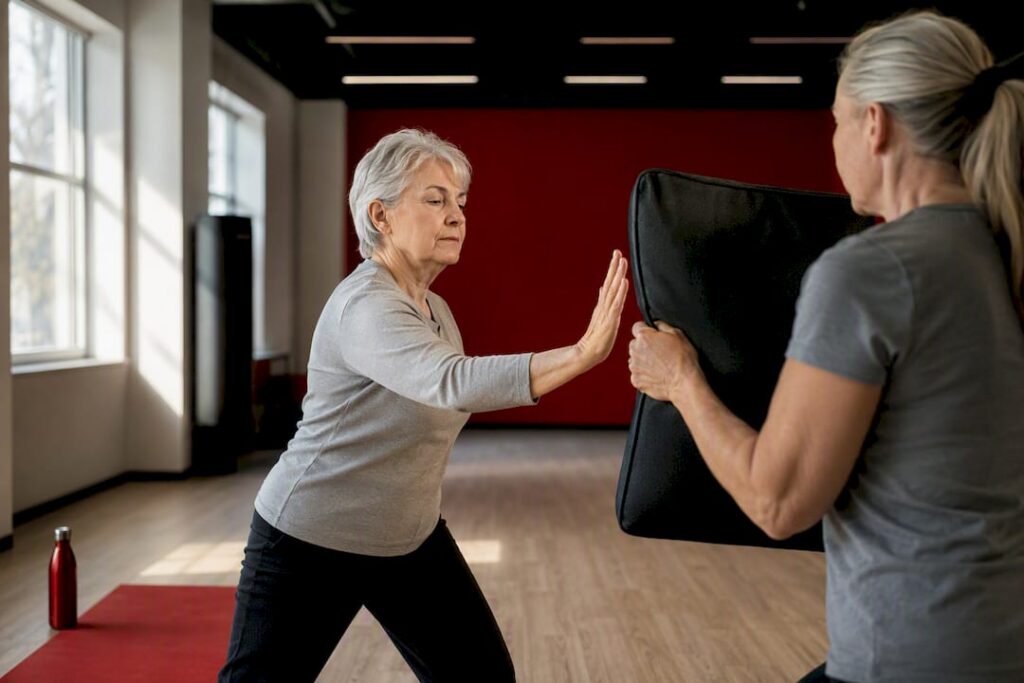
Practise these in short sets of five to eight reps with a partner holding a pillow or pad, never full contact. Check in after every set: any joint pain, dizziness, or shortness of breath means stop and rest.
Never twist or torque a joint that resists, and never push through pain during a wrist escape. The goal is disruption, not domination. Street Safe Self Defence’s beginner-focused drills follow this same logic: small, repeatable moves that create an opening to escape.
Pro Tip: Practise your palm-heel strike against a couch cushion held at chest height. Ten slow reps a day builds muscle memory faster than one intense weekly session.
How can seniors reduce risk before a confrontation starts?
Most self-defence encounters are won or lost before any physical contact happens. Awareness and early action buy time, and time is what allows an escape.
Build a simple scanning habit: check the street or parking lot ahead of you, note exits when you enter a store or building, and keep your phone charged and accessible rather than buried in a bag. Confident, upright posture signals to a would-be attacker that you’re paying attention, which alone reduces the odds of being targeted, according to insights from a self-defence guide for seniors that emphasizes creating distance and using the first-mover advantage.
A few habits worth building into your week:
- Scan your surroundings every time you park, enter a building, or walk to your door.
- Say “stop” or “back off” loudly and firmly if someone approaches uninvited. A raised voice draws attention and often ends the interaction there.
- Carry a personal alarm clipped somewhere you can reach it without looking.
- Shop and walk during busier hours when possible, and let someone know your route.
- Trust your instincts. If a situation feels wrong, leave before you’re sure why.
A well-designed personal safety plan also includes identifying safe zones along regular routes, whether that’s a neighbour’s porch light or a store you know stays open late. Balance training like tai chi supports all of this indirectly. Better balance means you can step back, pivot, or brace quickly instead of freezing, according to Harvard Health.
Pro Tip: Rehearse your verbal boundary line out loud at home. “Stop, don’t come closer” said with confidence feels awkward the first ten times and natural by the eleventh.
Can you defend yourself with a cane, walker, or wheelchair?
Mobility aids are not liabilities in a self-defence scenario. They’re tools, and with a little practice, they extend your reach and protect your balance at the same time.
- A cane or umbrella held horizontally can block an incoming grab or push, and a short, controlled swing to the shins or hand creates space without requiring you to close distance.
- Wheelchair users can work within what adaptive self-defence guidance calls a defensive “zone,” using the chair’s frame, footrests, or wheels to block an approach or trap an attacker’s leg against a wall, according to peer-reviewed guidance published in the West Journal of Medicine.
- If striking power is limited, focus on disruption over force: a firm poke to the eyes or throat with a cane tip, or a hard push to the chest, can create the half-second needed to call for help.
- Practise fall-safe recovery separately from any strike drill. Know how you’ll get back to a stable position if you go to the ground, before you ever need to.
None of this replaces hands-on coaching. A qualified instructor can watch how you sit, grip, and pivot, then adjust every technique to your actual range of motion rather than a generic template.
What self-defence tools are actually legal for seniors to carry?
Canadian law does not treat every defensive item the same way, and carrying something marketed as a “weapon” can create legal exposure even in a genuine emergency. Section 34 of the Criminal Code sets out when force is legally justified in self-defence, and it hinges on proportionality and the circumstances at the time, not on what you were carrying (see Section 34). Pepper spray and similar chemical deterrents are restricted in Canada, so most safety-focused seniors are better served by tools designed for deterrence rather than force.
Good options to look for:
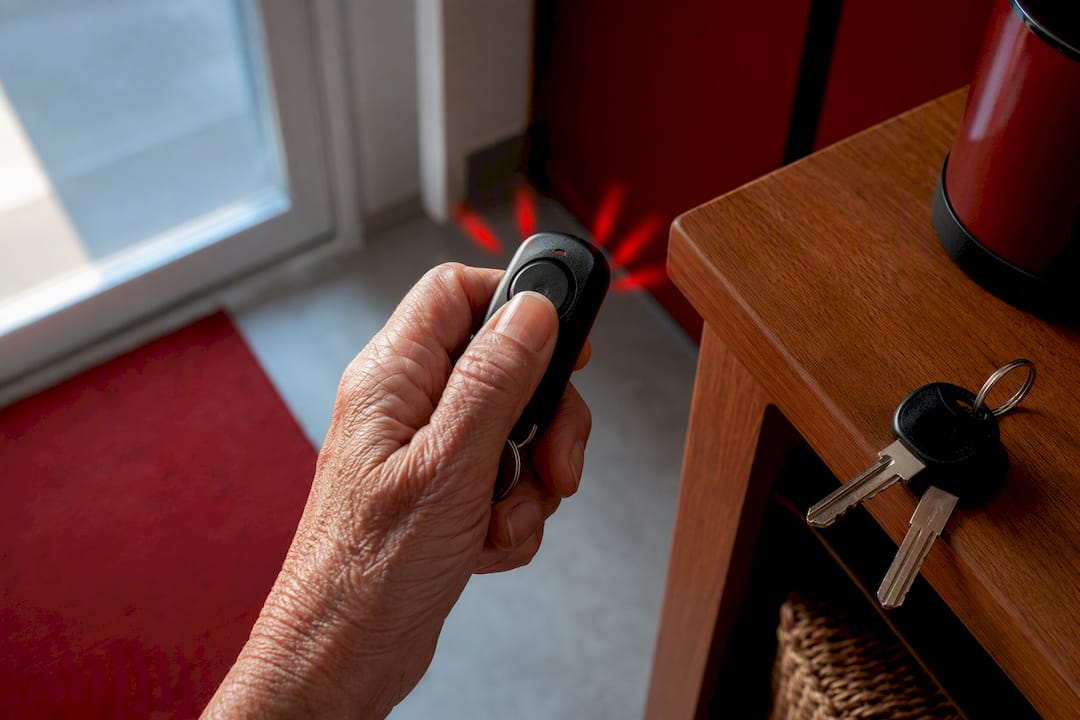
- A loud personal alarm, ideally 120 decibels or louder, with a pull-pin or button you can trigger one-handed.
- A tactical flashlight with a strobe function, which disorients without any legal ambiguity.
- A sturdy cane or umbrella with a solid grip, chosen for balance support first and defensive use second.
Falls remain one of the biggest risks facing older adults, which is exactly why balance and mobility support should factor into any tool choice, not just its defensive use. Statistics Canada data on older-adult injury risk underscores why stability matters as much as any striking technique.
Test any device under mild stress: can you activate the alarm with cold hands or while startled? Store it somewhere you’ll actually reach for, and never brandish a tool to intimidate. Escalation should always be a last resort, used only to create an escape.
How do you find a self-defence class that fits your body and pace?
Not every self-defence program is built for older joints, slower reaction times, or mobility aids. A few questions separate the classes worth your time from the ones that aren’t.
- Is the approach trauma-informed? Ask how the instructor handles anxiety, past trauma, or fear responses during training, not just physical technique.
- How accessible is the space? Confirm step-free entry, seating options, and whether drills can be done from a chair or with a walker.
- How small are the groups? Smaller classes mean more individual correction and safer pacing.
- What are the instructor’s credentials? Ask directly about training background and whether the program carries liability insurance.
- Can moves be modified? A good instructor adjusts strikes and escapes to your grip strength, balance, and joint range without pressure to “keep up.”
- What’s the cancellation and medical clearance policy? This matters if you have a condition that limits sudden movement.
A short course won’t turn you into a fighter, and it isn’t meant to. What it should deliver is confidence, two or three reliable escapes, and sharper situational instincts. Between sessions, revisit your palm-heel and knee-strike reps a few times a week, and consider online self-defence classes to reinforce what you learned in person.
What does Street Safe Self Defence offer seniors specifically?
Street Safe Self Defence runs a five-hour practical course designed around real threats, not competition-style martial arts. The mobile format brings the instructor to a community centre, retirement residence, or private group, so participants never have to travel with mobility aids in tow.
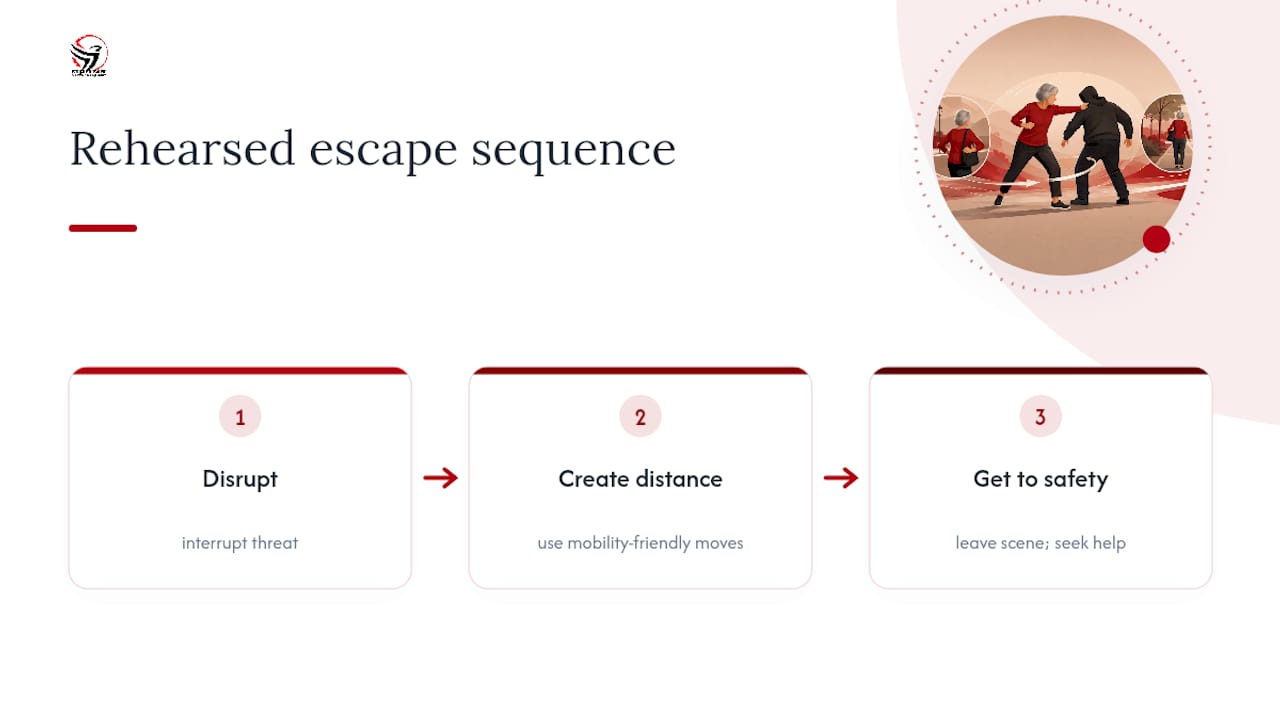
Every session uses trauma-informed instruction, meaning pacing adjusts to comfort level and past experience rather than pushing everyone through the same drills. Techniques are modified in real time for wheelchair users, cane users, and anyone with limited strength or range of motion, with escapes rehearsed as a sequence: disrupt, create distance, get to safety.
Participants across age groups and fitness levels have described leaving sessions with a clearer sense of what they’d actually do in a threatening moment, not just theoretical knowledge but a rehearsed physical response they trust under pressure.
…
An instructor’s take: start small, start now
You don’t need to master ten techniques to feel safer. You need two or three you’d actually use, rehearsed until they’re automatic, and a habit of scanning your surroundings before trouble ever gets close. That’s the realistic bar, and it’s an achievable one at any age or ability level.
This week, try three things: test your personal alarm to make sure it’s loud and easy to trigger, run ten slow palm-heel reps against a cushion, and book a short assessment session with a qualified instructor to see how your specific mobility factors into technique choice.
— Rob
Ready to start? Here’s how to book a session
Street Safe Self Defence is the practical alternative to generic martial arts classes for seniors: no belts to earn, no years of commitment, just a focused five-hour course that comes to you. The mobile delivery model means no driving to an unfamiliar studio, and sessions run one-on-one, in small groups, or through community and retirement organizations, with every drill adapted for mobility aids, joint limitations, and trauma histories.
A first booking typically starts with a short conversation about your mobility, any medical considerations, and what situations concern you most. From there, the course builds around palm-heel strikes, escapes, and situational awareness at a pace that matches your body. If you’re ready to build real, usable skills at home or in your community, explore self-defence training options built for home practice and book a session that fits your schedule.
Sources
For the legal side, read Section 34 of the Criminal Code directly. For wheelchair-specific tactics, see the West Journal of Medicine guidance. For fall-risk context, check Statistics Canada, and for balance training benefits, see Harvard Health on tai chi. If you’re folding safety planning into broader retirement prep, this retirement planning checklist is a useful companion.
- Self-Defense for People With Disabilities — West J Med
- Criminal Code — section 34 (self-defence)
- Harvard Health — the health benefits of tai chi
