

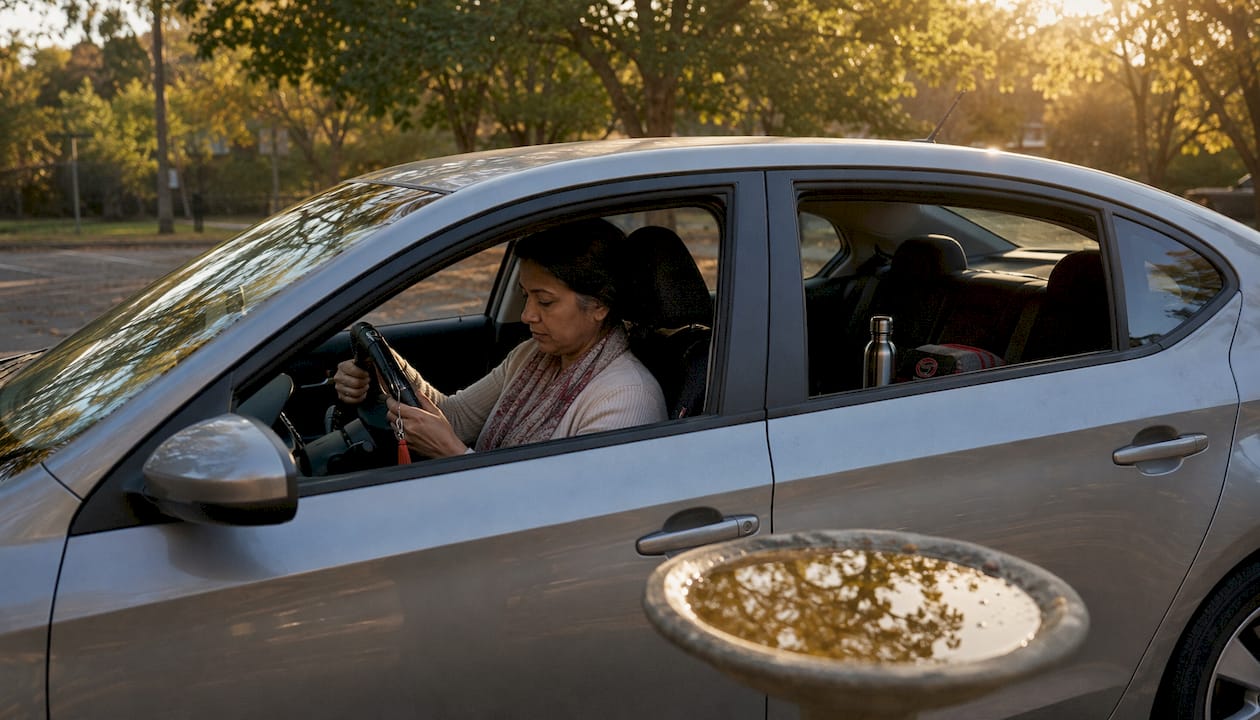
When it comes to self defence in a car, if a threat begins in or around your vehicle, your single most important action is to create distance. Drive away if the car can move. If it cannot, exit, put space between yourself and the threat, and call 9-1-1 as soon as it is safe to do so. Tactical training consistently emphasises that a car is a tool for escape, not a fighting platform.
Your immediate priorities:
- Unbuckle and exit if the vehicle is disabled and the route is clear
- Start the vehicle and drive away if the engine is running and the path is open
- Use the horn and headlights to draw attention and signal distress
- Access a defensive tool only if it is already on your person or in a fixed, reachable mount
- Call 9-1-1 as soon as you reach safety
Pro Tip: Keep any defensive tool on your body or in a dedicated mount within arm’s reach. A tool in a console or bag is rarely accessible under real stress.
Table of Contents
- What are your first priorities during an in-car assault?
- What techniques actually work inside a confined vehicle?
- How should you prepare your vehicle before a threat occurs?
- What are the legal considerations for self-defence in a car in Canada?
- How do you choose self-defence training that covers in-car scenarios?
- Short practice drills to build in-car muscle memory
- Key takeaways
- Why confined-space training changes everything
- Practical in-car training, brought to you
- Useful sources and further reading
What are your first priorities during an in-car assault?
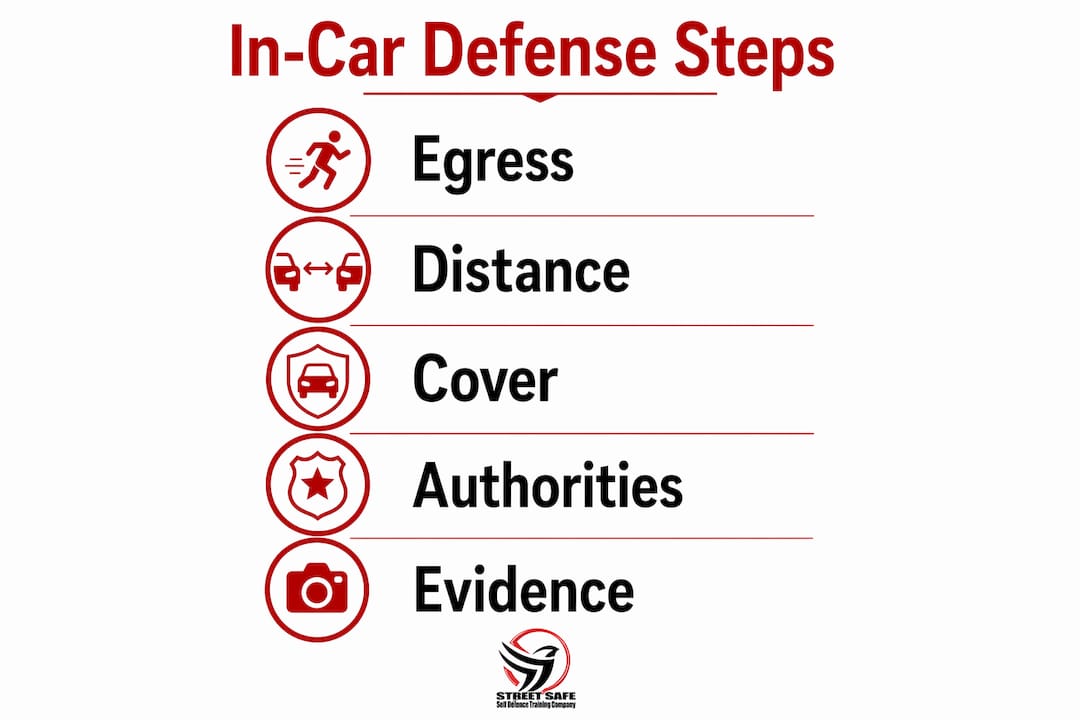
The priority order is straightforward: egress first, distance second, cover third, authorities fourth, evidence fifth. Getting that sequence right in the initial moments of an incident is what changes outcomes.
| Condition | Best action | Timing |
|---|---|---|
| Vehicle operable, route clear | Drive away immediately | Within 5 seconds |
| Vehicle disabled, attacker approaching | Exit away from threat, seek cover | Within 10 seconds |
| Safely away from scene | Call 9-1-1 | As soon as possible |
| Post-incident | Preserve evidence, document injuries | Before leaving the scene |
Drive away when the engine is running and there is a clear path forward or in reverse. Exit on foot when the vehicle is disabled, blocked, or the attacker is already inside and you can get out. Do not stay in a disabled car hoping it will protect you. Car panels and glass offer limited protection from determined attackers, and a stationary vehicle can trap you.
For preventive driving, maintain a 3-second following distance at normal speeds and scan your mirrors every 5–10 seconds. These habits give you the reaction time to avoid threats before they escalate.
What techniques actually work inside a confined vehicle?
Most standing-room self-defence techniques fail in a car. Instructors report that seatbelt interference, steering wheel obstruction, and confined legroom break the mechanics of standard strikes and draws. Train for the actual environment.
Techniques worth practising:
- Seatbelt release: Practise one-handed release under simulated stress so it becomes automatic. Fumbling with the buckle costs critical seconds.
- Short palm strikes and elbow strikes: These work in close quarters where a full punch has no room. Target the attacker’s face or throat to create a moment of opportunity.
- Shoulder and torso rotation: Rotating your upper body toward the threat frees your hands and improves your angle for a strike or tool access.
- Door handle and lock manipulation: Know your vehicle’s interior lock placement without looking. Practise opening the door with your non-dominant hand.
- High-port tool presentation: If you carry a defensive tool, drawing from a seated, belted position requires a specific shoulder-rotation movement and a high-port presentation to clear the steering wheel safely.
Pro Tip: Always practise with the seatbelt on, the steering wheel in place, and your seat in its normal driving position. Ergonomics that feel awkward in a gym become impossible under stress if you have never rehearsed them in the actual space.
Do not attempt live weapon draws or contact drills without certified, supervised instruction. Dry-fire and low-force simulation are the right starting points for solo practice.
How should you prepare your vehicle before a threat occurs?
Prevention reduces both the likelihood of an incident and the time it takes to respond when one happens. Start with the basics: keep your fuel level adequate, and stay current on routine vehicle maintenance, including brakes, tyre pressure, battery, oil, coolant, and wipers. A breakdown in an isolated area is its own safety risk.
Vehicle preparation checklist:
| Item | Recommended storage location |
|---|---|
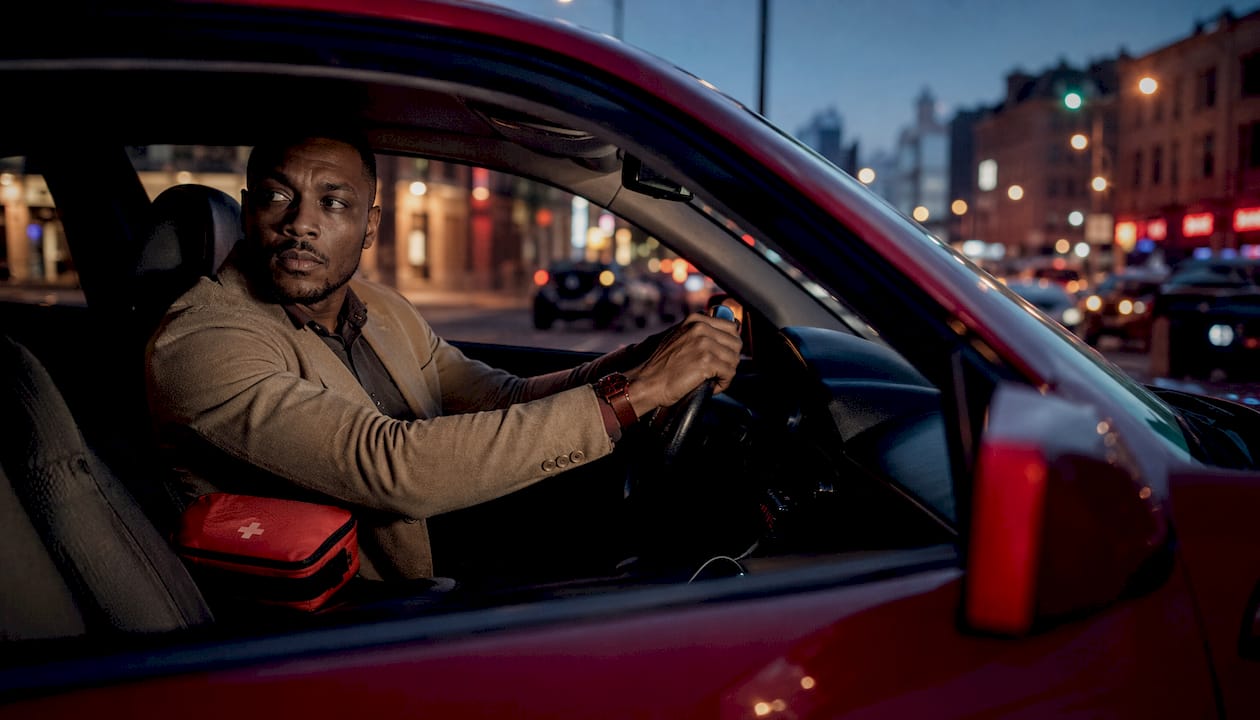
| First-aid kit | Rear seat or accessible boot area |
| Reflective warning triangle | Boot, easy to reach |
| Flashlight | Door pocket or centre console |
| Jumper cables | Boot |
| Drinking water | Rear floor or boot |
| Defensive tool (if carried) | On person or fixed mount within arm’s reach |
Parking choices matter as much as what you carry. Park in well-lit, visible areas. Orient your vehicle so you can pull forward to exit rather than reversing into an unknown situation. Avoid isolated spots when alone, particularly at night.
Secure mounts that allow tool retrieval without unbuckling significantly improve response time. A defensive tool in a bag on the back seat is functionally unavailable during a sudden threat.
What are the legal considerations for self-defence in a car in Canada?
In Canada, using a vehicle as a weapon carries serious legal consequences. Courts will assess whether your response was reasonable given the threat and whether you had a realistic opportunity to escape. Legal scrutiny intensifies when a vehicle is used offensively, even in a claimed self-defence situation.
Prioritise escape over any use of the vehicle as a weapon. If you do use force, document everything promptly. For a full overview of how Canadian law frames self-defence, the Canadian self-defence legal context is a useful starting point.
Post-incident checklist:
| Step | Action |
|---|---|
| Photograph the scene | Vehicle position, damage, any weapons visible |
| Record witness details | Names and contact numbers before they leave |
| Seek medical attention | Even for minor injuries — document them |
| File a police report | Get the file number for your records |
| Note your own account | Write down what happened while it is fresh |
This article provides general information, not legal advice. Confirm current rules with a qualified legal professional for your specific situation.
How do you choose self-defence training that covers in-car scenarios?
The single decisive criterion is this: the course must include confined-space, seatbelt-on scenario practice. A course that never puts you in a vehicle seat has not trained you for vehicle ergonomics.
What to look for when choosing a course:
- Scenario-based drills that simulate real vehicle constraints
- Instructor credentials grounded in practical, lived experience
- Mobile or on-site delivery so training happens in realistic settings
- Trauma-informed instruction that respects diverse backgrounds and stress responses
- Clear learning outcomes — for example, real skills developed in as little as five hours
Mobile, on-site training often outperforms classroom-only formats for in-car skills because the instructor can work directly in or around your actual vehicle. When comparing options, ask specifically about course duration, what skills you will leave with, and whether pricing is transparent upfront. Streetsafeselfdefence’s mobile training format is built around exactly this kind of situational realism. For guidance on choosing a course in Canada, a dedicated resource walks through the key criteria.
Short practice drills to build in-car muscle memory
Consistent, low-risk repetition builds the habits that hold under stress. These drills require no special equipment and can be done in a parked vehicle in a safe location.
Solo drills (parked, engine off):
- Seatbelt release repetition: buckle and release 10 times with your non-dominant hand, eyes forward.
- Door open drill: locate and operate the interior door handle without looking, both sides.
- Tool retrieval practice: if you carry a mounted defensive tool, practise reaching it from the belted position using slow, deliberate movements. Dry-fire only.
- High-port presentation: with an unloaded or inert training tool, practise the shoulder-rotation draw and high-port hold that clears the steering wheel.
Partner drills (low force, controlled environment):
- Timed egress: partner calls “go” from outside the vehicle; you unbuckle, open the door, and exit to a designated safe position. Time it and repeat.
- Distraction and response: partner taps the window or calls out; you practise scanning mirrors and identifying the threat direction without turning your back to the road.
Agree on a clear stop signal before any partner drill. No live weapons, no aggressive contact without certified instructor oversight. A short daily session plus a longer supervised session each week is a practical cadence for most people.
Key takeaways
Effective self defence in a car starts with one principle: prioritise egress over engagement, and prepare your vehicle and your habits before any threat occurs.
| Point | Details |
|---|---|
| Egress is the first priority | Drive away or exit on foot before considering any other response. |
| Keep tools accessible | Carry defensive tools on your person or in a fixed mount within arm’s reach. |
| Train in the actual environment | Practise seatbelt-on, confined-space drills so techniques transfer to a real vehicle. |
| Prepare your vehicle | Maintain brakes, tyres, and fuel, and carry an emergency kit for rapid response. |
| Seek scenario-based training | Streetsafeselfdefence offers mobile, confined-space training with real skills in as little as five hours. |
Why confined-space training changes everything
Most people who think about car safety focus on the vehicle itself — locks, parking spots, dashcams. Those things matter. What gets overlooked is the body’s response when a threat appears at close range inside a confined space. Stress narrows attention, slows fine motor skills, and makes anything you have not rehearsed feel impossible. That is why the training environment has to match the real one.
Generic self-defence classes are not useless, but they leave a gap. The techniques that work standing in an open gym often collapse the moment a seatbelt is across your chest. The draw that felt smooth on a flat range becomes a fumble when the steering wheel is six inches away. Scenario-based, confined-space training closes that gap in a way that no amount of general fitness or awareness training can replicate.
The other thing worth saying plainly: trauma-informed instruction is not a soft add-on. Many people who seek self-defence training have already experienced a frightening incident. A programme that ignores that reality and runs purely on adrenaline-based pressure drills can do more harm than good. Instruction that respects the whole person produces better skill retention and more confident, prepared participants.
Practical in-car training, brought to you
If you are ready to move beyond general awareness and build skills that actually work inside a vehicle, Streetsafeselfdefence brings reality-based, scenario-driven training directly to you. No commute to a gym, no standing-room-only class that never puts you in a car seat.
The mobile programme includes trauma-informed instruction, confined-space scenario drills, and focused modules that deliver real, usable skills in as little as five hours. Programmes are available for individuals, professionals, corporate teams, and groups across Canada. Whether you are a commuter, a realtor navigating client meetings, or a professional in a higher-exposure role, the training is built around your actual environment.
Visit the mobile training page to review programme details and request a booking.
Useful sources and further reading
The claims in this article draw on the following authoritative sources:
- Ready.gov car safety: vehicle emergency kit recommendations and maintenance checklist items.
- Consumer Reports defensive driving guide: 3-second following distance and mirror-scanning intervals.
- Inside Safariland — Vehicle Combatives: egress priority, tool placement, seated draw mechanics, and high-port presentation.
- Shooting Illustrated — defending yourself in your vehicle: training gap between standing techniques and vehicle ergonomics; dry-fire practice recommendations.
- American Rifleman — self-defence behind the wheel: vehicle cover limitations and the case for prioritising egress.
- Athlon Outdoors — legal considerations of defending against vehicle assaults: Canadian-relevant legal scrutiny of vehicle use as a weapon, post-incident documentation.