

Situational awareness (SA) is the ability to perceive what is happening around you, understand what it means, and anticipate what is likely to happen next — a three-level cognitive skill defined by researcher Mica Endsley as perception, comprehension, and projection. You can apply it right now with a 20-second micro-check every time you enter a new space:
- Pause at the threshold. Stop before you walk fully into the room, lot, or platform.
- Scan the space. Note exits, the number of people, and anything that feels out of place.
- Name your escape route. Identify at least one clear path out before you move deeper in.
Safety professionals confirm that SA is an intentional, learnable habit — not a personality trait you either have or lack.
Table of Contents
- What does situational awareness actually look like in practice?
- How to use the SLAM framework when risk increases
- A one-minute safety checklist you can use anywhere
- Is situational awareness the same as paranoia?
- How do you build situational awareness through practice?
- How should Canadian organisations approach SA training?
- Key takeaways
- What actually changes in a training room
- Practical SA training that comes to you, anywhere in Canada
- Useful sources and further reading
What does situational awareness actually look like in practice?
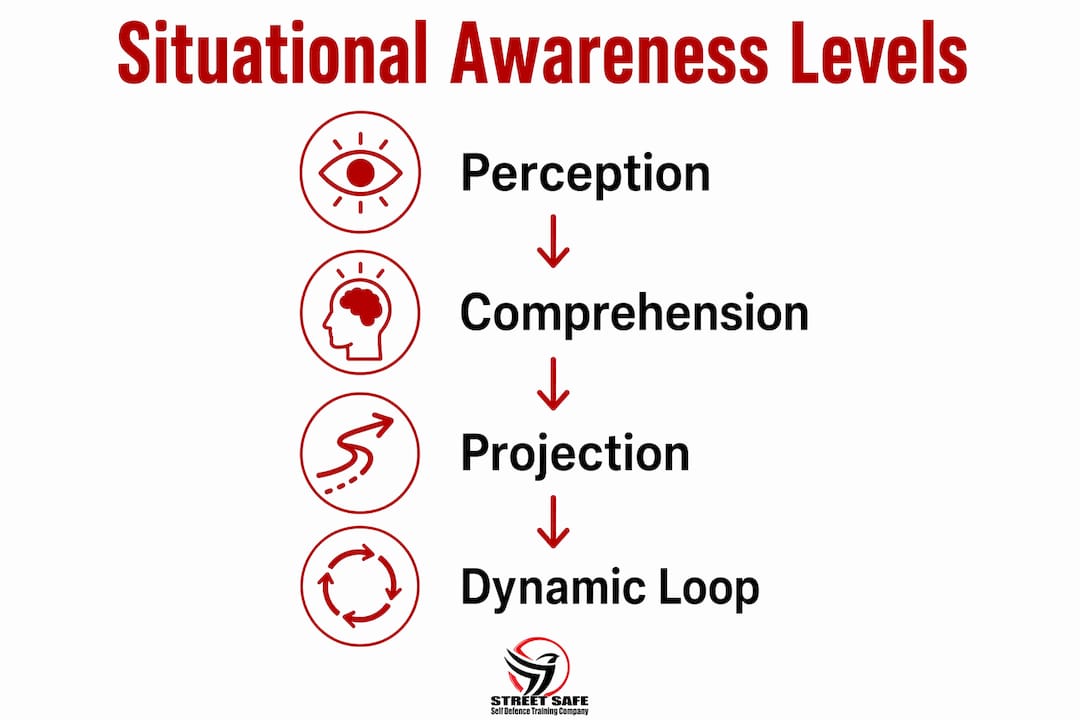
Endsley’s model gives SA a clear structure. Each level builds on the one before it, and together they determine whether you make a good decision or a reactive one.
Level 1: Perception is gathering raw data. You notice the man near the stairwell who keeps glancing at the door. You register that the parking lot is poorly lit and that only one other car is present. On a transit platform, you clock the group blocking the far exit. This is pure observation, no interpretation yet.
Level 2: Comprehension is assigning meaning. The man near the stairwell is pacing, not waiting. The poorly lit lot means your approach to your car will be visible to others before you can see them clearly. The group blocking the exit is loud and unpredictable. You now understand the significance of what you perceived.
Level 3: Projection is where real safety decisions happen. You anticipate that the man may approach when you reach the stairwell, so you choose a different route. You decide to return to the building and ask a colleague to walk out with you. You move to the centre of the platform, away from the blocked exit. Projection keeps you ahead of the situation so you choose options rather than react to threats.
Endsley’s model works as a dynamic loop: perception feeds comprehension, comprehension shapes projection, and projection tells you what to look for next. Practise cycling through all three levels deliberately, not just noticing things and stopping there.
How to use the SLAM framework when risk increases
When something feels off, the SLAM technique gives you a four-step method to assess and respond without freezing or escalating.
Stop. Pause before you act. This is the most valuable step. A brief, deliberate halt interrupts the impulse to react and creates the mental space needed for accurate projection. In a late-night parking lot, stopping means not rushing straight to your car the moment you sense something is wrong.
Look. Scan your environment for specific hazards. In an office common area, that means noting who is present, whether anyone is agitated, and where the nearest exit is. On a transit platform, it means checking sightlines and identifying who is watching whom.

Analyze. Assess whether the hazard affects you and whether you have the tools to manage it. Do you have a clear exit? Is the threat moving toward you or away? Are there other people nearby who could help?
Manage. Adjust your behaviour or your environment. Cross the street. Move to a busier area. Call ahead to let someone know your location. If you feel unsafe, stop and seek help rather than pressing forward.
Pro Tip: The Stop step is not hesitation — it is a deliberate cognitive reset. Research from the U.S. Army links this pause directly to reduced impulsive escalation and better decision quality.
A one-minute safety checklist you can use anywhere
The 20/20 rule — spend 20 seconds scanning 20 feet around you — is a quick way to break autopilot and tune your attention. Pair it with this checklist:
- Seat choice: Sit with your back to a wall and a clear view of the entrance when possible.
- Exits: Identify at least two exits before you settle in.
- Phone use: Keep your phone down until you have completed your initial scan.
- People: Note anyone whose behaviour seems inconsistent with the setting.
- Escape route: Mentally rehearse one clear path out.
- Companions: If you are with others, confirm they know the exit plan too.
This takes under 60 seconds and costs nothing. Simple, deliberate acts like choosing a seat with a clear view give outsized safety advantage with seconds of effort.
Pro Tip: You do not need to be on high alert all the time. Dial your focus up when you enter a new or unfamiliar space, then let it settle once you have completed your scan. Managing attention in cycles preserves energy for when you genuinely need it.
Is situational awareness the same as paranoia?
No. Paranoia is unfocused, chronic anxiety about threats that may not exist. SA is a targeted, time-limited skill you apply deliberately and then ease off. The difference is control.
SA is a trainable skill, not a constant state of high alert. Effective practitioners dial focus up or down depending on actual risk. A crowded transit station at midnight warrants more attention than your regular office hallway at 9 AM.
Phones, stress, and task overload are the biggest everyday threats to SA. Environmental distractions degrade attention and reduce your ability to project future states. Limiting phone use while navigating unfamiliar spaces, and rehearsing micro-checks until they are automatic, preserves cognitive capacity for Level 3 projection when it matters most.
How do you build situational awareness through practice?
Skill builds through repetition. Start with these progressive drills:
- Daily micro-check. Apply the 20/20 scan every time you enter a new space. Do this consistently for a sustained period before adding complexity.
- Pattern-spotting drill. Sit in a public space and observe baseline behaviour. Note what “normal” looks like, then identify anything that deviates from it.
- Projection drill. Choose a person in a public space and predict their next movements based on their current behaviour. Check your accuracy.
- Paired observation exercise. With a partner, each person independently scans a space and then compares notes. Gaps in your observations reveal blind spots.
A focused 30-minute mini-course can introduce core scanning and threat-recognition skills. A five-hour short course covers perception, comprehension, projection, and SLAM with scenario practice. Multi-session programmes build on that foundation over weeks.
To measure progress, use SAGAT-style check-ins: freeze a scenario mid-drill, answer targeted questions about what you perceived and projected, then compare your answers against what was actually present. This objective assessment method reveals exactly where your mental model breaks down.
For self-defence training at home, short daily sessions combined with weekly drills produce measurable improvement within a month.
How should Canadian organisations approach SA training?
Organisations face a specific challenge: SA must be consistent across a team, not just strong in a few individuals. The CMU Software Engineering Institute describes effective organisational SA as the ability to detect discrepancies from normal operations quickly, understand their cause, and act. That same principle applies to physical safety in Canadian workplaces, schools, and community settings.
| Implementation step | What it involves |
|---|---|
| Baseline audit | Assess current awareness gaps, physical environment, and existing safety culture |
| Staff briefings | Introduce the Endsley model and SLAM in plain language |
| Scenario drills | Run tabletop or live exercises matched to your environment |
| Designated roles | Assign specific observation responsibilities during high-risk periods |
| Measurement | Use scenario-based assessments or SAGAT-style freeze checks to track progress |
| Review cycle | Revisit training every six months or after any incident |
Trauma-informed delivery matters, particularly for groups that include survivors of violence, Indigenous communities, or young people. Training that acknowledges past harm, avoids re-traumatisation, and centres participant agency produces better learning outcomes and higher retention. Workplace violence prevention programmes in Canadian municipalities increasingly require this approach. For organisations focused on personal awareness and workplace development, pairing SA training with broader soft-skill development strengthens the overall safety culture.
Key takeaways
Situational awareness is a learnable, energy-managed skill built on three levels — perception, comprehension, and projection — that anyone can practise in under two minutes a day.
| Point | Details |
|---|---|
| Three-level model | Perception, comprehension, and projection form a dynamic loop; practise all three, not just observation. |
| SLAM framework | Stop, Look, Analyze, Manage gives you a four-step method to apply when risk increases in any environment. |
| One-minute checklist | Scan exits, seat position, phone use, and escape routes every time you enter a new space. |
| SA is not paranoia | Dial focus up in unfamiliar or higher-risk settings; ease off once you have completed your scan. |
| Streetsafeselfdefence | Offers five-hour short courses with mobile, trauma-informed delivery for individuals and organisations across Canada. |
What actually changes in a training room
Most people arrive at a safety training session believing they are already reasonably aware of their surroundings. Within the first 20 minutes of a scenario exercise, that confidence usually shifts. Participants who completed the micro-check and SLAM steps consistently caught cues that others walked right past — not because they were more alert by nature, but because they had a structure to follow.
The gap between knowing a concept and applying it under mild stress is where most SA training falls short. Scenario-based practice closes that gap. Clients who complete even a single short course report noticing exits, reading body language, and managing their phone use differently in everyday life. That shift is the goal: not fear, but readiness.
Practical SA training that comes to you, anywhere in Canada
Streetsafeselfdefence delivers mobile self-defence training directly to schools, workplaces, community groups, and organisations across Canada, so your team does not need to travel to a facility or rearrange schedules around a fixed venue.
The five-hour short-course format covers the Endsley model, SLAM, scenario drills, and practical de-escalation in a single day. Every programme uses trauma-informed instruction, making it appropriate for diverse groups including survivors, young people, and Indigenous communities. Courses are reality-based, not theoretical — participants practise the skills, not just hear about them.
Whether you are booking for a corporate team, a high school, or a community organisation, the next step is straightforward. Visit streetsafeselfdefence.com to check availability and book your session.
Useful sources and further reading
- Endsley model — Wikipedia: Clear summary of the three-level SA model; useful starting point for the academic definition and SAGAT measurement method.
- New Zealand Civil Aviation Authority — SA Guidance: Human factors guidance on SA as a trainable, energy-managed skill; supports sections on misconceptions and cognitive load.
- U.S. Army — SLAM article: Primary source for the SLAM framework and its four steps; directly applicable to personal and workplace safety.
- CMU Software Engineering Institute — Situational Awareness: Authoritative organisational SA definition; relevant for Canadian workplaces building team-level awareness programmes.
- Streetsafeselfdefence.com: Mobile, trauma-informed short-course training available across Canada for individuals, schools, and organisations.