

There is a lot of advice about walking alone at night.
Stay in well-lit areas. Keep your head up. Don’t look at your phone. Don’t wear earbuds. Walk with confidence.
None of that advice is wrong.
But it doesn’t teach you how to recognize when something around you is beginning to change.
I want to do something different.
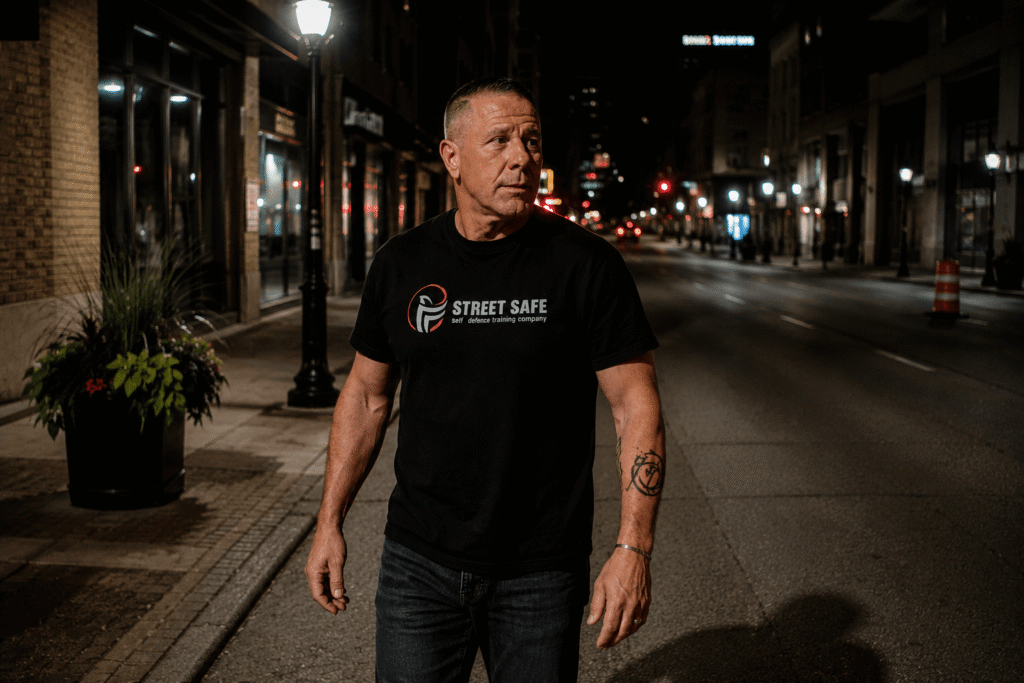
I want you to walk down a street with me at night.
I want to show you what I’m looking at, what I’m listening for, what gets my attention and, more importantly, what makes me change what I’m doing.
Because situational awareness isn’t simply looking around.
It’s understanding what you’re looking at.
How can you stay safer when walking alone at night?
Staying safer while walking at night starts with situational awareness and early threat recognition. Pay attention to changes in your environment and people’s behaviour, maintain distance, keep your hands available, identify possible exits, avoid unnecessary distractions and act when something doesn’t fit. The objective isn’t to walk afraid. It’s to recognize potential problems early enough that you still have choices.
What Does Situational Awareness Look Like at Night?
It’s 11:30 at night.
The businesses are mostly closed. Traffic has thinned out. There aren’t many people on the sidewalk. Cars are parked along both sides of the street. Some areas are well lit. Others disappear into shadows between buildings.
During the day, hundreds of people might move through this same street.
At night, the environment has changed.
So my level of awareness changes with it.
I move toward what is commonly referred to in personal safety training as Condition Orange.
That doesn’t mean I’m afraid.
It doesn’t mean I believe somebody is waiting around the corner to attack me.
It means the environment deserves more of my attention.
There is a huge difference between fear and recognition.
I’m not walking down the street scared.
I’m reading the street.
My Awareness Starts Before I Walk Outside
My awareness doesn’t begin halfway across the parking lot.
It starts before I leave the building.
Before I walk through that door, I look outside.
Who’s there?
Are people standing near the entrance?
Are there vehicles waiting?
Where did I park?
What’s between me and my vehicle?
Are there areas where the lighting disappears?
Are there open businesses?
Where are the other people?
Where could I go if something changed?
I’m establishing what normal looks like before I start looking for something that doesn’t fit.
That’s important.
You can’t recognize an anomaly if you haven’t established a baseline.
At Night, Context Matters
I don’t walk down the street looking for bad guys.
I don’t believe you can reliably identify someone’s intentions by their clothing, age, race, tattoos, hairstyle or appearance.
I’m interested in behaviour and context.
A man standing at a bus stop at 3:00 in the afternoon?
Nothing unusual about that.
A man standing at the same bus stop at 1:00 in the morning when the buses have stopped running?
That doesn’t make him dangerous.
But it gets my attention.
A person sitting inside a parked vehicle?
Normal.
The same person sitting in a dark vehicle who starts the engine as I walk past?
Now I have another piece of information.
Someone walking behind me?
Normal.
I cross the street.
They cross.
I change my pace.
They change theirs.
I turn.
They’re still behind me.
Now something is developing.
One thing may mean absolutely nothing.
Several things beginning to connect can mean something entirely different.
Threat recognition is often about accumulation.
Condition Orange Is Not Paranoia
This is where I think people misunderstand situational awareness.
Condition Orange doesn’t mean I’m preparing to fight everyone who approaches me.
It means something has earned more of my attention.
I’m still seeing the environment around me, but now I’m asking more specific questions.
Why did I notice this person?
Are they closing distance?
Are they matching my movement?
Are they watching me?
Are they positioning themselves somewhere I have to pass?
Are there other people with them?
Where are their hands?
Where can I move?
What’s behind me?
Where is my safest exit?
Most importantly:
Can I leave now?
Because if I can safely remove myself from something that doesn’t look right, I don’t need to wait around to find out whether I was correct.
Distance Is More Than Space
One of the things we teach at Street Safe is the importance of distance.
People think of distance as physical space.
I think of it as time.
If someone is twenty feet away from me, I have time.
Time to observe.
Time to move.
Time to make a decision.
Time to put something between us.
Time to leave.
Allow that same person to get three feet away and most of those options disappear.
That’s why I don’t wait until someone becomes an obvious threat before I start protecting distance.
If something doesn’t feel right, I’ll move.
I’ll cross the street.
I’ll angle away.
I’ll change my pace.
I’ll move toward other people.
I’ll walk into an open business.
I’ll change my route completely.
I’m not accusing anyone of anything.
I’m controlling my own movement.
Parked Vehicles Change What I Can See
At night, parked vehicles deserve attention.
Vans, SUVs, pickup trucks and delivery vehicles create blind spots.
Someone can be standing between two vehicles and you may not see them until you’re almost beside them.
So I’m looking into those gaps as I approach.
I’m noticing movement.
Shadows.
Interior lights.
Brake lights.
Doors opening.
Engines starting.
Someone sitting inside a vehicle.
I’m also asking myself whether I’m leaving enough room to move if something happens.
This isn’t paranoia.
It’s understanding the environment I’m actually standing in.
I Don’t Automatically Take the Shortest Route
People naturally choose convenience.
The shortest route to the car.
The quickest path through the parking lot.
The alley that saves two minutes.
The narrow sidewalk because it’s the direct route.
At night, I’ll trade convenience for information.
I’ll walk another hundred metres if the lighting is better.
I’ll move to the opposite side of the street if it gives me better visibility.
I’ll avoid walking tightly against buildings if I can create more space.
I’ll walk around a row of vehicles instead of cutting through them if something doesn’t look right.
Why?
Because convenience doesn’t outrank safety.
My Ears Are Working Too
Your eyes aren’t your only source of information.
At night, sound becomes extremely valuable.
Footsteps behind me.
Are they getting closer?
Did they speed up when I did?
A vehicle approaching from behind.
Did it slow down?
Did it stop?
Did I hear a door open?
A voice?
Movement somewhere I can’t see?
Someone calling to me?
Your hearing extends your awareness beyond your field of vision.
That’s one of the reasons I don’t like seeing someone walking alone through a parking lot at night with both earbuds blocking out the environment.
Your attention should be where your body is.
Windows Become Mirrors
I use reflections.
Storefront windows, vehicle windows and glass doors can tell me what’s happening behind me without requiring me to constantly turn around.
Is somebody gaining distance on me?
Did they cross when I crossed?
Did they stop when I stopped?
Is the same person still there after I changed direction?
Again, I’m collecting information.
I’m not making accusations.
I’m allowing behaviour to tell me what I need to know.
“Hey Buddy, You Got the Time?”
Now somebody approaches me.
“Hey buddy, you got the time?”
Maybe he genuinely wants to know the time.
That’s entirely possible.
But I’m not nearly as interested in his question as I am in what his body is doing while he’s asking it.
I can answer him from where I am.
“Yeah. It’s 11:40.”
I don’t need to let him walk into touching distance to be polite.
If I move back and he continues forward, I notice.
If I angle away and he changes direction to continue closing distance, I notice.
If he’s looking around repeatedly, I notice.
If another person starts moving toward my other side, I notice.
If his hands disappear, I notice.
If I establish distance and he refuses to respect it, I notice.
The words may sound harmless.
The behaviour surrounding those words may tell me something completely different.
Movement Can Expose Intent
If I believe someone may be following me, I’m not going to turn around and confront them just to prove something.
I’ll change something.
Cross the street.
Change my speed.
Stop.
Turn.
Enter a business.
Move toward other people.
Change direction.
Every change forces the other person to make another decision.
Maybe they continue on their original path.
Great.
Maybe we really were just going in the same direction.
But if I change direction and you change direction…
I cross and you cross…
I slow down and you slow down…
I move toward people and you continue trying to maintain contact…
Now you’re giving me information.
Movement can expose intent.
And now my Condition Orange becomes much more focused.
I’m no longer generally watching the street.
I’m watching you.
Your Voice Is Part of Self-Defence
If someone continues closing distance after I’ve made it clear I don’t want them approaching, my communication changes.
“How Can I Help You.”
Clear.
Direct.
No apology.
If necessary:
“STOP.”
I’ve now established a boundary.
I’ve potentially attracted attention.
And I’ve given that person an opportunity to respond to a very clear instruction.
A reasonable person may stop.
Someone who aggressively continues through a clearly established boundary has just given me another piece of information.
I’m going to pay attention to it.
Your Brain Should Be Ahead of Your Feet
This is one of the biggest mistakes I see people make.
They allow their body to arrive somewhere before their brain has processed what’s there.
They walk around the corner before looking.
They walk between vehicles without scanning.
They reach their car before noticing someone standing nearby.
They enter an underground parking garage while answering a text.
They continue walking toward something making them uncomfortable because their vehicle happens to be in that direction.
Your feet should not be making decisions your brain hasn’t already considered.
If I’m approaching a corner, I’m thinking about what I can’t see.
If I’m approaching my vehicle, I’m looking around it before I reach it.
If somebody is standing beside my vehicle and something about the situation concerns me, I don’t have to walk toward them.
I’ll walk right past my own car.
My vehicle isn’t worth surrendering my options.
Don’t Wait for Proof
This may be one of the most important things I can teach you.
You do not need proof that somebody intends to hurt you before you’re allowed to leave.
People talk themselves out of their own observations all the time.
Maybe I’m imagining it.
Maybe he’s just walking the same way.
Maybe that vehicle just happened to drive past twice.
Maybe I’m overreacting.
Maybe I’ll look rude.
Maybe.
So what?
Cross the street.
Turn around.
Go inside somewhere.
Move toward other people.
Call someone.
Change your route.
You haven’t accused anyone of being a criminal.
You’ve simply made a decision about where you are going.
If you were wrong, maybe you lost thirty seconds.
If you were right, those thirty seconds may have changed everything.
Then Behaviour Changes
Now imagine the person behind me isn’t simply walking in the same direction.
Something changes.
Their pace increases.
Their body orientation changes.
They’re closing distance quickly.
Their hands change position.
They begin looking around.
Another person starts moving toward my opposite side.
Someone begins intercepting my path…. These are clusters
I’ve established a boundary and they ignore it.
My decisions become much simpler.
Distance. Barrier. Exit. Voice. Hands available. Move.
I’m not standing there trying to determine exactly what kind of predator I’m dealing with.
I’m not trying to diagnose their motivation.
I’m dealing with behaviour.
Because there comes a point where awareness has done its job.
Now I have to make a decision.
If Orange Becomes Red
Red isn’t anger.
Red isn’t aggression.
Red doesn’t mean, “I’m going to teach this person a lesson.”
It means the information available to me has reached the point where immediate action may be necessary.
That action could be leaving quickly.
Getting behind a locked door.
Moving toward people.
Drawing attention.
Calling 911 when it’s safe and practical to do so.
And if an assault becomes imminent and there is no safe opportunity to escape, it may mean physically protecting myself long enough to create one.
The objective never changed.
Get out safely.
Everything I was doing in Orange was intended to prevent me from ever getting here.
And this is why I believe physical technique should be one of the smallest parts of good self-defence education.
Because if we’re only teaching you what to do after someone grabs you, we’ve ignored everything that happened before the grab.
The Real Work Happened Fifty Feet Ago
Think about that for a minute.
The real self-defence may have happened when I first noticed the behaviour.
When I established a baseline.
When something didn’t fit.
When I saw the hands.
When I protected distance.
When I crossed the street.
When I changed direction.
When I recognized that the other person changed direction too.
When I identified my exit.
When I decided to leave.
The real work happened fifty feet ago.
That’s where self-defence lives.
Not just in punches, kicks, wrist releases or techniques.
It lives in recognition.
Decision-making.
Distance.
Movement.
And knowing when to leave.
The Best Fight Is the One That Never Started
People sometimes look at my background and expect me to talk about fighting.
But when I’m teaching you how to walk down a street safely at night, fighting is almost the last thing I want to talk about.
I want to teach you how not to be there when the fight happens.
I want you recognizing the person before they’re beside you.
I want you noticing the vehicle before the door opens.
I want you seeing the hands before they become important.
I want you recognizing that someone is matching your movement before they’ve closed the distance.
I want you making decisions while you still have choices.
Because once somebody has grabbed you, struck you, produced a weapon or driven you to the ground, the problem has become exponentially more difficult.
Self-defence shouldn’t begin there.
It should begin much earlier.
Walk With Me One More Time
Phone away.
Head up.
Eyes moving.
Ears working.
Hands available.
Look ahead.
Check your sides.
Occasionally check behind you.
Use reflections.
Notice the gaps between vehicles.
Recognize concealment.
Establish what normal looks like.
Watch behaviour, not appearances.
Protect your distance.
Know where you’re going.
Know where you can go if that changes.
And when something doesn’t fit?
Pay attention to it.
Don’t explain it away because you don’t want to appear rude.
Don’t surrender distance because a stranger wants your attention.
Don’t continue walking toward something your brain is already telling you to move away from.
And don’t wait until danger becomes obvious before giving yourself permission to act.
You Don’t Need to Walk Afraid
I don’t want you walking through life afraid.
That’s not what this is about.
Fear says:
Something bad is going to happen.
Awareness says:
If something changes, I want to recognize it early enough to do something about it.
That’s Condition Orange.
I’m relaxed enough to see the environment, but aware enough to recognize when something inside that environment changes.
I’m looking.
I’m listening.
I’m establishing baselines.
I’m recognizing anomalies.
I’m protecting distance.
I’m identifying exits.
I’m watching hands.
I’m noticing vehicles.
And I’m constantly asking myself one simple question:
Does what I’m seeing make sense for where I am, what time it is and what’s happening around me?
You don’t need to walk down that street afraid.
You need to walk down that street informed.
There is a massive difference.
Because situational awareness isn’t about seeing danger everywhere.
It’s about recognizing danger early enough to do something about it.
That is Condition Orange.
That is threat recognition.
And that is what we mean at Street Safe when we say:
Stop the Before, so the After Never Happens.
Rob Andress
Violence Prevention Consultant, SAS-AP
Close Quarter Combative Instructor
Pure & Applied Debilitation Instructor
Active Threat Survival Trainer (A.L.I.V.E.)
Street Safe Self Defence Training Company
Author URL: https://streetsafeselfdefence.com/rob-andress/
FAQ Section
What is Condition Orange in situational awareness?
Condition Orange describes a heightened level of awareness where something in the environment has earned your focused attention. It doesn’t mean an attack is certain. It means you’re paying closer attention to behaviour, distance, movement and available exits.
What should I do if I think someone is following me at night?
Change something about your movement. Cross the street, change direction, enter an open business or move toward other people. If the person repeatedly changes their behaviour to maintain contact with you, that provides additional information. Seek safety and contact emergency services when necessary.
Why is distance important in self-defence?
Distance creates time. More distance can provide more time to recognize behaviour, make decisions, move toward safety and avoid physical confrontation.
What are possible pre-attack indicators?
No single behaviour proves someone intends violence. Concerning behaviours can include unexplained closing of distance, matching your movement, intercepting your path, concealed or unusual hand movements, coordinated movement with another person, or ignoring clearly communicated boundaries.
Should I trust my instincts if someone makes me uncomfortable?
You don’t need proof that someone intends to harm you before changing your own behaviour. Creating distance, changing direction or moving toward a safer environment can be reasonable responses when something doesn’t feel right.
CORPORATE SELF DEFENCE TRAINING
BY LAW & SECURITY OFFICER TRAINING
