

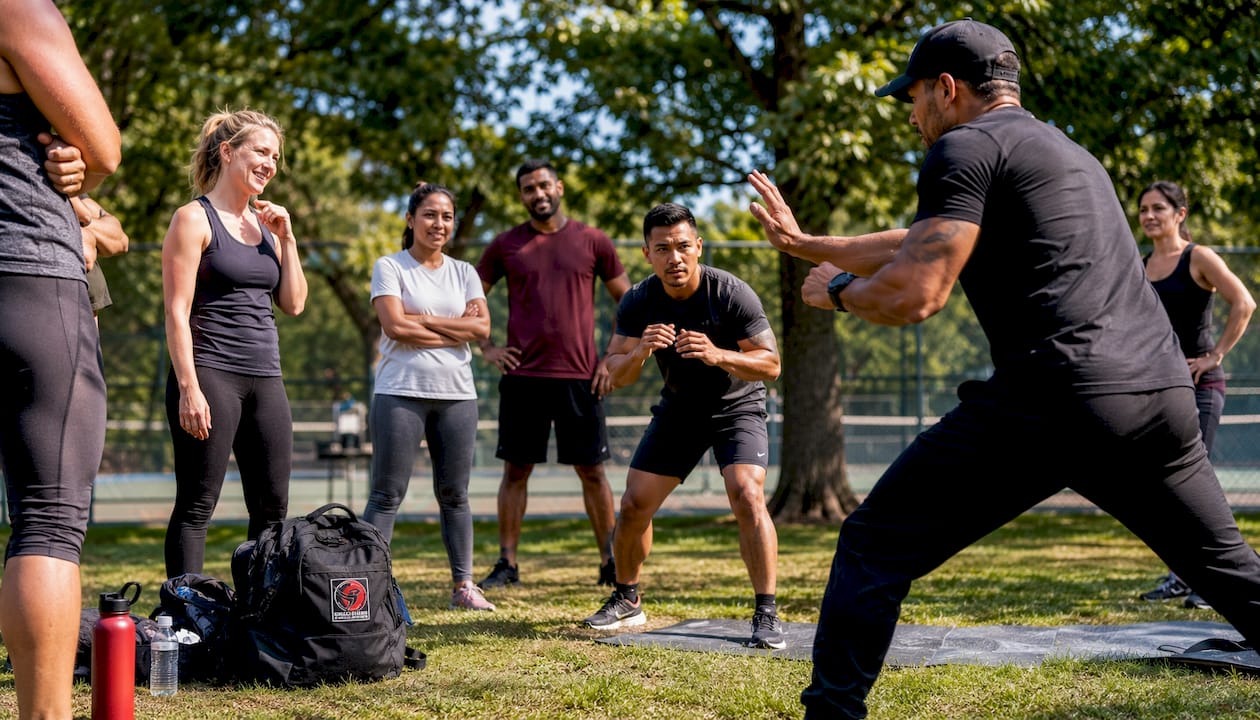
Scenario based training is a guided, realistic simulation that puts learners into controlled, pressure-tested moments to practise safety decisions before they face them in real life. The single most practical next step: run a short 3–5 minute role-play focused on one specific threat scenario, or book a pilot session with Streetsafeselfdefence to experience a structured, trauma-informed version firsthand.
Two things make this approach credible. First, peer-reviewed simulation literature on PubMed/PMC confirms that simulation replaces and amplifies real experiences with guided ones that replicate substantial aspects of the real world to practise skills safely. Second, the Northern Illinois University Centre for Innovative Teaching and Learning recommends that role-play exercises be short, content-focused, and tied directly to learning objectives. Both principles sit at the core of every well-designed safety scenario.
Key reasons scenario-based learning works for self-defence:
- It builds decision speed under realistic pressure, not just theoretical knowledge.
- It allows safe failure and immediate correction before real consequences exist.
- Short, focused runs of 3–5 minutes are adequate to test specific skills without overwhelming participants.
- Structured debriefs after each run lock in the learning.
Table of Contents
- What does scenario based training actually look like?
- Why scenario-based learning produces lasting safety skills
- How to design a safe, effective scenario session
- Trauma-informed safety, consent, and Canadian legal cautions
- Who benefits from scenario-based training in Canada?
- What a typical session costs and how long it takes to organise
- How to choose a scenario-based training provider in Canada
- How to measure whether scenario training is working
- How Streetsafeselfdefence runs scenario-based training
- Book a Streetsafeselfdefence pilot session in Canada
- Key takeaways
- Why short, guided scenarios are the most honest form of safety training
- Further reading and useful sources
What does scenario based training actually look like?
The term covers several distinct formats. Each suits a different objective, resource level, and group.
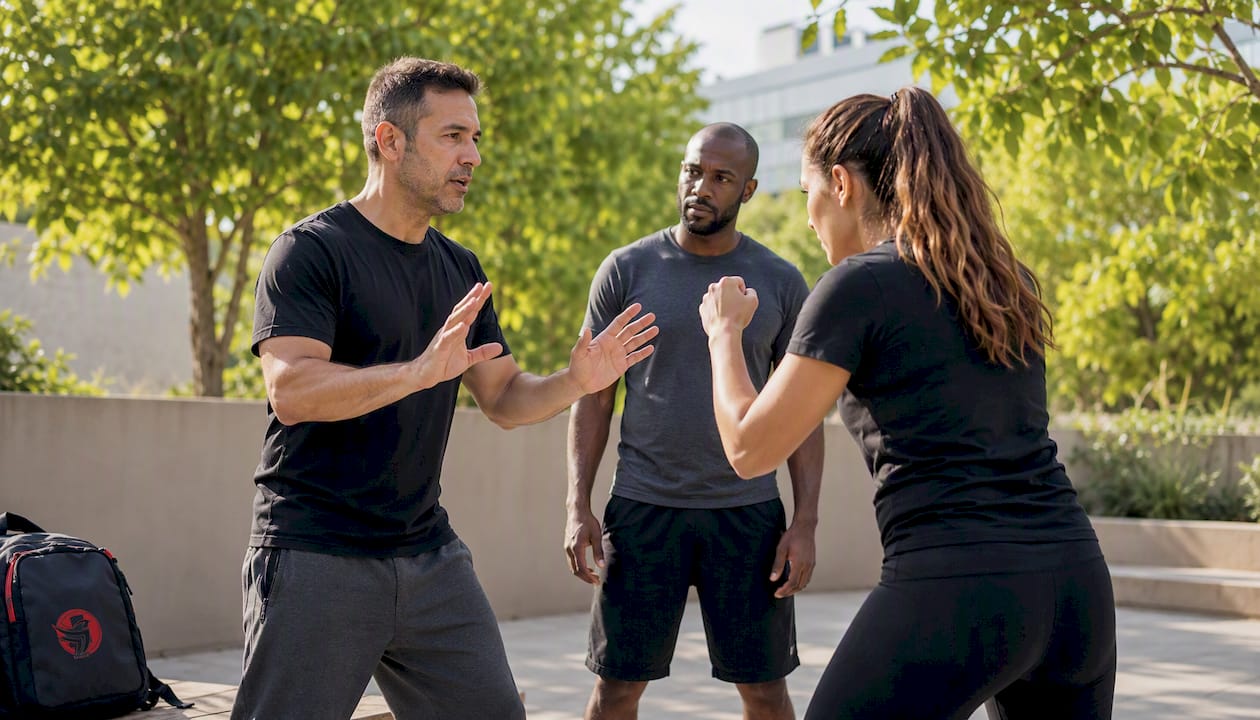
Short role-play is the most accessible format. Two or three participants act out a realistic encounter, such as a doorstep confrontation or a parking lot approach, for 3–5 minutes. One person plays the potential aggressor; the other practises awareness, boundary-setting, and exit strategies. Observers watch for specific cues and give structured feedback afterward.
In-situ drills take the scenario into the actual environment: a school hallway, a real estate showing, a hospital corridor. The physical setting adds fidelity that a classroom cannot replicate.
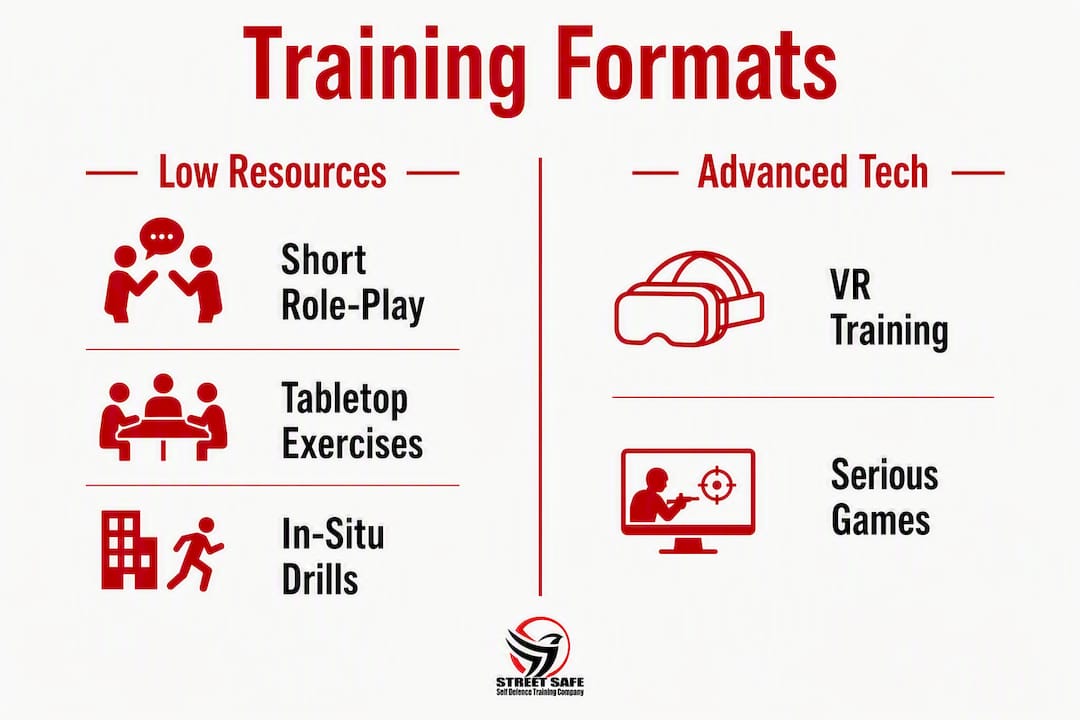
Tabletop exercises are discussion-based. A facilitator walks a group through an active-threat or workplace violence scenario step by step, asking what each person would do at each decision point. No physical movement is required, which makes them accessible for large groups or planning teams.
VR and serious games offer high immersion but require technology investment. They suit organisations with recurring training needs and budget for equipment.
| Format | Best objective | Realism level | Typical resource needs |
|---|---|---|---|
| Short role-play | Decision rehearsal, boundary-setting | Moderate | Facilitator, scenario cards |
| In-situ drill | Environmental awareness, exit routes | High | Venue access, facilitator |
| Tabletop exercise | Planning, team coordination | Low–moderate | Facilitator, scenario script |
| VR/serious game | Repeated immersive practice | Very high | Headsets, software, tech support |
Why scenario-based learning produces lasting safety skills
The mechanism is straightforward. Simulation-based learning has been applied across aviation, military, and healthcare precisely because it is educationally effective and complements traditional instruction. The learner faces a realistic choice under mild pressure, makes a decision, receives immediate feedback, and adjusts. That cycle builds both motor memory and decision fluency in a way that a lecture cannot.
Simulation training allows learners to practise decision-making and learn from mistakes in a controlled, risk-free environment, building the kind of confidence that transfers directly to real situations.
Three cognitive benefits stand out for self-defence contexts. Motor learning improves when the body rehearses a response repeatedly in a realistic context. Decision rehearsal reduces hesitation because the brain has already processed a similar threat pattern. Safe failure, where a participant makes the wrong call and immediately sees why, is often the most memorable learning moment in any session.
Pro Tip: Keep each scenario run to a single decision point. Trying to practise three different skills in one five-minute scenario dilutes all of them. Run it once, debrief, then run a second scenario targeting the next skill.
How to design a safe, effective scenario session
Start with a behavioural, measurable objective. “Participants will practise one verbal boundary-setting phrase and one physical exit strategy in a doorstep scenario” is a workable objective. “Participants will learn self-defence” is not.
Role-play exercises should be content-focused, match learning objectives, and include clear rules and observer roles. Observers are not passive. Give them a specific checklist: did the participant make eye contact, use a clear verbal signal, and move toward the exit? That specificity turns observation into useful feedback.
Providing private goals to a single participant adds a constructive twist that elicits spontaneous reactions and better develops adaptive decision-making. In a doorstep scenario, the person playing the aggressor might receive a secret instruction to escalate if the participant steps back. That unpredictability mirrors real encounters far more accurately than a fully scripted exchange.
Sample session plan (60-minute pilot):
| Time | Activity | Notes |
|---|---|---|
| — | Pre-brief: objectives, roles, stop signal | Consent confirmed, boundaries set |
| — | Scenario run 1 (3–5 min) + observer notes | Single decision point |
| — | Structured debrief: what worked, what to practise | Facilitator-led, non-judgmental |
| — | Scenario run 2 with adjusted trigger | Same participants or swap roles |
| — | Debrief + group discussion | Draw out learnings, not answers |
| — | Optional third run or tabletop variation | Based on group energy |
| — | Wrap-up and next steps | Reinforce key decisions |
Pro Tip: Stop the scenario on the early side if participants show frustration or confusion. Stopping before frustration peaks preserves the learning and protects the participant’s willingness to try again.
Trauma-informed safety, consent, and Canadian legal cautions
Consent is not optional. Before any simulation, every participant must understand the scenario’s purpose, their right to opt out at any point, and the stop signal the facilitator will use. This is especially important in self-defence contexts, where scenarios can activate real fear responses or prior trauma.
Key safety practices for Canadian facilitators:
- Conduct a written or verbal pre-brief that explains the scenario, roles, and physical boundaries.
- Establish a clear stop signal (a raised hand, the word “freeze,” or a physical tap) that all participants know before the session begins.
- Monitor emotional responses throughout. Stopping early is a valid instructional tactic, not a failure.
- Run a structured debrief that begins with feelings before moving to tactics.
- Offer a private check-in option for participants who may need to process the experience separately.
Debriefing is not a formality. It is where the learning is consolidated and where facilitators can identify and address any emotional distress before participants leave the room.
Canadian legal cautions are practical. Scenarios must not encourage or simulate the illegal use of force. Under Canadian law, the use of force in self-defence is governed by the Criminal Code of Canada, and any training that normalises disproportionate responses creates liability for the organiser. Confirm venue insurance covers physical training activities, and check whether your organisation’s liability policy extends to scenario-based exercises. For workplace violence prevention, Canadian provincial occupational health and safety legislation may also impose specific training documentation requirements.
This article is general information, not legal advice. Confirm current requirements with a qualified professional or the relevant regulatory body for your jurisdiction.
Who benefits from scenario-based training in Canada?
Scenario-based training fits a wide range of groups, and the format adapts to each.
- Women and individuals: Practise boundary-setting, awareness cues, and exit strategies in scenarios drawn from everyday situations: transit, parking lots, online meetings that escalate.
- Corporate teams: Corporate self-defence workshops use workplace-specific scenarios such as aggressive clients, after-hours encounters, and de-escalation breakdowns.
- School staff and high school students: Scenarios focus on peer conflict, active-threat awareness, and safe reporting. Group sizes of 8–15 allow everyone to participate and observe.
- Real estate agents: Doorstep and property-showing scenarios address the specific vulnerability of solo client meetings in unfamiliar locations.
- Security professionals and law enforcement: Higher-fidelity scenarios with event triggers and secret instructions test adaptive decision-making under realistic pressure.
- Indigenous community programmes: Culturally adapted scenarios address community-specific safety concerns with facilitators trained in trauma-informed delivery. Streetsafeselfdefence offers dedicated Indigenous community programming across Canada.
Accessibility matters. Scenario-based training does not require physical fitness. Verbal, observational, and planning-based roles mean participants of all ages and abilities can engage meaningfully.
What a typical session costs and how long it takes to organise
A standard pilot session runs 3–5 hours, covering pre-brief, multiple short scenario runs, debriefs, and wrap-up. Shorter 60–90 minute introductory formats work well for corporate lunch-and-learn slots or school staff days.
Cost drivers in Canada include facilitator credentials and experience, group size, whether the facilitator travels to your site (mobile delivery reduces venue costs), and any props or printed scenario materials required. Simple role-playing and interactive formats can be cost-efficient without sacrificing quality; VR and high-fidelity simulators offer deeper immersion but higher cost and logistical complexity.
Typical organising timeline:
- Week 1: Define objectives, confirm group size and venue, contact provider.
- Week 2–3: Provider customises scenarios to your context; consent and pre-brief materials prepared.
- Week 3–4: Session delivered; debrief and outcome data collected.
- Week 5: Follow-up survey and recommendations for next steps.
Most Canadian providers can deliver a pilot within three to four weeks of initial contact when the group size and objectives are clear upfront.
How to choose a scenario-based training provider in Canada
Core vetting checklist
- Facilitator holds verifiable credentials in self-defence instruction, adult education, or a related field.
- Provider uses a documented trauma-informed approach, not just verbal acknowledgment of it.
- Session philosophy favours short, focused scenario runs over long unscripted exercises.
- Provider carries liability insurance that covers physical training activities.
- References or testimonials from comparable Canadian groups are available on request.
Questions to ask before booking
- How do you manage a participant who becomes distressed mid-scenario?
- How do you adapt scenarios for our specific context and group?
- What does your debrief structure look like, and how long does it take?
- How do you measure whether participants have actually improved?
- What stop signals and opt-out mechanisms do you use?
Red flags to watch for
- No structured debrief plan.
- Insistence on long, fully unscripted “surprise” scenarios with no pre-brief.
- No evidence of trauma-informed practice or consent process.
- Facilitator cannot explain the learning objective behind each scenario.
- No insurance documentation available.
When de-escalation training alone is insufficient, a provider who only offers verbal techniques without physical awareness components may leave significant gaps in your team’s preparation.
How to measure whether scenario training is working
Pre and post confidence surveys are the simplest starting point. Ask participants to rate their confidence in three to five specific skills before the session and again immediately after. A meaningful shift in self-reported confidence is a reliable early indicator.
Observational metrics during scenarios give facilitators richer data. A short rubric might score each participant on: verbal boundary-setting (clear or unclear), physical positioning (aware or unaware), and decision speed (hesitant, prompt, or immediate). Scores across a group reveal which skills need more repetition.
For organisations, turn session outcomes into trackable KPIs: reduction in reported workplace incidents over six months, increase in staff confidence scores, or improvement in safety reporting rates. Connecting workplace safety culture to measurable outcomes makes the business case for ongoing training far easier to sustain.
How Streetsafeselfdefence runs scenario-based training
Streetsafeselfdefence delivers mobile, trauma-informed scenario training directly to clients across Canada. A typical pilot covers a condensed 3–5 hour programme with multiple short scenario runs tailored to the group’s specific context, whether that is high school staff, real estate agents, or a corporate team.
Each session follows the design principles outlined above: clear learning objectives set in advance, short scenario runs of 3–5 minutes, structured debrief after each run, and a trauma-informed pre-brief that establishes consent and stop signals before anything begins. Scenarios are drawn from real threat patterns relevant to the group, not generic exercises.
The T.R.A.A.C.S. programme is one example of how Streetsafeselfdefence structures evidence-informed curriculum delivery for professional and community groups. For healthcare and professional services contexts, the C.A.R.E. programme addresses the specific threat patterns those workers face.
Scenario-based training works when it is grounded in realistic choices, not theatrical performance. The goal is to build the decision patterns that protect people, not to impress them with complexity.
Participant outcomes consistently point to improved confidence, faster threat recognition, and a clearer sense of what to do in the first critical seconds of an encounter.
Book a Streetsafeselfdefence pilot session in Canada
Streetsafeselfdefence brings the training to you. Rather than asking your team to travel to a central venue, the mobile delivery model means a qualified, trauma-informed facilitator arrives at your workplace, school, or community space with everything needed to run a focused, safe scenario session.
To book a pilot, prepare three things: your group size, one or two specific safety objectives you want the session to address, and your preferred date range. That information allows Streetsafeselfdefence to customise scenarios before arrival and confirm insurance and venue requirements in advance.
The recommended starting point for most groups is a short at-home or small-group session or a mobile group booking for teams of five or more. Both options include a structured debrief and a follow-up recommendation for next steps. Contact Streetsafeselfdefence directly to confirm availability and receive a session outline tailored to your group.
Key takeaways
Scenario based training produces durable safety skills when sessions are short, objectives are specific, and every run is followed by a structured, trauma-informed debrief.
| Point | Details |
|---|---|
| Keep scenarios short | Runs of 3–5 minutes target one skill at a time and prevent participant overload. |
| Set objectives first | Define a behavioural, measurable outcome before designing any scenario. |
| Debrief every run | Structured debrief after each scenario is where the learning is consolidated. |
| Vet providers carefully | Confirm trauma-informed practice, liability insurance, and a documented debrief plan before booking. |
| Streetsafeselfdefence | Offers mobile, trauma-informed scenario training across Canada, tailored to your group’s specific context. |
Why short, guided scenarios are the most honest form of safety training
Most safety training fails not because the content is wrong, but because it stays abstract. People sit through a presentation, nod at the right moments, and walk away with no muscle memory, no decision rehearsal, and no real sense of what they would actually do. The scenario changes that. It puts the learner in the moment, forces a choice, and makes the feedback immediate and personal.
The short format is not a compromise. It is the point. A three-minute scenario that isolates one decision is more useful than a thirty-minute unscripted exercise that overwhelms the learner with too many variables at once. Repetition across short, focused runs builds the kind of automatic response that holds under real pressure. That is what participants carry out of the room.
The trauma-informed layer is not optional in self-defence work. Participants bring real histories into these sessions. A facilitator who treats consent, pre-briefing, and emotional monitoring as procedural checkboxes rather than genuine responsibilities can cause harm. The ethical obligation to protect learners is as important as the obligation to prepare them.
Further reading and useful sources
The following sources underpin the claims in this article and are worth reviewing directly if you are planning or commissioning scenario-based training in Canada.
- Simulation-based learning: justification and scope (PubMed) — The foundational academic case for simulation as a learning technique, not merely a technology. Relevant for anyone making the business case for scenario training.
- Simulation-based learning: Just like the real thing (PMC) — Evidence from high-stakes domains (healthcare, aviation, military) on why simulation complements traditional instruction.
- Simulation techniques and scenario design (PMC) — Covers secret instructions, event triggers, and adaptive scenario design. Practical for facilitators.
- Role playing | NIU Centre for Innovative Teaching and Learning — Instructional guidance on setting up role-play exercises with clear objectives and observer roles.
- A foolproof guide to running role plays (ACH) — Practical facilitator guidance including the 3–5 minute time limit recommendation and debrief best practices.
- Simulation training: types, applications, and benefits (WalkMe) — Overview of simulation formats (VR, tabletop, role-play, serious games, in-situ) and their relative strengths.
- Streetsafeselfdefence — workplace violence prevention training — Canada-specific guidance on legislative requirements and training documentation for organisations.
- Streetsafeselfdefence — trauma-informed self-defence — Detailed information on trauma-informed facilitation principles and survivor-focused programme design.