

Workplace harassment is defined as any unwanted conduct based on a protected characteristic, such as gender, race, disability, or religion, that creates a hostile or intimidating work environment. Knowing how to prevent harassment in the workplace is not optional for managers and employees. Nearly one in three employees feel unprotected from harassment, even at organisations that claim prevention is a priority. That gap between policy and lived experience is where real harm happens. Closing it requires clear policies, consistent training, accessible reporting, and a culture where respect is the standard, not the aspiration.

How to prevent harassment in the workplace with a strong policy
An anti-harassment policy is the legal and cultural foundation of any prevention effort. Without one, managers have no consistent standard to enforce, and employees have no clear signal about what behaviour is unacceptable.
A policy that actually works includes the following elements:
- Clear definitions. Name the forms of harassment explicitly: sexual harassment, racial harassment, workplace bullying, and harassment based on disability, religion, or age. Vague language creates loopholes.
- Protected characteristics. List every group covered under applicable human rights legislation, including the Canadian Human Rights Act and provincial equivalents.
- Multiple reporting channels. Employees must be able to report to someone other than their direct supervisor, especially when the supervisor is the source of the problem.
- Non-retaliation assurance. State plainly that no employee will face negative consequences for reporting in good faith. Without this, most incidents go unreported.
- Disciplinary measures. Specify the range of consequences for violations, from formal warnings to termination. Ambiguity here signals that the policy is not serious.
- Review schedule. Commit to reviewing the policy at least annually. Treating harassment as a psychosocial hazard within a workplace health and safety framework keeps the policy active rather than static.
Workplace discrimination settlements have reached $500,000 in recent cases. That figure reflects the legal and financial cost of failing to act, not just the human cost.
Pro Tip: Distribute the policy at onboarding, post it in shared spaces, and send a reminder every time it is updated. A policy no one has read offers no protection.
How can employees and managers build a respectful workplace culture?
Policy sets the rules. Culture determines whether those rules mean anything. A respectful workplace culture is one where people at every level model the behaviour they expect from others.
Leadership accountability is the single most important cultural driver. When managers dismiss complaints, make off-colour jokes, or tolerate cliques that exclude colleagues, they signal that the policy is decorative. When they address problems directly and consistently, they set a different standard entirely.
- Model respectful behaviour publicly. Leaders who correct disrespectful comments in meetings, not just in private, show that the standard applies to everyone.
- Create space for open dialogue. Regular team check-ins and anonymous pulse surveys give employees a low-stakes way to flag concerns before they escalate.
- Invest in diversity and inclusion training. Unconscious bias training reduces the micro-behaviours, such as interrupting, dismissing, or excluding, that often precede more serious harassment.
- Respond to early warning signs. Persistent cliques, patterns of exclusion, and repeated “jokes” at one person’s expense are cultural indicators that require intervention, not observation.
- Protect employee rights against harassment by naming bystander responsibility. Employees who witness harassment and say nothing become part of the problem. Train people to intervene safely or report what they saw.
Pro Tip: Run a brief, anonymous survey after each all-hands meeting asking whether employees felt respected. The data will tell you more than any formal review.

What are best practices for anti-harassment training programmes?
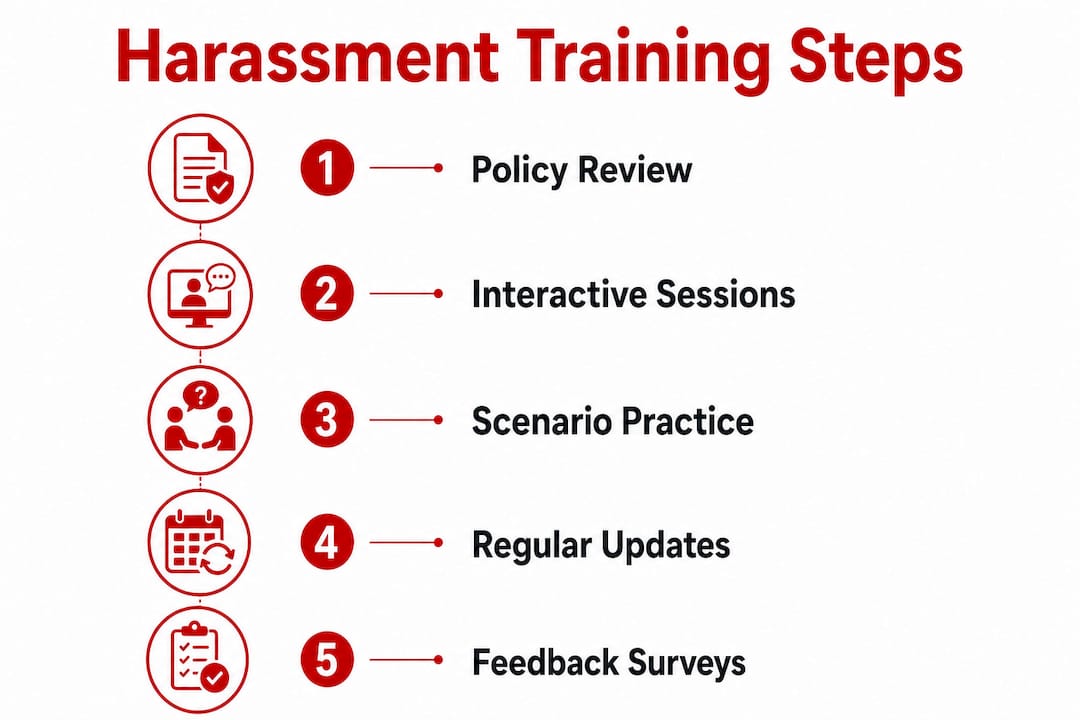
Training is the mechanism that turns policy into behaviour. A document in a shared drive does not change how people treat each other. Regular, well-designed training does.
Experts recommend annual anti-harassment training that includes live sessions with opportunities to ask questions. Automated click-through modules alone are not sufficient. Live sessions allow facilitators to address real scenarios, correct misconceptions, and model the kind of direct conversation that prevents harassment.
Effective training programmes share these characteristics:
- Role-specific content. Managers need training on their legal obligations, investigation procedures, and how to receive a complaint without dismissing it. Employees need training on recognising harassment, their rights, and how to report safely.
- Real-world scenarios. Case studies drawn from actual workplace situations, not abstract hypotheticals, produce better retention and more honest discussion.
- Interactive components. Role-play exercises, small group discussions, and Q&A segments keep participants engaged and build practical skills.
- Reinforcement of non-retaliation. Every training session should restate the organisation’s commitment to protecting reporters. Employees who fear retaliation will not use the system.
- Compliance with legal requirements. In Canada, provincial occupational health and safety legislation and human rights codes set minimum standards. Training must meet or exceed those requirements.
Training for harassment prevention is not a one-time event. It is an ongoing commitment that reflects the organisation’s values every time it is delivered.
How should organisations handle reporting and documentation?
Reporting systems fail when employees do not trust them. The most common reason for distrust is a single reporting channel that runs through a direct supervisor. Multiple confidential reporting options beyond direct supervisors increase reporting comfort and allow for earlier intervention.
Timely response to harassment reports is critical. Delays worsen harm and complicate resolution. Assigning a trained, neutral investigator at the outset signals that the organisation takes the complaint seriously.
Documentation is the legal backbone of any investigation. Detailed records should include dates, specific behaviours, involved parties, investigative steps taken, and employment decisions made during the process. Complete records reduce liability and improve transparency for all parties.
| Documentation element | Why it matters |
|---|---|
| Date and time of incident | Establishes a clear timeline and prevents disputes about sequence of events |
| Specific behaviours described | Removes ambiguity and supports consistent disciplinary decisions |
| Names of witnesses | Allows investigators to corroborate accounts independently |
| Investigative steps taken | Demonstrates procedural fairness and protects the organisation legally |
| Employment decisions during investigation | Proves that any personnel changes were not retaliatory |
Pro Tip: Store all harassment-related documentation in a secure, access-controlled system separate from general HR files. Limit access to those directly involved in the investigation.
Organisations that keep thorough workplace safety records are better positioned to defend decisions, support affected employees, and demonstrate good faith to regulators.
Key takeaways
Preventing workplace harassment requires clear policies, consistent training, accessible reporting, and a culture where leadership models the behaviour it expects from everyone else.
| Point | Details |
|---|---|
| Policy must be specific and active | Name all forms of harassment, list protected groups, and review the policy annually. |
| Culture starts with leadership | Managers who model respect and respond to early warning signs set the standard for everyone. |
| Training must be live and role-specific | Annual live sessions with real-world scenarios outperform automated modules for behaviour change. |
| Reporting needs multiple channels | Employees who distrust supervisors need alternative, confidential ways to report incidents. |
| Documentation protects everyone | Detailed records of incidents, steps, and decisions reduce liability and support fair outcomes. |
Why policies alone will never be enough
I have worked with organisations that had excellent written policies and genuinely terrible cultures. The policy sat in a shared drive. Nobody had read it since the year it was drafted. When an incident occurred, managers scrambled to find the document rather than knowing what to do.
The gap between policy and practice is not a paperwork problem. It is a trust problem. Human-centred, trauma-informed investigations that prioritise the affected person’s preferences produce better outcomes than processes that treat complaints as administrative tasks to be resolved quickly and quietly. Affected employees need to feel heard, not processed.
What I see consistently is that organisations invest in the visible parts of prevention, the policy document, the annual training module, the poster in the break room, and underinvest in the invisible parts. The invisible parts are the conversations managers have when something feels off, the willingness to act on a concern before it becomes a formal complaint, and the genuine commitment to protecting people who speak up.
Leadership accountability is not a soft concept. It is the mechanism that makes everything else work. A manager who dismisses a concern, even once, teaches every person who witnessed it that reporting is not safe. That lesson spreads faster than any training programme.
My advice is to treat your workplace safety culture as a living system that needs regular attention, not an annual compliance exercise. Listen to your employees. Act on what you hear. Adapt when the approach is not working. The organisations that do this consistently are the ones where harassment is genuinely rare.
— Rob
Streetsafeselfdefence and workplace safety training
Creating a respectful workplace means giving people the skills and confidence to act, not just the rules to follow.
Streetsafeselfdefence delivers reality-based violence prevention training directly to workplaces across Canada, with no gym required and no fitness prerequisite. The programme covers personal safety awareness, de-escalation, and boundary-setting in as little as five hours. It is designed for real people in real situations, including the kinds of situations that arise at work. Teams that complete the training report stronger confidence and a clearer sense of their rights and responsibilities. If your organisation is serious about creating a safer environment, Streetsafeselfdefence brings the training to you.
FAQ
What is workplace harassment?
Workplace harassment is any unwanted conduct based on a protected characteristic, such as race, gender, disability, or religion, that creates a hostile or intimidating work environment. It includes sexual harassment, bullying, and discriminatory behaviour.
How often should anti-harassment training happen?
Experts recommend annual anti-harassment training that includes live sessions with opportunities for questions. Automated modules alone are not sufficient for lasting behaviour change.
What should employees do when reporting harassment at work?
Employees should report to a designated HR contact, an ethics hotline, or another reporting channel that does not involve their direct supervisor. Documenting dates, behaviours, and witnesses before reporting strengthens the complaint.
Can an employer retaliate against someone who reports harassment?
Retaliation against an employee who reports harassment in good faith is prohibited under Canadian human rights legislation. Organisations must state this clearly in their anti-harassment policy and enforce it consistently.
How does documentation protect employees during an investigation?
Detailed records of incidents, investigative steps, and employment decisions made during the process demonstrate procedural fairness and protect both the affected employee and the organisation from legal claims of retaliation or discrimination.
