

By Rob Andress and Beth Andress
Street Safe Self Defence Training Company
At Street Safe Self Defence Training Company, one of Canada’s leaders in reality-based violence prevention and behavioural awareness, we spend a great deal of time studying how humans communicate under stress. One topic that often generates interest is micro expressions.ls.
What Are Micro Expressions?
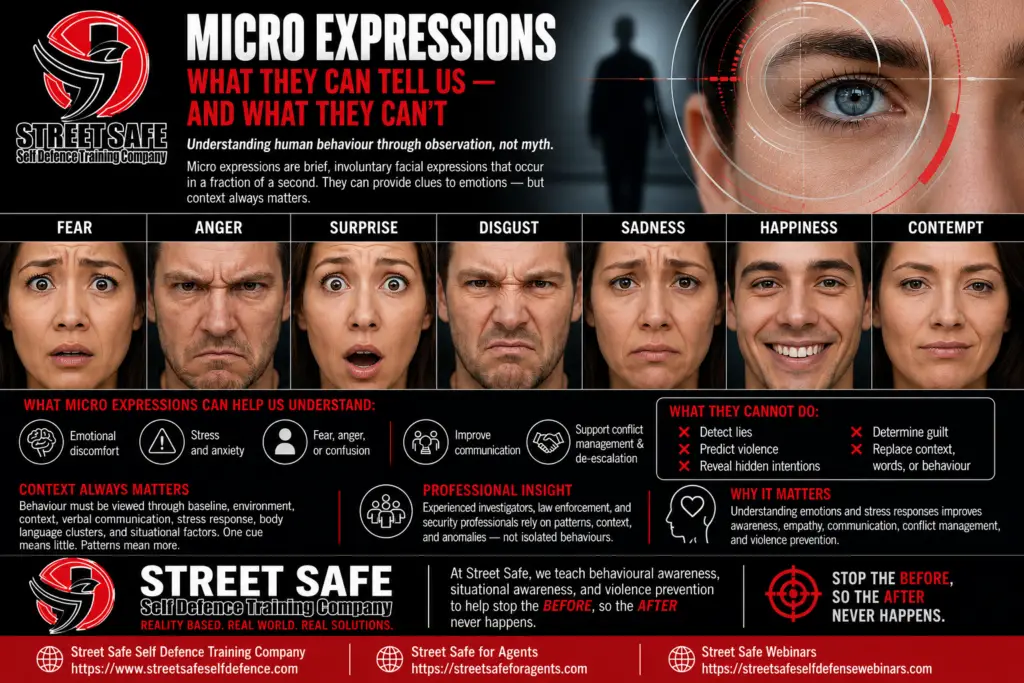
Micro expressions are brief, involuntary facial expressions that occur when someone experiences emotion. They happen very quickly, sometimes lasting less than half a second, and are believed to reflect genuine emotional reactions.
Research into facial expressions was pioneered by psychologist Dr. Paul Ekman, whose
Popular culture frequently portrays micro expressions as a “human lie detector.” Science says otherwise.
Understanding what micro expressions are—and equally important, what they are not, helps us become better observers, better communicators, and more effective violence prevention professionawork demonstrated that certain emotional expressions are recognized across cultures.
According to the Paul Ekman Group:
👉 https://www.paulekman.com
Examples of emotions commonly associated with facial expressions include:
- Fear
- Anger
- Surprise
- Disgust
- Sadness
- Happiness
- Contempt
These expressions may appear momentarily before a person consciously controls their response.
What Micro Expressions Cannot Do
Despite what television and social media often claim, micro expressions cannot:
❌ Detect lies
❌ Predict violence
❌ Reveal hidden intentions
❌ Determine guilt or innocence
❌ Replace context, words, or behaviour
Current scientific literature does not support using facial expressions as a stand-alone deception detector.
The American Psychological Association (APA) recognizes that emotions and behaviour are influenced by many factors:
👉 https://www.apa.org
Research databases from the National Institutes of Health (NIH) provide extensive literature on emotion and facial expression:
👉 https://www.nih.gov
PubMed Search:
👉 https://pubmed.ncbi.nlm.nih.gov/?term=facial+expressions+emotion
Context Always Matters
At Street Safe Self Defence Training Company, we teach that behaviour should always be viewed through the lens of:
- Baseline behaviour
- Environment
- Context
- Verbal communication
- Stress response
- Body language clusters
- Situational factors
One cue means little.
Patterns mean more.
This is why violence prevention specialists focus on behavioural clusters rather than isolated indicators.
Professional Discussions and Learning
Over the years, our understanding of behavioural awareness has been enriched through discussions with experienced investigators, intelligence practitioners, law enforcement professionals, and security specialists.
Those discussions consistently reinforce one reality:
No single behaviour predicts intent. Human beings are too complex.
Experienced professionals rely on patterns, context, and anomalies, not isolated facial movements.
Why Understanding Micro Expressions Matters
Micro expressions aren’t valuable because they expose lies.
They’re valuable because they remind us to pay attention.
Combined with situational awareness and communication skills, these observations may improve:
- Conflict management
- De-escalation
- Leadership
- Empathy
- Interviewing
- Violence prevention
What We Teach at Street Safe
At Street Safe Self Defence Training Company, founded by Rob Andress and Beth Andress, we teach behavioural awareness from a reality-based perspective.
Our programs focus on:
- Situational awareness
- Human behaviour
- Social versus asocial violence
- Baseline and anomaly recognition
- Conflict management
- De-escalation
- Workplace violence prevention
- Women’s safety
- Youth safety
- Healthcare safety
- REALTOR® safety
Our philosophy has always been simple:
“Stop the BEFORE, so the AFTER Never Happens.”
Learn more about Street Safe:
👉 https://www.streetsafeselfdefence.com
Related Street Safe Resources
High School Self Defence: Why Violence Prevention Matters More Than Fighting
Violence within schools often never needs to become physical. Understanding relationships, social violence, and early warning signs can create safer communities.
Women’s Violence Prevention Programs
Street Safe teaches women practical violence prevention strategies based on behavioural awareness rather than strength or athletic ability.
👉 https://streetsafeselfdefence.com/womens-self-defence/
REALTOR® Safety Training
Canada’s leading REALTOR® safety education and violence prevention programs.
👉 https://streetsafeforagents.com
Street Safe Self Defence Webinars
Online education for REALTORS®, healthcare professionals, security professionals, and organizations across Canada.
👉 https://streetsafeselfdefensewebinars.com
Scientific Resources
Paul Ekman Group
Micro Expressions Training and Research
https://www.paulekman.com/micro-expressions-training-tools/
American Psychological Association
APA Dictionary – Facial Expression
https://dictionary.apa.org/facial-expression
National Institutes of Health
PubMed Research Database
https://pubmed.ncbi.nlm.nih.gov/?term=facial+expressions+emotion
PLOS ONE Scientific Journal
https://journals.plos.org/plosone/
National Academies of Sciences
https://nap.nationalacademies.org
Frequently Asked Questions
Are micro expressions real?
Yes. Scientific research supports the existence of brief involuntary emotional expressions.
Can micro expressions tell you if someone is lying?
No. Current research does not support using them as lie detectors.
Can they predict violence?
No. Violence prediction requires context, behavioural patterns, and situational assessment.
Why do violence prevention specialists study them?
Because understanding stress, emotion, and communication can improve awareness, empathy, and conflict management.
Does Street Safe teach behavioural awareness?
Yes. Behavioural awareness, situational awareness, conflict management, and violence prevention are foundational principles in all Street Safe programs.
Learn more:
👉 https://www.streetsafeselfdefence.com
About the Authors
Rob Andress and Beth Andress are the founders of Street Safe Self Defence Training Company, one of Canada’s leaders in reality-based violence prevention, behavioural awareness, and situational awareness training.
Street Safe provides education to healthcare professionals, schools, municipalities, corporations, security teams, and real estate professionals across Canada.
Websites
🌐 Street Safe Self Defence Training Company
https://www.streetsafeselfdefence.com
🌐 Street Safe for Agents
https://streetsafeforagents.com
🌐 Street Safe Webinars
https://streetsafeselfdefensewebinars.com
