

Yes — the OODA loop helps civilians stay safer when you adapt it to real legal and psychological limits. You observe the cues, orient by reading intent and your legal footing, decide on a proportionate response like avoiding, deterring, escaping, or engaging, then act on rehearsed movements that get you to safety. Orientation, not speed, is where most people struggle and where training should focus.
TL;DR:
- Focusing on orientation during stress is crucial because biases like normalcy bias and confirmation bias often distort perception when under threat.
- Practicing quick observation and decision-making drills repeatedly, including scenario-based exercises, can significantly reduce reaction times and improve safety.
- Legal principles such as proportionality, necessity, and reasonableness must guide every response, with detailed documentation to protect against post-incident scrutiny.
- Predators exploit gaps in observation and quicken surprise attacks, so situational awareness and pre-planned exit routes help counteract such tactics.
- Trauma-informed, mobile training programs that incorporate structured observe, orient, decide, act sequences improve realistic decision-making under real stress.
Table of Contents
- What is the OODA loop, and why does civilian self-defence need a different version?
- How do you apply observe, orient, decide, and act in a real threat?
- Why does orientation break down under stress?
- What drills actually shorten your decision loop?
- What legal limits shape how civilians should decide and act?
- How do offenders exploit gaps in your OODA loop?
- How does Streetsafeselfdefence train realistic decision-making?
- When is OODA training actually worth the investment?
- Ready to practise this in a supervised setting?
- Where to go for deeper reading on this topic
- Sources
What is the OODA loop, and why does civilian self-defence need a different version?
U.S. Air Force Colonel John Boyd built the OODA loop in the early 1970s to explain why some fighter pilots consistently outmanoeuvred opponents in air combat. Observe, orient, decide, act: four steps, cycling continuously, each one feeding the next. Boyd’s insight held up well outside the cockpit, and today the model shows up in business strategy, law enforcement training, and personal safety programs.
Here’s the problem. Military and tactical versions of OODA assume authorised force, a clear mission, and teammates backing you up. None of that applies to you standing alone in a parking garage at 9 p.m. You have no rules of engagement briefing, no radio support, and a legal system that will scrutinize every choice you make in the seconds that follow.
Civilian OODA has to be rebuilt around three things: what the evidence actually says about stress and decision-making, what the law actually permits, and what a person carrying real trauma can realistically practise. Civilian self-defence applications have to account for ambiguous threats and legal accountability in ways a fighter pilot never had to consider.
How do you apply observe, orient, decide, and act in a real threat?
Each phase asks a different question, and each one has specific, learnable content. Here’s what it looks like when you break it down for street-level situations rather than a cockpit.
Observe means running a constant, low-effort scan of your environment:
- Who is nearby, and are they moving with purpose or drifting aimlessly?
- What sounds are out of place. Footsteps matching your pace, a car idling too long?
- Where are your exits, and would you actually reach one in under five seconds?
- Are bystanders present, and if so, are they likely to be helpful or neutral?
Orient is where you interpret what you just observed, and it’s the phase that decides almost everything else. This is where you check: is this person’s behaviour consistent with a normal environment, or does it break the pattern? Are you interpreting actual intent, or might your perception be influenced by preconceived notions? Ask yourself honestly whether fear or normalcy bias is colouring the read, and check your emotional state. Racing heart and tunnel vision both distort orientation, and knowing that in the moment helps you correct for it.
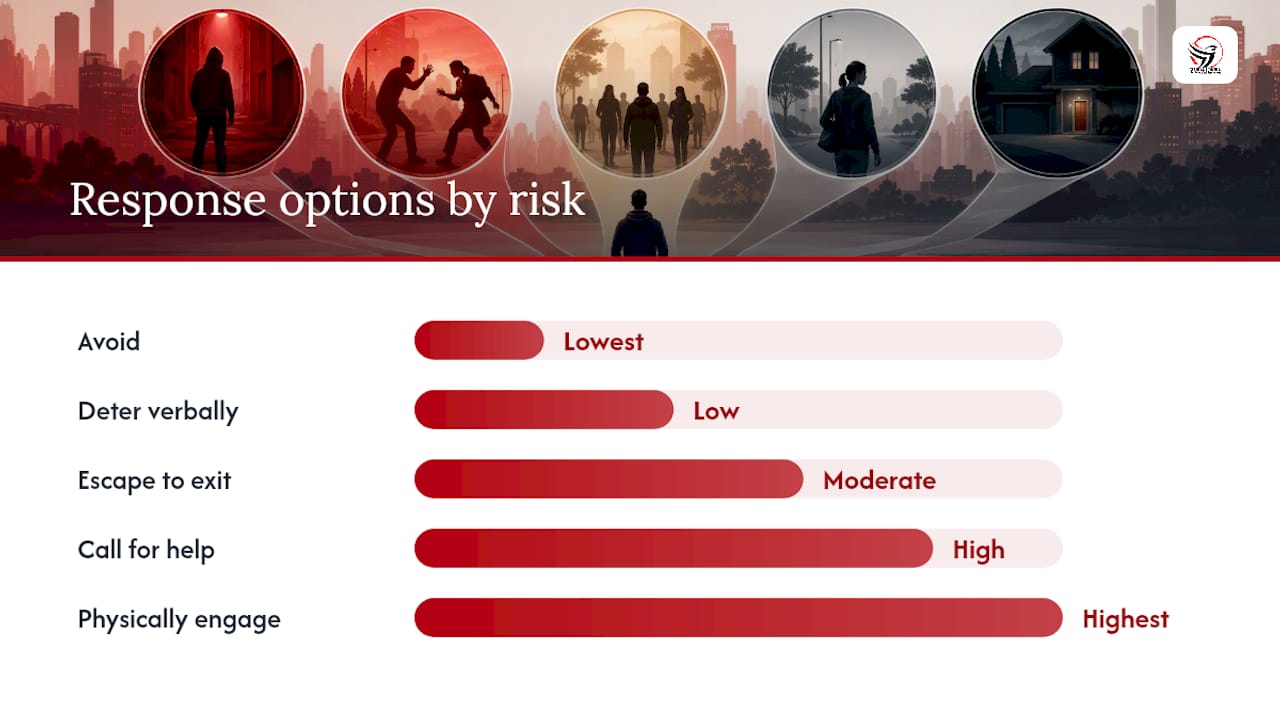
Decide works best as a short menu, not an open-ended brainstorm. Under stress, you don’t have the bandwidth for creative problem-solving, so give yourself four or five pre-built options: avoid, deter verbally, escape toward a specific exit, call for help, or physically engage as a last resort. Rank them by how much risk and force each one carries, and default to the lowest-risk option that still gets you safe.
Act is execution, and it should feel almost boring because you’ve already rehearsed it. A loud verbal command, a pivot toward a doorway, a hand raised to create distance. Chain these small movements together the same way every time you drill them, because a self-defence strategy is only useful if your body performs it without conscious debate in the moment.
Why does orientation break down under stress?
Orientation fails more than any other phase, and the reason is physiological, not a character flaw. Under acute threat, your body can trigger tonic immobility or a full freeze response, a documented reaction where muscles lock and thinking narrows to a single, often unhelpful, point. Attention tunnels onto the most obvious threat cue and blocks out everything else, including your own exit route.
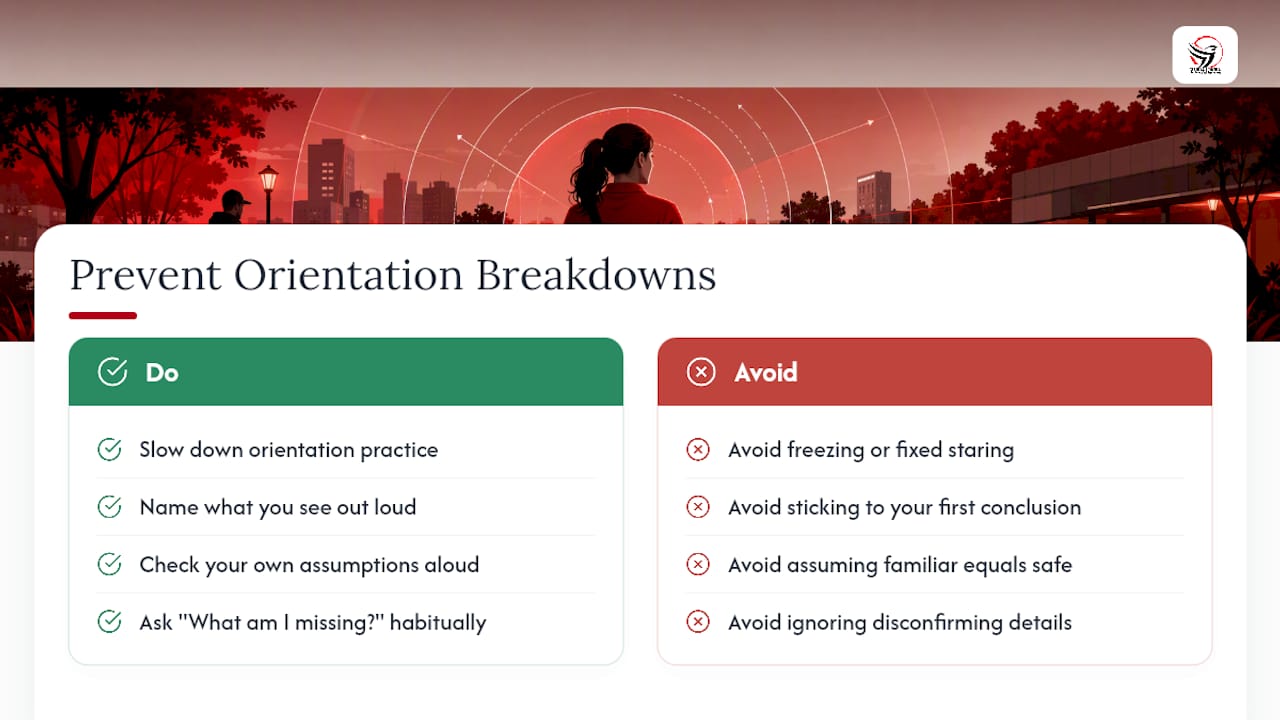
Three biases distort orientation specifically. First-conclusion bias locks you onto your initial read of a situation even after new information contradicts it. Normalcy bias tells you nothing this bad could be happening in a familiar place, so you delay reacting until the threat is much closer. Confirmation bias makes you notice only the details that support what you already believe, and ignore the ones that don’t.
Watch for these signs that someone (including yourself) is mis-orienting: fixed staring at one point while ignoring movement elsewhere, repeating the same question instead of processing an answer, or freezing mid-sentence. The fix isn’t more physical drilling. It’s slowing down orientation practice specifically: naming what you see out loud, checking your own assumptions, and building a habit of asking “what am I missing?” before deciding anything.
What drills actually shorten your decision loop?
Training the loop works the same way any decision-making skill develops: through repetition under mild, then increasing, stress. Boyd’s own approach leaned on continuous testing and feedback, and that same logic works for personal safety.
- Timed observation drills. Sit in a public space for two minutes and write down every person, sound, and exit you noticed. Compare your list to what you actually missed. Repeat weekly and track how much faster your list grows.
- Cue-list practice. Build a short, memorised list of five behavioural or environmental warning signs specific to your regular routes, and quiz yourself on them until they’re automatic.
- Partner scenario drills. Have a partner walk toward you with an ambiguous posture and give yourself a three-second window to decide: ignore, verbally engage, or move. Rotate roles so you practise reading intent from both sides.
- Action-chain rehearsal. Pick one proportionate response (verbal command plus a step toward an exit) and physically rehearse it until it happens without a conscious pause. Simple, rehearsed micro-behaviours cut the gap between deciding and acting.
- Decision journals. After each drill or real-life close call, write down what you observed, how you oriented, what you decided, and whether it worked. This mirrors the iterative testing Boyd built his own thinking around and gives you a record to spot patterns in your own mistakes.
Situational awareness programs recommend rehearsing observation and orientation against realistic hazards rather than abstract scenarios, and structured drills built around real threats transfer better to the street than generic reaction time exercises. For solo practice between sessions, home-based training routines let you keep cycling these drills without needing a partner every time.
Pro Tip: Track your drill times in a simple notebook or phone note. If your observation-to-decision time isn’t shrinking over four to six weeks of consistent practice, the drill itself needs to change, not just the repetition count.
What legal limits shape how civilians should decide and act?
Every decide-and-act phase you rehearse has to sit inside three legal principles: proportionality (your response can’t exceed the threat), necessity (you had no safer reasonable option), and reasonable belief (a reasonable person in your position would have perceived the same danger). These aren’t optional add-ons to your training. They’re the framework a court will use to judge your actions after the fact, and they vary by jurisdiction, so confirm the specifics that apply where you live.
Documentation matters more than most people expect. Note details immediately after any incident: time, description, what was said, and who witnessed it. Memory degrades fast under stress, and a written record protects you later.
Practically, that means avoidance and de-escalation come first every time they’re viable, calling police is almost always the right early move rather than a last resort, and preserving evidence (torn clothing, messages, a phone recording) matters as much as the physical outcome.
How do offenders exploit gaps in your OODA loop?
Predatory behaviour is often built specifically to break your orientation phase. Surprise attacks skip your observe step entirely by closing distance before you register a threat. Social manipulation, like asking for directions or “help,” exploits your instinct to be polite and delays your orientation into a threat frame. Deliberate ambiguity, someone loitering just close enough to be unsettling but not close enough to justify action, stalls your decide phase until it’s too late to choose a low-risk option.
Countermeasures map directly onto the same four steps:
- Position yourself with your back toward a wall or open space, never a corner, to protect your observe phase.
- Use visible deterrence like confident posture and direct eye contact to shift how an offender orients toward you.
- Keep a short verbal script ready (“Stop. Back up.”) so your decide phase doesn’t stall on word choice.
- Plan your exit route before you need it, so act happens without hesitation.
A person who scans early, states a boundary loudly, and moves toward a planned exit reverses the loop entirely, forcing the other person to re-orient around a target that suddenly looks harder to reach.
How does Streetsafeselfdefence train realistic decision-making?
Courses can be built around the orientation-first principle: trauma-informed instruction that respects how stress actually affects the body, delivered through mobile sessions brought directly to various locations such as schools, workplaces, and homes. Rather than drilling isolated techniques, learners rehearse short, complete action chains, the same observe-orient-decide-act sequences covered above, until they become close to automatic.
A typical short course moves a learner from basic awareness (noticing risk cues) through structured decision practice (choosing a proportionate response under mild pressure) to reliable action (executing a rehearsed response without freezing). The goal isn’t mastering dozens of techniques. It’s making one or two decision chains dependable under real stress.
When is OODA training actually worth the investment?
Decision training earns its place when you treat it as a skill, not a one-time seminar. The research on stress and orientation is consistent enough that skipping it in favour of pure technique practice leaves a gap most people never notice until they’re actually in danger. My advice: split your practice time between physical skill and decision drills, rehearse regularly rather than intensively, and keep every scenario grounded in what’s actually lawful for you to do. Ask yourself honestly what you’re training for. Confidence in a class, or reliability on the street? The answer should shape everything else.
— Rob
Ready to practise this in a supervised setting?
Mobile training sessions allow you to rehearse observe-orient-decide-act sequences with real feedback instead of guessing whether your instincts hold up under pressure. Unlike a general fitness class or a one-off seminar, this mobile format can offer convenience without travel, gym membership, or long-term commitment, just sessions built around decision skills similar to those covered here.
If you’re new to structured training, the introductory self-defence lesson walks you through what a first session actually involves and how long it takes to see real progress. For readers carrying past trauma who need a more sensitive pace, the trauma-informed course applies the same evidence-based approach with extra care around pacing and control. Want to keep drilling between sessions? The home training program lets you practise the observation and decision exercises above on your own schedule. Book a session and start turning this framework into something your body actually knows how to do.
Where to go for deeper reading on this topic
- The Wikipedia entry on the OODA loop covers Boyd’s original military framework in full detail.
- Farnam Street’s breakdown of Boyd’s thinking explains the iterative testing behind decision journals.
- AlertMedia’s situational awareness guide offers structured drill templates.
- For professional-grade scenario design ideas, see this security training example roundup.
Sources
- Situational awareness training exercises + download
- OODA loop: what you can learn from fighter pilots about making fast and accurate decisions
