

Carry a high-decibel personal alarm, wear a Road ID or similar wearable tag, and keep your phone accessible with Garmin LiveTrack or a comparable sharing feature turned on. Practise two escape drills a month so they’re automatic under stress. That’s the whole plan, and none of it breaks the law.

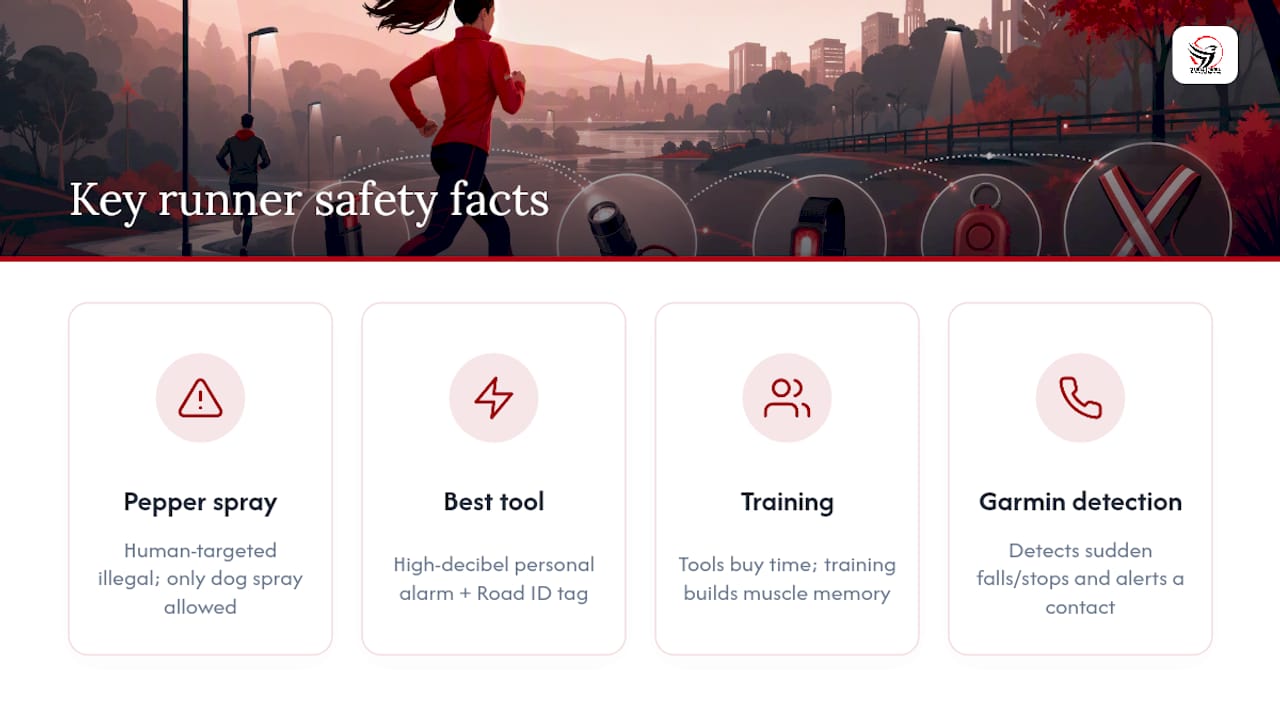
Here’s the part most runners miss: human-grade pepper spray is illegal in Canada. Only spray labelled and sold specifically for use against animals, commonly called dog spray, is legal to carry, and it’s meant for animal encounters only. Using it on a person can lead to criminal charges, even if you were defending yourself.
The safest, most legally sound self defense for runners combines non-weapon tools with a few rehearsed physical responses, not a weapon you hope you never have to explain to police.
- Carry a personal alarm clipped to your hand or strap, not buried in a pocket.
- Turn on phone-based incident detection or share your live route with one trusted contact.
- Wear a Road ID style tag with emergency contact info.
- Practise a wrist grab escape and a loud vocal projection drill weekly.
Key Takeaways
Effective self-defence for runners combines legal, non-weapon tools with a handful of rehearsed physical drills, not reliance on a single product.
| Point | Details |
|---|---|
| Carry non-weapon tools first | A personal alarm, Road ID, and phone-based tracking cover most scenarios without legal risk. |
| Know the spray law | Only animal-labelled dog spray is legal in Canada; using it on a person can bring criminal charges. |
| Accessibility beats concealment | Keep tools in hand or on a quick-release strap, not zipped away where seconds are lost. |
| Practise under exertion | Rehearse draws and escapes while your heart rate is up, since calm-only practice often fails under stress. |
| Train for the biggest return | A short Street Safe Self Defence session builds the reflexive skills tools alone can’t provide. |
Table of Contents
- Runner-friendly safety tools: what to carry and how they compare
- How to carry and access tools while running
- Reality-based tactics runners can learn fast
- Canadian legal rules you must know before buying or carrying defensive tools
- Tech and tracking options that increase safety without legal risk
- Quick checklist for choosing the right tools and habits for your runs
- How Street Safe Self Defence training complements your safety kit
- Frequently asked questions
- Sources
Runner-friendly safety tools: what to carry and how they compare
Four categories cover almost everything a runner reasonably needs, and none of them require a permit or a court date to explain later. A personal alarm, an animal-labelled deterrent spray, a wearable ID, and incident-detection tech each solve a different piece of the safety puzzle, and most runners are better off carrying two or three together rather than betting everything on one option.
SABRE-style personal alarms are a good example of the category: small, keyring-sized, and loud enough to startle an attacker or draw attention from anyone nearby. Road ID represents the wearable-ID category well, a simple wristband or shoe tag that lists your name, emergency contact, and any medical conditions EMS would need to know. Neither raises legal questions in Canada, and both cost less than a pair of running socks.
| Tool | Legal status in Canada | Deterrence / time to escape | Carry & access while running | Best for | Cost |
|---|---|---|---|---|---|
| Personal alarm | Fully legal | High, sound startles and draws attention | Excellent, clips to hand or strap | Urban and night routes | $10 |
| Animal deterrent spray (dog-labelled) | Legal for animal use only | Moderate, buys distance from a dog | Good, needs a belt holster or hand strap | Trail runs, rural routes with loose dogs | $15 |
| Wearable ID (Road ID style) | Fully legal | None directly, speeds emergency response | Excellent, worn passively | All runners, especially solo | $20 |
| Incident-detection tech (Garmin LiveTrack) | Fully legal | None directly, alerts contacts automatically | Excellent, runs in background | Remote trails, early-morning or night runs | Varies by device, often included with GPS watch |
Human-targeted pepper spray and most stun devices sit outside this table entirely because they’re either illegal or carry serious legal risk to possess in Canada. That’s not a technicality worth gambling on. Non-weapon tools like alarms, wearable ID, and live tracking consistently show up as the recommended first-line kit precisely because they improve rescue outcomes without exposing you to criminal liability.
Pro Tip: Keep your alarm or spray in your hand or on a quick-release wrist strap for the first and last mile of any run through a low-visibility area. Fumbling for a zipped pocket costs you the seconds that matter most.
How to carry and access tools while running
Accessibility beats concealment almost every time. A tool buried in a zippered pocket might as well not exist if you need it in the next three seconds.
- Hand-held strap: keeps an alarm or spray in your palm without gripping it the whole run.
- Quick-release belt holster: sits at the hip, draws in one motion.
- Chest strap pocket: works for phones and ID, less ideal for anything you need instantly.
- Wrist strap with clip: fast access for alarms, doesn’t interfere with arm swing.
- Shoe-mounted ID: passive and always with you, no retrieval needed.
Pro Tip: Practise the draw and deployment motion during your warm-up, while your heart rate is already up. Fine motor skills degrade under stress, and a movement you’ve only tried while calm often falls apart when adrenaline hits.
Reality-based tactics runners can learn fast

Physical technique matters less than most runners assume. Reality-based instructors prioritise threat recognition and the ability to shift from calm to explosive action over complicated fighting sequences, because spotting danger early beats fighting your way out of it every time.
A few drills are worth repeating until they’re reflexive:
- A 60-second awareness scan before you start, noting exits, people, and lighting.
- A 30-second vocal projection drill, practising a loud, sharp “back off” or “stop.”
- Two to three repetitions of drawing and using your chosen tool from its actual carry position.
- One wrist grab escape and one bear hug escape, both simple enough to remember under pressure.
Fitness and self-defence readiness aren’t the same skill. Running ability doesn’t prepare your nervous system for the freeze response a real threat can trigger, which is why short, targeted practice matters more than another 10K.
Runners who’ve gone through a Street Safe Self Defence session consistently describe faster reaction time and more confidence on solo runs, not because they became fighters, but because the drills were rehearsed enough to survive an adrenaline spike.
Pro Tip: Train the hair grab defense and an elbow strike to create distance together. Both use the same core movement, so learning one reinforces the other.
Canadian legal rules you must know before buying or carrying defensive tools
The rule is simple, but easy to get wrong: human-targeted pepper spray is illegal in Canada, and only spray labelled for animal defence is permitted to carry. Using a dog spray on a person, even in self-defence, can lead to criminal charges rather than protect you legally.
- Carrying an item you intend to use as a weapon, regardless of label, can itself trigger charges.
- Animal-labelled spray is meant for animal encounters, not human ones.
- Non-weapon tools carry no such legal exposure and often work just as well for getting help fast.
When in doubt, the safer legal path is a tool that summons help rather than one meant to incapacitate. It sidesteps the entire question of whether force was justified after the fact.
For a deeper look at how Canadian law treats self-defence generally, Street Safe Self Defence’s guide to understanding self-defence in Canada breaks down what’s actually permitted.
Tech and tracking options that increase safety without legal risk
Garmin’s incident detection and LiveTrack features notice sudden stops or falls and alert a chosen contact automatically, which matters most on remote trails where a fall or injury could go unnoticed for hours. For longer backcountry runs, a satellite communicator like Garmin inReach extends that coverage past cell service entirely. Road ID tags speed up EMS response by putting your name and emergency contact right on your wrist. Keep earbud volume low enough to hear your surroundings, since situational awareness depends on actually hearing what’s around you.
Pro Tip: Layer three low-effort tools together: LiveTrack shared with one contact, a personal alarm in hand, and a Road ID on your wrist. None of them require training to use correctly.
Quick checklist for choosing the right tools and habits for your runs
Match your kit to your actual route, not a generic list.
- Assess your route: lighting, population density, and known trouble spots.
- Predict likely threats: loose dogs on trails, vehicles at intersections, isolation at night.
- Confirm legal status of anything you plan to carry.
- Prioritise tools you can access without slowing down or looking away.
- Rehearse deployment monthly, not just once after purchase.
- Low cost: personal alarm, Road ID.
- Medium cost: animal-labelled spray plus a short training session.
- Higher investment: satellite communicator plus ongoing self-defence training.
Training remains the highest-return investment on this list. A short, focused course beats months of half-hearted practice on your own.
A trainer’s note on what actually works
Practise your extraction drill until it’s boring, and start with a personal alarm and a Road ID tag. Training sharpens your response, but awareness and avoidance still do most of the work.
How Street Safe Self Defence training complements your safety kit
Tools and tech get you time. Training tells you what to do with it. Street Safe Self Defence builds trauma-informed, reality-based sessions that fit into a single short module, often just a few hours, and focuses on the exact drills runners need most: fast escapes, vocal projection, and switching from calm to decisive action under stress.
Sessions are mobile, meaning instructors come to your gym, workplace, or running group rather than the other way around, and they’re built for people who’ve never taken a self-defence class before. If you run solo regularly, pairing a short course with the tools covered above closes the gap between having a plan and actually being able to execute it. You can also train from home if a scheduled group session doesn’t fit your routine, or check the Street Safe Self Defence homepage to see current class formats and booking availability. Book a module before your next season of early-morning or after-dark runs, not after something happens.
Frequently asked questions
Is pepper spray legal for runners to carry in Canada?
No. Human-targeted pepper spray is illegal to carry in Canada. Only spray labelled for animal use, often called dog spray, is legal, and it’s meant strictly for animal encounters.
What’s the single best tool for solo running safety?
A high-decibel personal alarm offers the best combination of legality, cost, and ease of access for most runners, especially paired with a Road ID tag.
Do I need self-defence training if I already carry safety tools?
Tools buy time; training tells you what to do with it. Short reality-based sessions build the muscle memory tools alone can’t provide.
How does Garmin incident detection help runners?
It detects sudden falls or stops and alerts a chosen contact automatically, which matters most on remote trails where a fall could otherwise go unnoticed.
This article is general information, not a substitute for advice from a qualified lawyer. Consult a qualified legal professional about your own circumstances before acting on anything here.
Sources
- Is pepper spray legal or illegal in Canada?
- The Best Self Defense Tactics for Runners
- Self-Defense For Runners: How To Stay Safe On The Road
