

The most common, observable signs that someone may be trying to abduct you or your child are: being followed on foot or by vehicle, repeated loitering near your location, attempts to isolate you from others, a car slowing down or pulling up with an offer of a ride, and unusual questions about your daily routine or home life. If you notice any of these, act immediately.

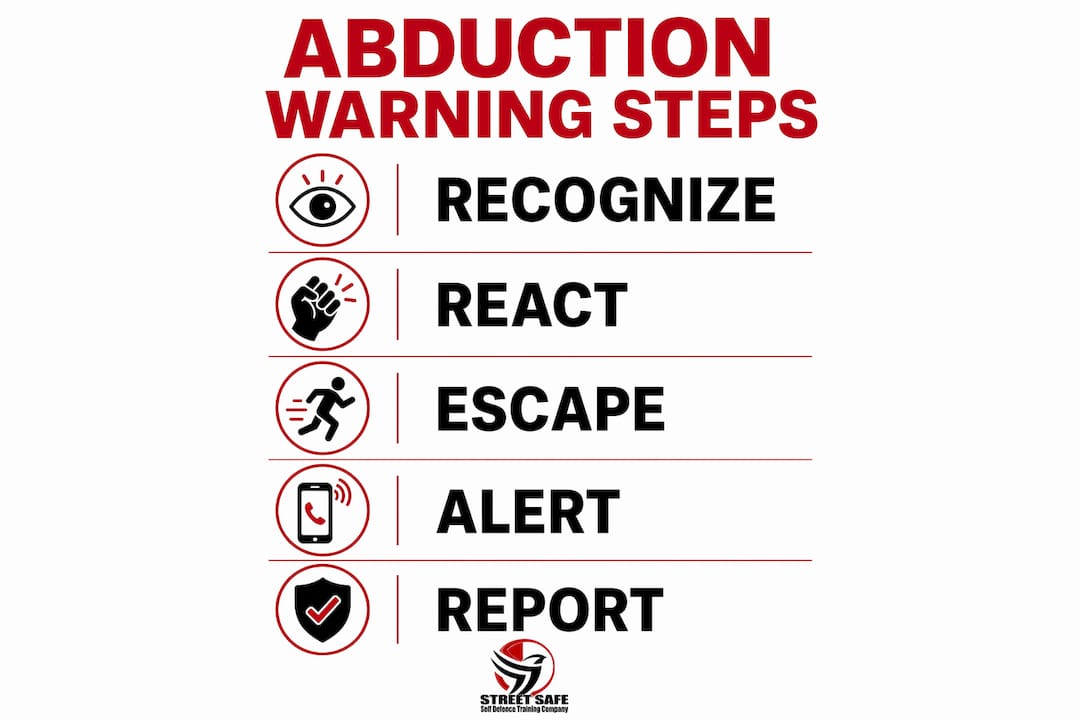
Immediate actions checklist:
- Put distance between yourself and the person right away. Move toward people, light, and open spaces.
- Make noise. Shout, draw attention, and name what is happening (“This person is trying to grab me!”).
- Call 911. In Canada, this is your first call for any ongoing threat or imminent danger.
- Record what you can safely observe: vehicle colour, make, licence plate, direction of travel, and a physical description of the suspect.
- Share your live location with a trusted contact if you can do so without slowing your escape.
Pro Tip: You do not need to be certain before you act. Permission to leave uncertainty is a real principle in personal safety: a strong gut feeling is enough reason to move away.
Table of Contents
- What are the signs someone is trying to abduct you as an adult?
- What signs and tactics are used to target children?
- What should you do right now if you suspect an abduction?
- How do experts identify pre-incident indicators (PINS)?
- How do you teach abduction awareness to children and household members?
- How and when do you report suspicious behaviour in Canada?
- Key takeaways
- Why rehearsal matters more than awareness alone
- Practical training that builds these skills
- Useful sources and Canadian resources
What are the signs someone is trying to abduct you as an adult?
Most adults dismiss early warning signs because each one, taken alone, seems explainable. The pattern is what matters. A single slow-moving car is unremarkable. The same car making a U-turn and passing you twice on a quiet street at night is a signal worth acting on.
Being followed on foot or by vehicle

Someone following you on foot will often mirror your pace and direction. If you change speed or cross the street and they adjust to match, that is deliberate. On the road, watch for a vehicle that drives slowly past you, circles the block, or repeatedly appears at different points along your route. Note the make, colour, and any part of the licence plate you can read safely.
Self-defence in a car carries its own set of risks. If a vehicle follows you while you are driving, do not go home. Drive to a police station, a fire hall, or any busy public location and call 911 from there.
Loitering near exits and attempts to isolate you

A person who positions themselves near the exit of a parking garage, a stairwell, or a quiet corridor is not always a threat. But if that same person moves when you move, or tries to steer you away from a group by asking you to step aside, that is an attempt to isolate you. Isolation is a prerequisite for most abductions. Stay in sight of others.
Unusual questions about your routine
Questions like “Do you live alone?” “What time do you usually finish work?” or “Is your husband home?” from someone you do not know are not small talk. They are reconnaissance. The same applies to someone who seems to already know details about your schedule or neighbourhood without a clear reason.
Pro Tip: Time of day and location change the risk level significantly. A question that feels harmless at noon in a busy café carries a different weight at 9 PM in an empty parking lot. Read the context, not just the words.
Contextual escalation is the clearest signal of all. A stranger who starts with a question, then moves closer, then touches your arm, then blocks your path is showing you a pattern. Each step tests your response. Recognising that escalation early, and responding firmly, is what protecting yourself from violent situations looks like in practice.
What signs and tactics are used to target children?
Children are targeted differently than adults. The approach is usually slower, more conversational, and designed to feel safe. According to KidSmartz / MissingKids, the most common lures used during abduction attempts include offering a ride, candy or treats, money, or showing an animal. Knowing these lures by name makes them easier to recognise and teach.
Common child-specific red flags:
- An adult asking a child for help finding a lost pet or giving directions (adults do not typically ask children for help).
- Offering gifts, money, or food with no clear reason.
- Asking a child to keep a conversation or meeting secret from their parents.
- Claiming to be a friend of the family, a teacher, or a school official the child does not recognise.
- Using an “emergency trick”: telling a child their parent has been hurt and they need to come right away.
- Accusing a child of wrongdoing to create fear and compliance (the “bad child” trick, as identified by Project Harmony).
KidSmartz / MissingKids data also shows that a significant share of attempted abductions involving children occur when they are travelling to or from school, often between 2 PM and 7 PM, and frequently involve a suspect in a vehicle.
Scripts parents can practise right now
Johns Hopkins Medicine recommends moving away from vague “stranger danger” messaging and teaching children specific, observable behaviours instead. Many offenders are known to the child, so “stranger” is not always the right frame. Teach the no-go-tell approach: say no clearly, go away from the person immediately, and tell a trusted adult as soon as possible.
Two short role-play examples to run with your child:
Scenario 1 (ages 5–8): “Someone you don’t know says their puppy is lost and asks you to help look. What do you do?” Walk through: say “No, I have to go,” run to the nearest safe adult, and tell them what happened.
Scenario 2 (ages 9–12): “Someone says your mum was in an accident and sent them to pick you up. What do you do?” Walk through: do not get in the car. Ask for the family code word. If they don’t know it, run to a safe place and call home.
Pro Tip: Set a family code word that only your household knows. If someone claims to be picking up your child on your behalf, they must give that word. No word, no go.
What should you do right now if you suspect an abduction?
Escape comes before everything else. Getting distance between yourself and a threat is more valuable than collecting evidence, confronting the person, or waiting to be certain. Once you are safe, you can call for help and document what you saw.
Step-by-step priority actions
- Get distance. Move toward people, light, and open spaces. Do not walk toward a vehicle that has pulled up near you.
- Make noise immediately. Shout a specific phrase: “Help! This person is trying to grab me!” Specific language cuts through confusion and tells bystanders exactly what is happening.
- Call 911. Tell the dispatcher your location first, then describe the threat. In Canada, 911 connects you to police, fire, and ambulance services. Stay on the line.
- Record details safely. If you can do so without slowing your escape, note the vehicle make, colour, licence plate, and direction of travel. A partial plate is still useful.
- Share your location. Use your phone’s built-in emergency SOS feature (available on both iPhone and Android) or share your live location through a messaging app with a trusted contact.
On the question of physical resistance: if escape is possible, escape. If you are grabbed and escape is not immediately possible, making noise and creating a scene is your most effective tool. Physical resistance techniques are best learned through structured practice. Attempting moves you have not rehearsed under stress often makes the situation worse.
Pro Tip: iPhone users can press the side button five times rapidly to trigger Emergency SOS. Android users can press the power button five times. Both call 911 and share your location automatically.
How do experts identify pre-incident indicators (PINS)?
Pre-Incident Indicators, or PINS, are the observable behaviours that precede most violent or predatory acts. Security researchers and practitioners, including Gavin de Becker, have documented that predators rarely act without first testing their target. Recognising PINS gives you time to act before a situation escalates.
Security experts note that would-be abductors commonly use a predictable set of manipulative tactics:
- Creating urgency: “We need to go right now.” Urgency bypasses your ability to think clearly.
- Offering unsolicited help: Carrying your bags, offering a ride, or insisting on walking you somewhere you did not ask for.
- Flattery: Excessive compliments designed to lower your guard and create a sense of obligation.
- Testing compliance with small requests: Asking you to move a few steps, hand over your phone, or step into a quieter area. Each small yes makes the next request easier to comply with.
- Rejecting your “no”: This is one of the clearest PINS. When someone continues after a clear refusal, they are demonstrating controlling intent. A person with good intentions accepts no. A person with bad intentions does not.
The first weapon a predator uses is confusion, not force. Disorienting you, making you second-guess your instincts, and keeping you engaged in conversation are all tactics designed to delay your escape response.
Pro Tip: If someone’s claim feels off, ask a verification question. “What’s my teacher’s name?” or “What’s our code word?” A legitimate person will understand. Someone with bad intent will stall, deflect, or escalate. That response is your answer.
Understanding human behaviour through frameworks like TRAACS gives you a structured way to read these patterns before they become physical threats.
How do you teach abduction awareness to children and household members?
Awareness without rehearsal fades quickly under stress. Role-play and physical practice build the kind of muscle memory that holds up when fear takes over. The goal is not to frighten children. It is to give them a clear, automatic response they can trust.
Core rules by age
For children aged 4–7, keep it to three rules: stay with a trusted adult, never go anywhere without telling a parent, and if someone makes you feel scared or uncomfortable, run and tell.
For children aged 8–12, add the no-go-tell framework from Johns Hopkins Medicine, the family code word, and a list of two or three named safe adults outside the home (a neighbour, a teacher, a relative).
For teens, introduce PINS awareness, the concept of escalation patterns, and how to use emergency phone features. Teens are also at risk from online grooming, so supervised location sharing and clear limits on sharing personal details with strangers on social media are worth discussing directly.
A simple 3-minute drill
KidSmartz / MissingKids recommends short, timed drills of 60–90 seconds that rehearse yelling a specific phrase, running to a named safe place, and telling an adult. Run this drill once a week for a month, then monthly after that. Name the safe place before you start. Time the run. Make it concrete.
Pro Tip: Keep the parental preparation steps from MissingKids on hand: know your child’s route to school, coordinate pickup policies with the school directly, and keep an up-to-date child ID kit with a recent photo and physical description.
On the digital side, enable location sharing between family members on a platform you all use (Apple’s Find My, Google Family Link, or Life360 are widely available in Canada). Set clear rules about who your child can accept friend requests from, and review privacy settings on their accounts together.
How and when do you report suspicious behaviour in Canada?
Call 911 immediately if an abduction is in progress, if someone is in immediate danger, or if you have just witnessed a threat. Give your location first, then describe what you saw.
For suspicious behaviour that has already occurred but does not require an emergency response, contact your local police non-emergency line. In most Canadian cities, this number is listed on the police service’s website. Report repeated contacts, loitering near a school or playground, or any incident that felt threatening but did not result in physical harm.
What to tell police:
- Exact time and location of the incident.
- Physical description of the suspect: height, build, clothing, hair, distinguishing features.
- Vehicle description: make, colour, model if known, licence plate (full or partial), and direction of travel.
- Names and contact information of any witnesses.
- Any photos or recordings you captured safely.
For child-specific concerns, the National Centre for Missing and Exploited Children’s Canadian counterpart, MissingKids.ca, provides resources and reporting guidance. The RCMP’s National Centre for Missing Persons and Unidentified Remains (NCMPUR) handles cases involving missing persons at the national level.
Regarding family or custodial abduction risk: research on parental abduction identifies prior threats, a history of hiding a child, liquidation of assets, and applications for passports or travel documents as warning signs worth reporting to police before an abduction occurs.
After filing a report, ask the responding officer about victim services in your province. Every province in Canada has a victim services programme that can connect you with counselling, safety planning, and legal information.
Pro Tip: Preserve all evidence before reporting: do not delete photos, texts, or voicemails. Screenshot any relevant social media activity. Write down everything you remember while it is fresh, including the exact words used.
Under Canadian law, abduction of a person under 16 is a criminal offence under the Criminal Code of Canada. This article is general safety information, not legal advice. For your specific situation, consult a qualified legal professional or contact your local police service directly.
Key takeaways
Recognising the signs someone is trying to abduct you and acting immediately, before certainty, is the single most important principle in personal abduction prevention.
| Point | Details |
|---|---|
| Top three red flags | Being followed (on foot or by vehicle), attempts to isolate you from others, and rejection of your “no” are the highest-priority warning signs. |
| First three actions | Get distance, make noise with specific language, and call 911. Escape precedes evidence collection every time. |
| Child lure awareness | Common lures include offering rides, candy, money, or showing an animal; attempts between 2 PM and 7 PM near schools carry elevated risk. |
| Teach and rehearse | Run short drills with children monthly, use a family code word, and name at least two safe adults outside the home. |
| Streetsafeselfdefence | Offers reality-based, mobile training that builds the PINS awareness and rehearsed escape responses described in this article. |
Why rehearsal matters more than awareness alone
Most people who read an article like this one will feel more informed for a day or two. Then the details fade. That is not a failure of memory. It is how the brain works under stress: what you have only read does not hold up the same way as what you have practised on your feet, out loud, in a real space.
The gap between knowing what to do and actually doing it under fear is significant. Security practitioners consistently point to this gap as the reason why behavioural intelligence, paired with short physical drills, produces better outcomes than awareness alone. An app on your phone will not close that gap. Rehearsal does.
What students often report after structured training is not just greater confidence. It is faster decision-making. They describe situations where they noticed something was wrong earlier than they would have before, and where they acted on that feeling without waiting for certainty. That earlier response window is exactly what PINS awareness is designed to create.
The practical recommendation is straightforward: read this article, run the drills with your household, and then get structured practice in a setting where someone can correct your technique and push your stress response. A few hours of well-designed training builds more reliable responses than months of passive reading.
Practical training that builds these skills
Knowing the warning signs of abduction is the starting point. Responding to them under pressure is a skill that requires practice. Streetsafeselfdefence brings reality-based, trauma-informed training directly to you, whether you are an individual, a parent, a school group, or a workplace team.

Participants learn to spot PINS in real scenarios, practise loud verbal scripts that attract attention, rehearse escape tactics, and build the decision-making speed that matters when seconds count. The mobile format means the training comes to your location across Canada, with no gym membership or long-term commitment required.
If you want to build the skills described in this article, self-defence training at home is the most direct next step. Book a session for your family, your team, or yourself and practise the responses that could matter most.
Useful sources and Canadian resources
The following sources were used in preparing this article. Each one offers reliable, practical information for further reading.
- KidSmartz / MissingKids (Preventing Abduction): Covers common lures, timing patterns, and parental preparation steps including route familiarisation and child ID kits.
- Johns Hopkins Medicine: Stranger Danger and Stranger Safety: Explains why “stranger danger” messaging falls short and how to teach observable behaviours and the no-go-tell approach.
- Project Harmony: Common Tricks: Lists the predictable lures abductors use on children, including the emergency trick, the animal trick, and the “bad child” trick.
- Quick and Dirty Tips: 7 Ways to Spot a Predator: Summarises the PINS framework and the role of pre-incident testing in predatory behaviour.
- Teen Health and Wellness: Ten Ways to Protect Yourself Against Abduction: Practical guidance on role-play, physical drills, and escape tactics for teens and adults.
- U.S. Department of State: Early Identification of Risk Factors for Parental Abduction: Research on custodial and family abduction indicators, including financial and behavioural warning signs.
- Streetsafeselfdefence.com: Mobile self-defence training and reality-based violence prevention courses available across Canada.
For training enquiries, visit Streetsafeselfdefence.com or book directly through the self-defence training at home page.
