

Street Safe Self Defence Training Company: Changing the Conversation About Violence Prevention Across Canada
Part 1: Why We Believe Violence Can Be Prevented
By Rob Andress
Violence Prevention Specialist
Founder, Street Safe Self Defence Training Company
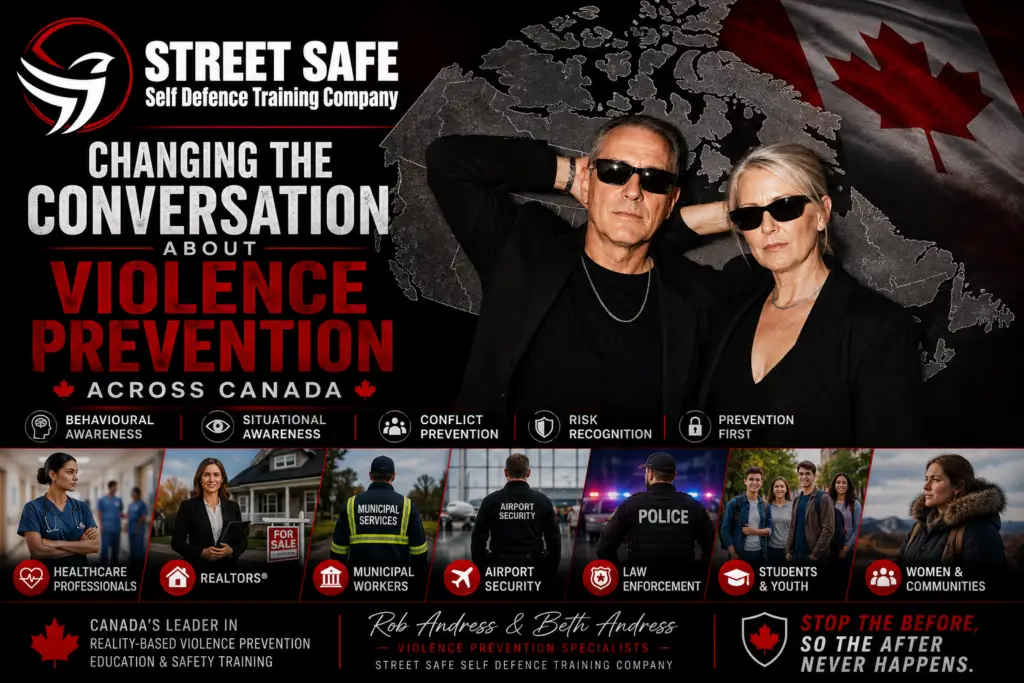
If you’d asked me years ago what self-defence meant, I probably would have talked about punches, escapes, joint locks, or how to survive an assault. Today, my answer is completely different.
I think we’ve spent decades asking the wrong question. For years, almost every self-defence course, workplace violence program, and safety seminar has started in exactly the same place.
“What do you do after the attack begins?”
Learn a strike! Learn an escape! Learn a restraint! Learn how to fight!
Those skills do have their place. I’d never suggest otherwise. But after spending years teaching thousands of Canadians, from high school students and healthcare professionals to REALTORS®, municipal employees, airport security teams, law enforcement officers, By-Law Professionals, and women across the country, I’ve come to believe something that has changed everything about the way Beth and I teach.
The better question isn’t how you survive violence. It’s how you prevent it from happening in the first place!
That single idea became the foundation of Street Safe Self Defence Training Company. It also became our mission.
Stop the Before, So the After Never Happens.
A Different Way of Looking at Violence
People often assume violence is random. In my experience, it rarely is. Violence is a human behaviour, and human behaviour follows patterns. Before someone becomes physically aggressive, something usually changes, and you’ll see it clearly, but only if you understand the behaviour.
Their emotions change.
Their communication changes.
Their body language changes.
Their decision-making changes.
Most people simply haven’t been taught what those changes look like. That’s what Street Safe has always been about.
Not teaching people to predict the future. Teaching them to recognize the behavioural clues that often appear before violence, intimidation, manipulation, or victimization.
That’s a very different skill set than learning how to fight.
Why We Believe Violence Is Predictable
One of the questions Beth and I hear more than almost any other is: “Can violence really be predicted?”
My answer is always the same. Not every act of violence can be predicted. But human behaviour is remarkably predictable.
People don’t suddenly become violent without a process. Long before a punch is thrown, a weapon is produced, or a threat is made, behaviour begins to change.
Those changes leave clues.
At Street Safe, we don’t teach people to predict the future. We teach them to recognize the behavioural patterns that often precede violence. Whether we’re teaching healthcare professionals, REALTORS®, airport security teams, municipal employees, high school students, or law enforcement officers, the principles remain remarkably consistent.
People communicate their intentions long before they act on them.
That’s why behavioural awareness sits at the centre of everything we do.
We teach the difference between social violence and asocial violence.
We teach how understanding a person’s normal behaviour, their baseline, this valuable information helps us recognize when something has changed.
We teach situational awareness, environmental awareness, and perhaps most importantly, self-awareness, because understanding your own reactions under stress, understanding ones “TRUE ABILITY” is every bit as important as understanding the person standing in front of you.
I’ve often said that violence rarely comes out of nowhere. It usually comes out of somewhere!
The problem is that most people have never been shown where to look, that’s what Beth and I have dedicated our lives to changing. Because when you recognize behavioural clues early enough, you create something incredibly valuable.
Time.
Time to think.
Time to create distance.
Time to make a better decision.
Sometimes, that time is the difference between becoming a victim and walking away safely.
That’s why we believe violence is often predictable.
Not because we can see the future.
Because we understand people.
More Than a Training Company
Street Safe was never built to be another self-defence company. It was built to change the conversation, to create a movement, a movement that involves truth, not ego, fact, not techniques that will work in the scenario
Over the years, that mission has taken Beth and me into hospitals, high schools, Indigenous communities, municipalities, international airports, corporate workplaces, real estate boardrooms, healthcare organizations, and communities across Canada.
Different professions.
Different environments.
The same human behaviour.
No matter where we teach, the message remains the same.
Awareness comes before action.
Understanding comes before technique.
Prevention comes before protection.
Because if we can stop the violence before it begins, we’ve already achieved the best possible outcome.
And that’s exactly what Street Safe has always stood for.
Street Safe Self Defence Training Company: Changing the Conversation About Violence Prevention Across Canada
Part 2: Building a National Standard for Violence Prevention
By Rob Andress
Violence Prevention Specialist
Founder, Street Safe Self Defence Training Company
When Beth and I started Street Safe, we never sat down with a map of Canada and said, “Let’s build a national training company.”
Our goal was much simpler than that, we wanted to change the way people understood violence.
If we could help one person recognize the warning signs before an assault happened, if we could give one woman permission to trust her instincts, or help one healthcare worker avoid an escalating confrontation, then we felt we were making a difference.
What we didn’t expect was how many different professions would discover they were facing the same problem.
The uniforms were different, the workplaces were different. The risks looked different, but the human behaviour behind the violence was remarkably similar. That’s when we realized Street Safe was never about one industry. It was about people!
Every Profession Faces Human Behaviour
Over the years, we’ve had the privilege of educating people in almost every corner of Canada.
We’ve taught violence prevention in more than 100 Canadian high schools, speaking with thousands of young people about healthy relationships, dating violence, consent, sextortion, online exploitation, coercive control, and the importance of understanding behaviour before crisis develops.
We’ve worked with healthcare professionals through our CARE (Clinical Awareness & Response to Escalation) program, helping staff recognize behavioural changes, communicate more effectively under stress, and reduce workplace violence while preserving the dignity of patients and families.
We’ve trained international airport security teams, municipal security professionals, by-law officers, protective services, and law enforcement through our TRAACS (Tactical Risk Awareness & Applied Combative Systems) program.
The principles remain the same.
Officer safety doesn’t begin when force becomes necessary. It begins minutes earlier, by recognizing behaviour, managing space, communicating effectively, and making better decisions before a confrontation reaches the point where force feels like the only option.
Changing REALTOR® Safety Across Canada
One of the journeys I’m most proud of has been watching the Canadian real estate industry begin to change its thinking around personal safety.
When Beth and I first started speaking to real estate boards, safety was often viewed as common sense.
There was an assumption that serious violence against REALTORS® was rare. But if there’s one thing I’ve learned over the years, it’s that the absence of reports is not the absence of risk.
Today, Street Safe has educated more than 8,000 REALTORS® across Canada through provincial associations, real estate boards, brokerages, licensing programs, and continuing education. Together, we’ve helped shift the conversation from reacting to dangerous situations to preventing them.
We’ve introduced concepts like First Point of Contact Management, SPACE Management, behavioural threat recognition, social versus asocial violence, identity verification, digital safety, workplace violence prevention, and AI-enabled fraud awareness.
More importantly, we’ve helped reinforce a simple truth. Safety isn’t just an individual responsibility. It’s an organizational responsibility!
That change in thinking may be one of the most important advances the profession has made.
Standing Beside Women, Not in Front of Them
One of the things Beth and I have always believed is that women don’t need false confidence. They need honest information, women need to be told the truth about the violence they face, and who their greatest Predator will be!
Over the years we’ve worked with women’s organizations across Canada, delivering violence prevention education that focuses on how predators select victims, how coercive control develops, why intuition has behavioural foundations, and how awareness creates options long before physical force is ever needed.
Some of the work we’re proudest of has taken us into Nunavik in Northern Quebec, where we developed one of Canada’s first specialized violence prevention programs created specifically for Inuit women experiencing intimate partner violence and sexual assault.
Every community has its own realities. Every culture deserves education that respects those realities.
Violence prevention should never be one-size-fits-all.
The Digital World Changed Everything
When people think about Street Safe, they often think about my work in behavioural awareness and violence prevention.
But today’s threats don’t always walk through the front door. Sometimes they arrive on your phone.
That’s where Beth has become one of the driving forces behind our company. Her work in digital fraud awareness, AI-generated threats, online family safety, identity theft, romance scams, and digital victimization has become an essential part of what Street Safe offers today.
Violence prevention isn’t just physical anymore. The digital world has become another environment where awareness protects people before harm occurs.
And if we’re going to prepare Canadians for the future, we have to prepare them for both worlds.
Looking Back With Gratitude
When I look back over the year, I don’t think first about the number of people we’ve taught. I think about the conversations, and the knowledge I’ve gained by hearing the reality of how, who and when these crimes of violence are committed. But the facts of real lived experiences. This is how we built our company, on fact, reality and truth. Not on ego, or what looks “COOL”
The healthcare worker who finally understood why a patient escalated.
The REALTOR® who decided not to enter a property because something didn’t feel right.
The municipal employee who recognized behavioural changes before an encounter became violent.
The young woman who realized she didn’t need proof to leave an uncomfortable situation.
Those are the moments that matter. Those are the moments that remind Beth and me why we started Street Safe in the first place. Because success isn’t measured by the techniques people remember. It’s measured by the confrontations that never happen.
Street Safe Self Defence Training Company: Changing the Conversation About Violence Prevention Across Canada
Part 3: The Future of Violence Prevention in Canada
By Rob Andress
Violence Prevention Specialist
Founder, Street Safe Self Defence Training Company
When people ask me what the future of violence prevention looks like, my answer usually surprises them.
I don’t think the biggest changes will come from teaching people better ways to fight. I think they’ll come from teaching people to understand other human beings. From truth, from fact, and from reality, not make believe.
We’ve invested enormous amounts of time teaching people what to do once violence has already begun. There will always be a place for physical skills. I’m not suggesting otherwise. But if we truly want to reduce violence, workplace injuries, trauma, and victimization, we have to start much earlier in the process.
We have to understand the person standing in front of us.
The Next Generation of Safety Education
I’ve watched the conversation begin to change.
Healthcare organizations are asking different questions. Municipalities are looking beyond physical intervention.
Real estate associations are recognizing that safety begins before an agent ever unlocks a front door. Schools are realizing that healthy relationships, coercive control, online exploitation, and behavioural awareness belong in the classroom, not after a crisis, but before one.
Even law enforcement and protective services are placing greater value on communication, positioning, behavioural recognition, and decision-making. That tells me we’re moving in the right direction. Not away from physical skills. Toward a more complete understanding of human behaviour.
Technology Has Changed the Risk
The world has also become more complicated.
Today’s predator doesn’t always stand in front of you, sometimes they’re hiding behind a fake social media profile.
Sometimes they’re using artificial intelligence to clone a loved one’s voice, sometimes they’re manipulating trust through romance scams, investment fraud, or identity theft.
Violence prevention can no longer focus only on physical environments. Today, it also has to include digital ones.
That’s one of the reasons Beth’s work has become such an important part of Street Safe. She’s helping Canadians understand that awareness doesn’t end when you lock your front door. It follows you online, then finds you in the real world!
The same principles that help us recognize manipulation in person can often help us recognize it on a screen.
The tools may have changed. Human behaviour hasn’t!
Why I Still Believe Prevention Comes First
I’ve been asked if I ever become discouraged after spending so many years working in violence prevention. Frustration in helping people be safe, NEVER! What I do find frustrating, is seeing self defence based on strength, technique and speed being taught. Training that doesn’t work! This type of hype creates victims, causes a false sense of safety, and the worse part, people believe they can actually defend against someone bigger, stronger and faster than them… Failure every time! This is frustrating, it’s also criminal!
In fact, I’m probably more optimistic today than I’ve ever been. Not because violence has disappeared, it hasn’t. I’m optimistic because more people are beginning to understand that prevention is a skill
Awareness is a skill.
Decision-making is a skill.
Those skills can be learned.
I’ve watched thousands of people leave our programs seeing the world differently than when they walked in.
Not fearful.
Aware.
Prepared.
Confident for the right reasons.
To me, that’s what real confidence looks like. Not believing you can win every fight. But believing you can recognize the situations, so you never need to fight in at all.
A Different Legacy
When Beth and I talk about Street Safe, we rarely talk about the number of people we’ve trained. We talk about the people who went home safely.
The nurse who recognized an escalating patient before anyone got hurt.
The REALTOR® who trusted their instincts and walked away.
The young woman who realized she didn’t owe anyone access to her.
The airport officer who solved a confrontation with communication instead of force.
The municipal employee who recognized behaviour before it became violence.
Those stories don’t make headlines. But they’re the stories that matter most to us, because every confrontation that never happens is a victory!
Looking Ahead
I believe Canada is ready for a different conversation about violence prevention.
One that’s built on knowledge instead of fear.
One that values behavioural awareness as much as physical ability.
One that recognizes that understanding people is often the greatest form of self-protection.
That’s the conversation Beth and I have been trying to start for years. It’s taken a lot of time, but, we’re just getting started.
Our commitment remains exactly the same today as it was when we first founded Street Safe Self Defence Training Company.
To help Canadians recognize risk before it becomes violence.
To replace myths with evidence.
To replace fear with understanding.
To give people the confidence that comes from knowledge, not false promises.
If that’s the legacy Street Safe leaves behind, I’ll be proud of what we’ve accomplished.
Because I don’t believe success is measured by how many people learned to defend themselves.
I believe it’s measured by how many people never had to.
That’s the future we’re working toward.
That’s why Street Safe exists.
Stop the Before, So the After Never Happens.
About the Authors
Rob Andress is the Founder of Street Safe Self Defence Training Company and a Leading Violence Prevention Specialist recognized across Canada for his work in behavioural awareness, situational awareness, conflict prevention, and evidence, informed violence prevention education. He has trained healthcare professionals, municipalities, airport security teams, law enforcement, schools, corporations, and more than 8,000 REALTORS® across Canada.
Beth Andress is the Co-Founder of Street Safe Self Defence Training Company and leads the company’s work in digital fraud awareness, AI-enabled threats, online family safety, identity theft prevention, and digital victimization education. Together, Rob and Beth continue to advance a prevention-first approach to personal and workplace safety across Canada.
Learn More
https://www.streetsafeselfdefence.com
