


By Rob Andress
Violence Prevention Specialist / Self Defence Expert
Street Safe Self Defence Training Company
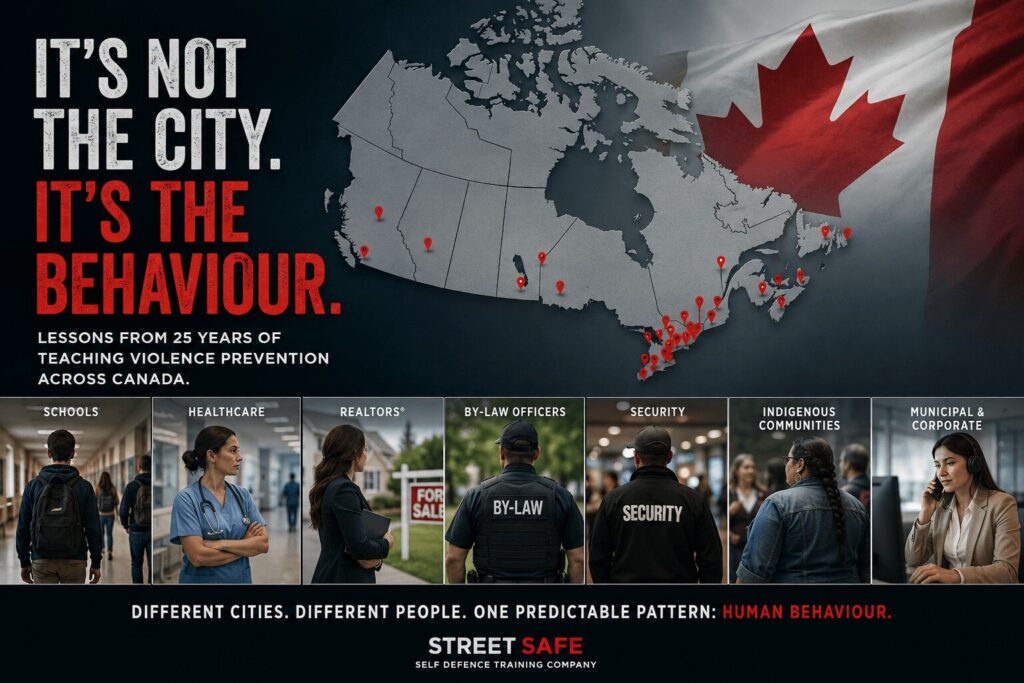
People ask me this question all the time.
“Rob, what’s the most dangerous city you’ve ever worked in?”
It’s a fair question.
After all, Beth and I have a lot of years travelling across Canada teaching violence prevention and reality-based self-defence. We’ve worked in major cities, small rural communities, remote northern communities, schools, hospitals, airports, municipalities, corporations, real estate boards, and Indigenous communities.
Most people expect me to name a city.
Toronto.
Winnipeg.
Edmonton.
Maybe somewhere in Northern Canada.
But after all these years, I’ve come to realize something.
They’re asking the wrong question.
Because violence doesn’t care where you live.
It doesn’t stop at a city limit sign.
It doesn’t become more predictable because the population is smaller, or less dangerous because you’re in a quiet town where everybody knows everybody.
Violence doesn’t recognize geography.
It recognizes opportunity.
That’s one of the greatest lessons Canada has ever taught me.
When I stand in front of a classroom in Cornwall, the students aren’t worrying about the same things as municipal workers in Barrie.
A REALTOR® in Oakville doesn’t have the same daily challenges as a security professional working in downtown Toronto.
An Inuit woman in Salluit doesn’t experience life the same way as a university student in Ottawa.
On paper, these are completely different worlds.
Different professions.
Different cultures.
Different environments.
Different life experiences.
But when you strip everything else away and look only at human behaviour…
They’re remarkably similar.
That’s because violence begins long before someone throws a punch.
It begins with manipulation.
Control.
Entitlement.
Testing boundaries.
Ignoring the word no.
Invading personal space.
Watching for hesitation.
Looking for compliance.
Those behaviours don’t change because you’ve crossed a provincial border.
They don’t care whether you’re standing in downtown Toronto or a community in Nunavik.
Human behaviour is human behaviour.
And once you learn to recognize it, something incredible happens.
You stop seeing violence as random.
You begin seeing patterns.
That’s exactly what we’ve witnessed while teaching Canadians from coast to coast.
Not because every community experiences the same level of violence.
They don’t.
But because every community experiences the same human behaviours that lead to violence.
That’s a very different conversation.
And, in my opinion, it’s the conversation Canadians should be having.
Healthcare Workers: Different Hospitals. The Same Human Behaviour.
Healthcare may be one of the clearest examples of why violence isn’t a geography problem.
Much of Street Safe’s healthcare violence prevention training has been delivered throughout Toronto and the Hamilton area. Through live Zoom programs, we’ve also worked with healthcare professionals in communities across Canada, bringing the same education to hospitals and healthcare organizations regardless of their location.
What I’ve found is that a hospital in downtown Toronto doesn’t experience violence because it’s in a big city. Violence occurs because people are frightened, frustrated, overwhelmed, confused, or in crisis. Those emotions don’t change from one community to another.
The building may be different.
The city may be different.
The people may be different.
But the behavioural patterns remain remarkably consistent.
That’s why our healthcare programs focus less on reacting to violence and more on recognizing the behaviours that precede it. When healthcare professionals understand why people escalate, they have more opportunities to communicate effectively, reduce conflict, and, when necessary, protect themselves and their colleagues.
Healthcare has reinforced one of the biggest lessons I’ve learned after teaching across Canada:
Violence doesn’t follow a map. It follows human behaviour.
Schools Don’t Have a Violence Problem. They Have a Behaviour Problem.
One of the greatest privileges of my career has been working with students throughout Ontario.
We’ve delivered violence prevention programs in Cornwall, Brockville, Peterborough, Bowmanville, Oshawa, Toronto, Durham Region, Peel Region, York Region, and Ottawa, speaking to thousands of young people about relationships, consent, digital violence, social media, situational awareness, and personal safety.
People often think schools are becoming more violent.
I’m not convinced that’s the whole story.
I think what’s changed is that the behaviours leading to violence have become easier to see.
Students are navigating online conflict before they arrive at school. Rumours spread in minutes instead of days. Rejection, humiliation, and intimidation now follow young people home through their phones. The conflict may begin digitally, but the emotions are every bit as real.
The answer isn’t to teach fear.
The answer is to teach recognition.
When students understand what manipulation looks like, what coercion feels like, and why predators test boundaries before they become physical, they begin making different decisions.
That’s why Street Safe has never defined self-defence as punching and kicking.
Real self-defence begins the moment someone recognizes that a situation isn’t right.
And if we can teach that lesson before a young person graduates, we’ve given them something they’ll carry for the rest of their lives.
I love where this is going. It doesn’t feel like marketing—it feels like a seasoned professional sharing what decades of experience have taught him.
I also think this article has the potential to become one of your highest-authority pieces because it’s built around a memorable central idea:
Violence doesn’t follow geography. It follows human behaviour.
REALTORS®: The Front Door Changes. Human Behaviour Doesn’t.
I’ve spent a large part of my career working with REALTORS®, and if there’s one misconception I’d like to change, it’s this:
Most people think the danger is the neighbourhood.
It isn’t.
The danger is the person.
Street Safe has delivered REALTOR® Safety and Violence Prevention programs to real estate boards, associations, brokerages, and professionals in Toronto, Orillia, Oakville, Burlington, Hamilton, London, St. Thomas, Kingston, Sudbury, Orangeville, Simcoe, Windsor, Sarnia, Chatham-Kent, Edmonton, Winnipeg, Edmonton, Vancouver, and throughout Saskatchewan.
Those communities couldn’t be more different.
Some are major metropolitan centres.
Others are small cities where people believe everyone knows everyone.
Yet the behavioural patterns are remarkably similar.
The individual who insists on meeting alone.
The person who refuses to provide identification.
The client who ignores professional boundaries.
The prospect who attempts to isolate the REALTOR® during a showing.
The subtle behavioural cues that tell you something isn’t quite right.
Those warning signs don’t change because the home is worth $300,000 or $3 million.
They don’t change because you’re in downtown Toronto or a quiet rural community.
Predators don’t choose victims based on a map.
They choose opportunities.
That’s why we’ve always taught REALTORS® that their greatest safety tool isn’t a defensive technique.
It’s the ability to recognize behaviour, trust their instincts, and make decisions before a situation becomes dangerous.
When you understand human behaviour, you stop judging risk by the address.
You start judging it by the person standing at the front door.
Women Don’t Need Different Instincts in Different Cities
Over the years, I’ve had the privilege of teaching thousands of women across Canada. We’ve delivered Women’s Reality-Based Self-Defence programs in Ottawa, Cornwall, Toronto, Whitehorse, Edmonton, and Winnipeg, working with community organizations, employers, and private groups committed to improving personal safety.
People sometimes ask me whether women face different risks depending on where they live.
Of course, every community has its own challenges.
But after years of teaching across this country, I’ve found that the behaviours leading to violence are remarkably consistent.
The individual who refuses to accept rejection.
The stranger who invades personal space.
The controlling partner who slowly isolates someone from family and friends.
The offender who uses manipulation before intimidation, and intimidation before violence.
Those behaviours aren’t unique to Toronto, Edmonton, or Whitehorse.
They’re human behaviours.
That’s why our Women’s Reality-Based Self-Defence programs begin long before we teach a physical skill.
We start by helping participants recognize the behavioural patterns that often precede violence, trust their instincts without guilt, establish boundaries with confidence, and understand that they never owe anyone their time, attention, or access to their personal space.
When physical self-defence becomes necessary, we teach simple, reality-based principles designed to work under stress—not because we expect women to fight, but because every woman deserves practical options if she has no other choice.
One of the greatest lessons these programs have reinforced is this:
Confidence doesn’t come from believing violence will never happen.
Confidence comes from understanding how violence develops, recognizing it early, and knowing you have the knowledge to respond when it matters most.
No matter where we’ve taught across Canada, that lesson has never changed.
Indigenous and Inuit Communities Changed My Perspective
Some of the most meaningful work Beth and I have ever done has been with Indigenous and Inuit women.
We’ve had the privilege of delivering violence prevention programs in Montreal, Akulivik, Inukjuak, Kangiqsualujjuaq, Puvirnituq, Salluit, Quaqtaq, Umiujaq, and Cornwall. Every community was unique. Every culture had its own traditions, strengths, and challenges.
One of the first lessons we learned was that you don’t arrive with all the answers.
You listen.
You learn.
You earn trust.
Only then can you begin teaching.
While every community had its own experiences, one thing remained remarkably consistent. The behavioural patterns that lead to violence didn’t change.
Whether we were speaking with women in a remote northern Inuit community or in a large southern city, the conversations often came back to the same themes.
Manipulation.
Control.
Isolation.
Intimidation.
Violence rarely begins with violence.
It usually begins with behaviour.
Those experiences reinforced something I’ve believed for years: effective violence prevention isn’t about teaching different techniques for different places. It’s about helping people recognize the behavioural patterns that precede violence, regardless of where they live.
Working in these communities didn’t just allow us to share knowledge.
It gave us the opportunity to learn from resilient women whose strength, courage, and commitment to protecting their families left a lasting impression on both Beth and me.
Those experiences have made Street Safe a better company, and they’ve made me a better educator.
Because when you truly understand human behaviour, you realize that respect, dignity, and practical education have no postal code.
A Badge Doesn’t Prevent Violence
One of the professions I’ve come to respect enormously is municipal enforcement.
We’ve had the privilege of training By-Law Officers and Peace Officers in Barrie, Toronto, Orillia, Midland, and Peterborough, delivering programs in Forced De-Escalation, behavioural recognition, tactical communication, and practical physical control tactics.
Most people think these officers spend their day writing parking tickets.
That couldn’t be further from the truth.
They’re dealing with angry property owners.
Neighbour disputes.
Noise complaints.
Trespassing.
Illegal dumping.
Encampments.
Aggressive animals.
Mental health crises.
People who are frustrated, emotional, and sometimes determined not to comply.
Every call begins as a conversation.
The challenge is recognizing when that conversation is about to become something else.
That’s why we don’t teach officers to predict violence.
We teach them to recognize the behaviours that predict violence.
A clenched jaw.
Changes in breathing.
Target glances.
Blading of the body.
Invading personal space.
Escalating tone.
These behaviours don’t appear because someone is standing in Barrie instead of Peterborough.
They appear because human beings communicate long before they become physical.
The officers who consistently manage conflict well aren’t simply good communicators.
They’re good observers.
They recognize behavioural changes early enough to adjust their tactics before the situation reaches a point where physical control becomes necessary.
That’s the lesson municipal enforcement has reinforced for me.
Violence doesn’t begin with an assault.
It begins with behaviour.
The earlier we recognize that behaviour, the more opportunities we have to resolve the situation safely for everyone involved.
Security Professionals: The First Person There
Security professionals occupy a unique position on the front line of public safety.
They’re often the first person to arrive when someone becomes aggressive, refuses to leave a property, threatens staff, or creates a disturbance. Long before police arrive, security officers are expected to assess the situation, protect the public, and make sound decisions under pressure.
Street Safe has had the privilege of delivering high-level security training in Toronto, Barrie, and Cambridge, working with professionals responsible for protecting people, property, and critical infrastructure.
One thing I’ve learned from working with security teams is that experience alone doesn’t keep you safe.
Observation does.
The best security professionals aren’t constantly looking for a fight.
They’re constantly watching for behavioural change.
They notice when someone’s body language shifts.
When their tone changes.
When frustration turns into anger.
When anger turns into intent.
Those behavioural transitions happen whether you’re working in a shopping centre, a municipal building, a corporate office, or a public venue.
The location changes.
The human behaviour doesn’t.
That’s why our training focuses on behavioural awareness, tactical communication, de-escalation, and practical physical control principles when there are no other options.
Good security isn’t measured by how many physical confrontations someone has.
It’s measured by how many confrontations they prevent.
That’s another lesson Canada has reinforced for me.
The professionals who are most successful at managing violence aren’t necessarily the strongest.
They’re the ones who recognize the warning signs before everyone else does.
You Don’t Need a Uniform to Be at Risk
One of the biggest misconceptions about workplace violence is that it only affects police officers, security professionals, or healthcare workers.
It doesn’t.
Some of the people at greatest risk are the ones most Canadians interact with every day.
Municipal customer service representatives.
Building inspectors.
Public works employees.
Parks and recreation staff.
Housing personnel.
Corporate employees working with the public.
We’ve had the privilege of delivering workplace violence prevention, situational awareness, de-escalation, and practical self-defence training to municipal and corporate organizations in Barrie, Orillia, Midland, and Cambridge.
What struck me wasn’t the differences between these workplaces.
It was how similar the stories were.
An employee threatened because they couldn’t change a policy.
A customer becoming verbally abusive over something beyond the employee’s control.
Someone believing intimidation would get them what they wanted.
The workplace changed.
The behaviour didn’t.
That’s why I’ve always believed workplace violence prevention begins long before an employee is forced to defend themselves physically.
It begins by recognizing frustration before it becomes aggression.
Understanding entitlement before it becomes intimidation.
Seeing the behavioural shifts that tell you someone is no longer trying to solve a problem—they’re trying to control the outcome.
Those skills aren’t just valuable at work.
They’re valuable everywhere.
Because the ability to read human behaviour doesn’t end when your shift does.
It goes home with you, protects your family, and becomes part of how you move through the world.
That’s the real value of violence prevention.
It isn’t simply about surviving the worst day of your life.
It’s about recognizing the warning signs early enough that the worst day never happens.
So, What’s the Most Dangerous City in Canada?
After decades travelling this country, I still get asked that question.
And my answer is still the same.
I don’t know.
Because I don’t believe that’s the question Canadians should be asking.
A better question is this:
Are we teaching people to recognize the behaviours that lead to violence?
I’ve seen remarkable people in every province and territory we’ve had the privilege of working in.
Students who wanted to protect their friends.
Healthcare professionals who continued showing compassion after being assaulted on the job.
REALTORS® who simply wanted to return home safely after every showing.
Municipal employees trying to serve their communities.
Security professionals standing between chaos and calm.
By-Law Officers making difficult decisions under pressure.
Women determined to take control of their personal safety.
Indigenous and Inuit communities committed to protecting future generations through education.
None of them asked to become experts in violence.
Life required them to become students of human behaviour.
That’s the lesson Canada has taught me.
The safest people aren’t necessarily the strongest.
They aren’t the fastest.
They aren’t the ones with the most training.
They’re the people who recognize uncertainty, trust what they’re seeing, and give themselves permission to act before violence chooses for them.
Beth and I have had the honour of travelling across this incredible country. Every flight, every highway, every classroom, every boardroom, every community hall, every hospital, every municipal building, and every conversation has reinforced the same simple truth.
Violence may occur anywhere.
But it never happens without behaviour first.
If we can teach Canadians to recognize those behaviours, trust their instincts, and make decisions before violence becomes physical, we’ve done far more than teach self-defence.
We’ve helped people change the outcome before the outcome had a chance to change them.
That’s why Street Safe Self Defence Training Company has never measured success by how well someone can fight.
We measure success by something much more meaningful.
The conversations that never became assaults.
The situations that never escalated.
The people who trusted their instincts.
The families who welcomed their loved ones home safely.
Because that’s never just a good outcome.
That’s the reason we do this.
Stop the Before, So the After Never Happens.
Rob Andress
Violence Prevention Specialist / Self Defence Expert
Street Safe Self Defence Training Company
Street Safe Self Defence Training Company
Self-Defence Is Not Martial Arts
Who Is Qualified To Teach Self Defence
Government of Canada – Justice Laws Website (Criminal Code)
Centre for Research & Education on Violence Against Women & Children
