

Rob Andress
Violence Prevention Consultant, SAS-AP
Close Quarter Combative Instructor
Pure & Applied Debilitation Instructor
Active Threat Survival Trainer A.L.I.V.E
“Stop the Before, So the After Never Happens.”
If someone wanted to become a driving instructor, we’d expect them to understand far more than how to drive.
If someone wanted to teach first aid, we’d expect them to understand human physiology, emergency care, and current medical protocols.
If someone wanted to teach firearms, we’d expect training, certification, legal knowledge, and ongoing accountability.
So why do we set the bar so much lower for someone teaching another human being how to survive violence?
I’ve asked that question for years.
I spent decades in them. I earned multiple black belts. I taught them. I competed. They gave me discipline, confidence, respect, and friendships I’ll always value. But martial arts and violence prevention are not the same profession.
And pretending they are may be one of the biggest mistakes we’ve made in self-defence education.
The Question Nobody Seems Willing to Ask
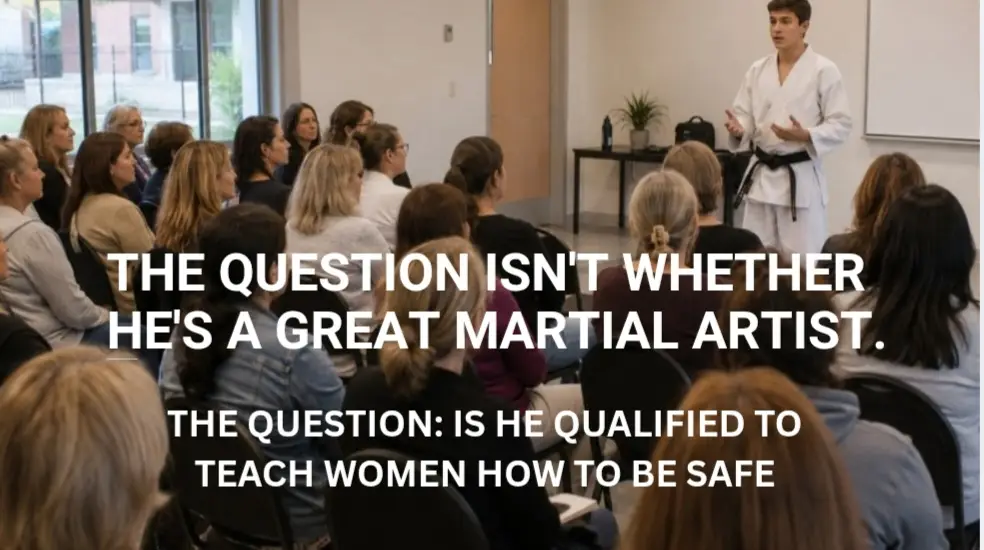
What are the minimum qualifications someone should possess before they’re trusted to educate another human being about violence?
Not teach punches.
Not teach kicks.
Not teach wrist grabs.
Teach violence.
Those are two completely different responsibilities.
Violence isn’t a sport.
It isn’t a tournament.
It doesn’t have weight classes, referees, rules, or time limits.
Violence is a human behaviour.
And if you’re educating people about human violence, shouldn’t you understand human behaviour first?
Being Able to Fight Doesn’t Automatically Make Someone Qualified to Teach Violence
This is where the conversation often becomes emotional.
People hear this and assume I’m attacking martial arts instructors.
I’m not!
I’m asking the same question we would ask in every other profession.
What qualifies someone to educate another person in an area where getting it wrong could cost them their life?
Being an exceptional martial artist doesn’t automatically make someone an expert in:
- behavioural threat assessment
- criminal victim selection
- pre-attack indicators
- trauma-informed education
- fear and human performance
- coercive control
- sexual violence dynamics
- conflict psychology
- Canadian self-defence law
- violence prevention strategies
Those are separate disciplines.
Some instructors study them.
Many don’t. And that’s the conversation we should be having.
Violence Is More Than Physical
After working with more than 30,000 high school and university women, thousands of REALTORS®, healthcare professionals, security officers, municipalities, and law enforcement across Canada, one lesson has become impossible for me to ignore.
The vast majority of dangerous situations never begin with a punch. They begin with behaviour.
Manipulation.
Boundary testing.
Isolation.
Forced teaming.
Charm.
Confusion.
Entitlement.
Social pressure.
The physical assault is usually the final chapter.
Not the first.
If an instructor only prepares students for the final chapter, they’ve ignored most of the story.
The Real Job of a Self-Defence Educator
In my opinion, the job isn’t to create better fighters.
It’s to create better decision-makers.
People who recognize danger sooner.
People who trust their instincts.
People who understand criminal behaviour.
People who know when to leave.
People who understand that creating distance is often more valuable than throwing a perfect punch.
That’s violence prevention.
And violence prevention should always come before physical self-defence.
We Don’t Teach Techniques. We Teach Principles.
One of the biggest differences in our work at Street Safe is that we don’t build confidence around memorizing techniques.
Because techniques fail.
People forget.
Stress changes everything.
Instead, we teach principles.
Principles adapt.
Principles work whether you’re 18 or 80.
Whether you’re five feet tall or six foot four.
Whether you’re athletic or you’ve never stepped inside a gym.
Principles don’t ask you to become stronger than your attacker.
They ask you to become smarter before the attack ever begins.
Women Deserve Better Than False Confidence
One statistic has shaped almost everything we teach.
The average male possesses approximately 186% greater upper-body strength than the average female.
Research also shows males generally have close to three times the grip and holding strength.
That means telling women they’ll simply overpower an attacker isn’t education.
It’s wishful thinking.
Our responsibility isn’t to sell confidence.
Our responsibility is to teach reality.
Targeting.
Leverage.
Timing.
Behavioural awareness.
Decision-making.
Legal understanding.
And the confidence that comes from understanding violence—not pretending strength differences don’t exist.
Maybe It’s Time We Raised the Standard
Imagine if someone advertised themselves as a heart surgeon because they’d spent twenty years studying anatomy books.
We’d never accept it.
Yet every day, people advertise themselves as self-defence instructors without ever studying violence itself.
Shouldn’t we expect more?
Shouldn’t we ask harder questions?
Shouldn’t we expect the people educating our daughters, our sons, our spouses, and our employees about violence to understand violence beyond the physical techniques?
I believe we should.
Not because martial arts aren’t valuable.
They absolutely are.
But because teaching violence prevention is its own profession.
And professions should have professional standards.
My Final Thought
The question has never been:
“Can this person fight?”
The better question is:
“Is this person truly qualified to educate another human being about violence?”
Those two answers are not always the same.
And until we start asking the second question, we’ll continue confusing martial arts with violence prevention—and the people we care about will be the ones paying the price.
“Stop the Before, So the After Never Happens.”
- Self-Defence Is NOT Martial Arts. It’s Time We Stopped Pretending They Are.
- Before You Trust Anyone to Teach Your Daughter Self-Defence, Read This First
- The First Weapon a Predator Uses Isn’t Violence. It’s Confusion.
- Women’s Violence Prevention Programs
- About Rob & Beth Andress
- Reality-Based Self-Defence Training
