

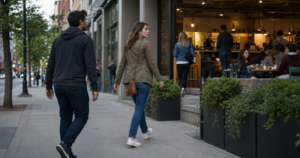
What Should I Do When a Stranger Won’t Leave Me Alone?
If a stranger continues walking beside you, asking personal questions, matching your movement or touching you after you have tried to disengage, stop worrying about appearing rude. Do not provide personal information. Create distance, move toward a populated and staffed location, and use clear commands such as, “I don’t want to talk,” “Back up,” or “Do not touch me.” Tell a specific person that you do not know the individual and need help. If you believe you are in immediate danger, call 911.

You do not need proof that someone intends to hurt you before you move toward safety.
Recognizing Unwanted Persistence, Boundary Testing and Escalating Behaviour Before Physical Violence Begins
By Rob Andress
Street Safe Self Defence Training Company
What should you do when a stranger keeps talking, follows your movement or touches you without permission? Rob Andress explains how situational, environmental and self-awareness can help you recognize escalating behaviour, create distance and move toward safety before violence begins.
You are walking down the street when a man you do not know starts talking to you.
At first, it may sound harmless.
“How are you?”
“Where are you going?”
“Do you live around here?”
You answer politely, but you keep walking. He adjusts his pace and continues walking beside you. You try giving shorter answers. You look away. You speed up. He speeds up too.
Then he lightly touches your arm, your shoulder or the middle of your back while he continues talking.
Nothing openly violent has happened, but you are frightened.
Now you are asking yourself the same question many women ask in situations like this:
“Am I overreacting?” My answer is no!
You are not accusing him of a crime. You are recognizing that a stranger has continued an interaction you do not want, matched your movement, entered your personal space and touched you without permission.
His words may still sound friendly.
His behaviour is telling you something different.
You do not need to know exactly what he intends to do before you protect yourself. You do not have to wait until his behaviour becomes violent before you are allowed to create distance, use your voice or ask for help.
This Is What I Would Tell a Woman Standing in Front of Me
Stop worrying about whether you are being rude.
Stop trying to make him comfortable.
Stop answering questions you never invited.
Your job is not to prove that he is dangerous. Your job is to recognize that his behaviour is unwanted and that he is ignoring the signals you have already given him.
Most strangers will respect distance. They will recognize when someone does not want to talk. If they accidentally touch you and see you move away, they will normally correct themselves.
The behaviour that concerns me is persistence.
You move away. He closes the distance.
You stop answering. He keeps questioning.
You change your speed. He matches it.
You show discomfort. He acts as though it does not matter.
You pull away from his touch. He touches you again.
One behaviour by itself may have an innocent explanation. A pattern of unwanted behaviours deserves your attention.
That is not paranoia.
That is awareness.
Situational Awareness: Pay Attention to What Is Changing
Situational awareness is not simply looking around and noticing that other people exist.
It means recognizing what is happening, what has changed and what that change may mean for your safety.
The situation changed when he stopped being a stranger who spoke to you and became a stranger who would not disengage.
It changed again when he began matching your movement.
It changed again when he entered your space.
It changed again when he touched you.
Do not get trapped trying to decide whether each individual action is serious enough to justify concern. Look at the whole pattern.
Is he asking questions that collect information about you?
Does he want to know where you live, where you are going, whether you are alone or whether someone is waiting for you?
Is he trying to make the interaction feel more familiar than it actually is?
Does he ignore your short answers, your change of pace, your lack of eye contact or your attempt to move away?
Does his attention stay fixed on you when the normal reason for the conversation has ended?
Behaviour is information.
You may not know his intention, but you can see that he is not respecting your boundary.
Environmental Awareness: Use What Is Around You
Once you recognize the behaviour, your environment becomes part of your response.
Look ahead.
Where are the people?
Where is the nearest open business?
Can you see employees, security, a transit operator, a hotel desk, a restaurant counter or a family walking together?
Where are the areas that would isolate you—an alley, a stairwell, a parking garage, a public washroom, a pathway hidden by trees or a quiet side street?
Your safest movement is generally toward people who can see you, hear you and help you. A well-lit place is useful, but light by itself cannot intervene. People can.
Do not lead him to your home.
Do not walk directly to your vehicle if doing so takes you into an isolated parking area or allows him to learn which vehicle is yours.
Do not enter an elevator, stairwell or washroom hoping he will stop following you.
Move into a staffed, populated place. Walk behind a counter if necessary. Approach a specific person and tell them exactly what is happening.
“I do not know this man. He has been following me and touching me. Please call the police.”
That sentence removes uncertainty. It tells the other person that this is not an argument between two people who know each other.
Use physical objects to help manage distance when you can. A parked vehicle, bench, shopping cart, table or store display can become a barrier between you and him. You are not looking for a place to stand and continue the conversation. You are using the environment to create time while moving toward safety.
Self-Awareness: Know What Is Happening Inside You
Self-awareness may be the most overlooked part of personal safety.
You may feel your chest tighten. Your legs may become heavy. Your thinking may narrow. You may start smiling even though you are frightened. You may hear yourself apologizing or answering questions because part of you is trying to keep the situation calm.
That does not mean you are weak.
Fight and flight are not the only human survival responses. People can also freeze or attempt to appease a perceived threat. Understanding that before it happens makes it easier to recognize when politeness is beginning to work against you. RAINN’s explanation of fight, flight, freeze and fawn provides useful background on these reactions.
Ask yourself:
Am I still answering because I want this conversation—or because I am afraid of what he might do if I stop?
Am I looking at my phone because I need help—or because I am trying to disappear into it?
Am I continuing toward my original destination even though that route is taking me somewhere isolated?
Am I remaining quiet because silence is the safest choice—or because I am afraid of embarrassing him?
Self-awareness means recognizing your own fear response without allowing shame to make the decisions for you.
It also means knowing your true ability. A phone is valuable, but it is not a force field. A safety app can help, but it cannot physically create distance. Confidence is useful, but confidence without awareness is not a safety plan.
Keep your head up. Keep your hands out of your pockets. Remove an earbud if you are wearing one. Do not bury your attention in your phone while someone is moving beside you.
You need your eyes, your ears, your hands and your balance available.
Stop Being Interviewed
You do not owe a stranger personal information simply because he asked for it politely.
Do not tell him where you live.
Do not tell him where you work.
Do not tell him that you are walking home alone.
Do not tell him which building, bus stop or vehicle belongs to you.
Do not invent a long story to persuade him to leave you alone. The longer you explain, the longer the interaction continues.
Use short, clear language.
“I can’t help you.”
“I don’t want to talk.”
If he enters your space or touches you, make the boundary unmistakable.
“Stop. Do not touch me.”
“Back up.”
Say it as a command, not a request. Do not smile. Do not apologize. Do not add a long explanation.
Your voice is not only for him. It is also for everyone around you.
A louder voice changes the environment. It attracts attention, creates witnesses and tells nearby people that the contact is unwanted.
A Light Touch Still Matters
People often minimize touching because it was “only” a hand on the arm, shoulder or back.
The amount of force is not the only issue.
Context matters.
This is a stranger who has already ignored your attempt to disengage. He is walking with you, controlling the length of the interaction and moving into physical contact without permission.
The touch may be an attempt to create false familiarity. It may be used to guide your movement, distract you, measure your reaction or see whether you will object. It may also be socially clumsy behaviour with no plan behind it.
You do not have to solve that mystery while he remains within reach.
Move away from the contact. Turn so you can see his hands and movement. Create distance. State the boundary clearly.
“Do not touch me again.”
Under section 265 of Canada’s Criminal Code, intentionally applying force to another person without consent falls within the legal definition of assault. Whether police lay a charge will depend on the facts and context, but “light” does not automatically mean meaningless or lawful. Read section 265 of the Criminal Code.
Change the Environment—Do Not Wait for Him to Change
You cannot control whether he decides to respect your boundary.
You can control your movement.
Cross the street when it is safe to do so. Change direction. Enter an open business. Move toward a group. Approach security or an employee.
These movements also give you more information.
If he had a legitimate reason to walk in the original direction, your change may separate you from him.
If he changes direction with you and continues following, the situation has changed again.
Do not keep conducting little tests until you find yourself alone. One purposeful change is enough to gather information. Once he continues matching you, move directly toward help.
Distance gives you time.
Time gives you options.
Options improve safety.
This connects directly with another Street Safe article, The First Weapon a Predator Uses Isn’t Violence. It’s Confusion. While you are trying to explain his behaviour, you may stop responding to what the behaviour is doing.
Make Other People Part of Your Safety Plan
Do not assume bystanders understand what is happening.
From a distance, they may think you know him. They may believe you are having a private disagreement. They may wait for someone else to act.
Tell a specific person what you need.
“You in the blue jacket—please call 911. I do not know this man.”
“I need to stand with you. That man is following me.”
“Please get security. He will not leave me alone.”
Specific language creates a specific job.
If you are on public transit, move toward the operator or alert transit staff. If you enter a business, do not remain near the entrance where he can continue reaching you. Move toward employees and tell them directly that you need help.
When Should You Call 911?
If you believe you are in immediate danger, call 911.
Tell the operator what is happening in plain language:
“A man I do not know is following me. He has touched me, he will not leave me alone and I am afraid for my safety.”
Give your location first. Describe where you are moving, what he looks like and whether you have seen a weapon. Follow the operator’s instructions when you can safely do so.
Ontario’s official guidance is clear: if you are in danger, call 911 or your local police immediately. The Ontario Provincial Police lists 911 for emergencies and 1-888-310-1122 for non-emergency calls in Ontario.
Do not threaten him with your phone as though it were a weapon. If calling is the safest option, call. If you can reach people and security faster than you can unlock your phone and explain the situation, move toward them while calling.
Do not become so focused on filming that you lose awareness of his hands, distance or movement. Evidence may matter later. Your safe exit matters now.
What If He Grabs You or Tries to Move You?
The situation is now physical.
Your goal is not to teach him a lesson. Your goal is not to stand there and win a fight.
Your goal is to stop the immediate contact, create an opportunity and leave.
Protect your balance. Use your voice. Attract attention. Respond immediately with simple actions appropriate to the threat so you can break contact and move toward safety.
Do not allow yourself to be moved willingly into a vehicle, alley, isolated room or secondary location. The environment he chooses will almost always benefit him, not you.
This is where realistic physical training matters. Reading about a wrist release is not the same as performing under fear, surprise and resistance. The body will never go where the mind has not been. Your response must be simple enough to access under stress and focused on escape—not trading techniques.
Our Women’s Self Defence training is built around this reality: recognition first, physical response when necessary, and leaving as soon as it is safe.
After You Reach Safety
Once you are safe, write down what happened while it is still fresh.
Record the time, location, direction of travel, his description, his words, where he touched you and whether he followed you after you changed direction. Record vehicle information only if you can do so safely. Do not return to danger to collect evidence.
Tell someone you trust. Notify security or the business where you sought help. Report the incident to police when appropriate.
If the behaviour becomes repeated—following you from place to place, repeatedly communicating with you, watching your home or workplace, or engaging in threatening conduct—Canada’s Criminal Code addresses those patterns under criminal harassment. Justice Canada explains criminal harassment and stalking here.
One incident may not meet every element of criminal harassment. That does not mean you must ignore it, and it does not erase any unwanted touching or other conduct that occurred.
What Should You Remember?
You do not have to know whether he is a predator.
You do not have to wait for a threat.
You do not have to wait for the touching to become harder.
You do not have to sacrifice your safety to protect a stranger from embarrassment.
Pay attention to the situation.
Use the environment.
Recognize what fear, freezing or politeness may be doing to your decisions.
Stop answering.
Create distance.
Use your voice.
Move toward people.
Ask directly for help.
Call 911 when you believe you are in immediate danger.
If the situation becomes physical, create the opportunity to escape and leave.
Self-defence does not begin when somebody grabs you.
It begins when you recognize that normal behaviour has changed, your boundaries are being ignored and your safety may be moving in the wrong direction.
Awareness comes before action.
Understanding comes before technique.
Prevention comes before protection.
Stop the Before, So the After Never Happens.
Frequently Asked Questions
Am I overreacting if a stranger’s behaviour frightens me?
Creating distance is not an accusation. You do not need proof that someone intends to hurt you before ending an unwanted interaction. Fear is information, not proof—but proof is not required before you move toward safety.
Should I ignore him or tell him to stop?
Your safest response depends on the circumstances. If quiet disengagement allows you to leave safely, use it. If he continues following, enters your space or touches you, a clear boundary such as “Stop. Do not touch me. Back up” can alert both him and the people around you. Do not remain in place to argue.
What if he says he is only being friendly?
Friendly people respect boundaries. You do not have to debate his explanation. End the interaction and continue moving toward safety.
Should I go home or get into my car?
Not if he is still following you. Going home can reveal where you live. Walking into an isolated parking area can reduce your options. Go to a populated, staffed place and ask for help.
Does light touching count as assault in Canada?
Section 265 of the Criminal Code defines assault to include intentionally applying force to another person without consent. The legal outcome depends on the full facts and context, but unwanted touching should not be dismissed simply because little force was used.
What should I say when I call 911?
Give your location and describe the immediate behaviour:
“A man I do not know is following me, he has touched me, he will not leave me alone and I am afraid for my safety.”
Then answer the operator’s questions as clearly as you can.
Related Street Safe Reading
- The First Weapon a Predator Uses Isn’t Violence. It’s Confusion.
- Walking With Purpose and Confidence in Self Defence
- Stopping Street Harassment: Your Practical 2026 Guide
- Women’s Self Defence Training
About the Author
Rob Andress is a Canadian leader in reality-based self-defence, violence prevention and close-quarter combatives. As co-founder of Street Safe Self Defence Training Company, he delivers practical, behaviour-based training that helps people recognize the warning signs of violence, make informed decisions under pressure and respond effectively when personal safety is threatened.
Drawing on decades of experience in self-defence, combatives and violence-prevention education, Rob holds SAS and SAS-AP certifications, along with certifications in Date Rape and Drink Spiking Prevention, A.L.I.V.E. Active Threat Survival, De-Escalation and Force De-Escalation, Close-Quarter Combatives, Trauma-Informed Practice, Family Dynamics of Violence and Threat Assessment.
Rob works with municipalities, By-law Officers, security teams, healthcare professionals, high schools, women and youth, and Inuit and Indigenous communities across Canada. His mission is simple: to give people the awareness, confidence and practical skills needed to recognize danger earlier, prevent violence whenever possible and survive when avoidance is no longer an option.
Rob Andress
Violence Prevention Consultant, SAS-AP
Close Quarter Combative Instructor
Pure & Applied Debilitation Instructor
Active Threat Survival Trainer (A.L.I.V.E.)
Street Safe Self Defence Training Company
