

CORNERSTONE ARTICLE

By Rob Andress
Founder, Street Safe Self Defence Training Company
I’m going to ask a question that almost nobody in the self-defence industry wants to answer.
Who should be teaching self-defence?
Not who can, but who should? Because they’re not the same thing!
Right now, there is no meaningful standard in Self Defence Education today, none!
If you have a black belt, you can teach self-defence. If you fought professionally, you can teach self-defence.
If you worked security, you can teach self-defence. If you served in the military, you can teach self-defence.
If you were a police officer, you can teach self-defence.
But let me ask you something.
Why?
Who decided that? More importantly…
What actually qualifies someone to educate another human being about violence?
Self Defence, a life skill, human skills, skills that are taught not to learn how to fight, but how to survive the worst 30 to 60 seconds of your life! What qualifies someone to teach this?
Because knowing how to fight and knowing how violence works are two completely different things.
One teaches physical skill, the other teaches human behaviour.
One teaches how to hit, the other teaches how not to get hit in the first place.
Those are not the same profession.
Imagine if we applied the same thinking anywhere else.
Would you let someone teach medicine because they spent years in a hospital?
Would you hire someone to teach psychology because they’d been in a lot of arguments?
Would you trust someone to teach driving because they owned a fast car?
Of course not! Experience matters here!
But experience alone has never been the standard for education. So why is violence the exception?
Beth and I have studied violence, researched violence, and worked face-to-face with more than 30,000 high school and university women, 8,000 REALTORS®, hundreds of healthcare professionals, hundreds of security teams, and over a 1000 municipal workers, and large corporations and organizations across Canada.
One lesson has become impossible to ignore.
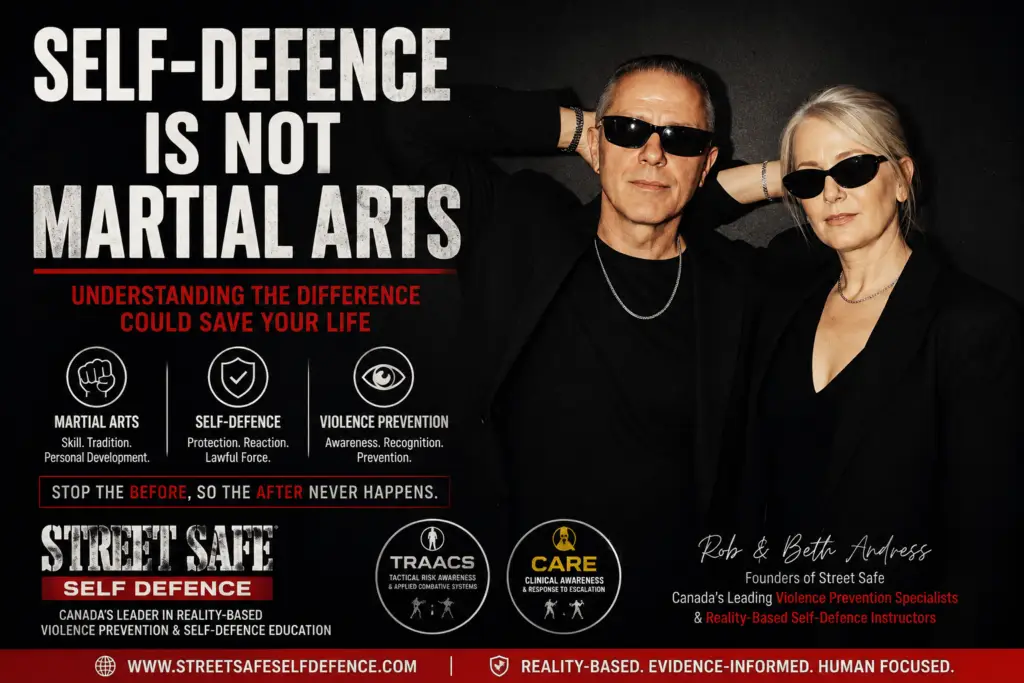
Violence isn’t a martial art. Violence is human behaviour!
And if violence is human behaviour… Then why are we still measuring instructors by what they can do with their hands instead of what they understand about the people standing in front of them?
It’s time our industry answered that question. Because when someone walks into a self-defence class, they aren’t buying techniques. They’re trusting that the person standing at the front of the room knows enough to prepare them for one of the worst days of their life.
That’s a responsibility far greater than teaching someone how to throw a punch.
Experience Matters. But Is It Enough?
Let me be very clear. I’m not questioning the experience of martial artists.
I’m not questioning the experience of police officers. I’m not questioning the experience of military personnel.
I’m not questioning the experience of security professionals. Every one of those professions has something valuable to contribute to the conversation about personal safety.
But here’s my question.
Is experience alone enough to qualify someone to educate another human being about violence?
I don’t believe it is.
Because violence isn’t just physical. Violence is behavioural.
It’s psychological.
It’s emotional.
It’s legal.
It’s physiological.
It’s environmental.
It’s predictable.
And if we’re going to educate people about violence, shouldn’t we first understand all of those things?
Shouldn’t we understand how predators select victims?
Shouldn’t we understand coercive control?
Shouldn’t we understand fear and how it affects memory, decision-making, and physical performance?
Shouldn’t we understand trauma and why some survivors freeze instead of fight?
Shouldn’t we understand conflict management, de-escalation, and the law surrounding the use of force?
Shouldn’t we understand how ordinary people actually behave under extreme stress—not how we’d like to think they’ll behave?
Those aren’t martial arts questions.
They’re violence prevention questions.
And that’s exactly my point.
For decades, we’ve treated self-defence as if it were simply another branch of martial arts.
I don’t believe it is.
I believe violence prevention and self-defence deserve to be recognized as their own profession—one built on research, behavioural science, human performance, legal knowledge, and evidence-based education, not just physical skill.
Because if the goal is to help people survive violence, then we have a responsibility to teach far more than punches, kicks, blocks, or escapes. We have a responsibility to teach people how to recognize violence before it happens.
How to avoid it when they can, how to manage it when they can’t.
And only then, if absolutely necessary, how to respond physically in a way that’s reasonable, lawful, and effective.
That’s a very different educational objective.
And it requires a very different body of knowledge.
So… What Should a Self-Defence Instructor Actually Know?
This is the question I’ve been asking myself for years.
If I were putting my daughter, my wife, or someone I love into a self-defence program…
What knowledge would I expect that instructor to possess?
Not what style they trained in.
Not what rank they achieved.
Not how many fights they’ve had.
What should they actually know?
Here’s where I’d start. They should understand how violence begins, not the physical assault.
The behaviour that comes before it.
They should understand victim selection, why one person is targeted while another standing beside them isn’t.
They should understand pre-attack indicators, not because every attack looks the same. But because human behaviour follows patterns far more often than people realize.
They should understand fear. Not motivational quotes about fear! But the science of fear.
How it affects memory.
How it affects decision-making.
How it affects fine motor skills, communication, and the ability to think clearly under stress.
They should understand trauma, not because they’re therapists. But because the person standing in front of them may already be living with trauma, and the way we teach can either build confidence or unintentionally reinforce fear.
They should understand the law.
Because teaching someone to survive physically while ignoring the legal consequences of their actions is incomplete education.
They should understand communication.
Conflict management.
De-escalation.
Boundary setting.
Predatory interviewing.
Coercive control.
The social dynamics that often lead people to ignore their instincts.
And yes… They should understand physical self-defence. Because there are moments when talking has failed, leaving has failed, and violence has become unavoidable.
But physical skills should never be the beginning of the conversation.
They should be the final option after everything else has failed.
That’s what Beth and I have believed for years. The greatest self-defence lesson isn’t how to throw a better punch. It’s how to recognize the moment when a punch may never have to be thrown.
Because if we can stop the violence before it starts… We’ve already won.
We’ve Confused Two Different Professions
After decades studying violence, researching violent behaviour, and standing in front of more than 30,000 high school and university women, I’ve become convinced of one thing.
We’ve confused expertise in fighting with expertise in educating people about violence.
Those are not the same profession.
A person can be an exceptional martial artist and still know very little about victim selection, coercive control, pre-attack indicators, trauma-informed education, the physiology of fear, or how predators manipulate human behaviour long before violence ever becomes physical.
The opposite can also be true.
Someone may possess an extraordinary understanding of violence, behavioural awareness, conflict management, de-escalation, fear and human performance, Criminal Code compliance, trauma-informed practice, and the realities of interpersonal violence, yet never claim to be a champion fighter.
Neither should diminish the other.
They’re simply different areas of expertise. The problem is that, for decades, our industry has treated them as though they’re interchangeable. I don’t believe they are.
I believe violence prevention and self-defence education deserve to be recognized as their own profession—one built on behavioural science, evidence-based research, legal understanding, human performance, trauma-informed practice, effective communication, and physical intervention only when every other reasonable option has failed.
That’s a higher standard.
Some people will read that and disagree. That’s okay.
But I would ask them the same question I asked at the beginning of this article.
What are the minimum qualifications someone should possess before they’re trusted to educate another human being about violence?
If we can’t answer that question, then perhaps it’s time we started asking it.
Because when someone walks into a self-defence class, they aren’t just buying techniques.
They’re placing their trust in the person standing at the front of the room.
They’re trusting that instructor to prepare them for one of the most frightening, confusing, and life-changing moments they may ever face.
I believe that responsibility demands more than experience alone.
I believe it demands a professional standard.
And I believe the people we teach deserve nothing less.
The Standard I’d Like to See
So, what would I like to see? I’d like to see self-defence recognized as a profession with its own body of knowledge.
A profession where instructors are expected to understand far more than physical techniques.
I’d like to see instructors educated in behavioural awareness.
Victim selection.
Pre-attack indicators.
The psychology of violence.
Fear and human performance.
Trauma-informed teaching practices.
Conflict management and de-escalation.
Criminal Code compliance and the legal realities surrounding self-defence.
Communication under stress.
Adult learning principles.
And yes… effective physical intervention. Because there are times when words fail.
There are times when escape isn’t possible.
There are times when violence becomes unavoidable.
But those moments should never define the entire profession.
Physical self-defence is an important part of violence prevention education.
It just isn’t all of it. I’d also like to see instructors commit to ongoing professional development.
Violence changes.
Technology changes.
Predatory behaviour changes.
The research changes.
If we’re going to call ourselves educators, we have a responsibility to keep learning.
Now, you may have noticed something.
I never once said a person must study a particular martial art.
I never said they needed a specific rank.
I never said they had to come from law enforcement, the military, or the security profession.
Not because those experiences lack value. They absolutely have value.
But none of them, on their own, represent a complete education in interpersonal violence.
The standard shouldn’t be built around where someone came from.
It should be built around what they know, what they continue to learn, and whether they can prepare another human being for one of the most difficult moments of their life in a way that’s ethical, evidence-based, trauma-informed, and legally responsible.
If we can begin measuring educators by that standard instead of by titles, uniforms, belts, or trophies, I believe we’ll elevate the entire profession.
And more importantly… We’ll better serve the people who place their trust in us.
Conclusion
I know this article will make some people uncomfortable. That’s not my intention.
My intention is to start a conversation our profession should have started years ago.
If we’re going to educate people about one of the most frightening experiences they may ever face, then we have a responsibility to ask more of ourselves than experience alone.
We should expect knowledge.
We should expect evidence.
We should expect ongoing education.
We should expect an understanding of human behaviour, fear, trauma, communication, conflict, the law, and effective physical intervention.
Most of all, we should expect the courage to question the way we’ve always done things if it means better preparing the people who trust us.
The question was never whether martial arts, law enforcement, military service, or security experience have value.
They do.
The real question is whether any one of those experiences, by itself, is enough to prepare someone to educate another human being about violence.
I believe the answer is no.
I believe it’s time for violence prevention and self-defence education to be recognized as a profession in its own right, with its own standards, its own body of knowledge, and its own commitment to evidence-based practice.
Because the people we teach deserve nothing less.
And I’ll leave you with one final thought.
Violence doesn’t care what colour your belt is. It only cares whether the education you received prepared you for reality.
I think it’s time our profession asked itself the same question.
Primary Cornerstone Article
Self-Defence Is NOT Martial Arts. It’s Time We Stopped Pretending They Are.
Women’s Violence Prevention Programs
High School Violence Prevention Programs
Department of Justice Canada – Criminal Code Section 34 (Self-Defence)
Public Health Agency of Canada – Family Violence
United Nations Office on Drugs and Crime (UNODC) – Crime Prevention
Centers for Disease Control and Prevention (CDC) – Violence Prevention
