

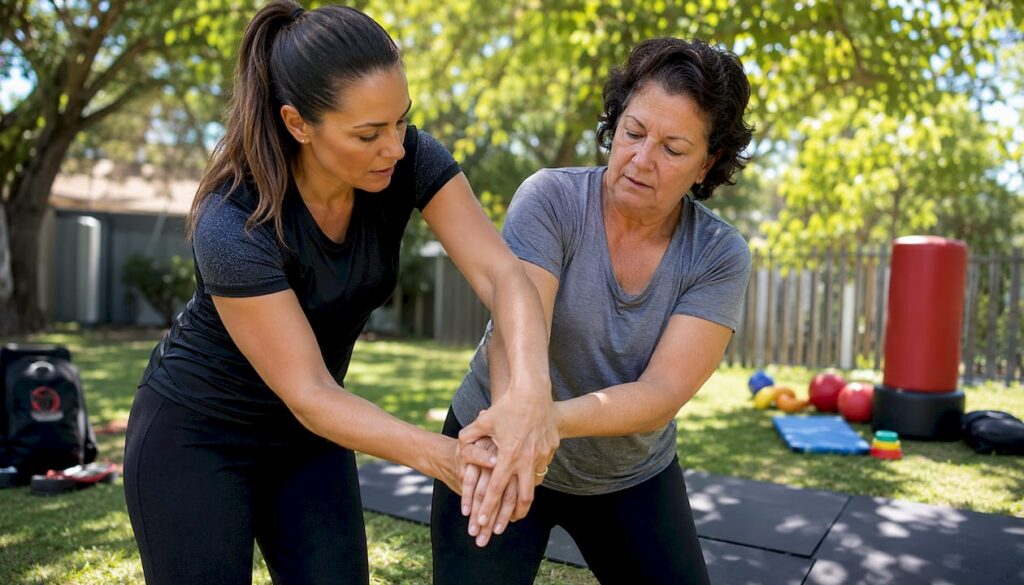
REALTOR safety training must address how violence develops, not only what agents should do after danger appears.
Why Most Safety Advice Misses the Real Problem
By Rob Andress and Beth Andress
Street Safe Self Defence Training Company
Canada’s leader in reality-based violence prevention and REALTOR® safety education.
For years, the real estate industry has talked about safety.
Agents are told to carry their phones, use safety apps, meet in public places, text office staff, share locations, and “trust their instincts.”
While well intentioned, much of this advice is built around a misunderstanding of violence itself.
The reality is simple:
Violence is not random. It is patterned, predictable, and often preventable.
Unfortunately, much of the industry’s safety training focuses on what to do after danger appears instead of understanding how danger develops in the first place.
At Street Safe Self Defence Training Company, we’ve spent years working with REALTORS®, healthcare professionals, municipalities, schools, security personnel, and frontline workers across Canada. One thing remains consistent:
People cannot manage what they do not recognize.
Violence Is Not One Thing
One of the greatest misunderstandings within real estate is treating all violence as though it is the same.
In reality, there are two very different forms:
Social Violence
Social violence is emotional.
It is driven by ego, status, anger, embarrassment, or frustration.
Examples include:
- Angry sellers.
- Frustrated buyers.
- Boundary violations.
- Harassment.
- Escalating arguments.
- Clients experiencing emotional crisis.
Social violence usually gives warning signs.
Because the goal is emotional expression rather than harm itself, social violence can often be interrupted through awareness, communication, and de-escalation.
A-Social Violence
A-social violence is different.
It isn’t emotional.
It is purposeful.
Its goal is control.
Examples include:
- Sexual assault.
- Predatory attacks.
- Robbery.
- Home invasion.
- Kidnapping.
- Stalking.
Predators frequently appear calm, friendly, and helpful.
They don’t look angry.
They don’t “snap.”
They plan.
Which means many traditional de-escalation methods don’t work because there is no emotional conflict to de-escalate.
Understanding this distinction changes everything.
Safety Apps Don’t Stop Violence
Safety apps have become popular throughout the industry.
Many brokerages believe location sharing and emergency alerts are the answer.
But ask a difficult question:
Who receives the alert?
Often someone twenty minutes away.
Sometimes an office administrator.
Sometimes nobody notices immediately.
Violence happens quickly.
Response comes later.
Safety tools are valuable for accountability and investigation, but they do not replace prevention.
They are recovery tools—not prevention tools.
“Meet In Public” Isn’t Always Practical
Another common recommendation is:
“Always meet in public first.”
While meeting publicly may reduce some risks, most real estate transactions eventually require:
- Vacant homes.
- Rural properties.
- Isolated areas.
- Basements.
- Commercial buildings.
- Construction sites.
Eventually, REALTORS® must enter environments they do not control.
The real question becomes:
How do we control the first point of contact?
Criminals Adapt Faster Than Safety Policies
Most criminals understand:
- Agents work alone.
- They are service oriented.
- They want to avoid appearing rude.
- They fear losing business.
- They are conditioned to trust.
Predators exploit these human dynamics.
They know people dislike confrontation.
They know professionals don’t want to offend.
This is why many attacks begin long before the showing itself.
The process often starts with:
- Online inquiries.
- Text messages.
- Fake identities.
- Refusal to provide information.
- Requests for immediate showings.
- Pressure and urgency.
By the time the agent feels uncomfortable, the predator may already have selected them.
The Industry Focuses Too Much On Physical Self-Defence
Another misconception is that safety means learning to fight.
The truth?
Most violence prevention occurs before physical violence begins.
No punch, kick, or martial arts technique can compensate for poor threat recognition.
Research continually demonstrates that awareness, behavioural assessment, environmental management, and boundary setting are more effective than relying solely on physical responses.
Physical skills matter.
But they should never be the foundation.
They should be the last layer.
Fear Is Not A Reliable Safety Tool
Agents are often told:
“Trust your instincts.”
Instincts are important.
But instincts are built upon experience and recognition.
Fear is emotional.
Awareness is observational.
By the time fear appears, something has already entered your subconscious.
The better question becomes:
What did I miss earlier?
Violence prevention starts with understanding human behaviour long before fear arrives.
Safety Is About Managing Human Behaviour
Real estate is a relationship business.
Which means safety is also a human dynamics business.
Professionals should understand:
- Baseline and anomaly.
- Predatory interviewing.
- Boundary testing.
- Transparency Effect.
- Social versus a-social violence.
- Environmental management.
- Space management.
- First point of contact control.
- Behavioral awareness.
- Escalation patterns.
- Digital threats and scams.
Because violence doesn’t start with punches.
It starts with people.
The Future Of REALTOR® Safety
The industry is beginning to change.
Organizations such as the British Columbia Real Estate Association (BCREA), along with progressive boards across Canada, are recognizing that safety is more than apps and panic buttons.
It is education.
It is awareness.
It is understanding human behaviour.
And most importantly:
It is prevention.
At Street Safe Self Defence Training Company, our philosophy has always been simple:
Stop the Before, so the After Never Happens.
Because the best self-defence technique is not surviving violence.
It’s recognizing and preventing it before it begins.
About The Authors
Rob Andress and Beth Andress are the founders of Street Safe Self Defence Training Company, one of Canada’s leaders in reality-based violence prevention, situational awareness, and REALTOR® safety education.
Through live programs, webinars, and consulting, Street Safe has educated thousands of professionals across Canada, helping individuals and organizations understand the human side of violence and how to prevent it.
Websites
🌐 Street Safe Self Defence Training Company
https://www.streetsafeselfdefence.com
🌐 Street Safe for Agents
https://www.streetsafeforagents.com
Additional Resources
- National Association of REALTORS® Safety Program
https://www.nar.realtor/safety - Canadian Centre for Occupational Health and Safety
https://www.ccohs.ca - Public Safety Canada
https://www.publicsafety.gc.ca - FBI Behavioral Analysis Resources
https://www.fbi.gov - Street Safe REALTOR® Safety Education
https://www.streetsafeforagents.com
