

Never enter a showing alone without a verified identity and a check-in plan someone else knows about. That is the single rule to adopt today. Verify who you are meeting, tell a trusted contact where you will be and when you expect to be out, and treat every other precaution below as backup, not a substitute.
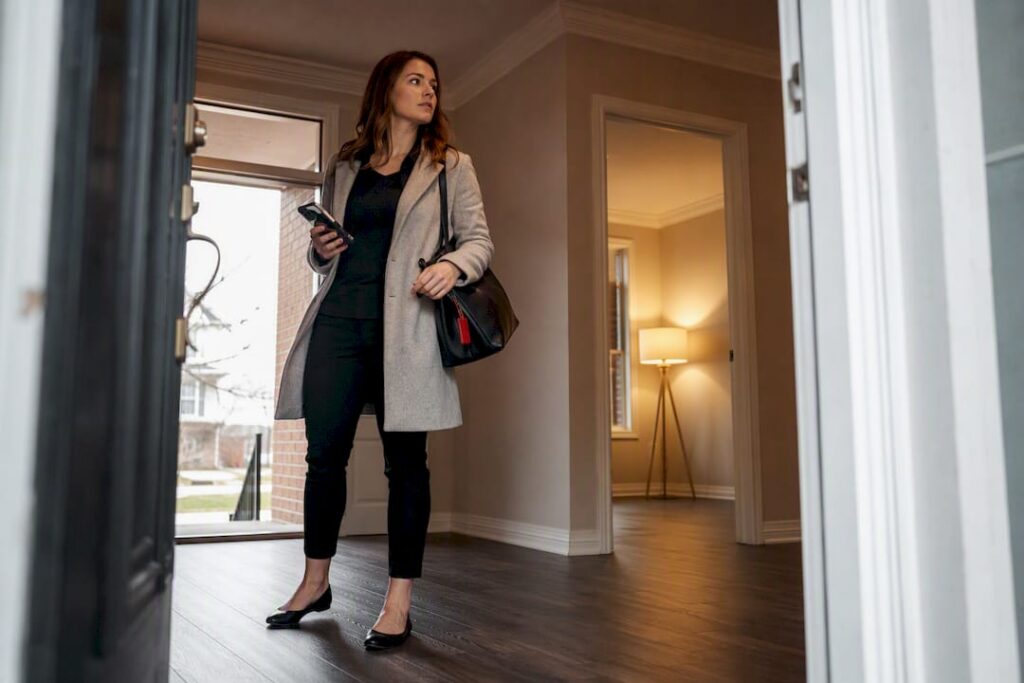
10 Second Arrival Sweep: Safety Playbook for Real Estate Agents
TL;DR:
- Avoid entering showings alone by verifying client identities with government-issued ID and keeping detailed logs of every contact.
- Schedule initial meetings in public spaces, favor daylight hours, and position yourself between exits to minimize risks during property visits.
- Control open house access with sign-in procedures, limit entry points, and remove valuables to protect both agents and clients from potential threats.
- Use safety apps, alarms, and pre-appointment checklists as backup tools, but prioritize developing strong habits like the 10-second sweep and awareness of exits.
- Engage in scenario-based safety training to build rapid, instinctive responses to de-escalate conflicts, leaving safety protocols automatic.
Table of Contents
- Real estate agent safety starts with client screening and verification
- Safe logistics for travel, arrival and showing positioning
- What does a safe open house checklist look like?
- Real estate safety apps, wearables and their real limits
- Practising the 10-second arrival sweep and knowing your exits
- Why short, reality-based training changes how agents respond
- A personal note on safety and professional service
- Book scenario-based safety training for your brokerage
- Where to go for official safety guidance
- Sources
Real estate agent safety starts with client screening and verification
Every safety protocol you build falls apart if you skip the first step: knowing who you are actually meeting. A standard intake script does the heavy lifting here. Ask how the client found the listing, what their timeline looks like, and whether they are working with a lender or another agent. Genuine buyers answer these questions without friction. Someone with different intentions often hesitates, deflects, or pushes to skip the conversation entirely.
Require government-issued ID from every attendee who is an adult before a private showing, not just the person who booked it. Industry guidance is consistent on this point: verification is step one, and vetting tools such as Forewarn are commonly used to cross-check a name or phone number against public records. Forewarn is a US-built platform; confirm current availability and coverage in your area before relying on it, and treat any such tool as one layer among several rather than a replacement for your own judgement.
Watch for a cluster of red flags that, together, should change your plan:
- The person refuses to show ID or gives inconsistent contact details.
- They push hard for an unscheduled viewing, especially at dusk or later.
- They ask to view the property alone or request you meet them somewhere other than the listed address.
Pro Tip: Keep a simple log (name, phone number, ID type, and the property address) for every new client contact. If you ever need to retrace a decision, that record does the work for you.
Safe logistics for travel, arrival and showing positioning
Getting to and through a showing safely is mostly a matter of sequence: what you do first, where you park, and where you stand once you’re inside.
- Meet new clients in the office or a public spot first. A quick coffee-shop meeting or a video call before the first private showing lets you read the person before you’re ever alone with them in a house.
- Favour daylight appointments. If an evening showing is unavoidable, bring a colleague or set a firm check-in time with someone who knows the address.
- Park with your exit in mind. Avoid driveways where another vehicle could box you in, and where possible, use street parking on the driver’s side so you can get into your car quickly. Recommended practice also includes noting the make, colour, and licence plate of the client’s vehicle and sending that detail to a contact before the appointment.
- Position yourself between the client and the nearest exit in every room you enter, not just the front door. It sounds small, but it changes your options completely if something feels wrong.
- Keep interior doors open as you move through the property. Closed doors kill your sightlines and give you no warning if someone else is in the house.
One habit that costs nothing and pays off constantly: share your showing schedule and appointment details with two trusted contacts before you leave the office. It takes ten seconds and means someone always knows where you are supposed to be.
What does a safe open house checklist look like?
Open houses are a different animal from private showings. You’re inviting strangers into an unlocked home for hours at a stretch, which means your protocol needs structure rather than instinct.
Start at the door. Require sign-in, even a simple name and phone number, and control entry through a single main door rather than leaving side or back entrances unlocked for convenience. A two-agent system can help, with one agent managing entry and another monitoring inside. If you’re running the event solo, stagger entry and consider a quick virtual check-in for visitors before they arrive, so you’re not the only person who knows who’s in the building.
Coach sellers ahead of time to clear valuables, prescription medication, and personal documents like passports or financial statements into a locked room or off-site entirely. This isn’t about distrust of buyers generally. It’s about removing temptation and risk from a home full of unfamiliar faces.
Subtlety matters as much as the rules themselves. Security experts point out that a home staged for smooth, obvious traffic flow, with a visible but unobtrusive camera near the entry and position refreshments near the exit point, keeps people moving naturally without making the house feel guarded.
- Sign-in sheet or digital registration at one controlled entrance.
- Two-agent coverage, or staggered entry and virtual check-in when solo.
- Valuables and documents should be secured or removed before the open house begins.
Pro Tip: Place your refreshment table near the exit, not deep in the house. It naturally draws foot traffic toward the door and gives you a built-in reason to walk visitors out.
Real estate safety apps, wearables and their real limits
Technology adds a layer of protection, but it works best as backup to your habits, not a replacement for them. Location-sharing apps and timed check-in tools let a contact see exactly where you are during a showing, especially useful for evening or unfamiliar-neighbourhood appointments. A loud personal alarm clipped to your bag or keys, paired with a smartwatch SOS function set up and tested in advance, gives you a fast way to signal for help without fumbling for a phone.

Digital lockboxes are worth understanding correctly. They log every entry with a timestamp, which is genuinely useful after the fact. But that log is a forensic record, not real-time protection — it tells you who was there later, not whether someone is a threat right now.
Statistic Callout: NAR’s safety resource hub compiles 56 weekly safety tips covering everything from client vetting to cyber hygiene, reflecting just how many small habits go into a complete safety routine, no single app included.
Build a short pre-showing tech check into your routine:
- Confirm your phone has cell coverage at the property, not just at your office.
- Test your smartwatch SOS or alarm before, not during, an emergency.
- Never let a lockbox or app convince you it’s fine to let a stranger view a property unsupervised.
Practising the 10-second arrival sweep and knowing your exits
Situational awareness is a skill, and like any skill, it gets sharper with repetition. The habit worth practising every single time is what some agents call the 10-second rule: before you unlock the door for a client, spend ten seconds scanning the property. Check that nothing looks disturbed, that no unfamiliar vehicle is parked nearby, and that the exterior matches what you’d expect from your last visit.
- Do a quick interior sweep before guests arrive, room by room, noting anything out of place.
- Identify your primary and secondary exits the moment you walk in, and keep both clear of furniture or boxes throughout the visit.
- Share appointment details with two trusted contacts: client name, vehicle description, and expected check-out time.
- Set a mental rule for ending a showing early. If something feels wrong, trust that instinct immediately rather than talking yourself out of it.
Experienced agents treat unusual requests, like a dusk-only viewing or a refusal to meet publicly first, as a professional boundary to enforce, not an overreaction. NAR’s guidance backs this instinct: reschedule, don’t rationalize.
Pro Tip: If you ever have to choose between defusing a situation verbally and leaving, leave. Flight beats fight every time you have the option.
Why short, reality-based training changes how agents respond
Reading a checklist and reacting under real pressure are two different skills, and only one of them gets built through repetition. Reality-based, trauma-informed training compresses months of theoretical awareness into a few focused hours, moving a response from something you have to think through to something your body does automatically. That gap matters most in the exact moment a showing goes sideways.
Effective sessions for real estate professionals typically include:
- Verbal de-escalation drills using language specific to client interactions.
- Practised exit strategies from confined spaces like hallways and bathrooms.
- Role-played scenarios that mirror actual showing and open-house situations.
Short, scenario-driven training delivered on-site can build practical skills and real confidence in a matter of hours rather than weeks, and mobile delivery means a brokerage can schedule a session for an entire team without anyone travelling to a gym or studio.
Muscle memory built through short, scenario-specific practice tends to hold up better under real stress than skills learned in a general martial-arts class, simply because the drills mirror the actual situation an agent might face.
A personal note on safety and professional service
Good client service and good safety habits aren’t in tension. They’re the same discipline. An agent who verifies ID, shares a check-in plan, and knows their exits isn’t being paranoid; they’re running a professional operation the way a good contractor pulls permits or a good lawyer keeps files organized. Security professionals frame it exactly this way: consistent protocols build trust rather than eroding it.
The agents who adopt these habits early rarely think about them after a few weeks. They become as automatic as locking your car. If you want that automaticity to extend to physical situations too, hands-on practice through Streetsafeselfdefence’s realtor self defence programs is where that instinct gets built.
— Rob
Book scenario-based safety training for your brokerage
This training is an alternative to traditional slide deck sessions on agent safety. Instead of reading about de-escalation, participants practise it on-site with scenarios built around actual showings and open houses. A typical session for agents runs a few focused hours and covers verbal de-escalation, exit drills, and role-played client interactions, tailored to solo showings, evening appointments, and open-house crowds alike.
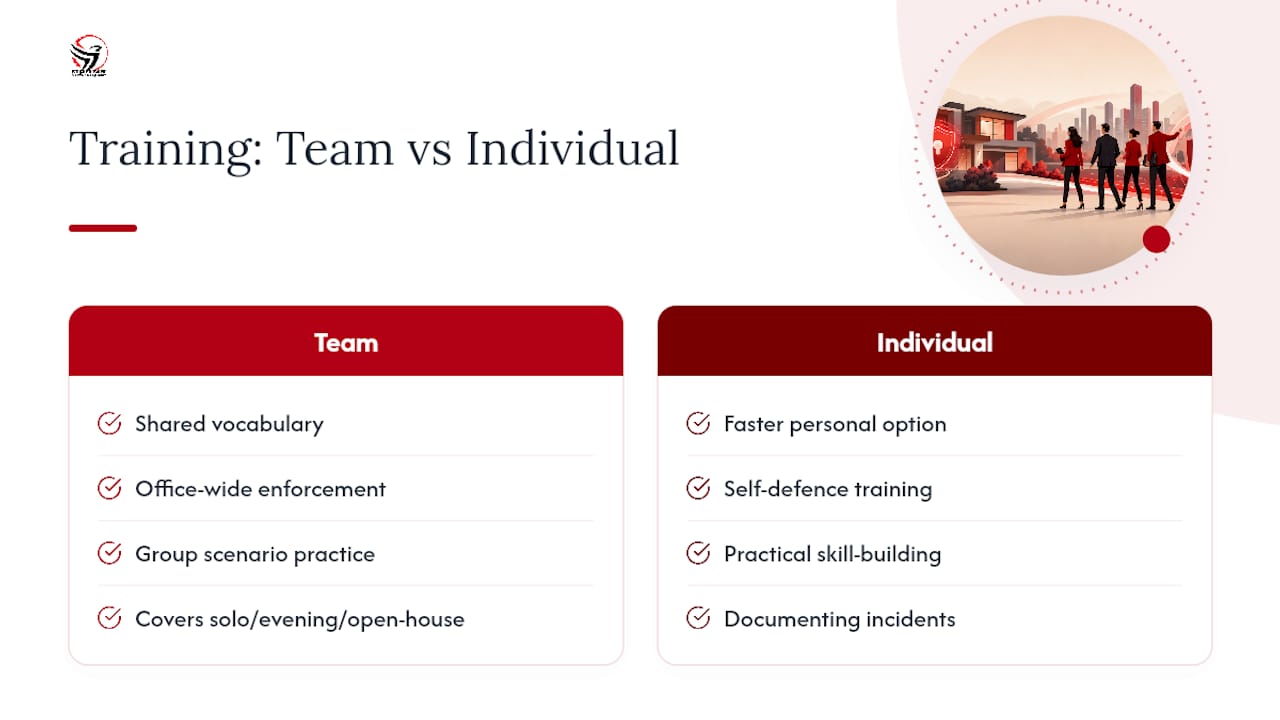
Brokers booking for a full team get the added benefit of shared vocabulary. Everyone learns the same escape cues and check-in language, which makes the habits in this article easier to enforce office-wide. Individual agents wanting a faster, more personal option can look at self-defence training built for quick, practical skill-building. If your team travels clients or handles incident paperwork after a fender-bender or worse, it’s also worth knowing how to protect your claim and document an accident properly after the fact.
To book a session for your brokerage or yourself, visit Street Safe Self Defence and pick a date that works for your team’s schedule.
Where to go for official safety guidance
For deeper reading beyond this checklist, these are the primary sources worth bookmarking:
- NAR’s safety hub — the broadest collection of vetting, open-house, and cyber-hygiene guidance available to REALTORS®.
- NAR’s field safety strategies — practical steps on ID verification, parking, and lockbox limitations.
- Open house security without losing the buyer experience — subtle staging and traffic-flow tactics.
Sources
- Safety in the field: 8 strategies to keep you protected
- Safety
- Open house safety starts before buyers arrive
- 10 Ironclad Safety Tips for Real Estate Agents
