


By Rob Andress
Violence Prevention Specialist / Self Defence Expert
Street Safe Self Defence Training Company
I’ve spent years teaching violence prevention across Canada.
During that time, I’ve reviewed countless self defence programs, violence prevention courses, workplace safety programs, and security training. Some have been excellent. Others have relied more on fear than education.
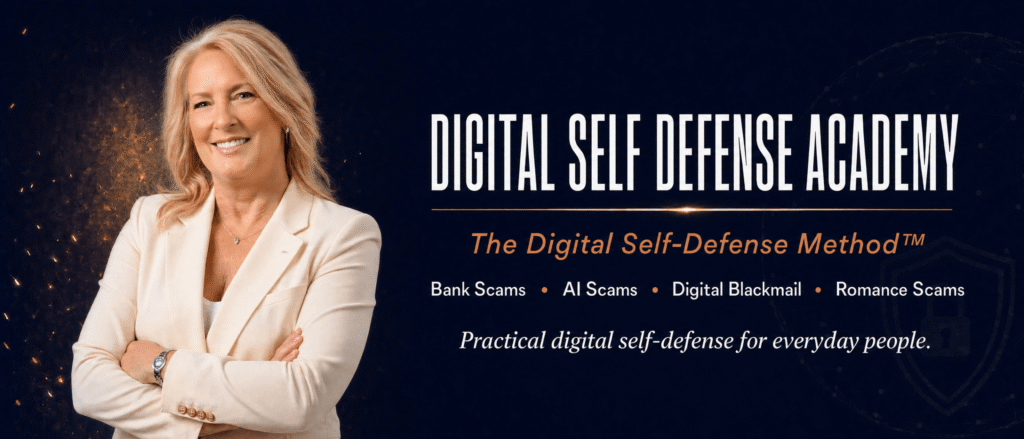
Recently, I had the opportunity to review The Digital Self-Defense Academy, developed by Beth Andress.
What impressed me wasn’t the technology.
It was the philosophy.
Most digital safety programs teach people to recognize the latest scams.
That information is valuable, but it has one obvious limitation.
Tomorrow’s scams will look different.
Technology changes rapidly.
Artificial intelligence is already changing the way criminals communicate, impersonate trusted people, and deceive victims.
Trying to memorize every new scam is almost impossible.
The Digital Self-Defense Academy takes a different approach.
Instead of teaching people to remember hundreds of scams, it teaches them to recognize the behavioural patterns behind manipulation.
That’s an important distinction.
Whether it’s a romance scam, an investment fraud, a phishing email, an AI-generated voice, or a fake customer support call, the technology may change.
The psychology rarely does.
Throughout the Academy, Beth repeatedly returns to one simple principle.
Technology changes. Human behaviour changes very little.
I believe that’s exactly the right place to begin.
As someone who has spent years studying violence prevention, I’ve learned that people rarely become victims because they lack intelligence.
They become victims because someone successfully influences their decisions.
That principle applies whether someone is standing in front of you…
…or communicating with you through a smartphone.
One lesson that particularly stood out to me explains that manipulation isn’t a single event.
It’s a process.
Victimization doesn’t usually begin when money changes hands.
It begins much earlier, with small, seemingly reasonable decisions that gradually build trust, commitment, and emotional investment.
Understanding that process helps remove the shame often associated with scams.
It also gives people a better opportunity to recognize manipulation before it reaches the point of financial loss.
The Academy also approaches artificial intelligence in a thoughtful way.
Rather than presenting AI as something to fear, Beth explains that AI didn’t invent manipulation.
It simply made it easier to scale.
That’s a balanced perspective that encourages awareness without sensationalism.
What I appreciate most is the Academy’s tone.
It doesn’t blame victims.
It doesn’t overwhelm people with technical jargon.
And it doesn’t rely on fear.
Instead, it teaches people how to think.
To slow down.
To ask better questions.
To recognize behavioural patterns.
Those are skills that will remain valuable long after today’s scams disappear.
In my opinion, that’s what makes this Academy different.
It’s not just teaching digital safety.
It’s teaching people how to make better decisions in an increasingly complex digital world.
For individuals, families, professionals, municipalities, and organizations looking to strengthen digital awareness, I believe The Digital Self-Defense Academy provides a practical, thoughtful, and behaviour-focused approach that deserves serious consideration.
As technology continues to evolve, understanding human behaviour may become the most valuable digital safety skill any of us can learn.
That statement isn’t just an opinion. It’s the direction digital crime is taking.
For years, we were taught that protecting ourselves online meant installing antivirus software, creating stronger passwords, and being cautious about suspicious emails. Those things are still important, but they no longer tell the whole story.
Today’s criminals don’t always attack computers.
They attack people.
They study human behaviour. They understand how trust is built, how urgency clouds judgment, and how emotions influence decisions. They know that if they can convince someone to act before they have time to think, technology often becomes irrelevant.
That’s exactly why I believe the Digital Self-Defense Academy is so valuable.
Beth isn’t trying to create cybersecurity experts.
She’s helping ordinary people understand how manipulation works.
Whether you’re a retiree worried about investment fraud, a parent concerned about online grooming, a REALTOR® communicating with clients, or a municipal employee handling sensitive information, the principles remain remarkably consistent.
Recognize the behaviour.
Slow the decision-making process.
Verify before you trust.
Those aren’t simply digital safety tips.
They’re life skills.
As someone who has spent decades teaching violence prevention, I found that philosophy immediately familiar.
At Street Safe, we’ve always believed that prevention begins long before violence occurs. It begins with recognizing behavioural cues, understanding risk, and making good decisions before a situation escalates.
The Digital Self-Defense Academy applies that same prevention-first philosophy to the online world.
Instead of teaching people to react after they’ve become victims, it teaches them how to recognize the process of manipulation while they still have the ability to change the outcome.
To me, that’s one of the Academy’s greatest strengths.
It isn’t built around fear.
It’s built around confidence.
Confidence doesn’t come from knowing every scam.
Confidence comes from understanding the behaviours that exist behind every scam.
That distinction is what makes this program stand out.
Technology will continue to evolve.
Artificial intelligence will become more sophisticated.
New scams will appear.
Old scams will disappear.
But the human behaviours criminals rely upon, trust, urgency, fear, hope, authority, curiosity, and emotional influence—have remained remarkably consistent throughout history.
If we teach people to recognize those behaviours, we’re preparing them not just for today’s threats, but for the ones that haven’t even been created yet.
That’s what impressed me most about reviewing this Academy.
It doesn’t simply educate people about digital crime.
It changes the way they think about it.
And in my experience, changing the way people think is the first step toward changing the decisions they make.
Final Thoughts
Throughout my career, I’ve taught one principle over and over again.
The greatest opportunity to prevent victimization exists before the crime occurs.
That philosophy has guided Street Safe’s approach to violence prevention for more than two decades.
After reviewing the Digital Self-Defense Academy, I see that same philosophy reflected throughout Beth’s work.
She isn’t teaching people to memorize scams.
She isn’t relying on fear to get people’s attention.
She’s teaching people how to understand human behaviour.
That’s a significant difference.
Technology will continue to evolve.
Artificial intelligence will become more sophisticated.
Tomorrow’s scams won’t look exactly like today’s.
But the behaviours criminals depend upon—trust, urgency, fear, authority, curiosity, and emotional manipulation—have remained remarkably consistent throughout history.
If we teach people to recognize those behaviours, we prepare them not only for today’s digital threats, but for the threats that haven’t been created yet.
That’s what impressed me most about this Academy.
It doesn’t simply teach digital safety.
It teaches people how to think differently.
And when people think differently, they make better decisions.
Better decisions lead to better outcomes.
In my opinion, The Digital Self-Defense Academy is one of the most practical, well-structured, and behaviour-focused digital safety programs available today.
Whether you’re protecting yourself, your family, your employees, or your community, the lessons taught throughout this Academy provide skills that extend well beyond the digital world.
They’re life skills.
Because at the end of the day, criminals don’t just exploit technology.
They exploit people.
The more we understand human behaviour, the harder we become to manipulate.
And that may be the most valuable form of self-defence any of us can learn.
Rob Andress
Violence Prevention Specialist / Self Defence Expert
Street Safe Self Defence Training Company
- Digital Risk & Fraud Awareness Training
- AI Governance Services
- REALTOR® Safety Training
- Violence Prevention Training
- Street Safe Academy
- Your Digital Self Defence
- Women’s Violence Prevention
- Paramedic Safety
- Canadian Anti-Fraud Centre (CAFC)
- Street Safe Learning (Blog)
- Canadian Centre for Cyber Security
- National Cyber Security Alliance
- Canadian Centre for Child Protection
