

By Rob Andress
Violence Prevention Specialist / Self Defence Expert
Street Safe Self Defence Training Company
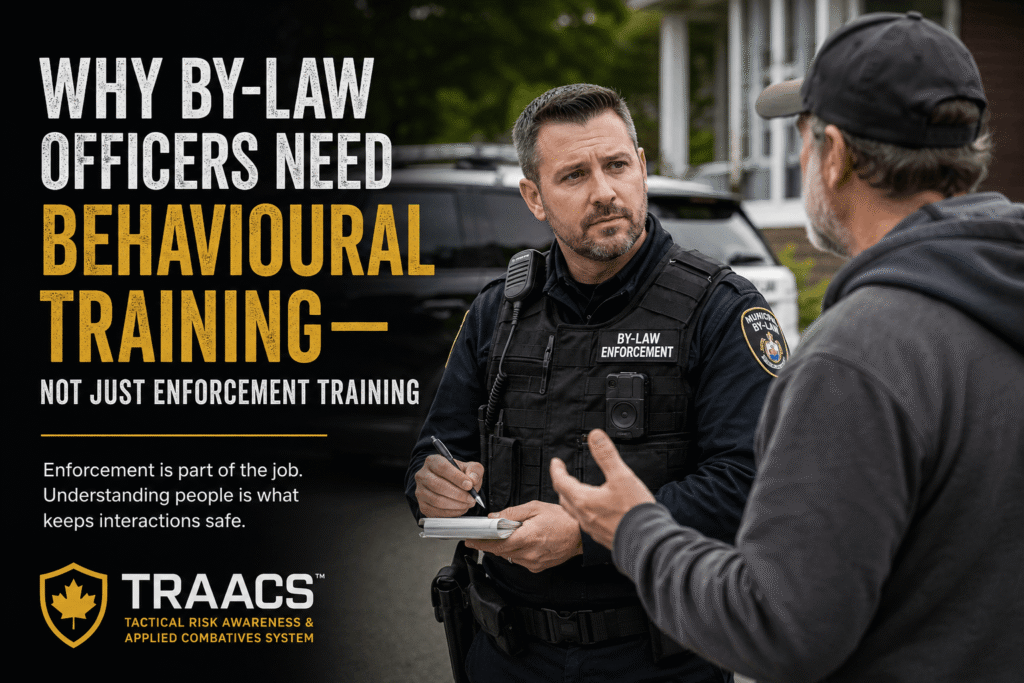
There is a common misconception about By-Law Officers.
Many people think the job is about writing parking tickets, enforcing municipal bylaws, or responding to complaints.
Anyone who has spent time working alongside municipal enforcement officers knows that couldn’t be further from the truth.
Today’s By-Law Officer is often the first government representative to arrive at situations involving angry residents, escalating neighbour disputes, encampments, aggressive animals, abandoned properties, illegal dumping, business compliance, noise complaints, property standards, and increasingly, individuals experiencing mental health or substance use crises.
They don’t simply enforce legislation.
They manage people.
And people are unpredictable.
That is exactly why behavioural training has become just as important as enforcement training.
Enforcement Begins Long Before the Conversation
The public often believes enforcement starts when an officer identifies a violation.
In reality, it starts much earlier.
The moment an officer parks their vehicle.
The walk toward the property.
The first eye contact.
The first greeting.
Every one of those moments provides behavioural information.
Is the person emotionally regulated?
Are they embarrassed?
Are they becoming defensive?
Are they trying to control the interaction?
Are they displaying signs of fear, anger, desperation, or intoxication?
These observations influence every decision that follows.
An officer who can accurately assess behaviour is already making safer, more informed decisions before discussing a single by-law.
Compliance Is About Human Behaviour
One of the biggest mistakes we make in enforcement is believing people become aggressive because they received a ticket.
Most don’t.
People become aggressive because of what that ticket represents.
Loss of control.
Loss of money.
Embarrassment.
Public exposure.
Perceived disrespect.
Fear of consequences.
Threats to their identity.
Human beings react emotionally long before they react logically.
That isn’t a weakness.
It’s simply how we’re wired.
When officers understand those behavioural drivers, they become significantly better at recognizing when someone is merely frustrated—and when that frustration is beginning to evolve into violence.
Behaviour Is Predictable
One of the core principles we teach through TRAACS is simple:
Violence is patterned. Violence is predictable. Violence is often preventable.
Very few assaults happen without warning.
The problem isn’t that warning signs don’t exist.
The problem is that many professionals have never been trained to recognize them.
Changes in voice.
Changes in posture.
Changes in breathing.
Rapid emotional shifts.
Invading personal space.
Fixated staring.
Scanning.
Target glances.
Sudden silence.
Hands disappearing.
Excessive movement.
None of these behaviours automatically mean violence is about to occur.
But together, they begin telling a story.
Experienced officers learn to read that story before it reaches its conclusion.
By-Law Officers Are Not Police Officers
This distinction matters.
Police officers are trained to investigate crime and enforce criminal law.
By-Law Officers operate under entirely different legislation, authorities, responsibilities, and public expectations.
Yet many violence prevention programs are borrowed directly from policing.
That often creates a mismatch.
The goal of a By-Law Officer is not to dominate an encounter.
The goal is to resolve it safely, professionally, and lawfully.
Behavioural awareness supports that mission far better than relying solely on enforcement models.
The Best Outcome Is the One That Never Becomes Physical
The public sometimes assumes self-defence training is about learning to fight.
Professional violence prevention is the opposite.
The greatest success is ending an encounter without anyone getting hurt.
Without force.
Without injury.
Without complaints.
Without workers’ compensation claims.
Without psychological trauma.
That requires officers to recognize changing behaviour early enough to adapt their communication, reposition themselves, request assistance, slow the interaction, or disengage when appropriate.
Those decisions are behavioural decisions.
Not enforcement decisions.
Behavioural Training Protects More Than Officers
When an officer understands human behaviour, everyone benefits.
The officer is safer.
The resident is treated with greater professionalism.
The municipality reduces risk.
Investigations become easier to explain.
Documentation becomes stronger because it is based on observable behaviour rather than assumptions.
Most importantly, decisions become easier to defend because they are grounded in what the officer actually observed.
That is exactly how professional risk management should work.
Why TRAACS Was Built for Municipal Enforcement
TRAACS—Tactical Risk Awareness & Applied Combatives System—was never designed to replace enforcement training.
It was designed to strengthen it.
TRAACS teaches officers how to recognize behavioural changes before conflict escalates, understand why people react the way they do under stress, assess risk dynamically as situations evolve, make sound decisions under pressure, and use simple, legally defensible protective responses only when prevention is no longer possible.
It recognizes a reality every experienced By-Law Officer already knows.
Most calls are not dangerous because of the by-law.
They become dangerous because of human behaviour.
If we truly want to reduce workplace violence in municipalities, we cannot focus only on legislation and enforcement.
We must also teach officers to understand the people standing in front of them.
Because every interaction begins with behaviour.
And behaviour will always tell the story before violence does.
Rob Andress
Violence Prevention Specialist / Self Defence Expert
Street Safe Self Defence Training Company
Canadian Centre for Occupational Health and Safety (CCOHS
Ministry of Labour, Immigration, Training and Skills Development
Public Services Health and Safety Association (PSHSA)
TRAACS Certification for Municipalities
Every Municipality in Canada Is Talking About Workplace Violence
