

Onsite training earns its keep when an organisation needs hands-on skill transfer, fast team alignment, and lower per-head costs for groups. It’s the right call for operational teams, safety-critical roles, and anyone who learns best by doing it in the space where the work actually happens. The evidence and the logistics below explain why, and how to run it well.

TL;DR:
- Face-to-face training yields a modest 2.5% higher knowledge retention and significantly improves engagement and self-efficacy compared to distance learning.
- Onsite training is most effective for safety-critical skills, equipment use, and team cohesion, especially when practice in the actual environment is crucial.
- It can be cost-efficient for groups larger than ten to fifteen people due to group rates and avoided travel and venue expenses.
- Blended approaches combining online learning with onsite practice optimize both cost and skill transfer.
- Outsourcing onsite training to providers with a mobile model saves travel, venue costs, and ensures content is tailored to your specific workplace needs.
Table of Contents
- Onsite training benefits every decision-maker should weigh
- What the research says about face-to-face versus distance learning
- Onsite, offsite, or online: how to choose the right format
- Calculating the real ROI of onsite training
- How to plan and run onsite training that actually works
- When onsite beats offsite or online, and when it doesn’t
- Publisher perspective: how Street Safe Self Defence approaches onsite training
- Bring Street Safe Self Defence onsite to your organisation
- Sources
Onsite training benefits every decision-maker should weigh
Choosing a training modality is a budget decision as much as a learning decision. Here’s what tips the scale toward onsite delivery:
- Time and convenience. No travel days, no flight delays eating into productive hours. Sessions slot into existing shifts, and people are back at their desks or on the floor the same day.
- Customisation to your actual workplace. A trainer walking your floor can reference your equipment, your policies, your near-misses. That’s a different experience than a generic slide deck built for 500 companies at once. The ASSP notes this tailoring as one of onsite training’s three defining advantages.
- Cost-effectiveness at scale. Group rates apply once, not per traveller. You avoid flights, hotels, per diems, and venue rental entirely, which matters most once your group passes ten or fifteen people.
- Hands-on practice with real feedback. Role-play, equipment drills, and scenario walk-throughs let a facilitator correct form and technique in real time. That correction loop is hard to replicate on a screen.
- Higher engagement and self-efficacy. People report feeling more confident applying what they learned when they practised it face to face, not just watched it.
- Team cohesion. Shared physical space means shared problem-solving. Colleagues who train together tend to reference the same experience later, which reinforces the material long after the session ends.
- On-the-spot troubleshooting. A trainer standing in your actual workplace can spot a workplace-specific gap and fix it immediately, something a pre-recorded course simply cannot do.
Pro Tip: Ask any prospective trainer whether they’ll walk your space before the session. If they say no, that’s a signal they’re delivering a canned program, not a tailored one.
What the research says about face-to-face versus distance learning
A peer-reviewed comparison of occupational health and safety training methods found face-to-face learners scored 2.5% higher on post-training knowledge tests than distance learners, with a confidence interval running from 0.3% to 4.7%. That’s a real but modest gap. The bigger story is what happened with engagement and self-efficacy, where face-to-face training showed meaningfully larger effects. Knowledge retention differences are small across delivery methods; confidence in applying that knowledge is where onsite pulls ahead.
That doesn’t mean onsite always wins. Training magazine reports on a Hilton survey where 63% of 607 decision-makers said meetings held away from the office felt more productive, largely due to fewer interruptions and less pull toward daily tasks.
Off-site settings can sharpen focus for reflection-heavy work. Onsite settings sharpen focus for skill you need to use tomorrow, on the same equipment, in the same room.
The takeaway for decision-makers: lean onsite when the goal is applied skill, lean off-site when the goal is deep thinking away from daily noise.
Onsite, offsite, or online: how to choose the right format
Match the format to the objective, not to habit. Four criteria decide it: the learning objective (knowledge versus skill), cohort size, whether hands-on practice is required, and budget.
- Choose onsite when people need to physically practise a skill, use specific equipment, or align quickly as a team. Safety training, de-escalation drills, and equipment certification all belong here.
- Choose off-site when the goal is strategic thinking, creative problem-solving, or networking away from daily distractions. Leadership retreats and planning sessions fit this mould.
- Choose online when you’re updating knowledge at scale across a dispersed workforce and hands-on practice isn’t the point, like a policy refresher or compliance update.
- Choose a blended approach when you need to cover foundational knowledge online first, then reinforce it with an onsite practical session.
Calculating the real ROI of onsite training
Run the math before you commit a budget line. Direct savings are the easiest to quantify:
- Travel: flights, mileage, or transit for every traveller you’re not sending.
- Lodging: hotel nights avoided for multi-day offsite programs.
- Venue rental: conference room or external facility fees.
- Per diems: meal and incidental allowances for time away.
Indirect value is softer to measure but often larger. Reduced downtime, faster application of skills, and fewer safety incidents all show up on the balance sheet eventually, even if they don’t have a line item today.
A simple formula: ROI = (avoided costs + productivity retained) ÷ total training spend. For a 20-person session, avoiding two nights of hotel stays and a half-day of travel per person can save thousands compared to sending the same group offsite, before you even account for the training fee itself.
Pro Tip: Watch for hidden costs on the other side of the ledger, like a training room that’s too small, or a facility with constant interruptions. A distraction-heavy environment can quietly erase the savings you calculated.
How to plan and run onsite training that actually works
Good onsite sessions follow a repeatable sequence.
- Set objectives and baseline measures before you book anything. Know what “success” looks like.
- Select participants based on role relevance, not just availability.
- Confirm space and equipment requirements with the facilitator in advance.
- Customise content to your actual workplace scenarios and policies with workplace personal awareness and success training that can be tailored onsite.
- Deliver with practice and feedback loops built in, not just lecture time.
- Assess immediately after the session, then check transfer again at 30 to 90 days.
- Reinforce with manager follow-up so the skill doesn’t fade without practice.
Before the day itself, work through a short logistics list:
- AV equipment and backup power
- Adequate room size and layout for movement
- Safety gear or PPE if the training requires it
- A scheduling window with minimal interruptions
Our guide on employee safety training topics walks through common scenario choices if you’re still deciding what to cover.
When onsite beats offsite or online, and when it doesn’t
Onsite wins clearly when the training is safety-critical, hands-on, or tied to specific equipment or environments. Lone-worker safety training, de-escalation practice, and equipment-specific drills all lose value fast when delivered through a screen, because the whole point is muscle memory and situational reaction, not just information recall.
Offsite makes more sense when you’re removing people from daily distractions on purpose, for strategic planning, leadership development, or team-building that benefits from a change of scenery. Online wins on pure scale and cost when the content is informational and doesn’t require physical practice, like annual compliance refreshers across a workforce spread across multiple sites.
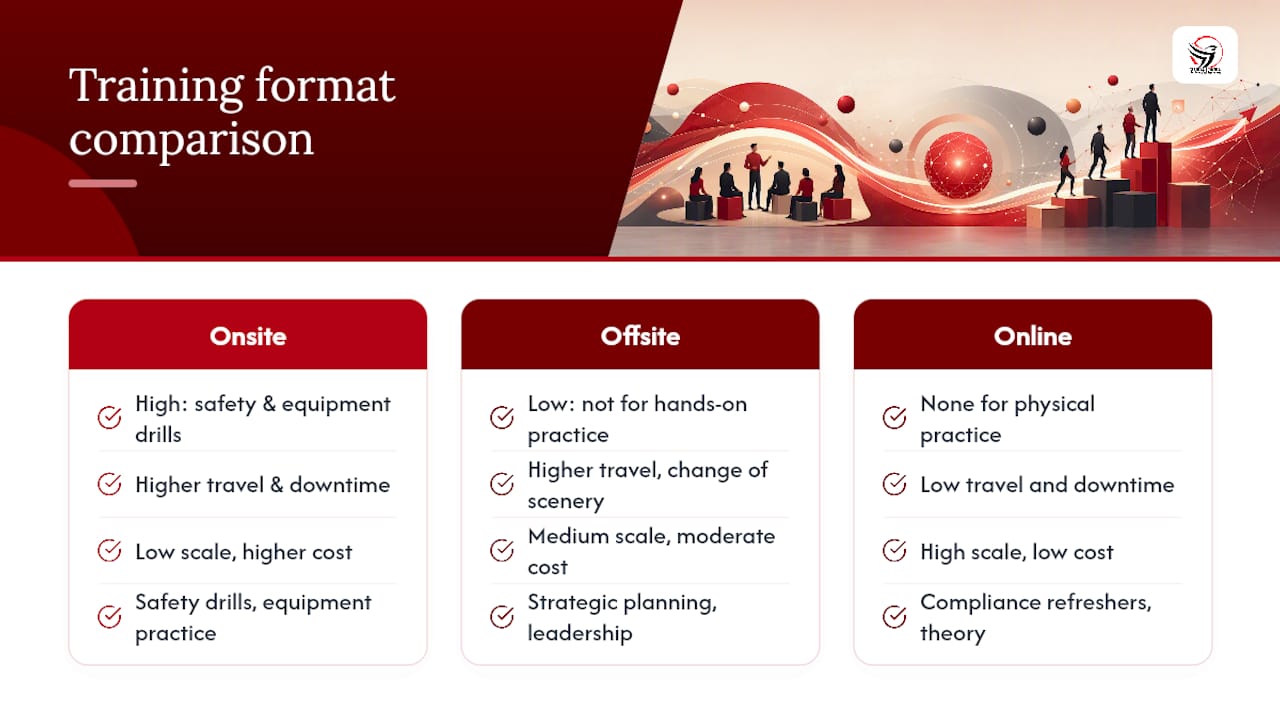
The middle ground matters too. Many organisations get the best result blending formats: an online module covering policy and theory, followed by a short onsite session to practise the physical or interpersonal skill. That combination respects both the convenience of onsite delivery and the need to keep travel and downtime low for large, distributed teams.
The mistake we see most often is defaulting to whatever format is easiest to schedule, rather than what the actual skill demands. A team that needs to know how to respond physically to a threat doesn’t build that capability by watching a video. It builds it by practising the movement, under guidance, with correction, in a space that resembles where the skill will actually be used.
Publisher perspective: how Street Safe Self Defence approaches onsite training
Street Safe Self Defence delivers trauma-informed, reality-based training directly to workplaces, schools, and community groups through a mobile model. Sessions run from a few hours to a full day, covering groups from corporate teams to high school students, real estate professionals, and Indigenous communities, with outcomes measured in confidence and practical readiness, not just attendance.
— Rob
Bring Street Safe Self Defence onsite to your organisation
Street Safe Self Defence trains your people where they already work, in a session built around your actual risks rather than a generic curriculum. That means corporate teams get workplace-specific de-escalation and lone-worker safety practice, real estate agents get scenario training built around property showings, and high schools get age-appropriate violence prevention delivered by trauma-informed instructors.
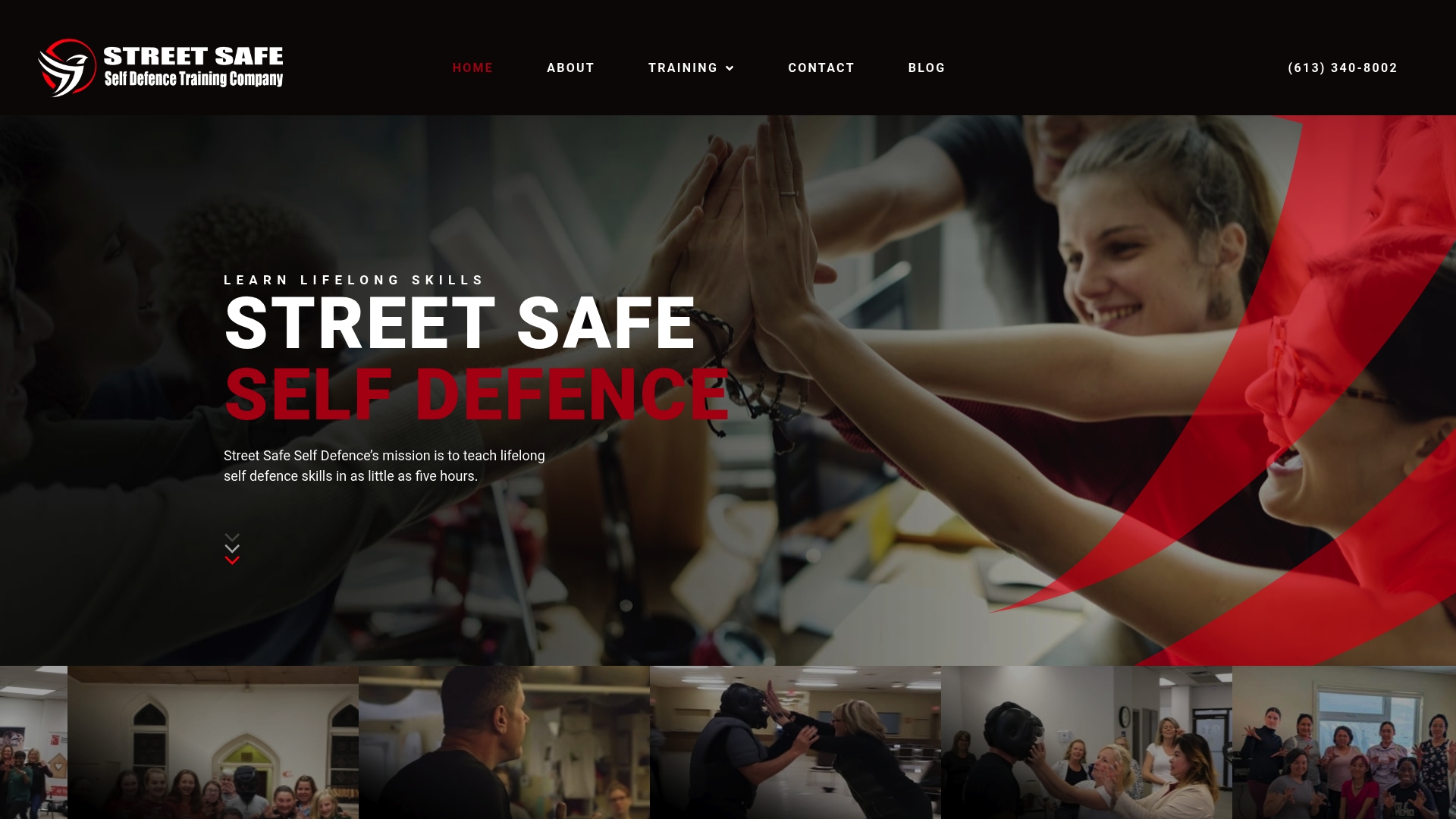
This mobile format solves the exact problems this article has walked through: no travel costs to absorb, no venue to book, and content shaped around your equipment, policies, and people from the first session. Our corporate self defence programs cover team cohesion and lone-worker safety in a single onsite booking, and our mobile training service brings the instructor to your site on a schedule that fits your operation. If your team’s safety training has been sitting on the back burner, book a session and get a date on the calendar this month.
Sources
- Differences in the effectiveness of three OHS training delivery methods (peer-reviewed study)
- On-site vs off-site training (Training magazine)
- Top three benefits of on-site training (ASSP)
