

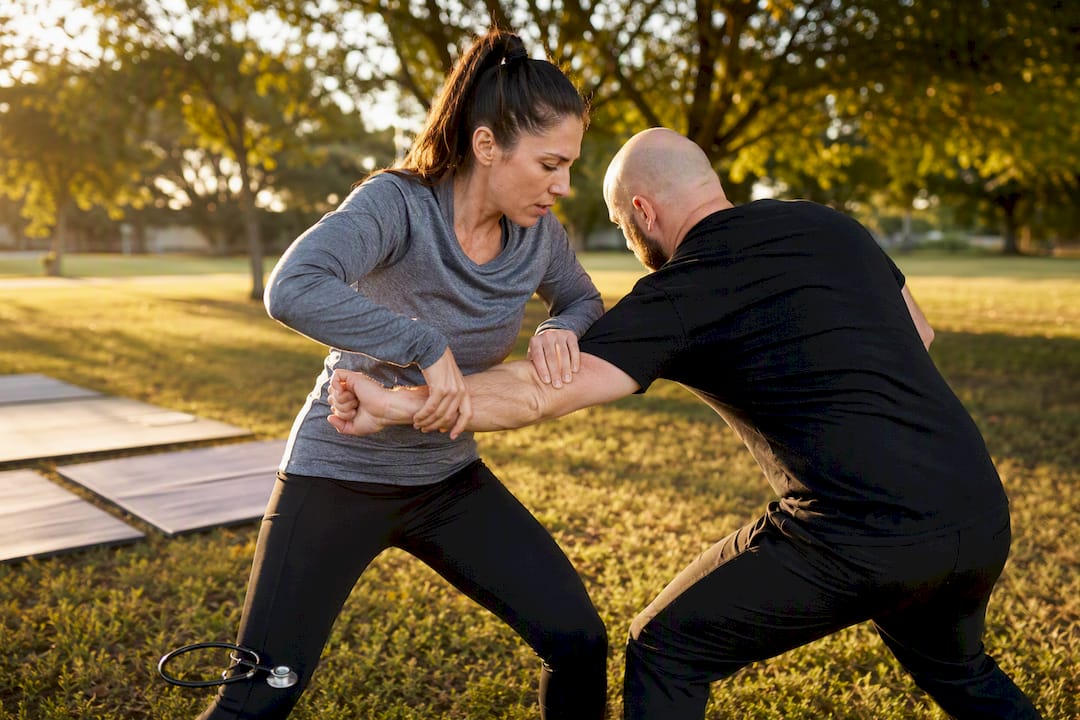
The most practical safety intervention healthcare teams can deploy quickly is a short, reality-based programme that pairs de-escalation, situational awareness, and hands-on, trauma-informed self-defence. Staff who complete this kind of training report faster recognition of agitation, more confident verbal defusion, and safer disengagement when a situation escalates. Fewer lost workdays tend to follow. The sections ahead break down how to build that programme, how to run it inside a real unit, and how to book a pilot session.
TL;DR:
- De-escalation training is most effective when it includes recognition, verbal scripts, situational awareness, trauma-informed self-defense, and post-incident care.
- Training alone only improves staff confidence and reduces lost workdays unless combined with policies, environment controls, security, and technology.
- Pilot programs should be short, unit-specific, and include baseline surveys, with refresher drills for high-risk environments, and real scenario practice.
- Measuring success involves tracking confidence levels, incident severity, reporting rates, and response times over 30 to 90 days after training.
- Regulatory compliance requires integrating training into a broader safety plan with clear policies, technology, reporting, and leadership engagement.
Table of Contents
- Building healthcare worker safety training that actually works
- Why training must sit inside a layered safety strategy
- What a 3 to 5 hour clinical training session should cover
- Rolling out training at the unit level
- Measuring whether the training programme is working
- Legal and regulatory requirements related to healthcare worker safety
- Psychological safety and mental health support for healthcare workers
- Use of personal protective equipment and infection control measures
- Impact of workplace culture on healthcare worker safety
- Emergency response protocols specific to healthcare environments
- Where Street Safe Self Defence fits in a healthcare safety plan
- Book a training session built for your unit
- Sources
Building healthcare worker safety training that actually works
Not every self-defence course belongs in a hospital, clinic, or long-term care home. A programme built for clinical settings needs five core modules, and skipping any one of them leaves a gap staff will feel the first time a real incident happens.
- Early recognition — reading body language, tone shifts, and environmental cues before agitation turns physical.
- Verbal de-escalation scripts — specific phrasing staff can fall back on under stress, rather than improvising in the moment.
- Situational awareness — exit routes, room layout, and positioning relative to the door.
- Hands-on safe defence techniques — simple, trauma-informed movements for breaking contact and creating space.
- Post-incident trauma care — what happens for the staff member in the minutes and days after.
Role-play, simulations, and drills matter more than lecture time here. A nurse who has practised a verbal script under mild stress in a mock scenario is far more likely to use it correctly on the floor than one who only read it in a handbook. OSHA’s guidance for healthcare and social service workers lists role-play and drills as essential elements precisely because skills that aren’t rehearsed under pressure tend to disappear under pressure.
Content should flex by unit. Emergency departments face sudden, high-intensity encounters. Psychiatric units deal with sustained behavioural escalation. Long-term care staff often work alone with residents experiencing cognitive decline. Home-visit workers face isolation with no colleagues nearby. A single generic script for all four groups misses the mark.
Pro Tip: Draw a hard line in training between de-escalation and physical intervention. Staff should walk away knowing that withdrawal and calling security is always the correct choice when de-escalation fails, not a fallback for people who “couldn’t handle it.”
Programs that skip verbal scripts entirely and jump straight to physical technique tend to underperform, because reality-based scripts for real confrontations give staff something concrete to reach for before physical skills are ever needed.
Why training must sit inside a layered safety strategy
Training alone will not fix a facility’s violence problem. A rapid evidence assessment from RAND Europe found that de-escalation training reliably improves staff confidence and cuts lost workdays, but it rarely reduces the total number of incidents unless it’s paired with other safety measures. That distinction should shape how managers pitch training internally: it’s a staff-protection tool first, an incident-reduction tool second.
A layered strategy stacks training on top of policy, environment, and technology so that no single failure point brings the whole system down. Build it in this order:
- Policy — clear reporting expectations and a written workplace violence prevention plan.
- Environment — sightlines, secure triage areas, controlled access points.
- Security presence — visible staff or officers where risk is highest.
- Technology — duress buttons, rapid alerting, monitoring systems.
- Training — the human skill layer that ties the other four together.
Security Magazine’s reporting on layered safety in healthcare makes a point worth repeating to leadership: staff consistently say seconds matter, and rapid alerting combined with visible security is often what makes them feel safest, not training in isolation. Getting buy-in for the full stack usually means bringing security, HR, and clinical leads into the same room early, before the pilot is scheduled, so the training isn’t dropped in as an isolated checkbox exercise.
What a 3 to 5 hour clinical training session should cover
A well-designed session moves in a specific order, and skipping the sequence undercuts the learning. Start with short theory (30 to 45 minutes) covering recognition and the psychology of agitation. Move into scenario practice next, then hands-on skills, then communication drills, and close with a hotwash debrief and documentation review.
- Session objectives should map to four outcomes: recognition, defusion, safe withdrawal, documentation.
- Scenarios should mirror the actual unit: a combative patient in an ED bay, a resident with dementia becoming physical during care, a home-visit worker facing a hostile family member.
- Hands-on skill time should stay short and focused. Complex techniques get forgotten; two or three reliable movements get remembered.
- The hotwash at the end matters as much as the drills. It’s where staff process what felt real and what didn’t.
Deep knowledge from trauma-informed programme design backs this sequencing: teach recognition and verbal defusion first, and only introduce physical technique once participants can reliably spot warning signs and identify a safe exit. Jumping straight to physical skill without that groundwork tends to produce staff who freeze rather than react.
Pro Tip: Ask whoever facilitates the session about their trauma-informed training background before booking. A facilitator without it can accidentally re-traumatize a participant who has a personal history with violence, which undoes the confidence-building goal of the entire session.
Instructors should hold real facilitation experience in clinical or high-stress environments, not just a general self-defence background. The OSHA guidelines also recommend including supervisors and managers in this same training, since they need to recognize high-risk situations and avoid assigning staff to tasks that compromise safety.
Rolling out training at the unit level
A pilot rollout doesn’t need a six-month planning cycle. It needs a short, sequenced plan that gets one unit trained and measured before scaling further.
- Hold a stakeholder meeting with unit leadership, HR, and security to align on scope.
- Map risk by shift and role, identifying which staff face the highest exposure.
- Select a pilot cohort, ideally one unit rather than the whole facility.
- Run baseline confidence surveys before the session so results are measurable.
- Schedule the session using a mobile provider to avoid pulling staff off-site.
Recommended cadence is straightforward: new-hire orientation covers the basics, then an annual refresher for most staff. High-risk units like psychiatric care or emergency departments benefit from monthly or quarterly practice drills instead, a frequency OSHA’s guidance specifically calls out for elevated-risk environments.
Recordkeeping should tie directly into incident reporting. When a real event happens, the same documentation flow used in training debriefs should apply, including a trauma-informed check-in for the affected staff member. Mobile, on-site delivery removes the biggest scheduling barrier managers face: staff train in their own unit, on shift, without a facility-wide disruption.
Measuring whether the training programme is working
Track a small set of metrics rather than trying to measure everything at once.
- Staff confidence, measured through a short pre- and post-session survey.
- Lost workdays tied to violence-related incidents, tracked quarter over quarter.
- Incident severity, not just frequency, since severity often drops before counts do.
- Reporting rates, since a rise in reported near-misses often signals more trust, not more danger.
- Security response times during drills and real events.
A quality-improvement project using a modified AVADE education model found that participants applied de-escalation strategies from training within 30 days of completing it, which gives managers a realistic checkpoint for a retention follow-up. Run that same 30 to 90 day survey after a pilot, present the before-and-after confidence numbers to leadership, and use the gap to justify scaling. If the pilot data holds up, the next step is folding training into a formal, written workplace violence prevention programme rather than treating it as a one-off session.
Legal and regulatory requirements related to healthcare worker safety
Regulatory expectations for healthcare worker safety vary by jurisdiction, but the pattern across most frameworks is consistent: employers carry a general duty to identify and control foreseeable hazards, including violence from patients, visitors, or the public. In Canada, occupational health and safety legislation at the provincial level typically requires employers to assess violence-related risks and implement a written prevention plan, with specific obligations around reporting and investigation timelines.
OSHA’s guidelines for healthcare and social service workers reflect a similar approach in the United States: a written workplace violence prevention programme, staff training, and a hazard assessment process. While OSHA’s specific requirements apply to American employers, the underlying framework, risk assessment, documented policy, training, and incident review, mirrors what Canadian occupational health regulators expect as well.
Managers shouldn’t treat a training session as the entire compliance obligation. Regulators generally want to see the training embedded inside a broader written programme that includes reporting procedures, follow-up investigation steps, and periodic review of whether the plan is actually reducing risk. The IAHSS Workplace Violence Prevention and Mitigation certificate was built specifically for this gap. It gives healthcare security leaders a structured framework for programme development and data-driven evaluation rather than a one-time skills course, and it’s worth pursuing for organizations that need to formalize governance around this obligation, not just deliver a workshop.
Facilities should confirm current requirements with their own jurisdiction’s occupational health authority, since specific thresholds and reporting timelines differ by province and by sector.
Psychological safety and mental health support for healthcare workers
Physical safety and psychological safety aren’t separate problems in a clinical setting. A staff member who doesn’t feel safe reporting an incident, out of fear it will be dismissed or held against them, is a staff member who stops reporting altogether, and that silence hides the true scale of a facility’s violence problem.
Psychological safety means staff can flag a near-miss, a threatening comment, or a pattern of aggressive behaviour without worrying about being blamed for the encounter. Building that culture takes deliberate leadership behaviour: acknowledging reports promptly, following up visibly, and never framing an incident as a performance failure on the reporting staff member’s part.
Mental health support after a violent or threatening encounter matters just as much as the physical response. A trauma-informed debrief immediately after an incident, access to counselling, and a clear path back to regular duties (rather than an unspoken expectation to “push through”) all reduce the compounding effect of repeated exposure to aggression. Staff who face this kind of stress repeatedly without support are at higher risk of burnout, which itself becomes a safety issue since fatigued, disengaged staff are slower to recognize warning signs.
Training plays a role here too. A trauma-informed programme doesn’t just teach physical skills, it normalizes talking about fear, freeze responses, and the emotional aftermath of a threatening encounter, which makes staff more likely to seek support rather than mask the impact.
Use of personal protective equipment and infection control measures
Personal protective equipment in a healthcare violence-prevention context serves two overlapping purposes: infection control and physical protection during unpredictable patient encounters. Gloves, gowns, and masks remain the baseline for infection control, but PPE selection also intersects with safety planning in ways that are easy to overlook. Loose gowns and dangling lanyards, for instance, create grab points during a physical encounter, something rarely covered in standard infection-control training.
Staff working in high-risk units, psychiatric care, emergency departments, or home visits, benefit from combining PPE protocols with basic safe positioning taught in healthcare worker safety training from a medical staffing agency and de-escalation and self-defence training. Standing at an angle rather than directly in front of a patient, keeping a hand free rather than fully occupied with equipment, and knowing how to break away cleanly if a gown or badge lanyard is grabbed are small adjustments that don’t appear in most PPE compliance checklists but come up naturally in hands-on training sessions.
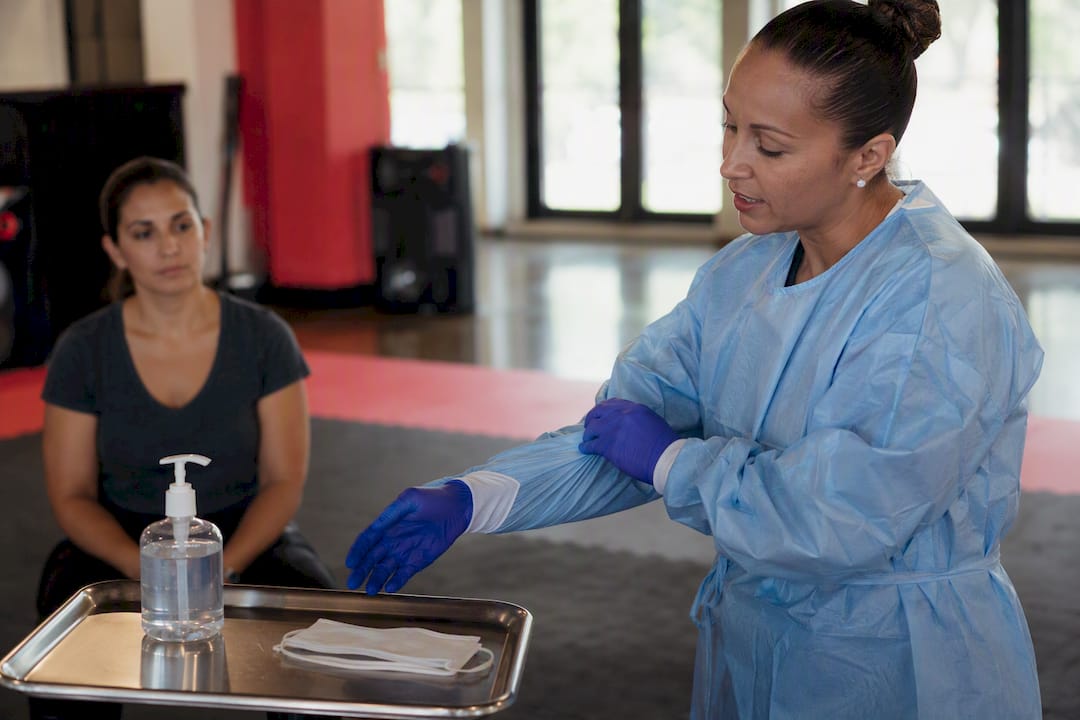
Infection control measures also shape how physical de-escalation techniques get taught. Any hands-on component in a clinical training session needs to account for gloved hands, PPE restrictions on movement, and realistic constraints like IV lines or medical equipment nearby. A self-defence technique that works cleanly in an open gym often needs modification for a crowded patient room. Training providers who understand clinical environments build that adaptation into the curriculum rather than teaching generic techniques that assume open space and unrestricted movement.
Impact of workplace culture on healthcare worker safety
Culture determines whether a safety programme succeeds or quietly fails within a year. A unit where reporting is normalized, where leadership visibly follows up on incidents, and where staff aren’t expected to simply absorb aggressive behaviour as “part of the job,” will get far more value out of training than a unit where none of that is true.
The phrase “part of the job” deserves direct pushback. It’s one of the most common cultural barriers to healthcare worker safety, and it shows up in subtle ways: a manager who shrugs off a verbal threat, a scheduling system that assumes violence is inevitable so training feels pointless, or senior staff who discourage newer colleagues from reporting minor incidents. That normalization erodes the very confidence training is meant to build.
Leadership visibility matters more than most managers expect. When a director attends the training session alongside frontline staff, or personally reviews incident reports rather than delegating that entirely, it signals the programme is a genuine priority rather than a compliance exercise. Staff pick up on that difference quickly, and it shapes whether they actually use the skills learned in training or quietly disengage from the whole initiative.
A practical guide to employee safety training topics can help unit managers frame this cultural shift alongside the technical training rollout, since the two need to move together to actually change outcomes.
Emergency response protocols specific to healthcare environments
Emergency response in a clinical setting differs from a generic workplace violence protocol in one key way: staff often can’t simply evacuate. Patients depend on continuous care, so response plans need a version of “lockdown” that accounts for people who can’t be moved quickly, if at all.
A workable protocol usually includes a clear code or alert system understood facility-wide, a designated response team (often including security and a charge nurse or unit lead), and pre-assigned roles so staff aren’t improvising who calls for help versus who manages the immediate scene. Duress buttons and rapid alerting systems, flagged in industry reporting as one of the features staff say makes them feel safest, only work if staff have practised using them under simulated pressure, not just read about them in an orientation packet.
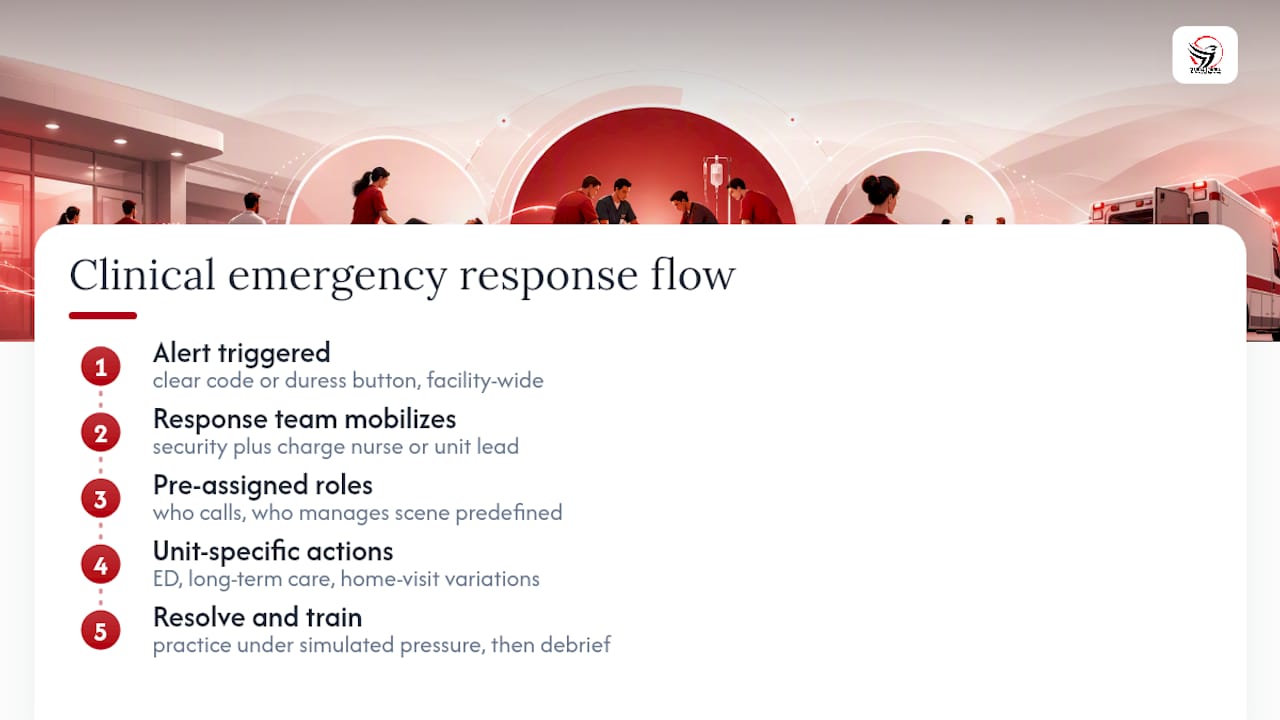
Protocols also need unit-specific versions. An emergency department’s response to an armed or highly agitated individual looks different from a long-term care facility’s response to a resident-on-resident altercation, which looks different again from a home-visit worker’s plan for a hostile household with no colleagues nearby to call on. Training sessions that walk through these scenario-specific protocols, rather than a single generic emergency plan, give staff a much clearer sense of what to actually do when a real alert sounds.
Where Street Safe Self Defence fits in a healthcare safety plan
Healthcare violence prevention rewards a programme built for the realities of clinical work rather than a generic self-defence course retrofitted for hospitals. That’s the gap Street Safe Self Defence’s healthcare-focused training was built to close: mobile delivery that comes directly to a unit, trauma-informed instruction, and content built around the recognition-to-withdrawal sequence rather than generic striking technique. Participant testimonials describe measurable gains in confidence and situational awareness after sessions.
Street Safe works best as a pilot layer inside a broader plan, not a replacement for policy or security investment. A single unit can run one session, measure confidence before and after, and use that data to justify expanding to recurring refreshers across the facility. It won’t fix an environment with no reporting culture or a facility with no duress technology. What it does well is give staff a rehearsed, practical response they can actually use, which is the piece training alone can control.
— Rob
Book a training session built for your unit
Street Safe Self Defence runs mobile, onsite workshops built specifically for clinical teams, including trauma-informed formats designed around the recognition, defusion, and safe-withdrawal sequence covered throughout this guide. Because sessions come to your unit instead of pulling staff off-site, scheduling friction drops and a single-unit pilot can be booked and run within weeks, not months.
A pilot booking gets your team:
- A session length built around your unit’s shift patterns, not a fixed template
- Scenario content adapted to your specific risk profile (ED, psych, long-term care, or home visits)
- A trauma-informed facilitator rather than a generic self-defence instructor
- A practical basis for the confidence survey data leadership needs to approve wider rollout
Start with a self-defence training session built around your unit’s schedule, or visit Street Safe Self Defence’s main booking page to request a quote for a single-unit pilot and see how quickly a measurable confidence gain can show up on your next staff survey.
Sources
- Reviewing the Evidence Base for De-escalation Training: A Rapid Evidence Assessment | RAND
- Workplace Violence Prevention Program – IAHSS
- Why de‑escalation must be part of a layered safety strategy in healthcare | Security Magazine
- Guidelines for Preventing Workplace Violence for Healthcare and Social Service Workers | OSHA