


Use five repeatable moves — safety first, create space, lower your voice, listen actively, and offer limited choices — to stabilise most confrontations before they turn physical. These moves are grounded in frameworks from the Crisis Prevention Institute (CPI), the BETA 3-step paradigm, and CISA’s De-Escalation Action Guide. They apply whether you are a teacher, a healthcare worker, a retail employee, or a parent.
Your quick-reference checklist:
- Assess safety before engaging — if there is a weapon or imminent physical threat, disengage immediately
- Stay an appropriate distance away and keep your posture open and non-threatening
- Lower your voice, slow your speech, and breathe before you speak
- Ask open questions and paraphrase what you hear
- Validate the person’s feelings without agreeing with their behaviour
- Offer two concrete choices, not commands
- Use one speaker only — ask bystanders to step back
- If the situation escalates despite your efforts, call 9-1-1
Safety warning: De-escalation is not appropriate when someone is armed, actively attacking, or in a medical emergency. Stop and call 9-1-1. Justice Canada and Public Safety Canada both emphasise that personal safety takes priority over any communication attempt.
Pro Tip: The single most common mistake is speaking too quickly. Slow down by half. A measured pace signals calm and gives the other person’s nervous system a chance to follow.
Key takeaways
Effective de-escalation requires self-regulation, active listening, and clear safety limits — practised together, not applied as a checklist.
| Point | Details |
|---|---|
| Safety comes first | Assess before engaging; disengage immediately if a weapon appears or physical aggression begins. |
| Self-regulation is a skill | Staying calm under pressure is trainable, not innate — practise breathing and pacing before you need them. |
| Active listening drives results | Open questions, paraphrase, and intentional pauses build rapport faster than any single phrase. |
| Environment and body language matter | Off-angle stance, two-arm-length distance, and reducing noise are as effective as the right words. |
| Streetsafeselfdefence offers guided practice | Mobile, onsite training across Canada covers verbal de-escalation, trauma-informed instruction, and scenario-based practice. |
Table of Contents
- What are the core principles behind effective de-escalation techniques?
- How to de-escalate conflict: a step-by-step process
- What verbal de-escalation techniques actually work?
- How do nonverbal cues and environment shape a confrontation?
- When should you stop de-escalating and call for help?
- How do you adjust de-escalation skills for children, patients, and victims?
- Short role-play scenarios you can practise right now
- What does the research say about these frameworks?
- Why practise matters more than most people think
- Streetsafeselfdefence brings de-escalation training to you
- Sources
What are the core principles behind effective de-escalation techniques?
De-escalation is not a script you recite. It is a mindset you practise until it becomes instinct. Three principles sit at the foundation of every technique covered in this article.
Empathy means genuinely trying to understand what the other person is experiencing, not just what they are saying. An agitated person needs to feel heard before they can hear you.
A nonjudgmental stance means suspending your evaluation of whether the person’s feelings are reasonable. Telling someone their reaction is overblown is one of the fastest ways to make things worse.
Self-regulation means managing your own physiological response first. You cannot calm someone else while your own threat response is running at full speed. Active listening research confirms that practitioners who shift from reacting to responding — a deliberate, regulated response rather than an automatic one — are far more effective at building the rapport that de-escalation requires.
Tone and pacing matter as much as word choice. A calm, steady voice at a moderate volume communicates safety to the escalated brain before any sentence lands. Avoid the “trap of authority” — phrases like “calm down,” “you need to relax,” or “that’s not a big deal” dismiss feelings and tend to escalate rather than settle a situation. Neutral, validating language works better every time.
Personal limits matter too. Justice Canada’s guidance is clear: you are not obligated to attempt de-escalation when doing so puts you at risk. Knowing your own limits is not a weakness — it is part of the skill set.
Pro Tip: Before you speak, take one slow breath out. Exhaling activates the parasympathetic nervous system and visibly lowers your shoulders, which the other person reads as calm.
How to de-escalate conflict: a step-by-step process
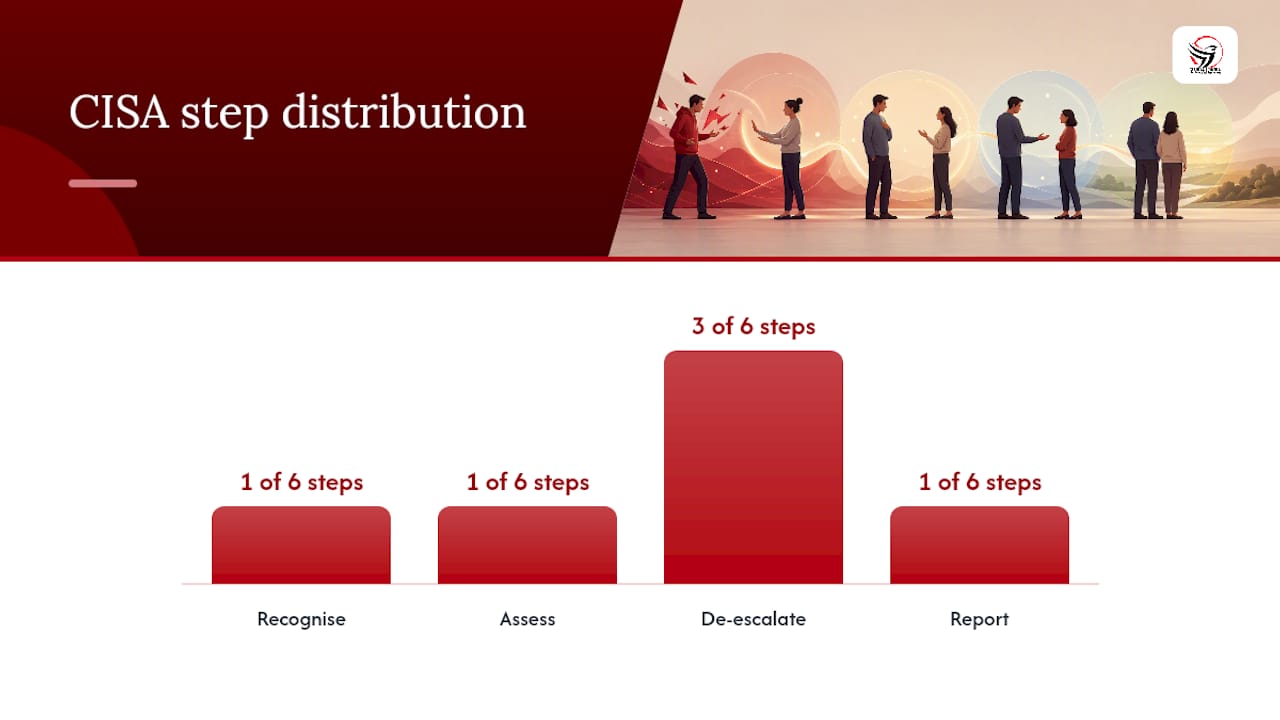
The most reliable process maps closely to the CISA Recognise-Assess-De-escalate-Report model and the clinical BETA 3-step paradigm (engage, establish collaboration, verbally de-escalate). Here is how to apply it in sequence.
Step 1 — Recognise: Notice the signs of escalation early. Raised voice, clenched fists, pacing, and rapid breathing are all signals. The earlier you recognise them, the more options you have.
Step 2 — Assess safety: Before you say a word, ask yourself: Is this safe to attempt? Is there a weapon? Is the person in a medical crisis? CISA is explicit that safety and assessment come before any communication attempt. If the answer to either safety question is yes, disengage and call 9-1-1.
Step 3 — Engage: Approach calmly, at an angle rather than head-on, and introduce yourself if you are not known to the person. Keep your hands visible. Say something simple: “I can see you’re upset. I’m here to help.”
Step 4 — Establish collaboration: The BETA clinical model frames this as the pivot point — moving from confrontation to partnership. Invite the person to sit, offer water, and ask an open question. “Can you tell me what’s going on?”
Step 5 — Verbally de-escalate: Use active listening, paraphrase, validate, and offer choices. This is where most of the verbal techniques in the next section come in.
Step 6 — Report: After the situation resolves, document what you observed and report through your organisation’s channels. CISA’s framework includes reporting as a formal step because it informs threat assessment and improves future responses.
Safety decision point: Disengage immediately if the person produces a weapon, makes a direct physical threat, begins to close distance rapidly, or shows signs of a medical emergency (seizure, overdose, psychotic break). Move to safety and call 9-1-1. Do not attempt further verbal intervention.
Framework mapping at a glance:
| Step | CISA Model | BETA Paradigm | CPI Guidance |
|---|---|---|---|
| Recognise early signs | Recognise | Engage | Observe behaviour |
| Assess safety first | Assess | Engage | Safety priority |
| Approach and connect | De-escalate | Establish collaboration | Calm presence |
| Listen and validate | De-escalate | Verbally de-escalate | Active listening |
| Offer choices | De-escalate | Verbally de-escalate | Limit choices |
| Document and report | Report | Post-incident | Debrief |
What verbal de-escalation techniques actually work?
Words are your primary tool. The right phrase at the right moment can shift the entire dynamic; the wrong one can undo everything you have built. Verbal Judo frames this as responding rather than reacting — using empathy and calibrated language to gain voluntary cooperation without coercion.
Core verbal moves
- Open questions: “What’s happening for you right now?” invites the person to speak and gives you information.
- Paraphrase: Repeat the core of what they said in your own words. “So you’re saying the wait has been over an hour and nobody told you anything.”
- Reflective statements: Name the emotion you observe. “It sounds like you’re really frustrated.”
- Intentional pauses: After paraphrasing, stop. Silence gives the person space to process and often prompts them to continue or soften.
- Validation: Acknowledge the feeling without endorsing the behaviour. “I understand why that would be upsetting.”
- Limited choices: Offer two acceptable options. “Would you prefer to talk here or somewhere quieter?”
- Agree to disagree: When a factual dispute is fuelling the conflict, step around it. “We may see that differently, and that’s okay. Right now I want to make sure you’re okay.”
Active listening techniques — open questions, paraphrase, reflective statements, and intentional pauses — are foundational to de-escalation and consistently build the rapport needed to move a situation forward.
Sample scripts for common scenarios
- Angry customer: “I hear you — that’s a long wait and I’m sorry. Let me see exactly what I can do for you right now.”
- Intoxicated person: “Hey, I’m not here to cause you any trouble. Can we just sit down for a minute?”
- Partner argument: “I want to understand your side. Can you help me see what I’m missing?”
- Distressed child: “I can see you’re really upset. I’m right here. You’re safe.”
- Agitated patient: “I’m not going anywhere. Tell me what you need most right now.”
- Workplace confrontation: “I want to sort this out with you. Can we step somewhere quieter?”
- Distressed witness: “You’re safe now. I’m going to stay with you. Take your time.”
- Public confrontation: “I don’t want any trouble. I’m going to give you some space.”
What to say and what to avoid
| Say this | Not this | Why it matters |
|---|---|---|
| “I can help.” | “Calm down.” | Commands trigger resistance |
| “Tell me what happened.” | “You need to relax.” | Dismisses the person’s experience |
| “I understand why you’re upset.” | “That’s not a big deal.” | Invalidation escalates tension |
| “Would you like to sit?” | “You have to sit down.” | Choice reduces perceived threat |
| “We can figure this out.” | “Stop overreacting.” | Labels feelings as wrong |
| “Take your time.” | “Hurry up.” | Pressure increases agitation |
Cultural sensitivity in Canada: Canada’s communities are diverse, and phrasing that feels respectful in one cultural context can land differently in another. Direct eye contact signals honesty in some communities and aggression or disrespect in others. Formal titles matter to some people and feel distancing to others. When working with Indigenous communities, culturally grounded approaches that centre respect, relationship, and community context are more effective than standard scripts. The principle is simple: follow the other person’s lead on formality, eye contact, and physical distance.
Pro Tip: Avoid the word “but” after a validation statement. “I understand you’re upset, but…” erases everything before it. Use “and” instead: “I understand you’re upset, and I want to help.”
How do nonverbal cues and environment shape a confrontation?
Your body communicates before you open your mouth. An escalated person’s brain processes nonverbal signals faster than words, which means your stance, proximity, and movement either reinforce or undermine everything you say.
Body language essentials
- Positioning: Approach at a 45-degree angle rather than straight on. Standing directly in front of someone reads as confrontational. Side-by-side or slightly off-angle reduces perceived threat.
- Distance: Maintain at least two arm-lengths of space. CHOP’s child-centred guidance recommends this same two-arm-length rule for all ages — it preserves personal space without signalling retreat.
- Hands: Keep them visible, open, and at waist height. Crossed arms, hands in pockets, or hands behind your back all read as closed or concealed.
- Eye contact: Steady but not fixed. Staring can feel like a dominance challenge; looking away entirely signals disengagement. Aim for natural, intermittent contact.
- Posture: Slightly lowered shoulders, relaxed jaw, and a gentle forward lean communicate attentiveness. Standing rigidly upright signals authority, which can trigger resistance.
- Movement: Move slowly and deliberately. Sudden movements spike the other person’s threat response even when your intention is neutral.
Environmental adjustments
CPI and CISA guidance converges on a short list of environmental fixes that are high-value and low-cost:
- Reduce background noise — turn off music, move away from machinery
- Lower harsh lighting where possible
- Limit the number of people in the space; ask bystanders to step back
- Ensure both you and the other person have a clear exit route
- Remove objects that could become projectiles if the situation deteriorates
- Move to a quieter, less public space when the person is willing
Positioning callout: Picture a clock face. You are at 10 o’clock; the other person is at 12. That angle keeps you outside the direct line of a forward lunge, gives you lateral movement options, and still allows full eye contact. Never position yourself with your back to a wall or a corner.
Pro Tip: Physical positioning is a safety skill, not just a communication tool. Crisis intervention training consistently identifies off-angle stance and hand visibility as two of the highest-value physical habits to practise.
| Nonverbal signal | Helpful version | Escalating version |
|---|---|---|
| Stance | 45-degree angle, open posture | Square-on, arms crossed |
| Distance | Two arm-lengths | Crowding personal space |
| Hands | Visible, open, waist height | Hidden, pointing, clenched |
| Eye contact | Steady, intermittent | Fixed stare or avoidance |
| Movement | Slow, deliberate | Sudden, fast |
| Voice volume | Slightly below normal | Raised, matching the other person |
When should you stop de-escalating and call for help?
Knowing when to stop is as important as knowing how to start. De-escalation is a continuous assessment process, not a commitment you make at the beginning of an interaction. CISA is clear: attempt de-escalation only when it is safe to do so, and reassess continuously.
Triggers that require immediate disengagement
- A weapon appears or is referenced as a threat
- The person begins closing distance rapidly despite your verbal attempts
- Physical aggression begins
- The person shows signs of severe dissociation, psychosis, or a medical emergency (seizure, overdose, unresponsive)
- Your own safety is no longer assured
When any of these triggers appear, stop talking, create distance, and call 9-1-1.
Reporting and referral in Canada
After a serious incident, report through your organisation’s internal channels first, then to the appropriate external body if required. CISA’s framework includes a formal reporting step because documented observations feed threat assessment and help prevent future incidents.
- Workplace incidents: Follow your employer’s violence prevention policy. Under Canadian federal law, employers covered by the Canada Labour Code must investigate and report workplace violence incidents.
- Community settings: Contact local police (non-emergency line) or a community crisis line if the person needs mental health support rather than police response.
- Emergencies: Call 9-1-1.
Public Safety Canada and Justice Canada both provide guidance on rights and obligations in public safety contexts. In Canada, you are not legally required to intervene in a conflict involving strangers, but you do have a duty to report certain offences and to take reasonable steps to protect yourself and others in your care. When in doubt, call for professional support rather than continuing an attempt that is not working.
For workplace-specific protocols and what to do when de-escalation does not succeed, this resource on workplace violence training covers the practical next steps.
Pro Tip: After any serious incident, take five minutes to write down what you observed — behaviours, words, sequence of events. Memory degrades quickly under stress, and accurate notes protect both you and the people involved.
How do you adjust de-escalation skills for children, patients, and victims?
The core principles stay the same. The delivery changes significantly depending on who you are working with.
Children and youth
CHOP’s behavioural guidance recommends short, concrete directions (“Please sit down” rather than “I need you to think about calming yourself”), specific praise for positive behaviour (“Thank you for staying in your seat”), and limiting the number of adults speaking at one time. Children respond to predictability, so naming what will happen next reduces anxiety. For high school settings, peer dynamics add complexity — removing the audience often removes the fuel.
Older adults and people with neurodiversity
Speak slowly, use simple sentences, and allow extra processing time before expecting a response. Avoid sarcasm, idioms, and abstract language. For people with dementia or cognitive differences, reduce environmental stimulation first — noise and crowding amplify distress before any verbal technique can take hold.
People in acute mental health crisis
Avoid arguing with delusions or hallucinations. Instead, acknowledge the distress: “That sounds really frightening. I want to help you feel safer.” Do not rush. A person in acute crisis may need several minutes just to register that you are not a threat.
Victims and witnesses
Trauma-informed phrasing avoids re-traumatisation. Lead with safety: “You’re safe now.” Ask before touching. Let the person set the pace. Trauma-informed practice recognises that a survivor’s nervous system may still be in threat-response mode even after the immediate danger has passed.
Grounding and breathing exercises
| Exercise | How to guide it | Best used for |
|---|---|---|
| Box breathing | Inhale 4 counts, hold 4, exhale 4, hold 4 | Panic, hyperventilation, acute anxiety |
| 5-4-3-2-1 grounding | Name 5 things you see, 4 you hear, 3 you can touch, 2 you smell, 1 you taste | Dissociation, flashback, overwhelm |
| Slow exhale | Breathe in normally, exhale twice as long | General agitation, children, quick reset |
Pro Tip: Guide grounding exercises by doing them alongside the person, not just instructing them. Modelling the breath or the sensory scan makes it feel collaborative rather than clinical.
Short role-play scenarios you can practise right now
Reading about de-escalation skills is a start. Practising them — even alone, even briefly — is what builds the muscle memory you need when adrenaline is running. Try these three scenarios with a partner or by recording yourself.
Scenario 1: Angry customer at a service counter
Setup: A customer is loudly demanding a refund, insisting they were overcharged. Other customers are watching.
Your lines:
- “I can see you’re really frustrated. Let me take a look at this with you.”
- “Can you walk me through what happened?”
- “Here’s what I can do right now — [option A] or [option B]. Which works better for you?”
Practice objective: Stay at a steady volume while the “customer” raises theirs. Do not match their energy.
Debrief: Notice whether you instinctively raised your voice or leaned forward. Both are common. The goal is to hold your own regulated state while the other person vents. If you felt the urge to defend the policy before validating the feeling, that is the habit to work on.
Scenario 2: Escalating argument between two colleagues
Setup: Two coworkers are arguing loudly in a shared space. One is pointing and the other is backing away.
Your lines:
- “Hey, I want to help sort this out. Can we take this somewhere quieter?”
- “[Name], can I talk to you for a minute over here?” (Separate them first.)
- “I hear that this is really important to both of you. Let’s figure out next steps.”
Practice objective: Interrupt the escalation cycle without taking sides.
Debrief: Separating the parties is often the single most effective move in a two-person conflict. Watch for whether you felt pulled to judge who was “right” — that pull is natural, and acting on it usually makes things worse.
Scenario 3: Agitated family member at home
Setup: A family member returns home visibly upset and begins raising their voice about a perceived slight.
Your lines:
- “I can see something happened. I’m listening.”
- “That sounds really hard.”
- “What do you need from me right now — do you want to talk it through or just have some space?”
Practice objective: Resist the urge to problem-solve or defend. Just listen and reflect.
Debrief: Most people find this scenario the hardest because the emotional stakes are personal. If you notice yourself planning your rebuttal while the other person is still speaking, that is the moment to practise the intentional pause instead.
Solo practice methods: Shadow a recorded scenario by pausing a podcast or video and responding aloud. Record yourself delivering three scripts and listen back for pace, volume, and tone. Run a two-minute micro-roleplay with a friend using any of the scenarios above.
Pro Tip: Boundary-setting skills are the foundation of every scenario above. Practising assertive, clear language in low-stakes situations builds the confidence to use it when the stakes are high.
What does the research say about these frameworks?
The techniques in this article are not invented. They map to named, established frameworks with documented rationales. Here is where each comes from.
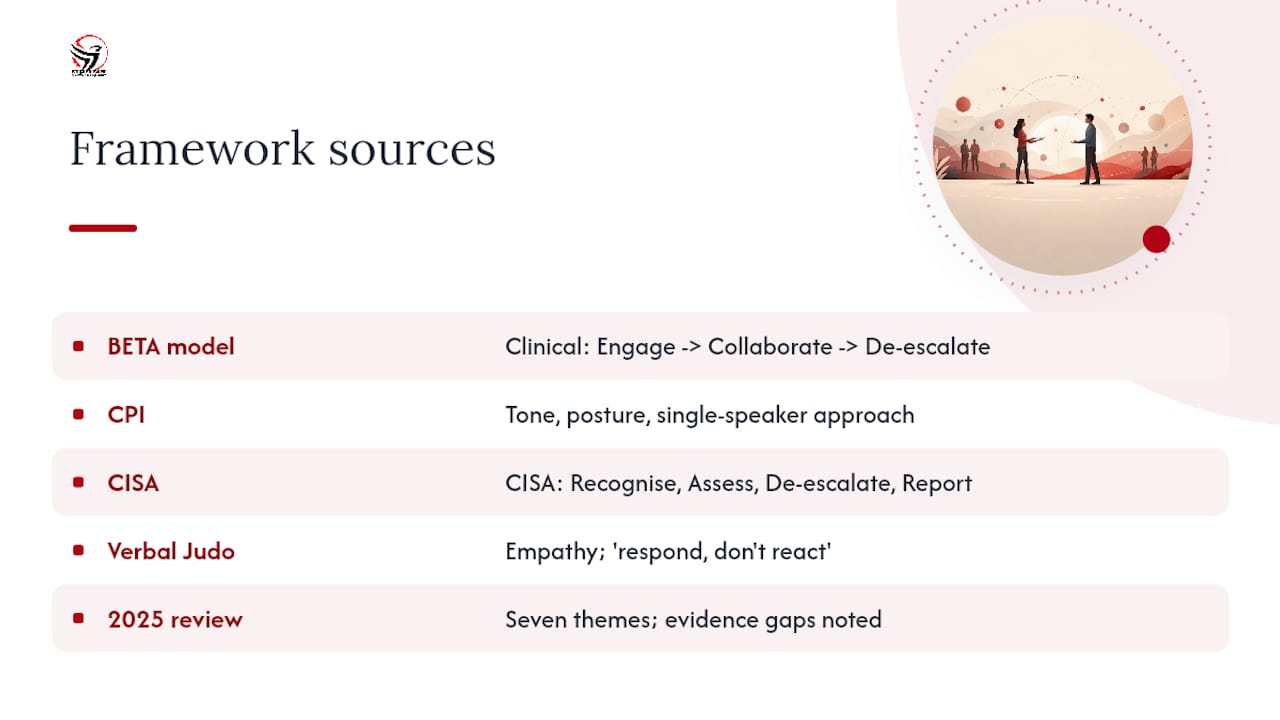
BETA 3-step paradigm: Drawn from clinical literature on managing agitated patients, the BETA model (Engage, Establish collaboration, Verbally de-escalate) is described in published clinical guidance as a structured approach to ensuring safety and avoiding coercive interventions. It is widely used in healthcare and crisis intervention settings across Canada.
CPI (Crisis Prevention Institute): CPI’s training framework emphasises tone, posture, and approach as practical skills for calming agitated persons. Its Top 10 de-escalation tips align closely with CISA guidance: remain calm, respect space, use a single speaker, and change the environment when possible.
CISA De-Escalation Series: CISA’s four-category model (Recognise, Assess, De-escalate, Report) provides a practical process framework applicable to workplace, community, and public settings. CISA also publishes a broader De-Escalation Series for ongoing practitioner development.
Verbal Judo: Developed by George Thompson, Verbal Judo frames de-escalation as a discipline of empathy and calibrated language. The core idea — respond, don’t react — underpins the self-regulation principle throughout this article.
2025 scoping review: A 2025 scoping review identified seven thematic areas that underpin effective de-escalation: communication style, empathy, self-regulation, role division, positioning, environmental factors, and post-incident response. Critically, the review also noted significant gaps in observational effectiveness studies — meaning that while the frameworks are well-reasoned and widely adopted, the real-world evidence base is still developing.
That finding matters practically. It means you cannot simply memorise scripts and expect them to work under stress. The emotional regulation piece — staying regulated yourself — is what allows the scripts to land. This is precisely why guided, scenario-based training produces better outcomes than reading alone.
Where the evidence is thin: The scoping review is candid about limits. Most studies rely on self-report or training evaluations rather than direct observation of real incidents. Effectiveness in high-stakes, real-world encounters is harder to measure than effectiveness in a training room. That does not invalidate the frameworks — it means practising them in realistic conditions matters more, not less.
Why practise matters more than most people think
Most people read a list of de-escalation strategies and feel prepared. They are not. Reading activates understanding; practice activates skill. There is a real difference between knowing what to say and being able to say it when your heart rate is at 140 beats per minute and someone is in your face.
The 2025 scoping review makes this point structurally: self-regulation is listed alongside communication style as a core theme — not as a prerequisite you either have or don’t. It is a trainable skill. And it is trained through repetition under simulated pressure, not through reading.
What guided training delivers that self-study does not is live feedback on the moments you don’t notice yourself — the slight edge in your voice when you feel challenged, the instinctive step forward when you should step back, the pause you skip because silence feels uncomfortable. A skilled instructor catches those habits and corrects them before they become the thing that fails you in a real situation.
Verbal self-defence and physical self-defence are not separate disciplines. The same awareness, the same regulation, and the same decision-making process underlie both. Training them together produces people who are genuinely safer — not just better informed.
Streetsafeselfdefence brings de-escalation training to you
Reading this article gives you a solid foundation. What it cannot give you is the experience of staying regulated while someone is escalating in front of you — that takes practice with a real person, real feedback, and realistic scenarios.
Streetsafeselfdefence delivers mobile, onsite training directly to your workplace, school, or community group across Canada. No commute, no scheduling around a fixed class calendar. The programme covers verbal de-escalation, trauma-informed instruction, boundary setting, and physical self-defence — all in a single, practical session that takes as little as five hours. Courses are tailored for women, high school students, corporate teams, Indigenous communities, healthcare workers, and security professionals. Women-only workshops and trauma-sensitive programmes are available for groups that need a specialised approach. Book a session or request a quote at Streetsafeselfdefence.
Sources
These resources are the authoritative starting points for anyone who wants to go deeper on de-escalation strategies, Canadian policy, or specialised training frameworks.
- Re‑Thinking Police De‑Escalation Training
- De‑Escalation Action Guide
- What Do We Mean by De‑Escalation in Police‑Citizen Encounters? A scoping review
- Behavioral escalations de‑escalation strategies — CHOP
- Crisis intervention and verbal de‑escalation (PubMed record)
- Crisis Intervention and de‑escalation techniques — CIT (presentation)
- De‑escalation techniques — Justice Canada