

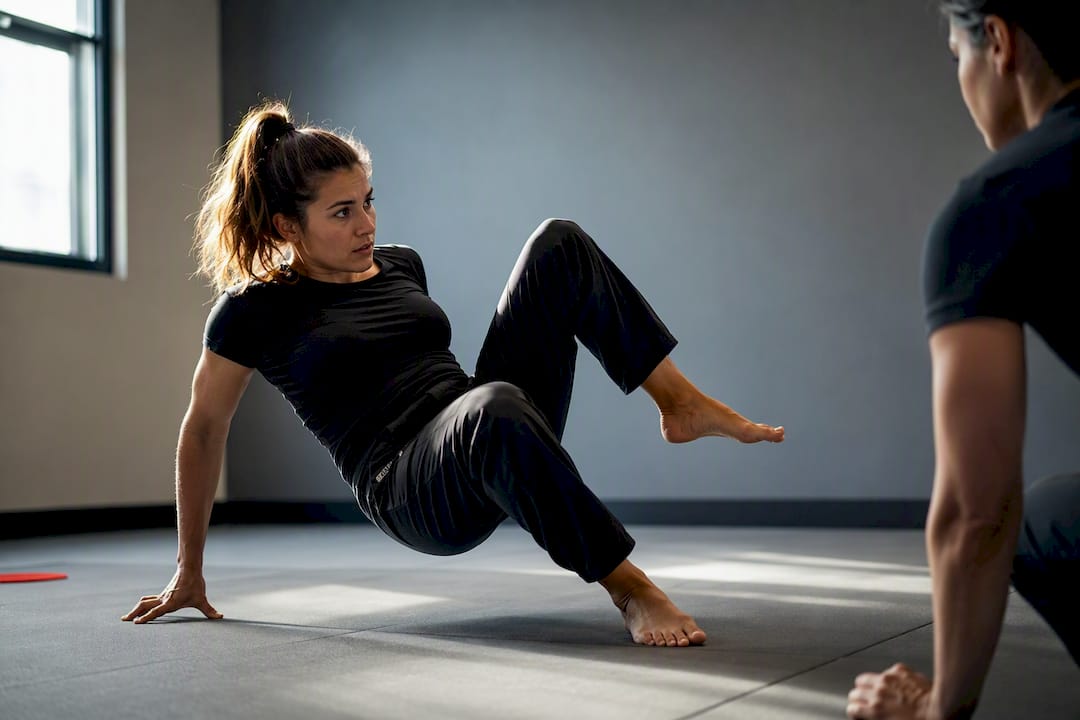
If a fight takes you to the ground, your job is not to win the grapple. Your job is to protect your head, create space with your legs, and get back to your feet as fast as possible. Tuck your chin, turn to your hip instead of lying flat, and use loud commands to draw help while you frame the attacker off you. Supervised training teaches these reactions until they become automatic.
TL;DR:
- The first ten seconds on the ground are critical for protecting your head, creating space, and establishing an exit, not fighting or submitting.
- Repeating core movements like technical stand-ups and hip bridges daily builds muscle memory that outperforms memorizing many techniques under stress.
- Key defensive actions include framing with your limbs, using short strikes to open opportunities, and transitioning quickly to standing, especially against multiple attackers.
- Training should prioritize supervised, scenario-based practice over solo drills to correct bad habits and adapt to varied terrain and real-time stress.
- Fostering recognition of position and response through repetition reduces decision fatigue and enables automatic reactions during an attack.
Table of Contents
- Core principles that guide every ground-survival choice
- What to do in the first 10 seconds after you hit the ground
- High-value ground techniques and when to use them
- A safe training progression and drills to build muscle memory
- Why reality-based, trauma-informed training accelerates safe skill building
- Defensive tactics against common ground attack positions
- Using improvised weapons or the environment on the ground
- Defending against multiple attackers while on the ground
- Moving from defence to offence while on the ground
- Staying calm and deciding fast under ground attack
- How to book practical ground-survival training with a self-defence training provider
- The one habit that matters more than any single technique
- Sources
Core principles that guide every ground-survival choice
Every physical technique in this article is a backup plan. Avoidance and situational awareness come first, always. If you never end up on the ground, none of the rest matters, and reading a room, keeping distance, and leaving early remain the highest-percentage safety tools you have. Ground defence exists for the moment those first layers fail.
Once you’re down, posture decides everything. Lying flat on your back with your head against the floor gives an attacker leverage and gives you almost none. Favouring your hip, keeping your head off the ground, and treating your legs as active barriers rather than dead weight are the dynamic posture and framing principles that let a smaller person create room against a bigger attacker.
Think of your response in this order:
- Protect your head and airway first
- Create space with frames and leg pressure
- Use short strikes only to open an escape window
- Get to your feet the moment a gap appears
Grabbing and holding a limb (a wristlock or arm bar attempt) can work, but only briefly. Practitioners who teach street-focused ground defence use what’s sometimes called the three-second rule: if a limb-control attempt hasn’t created an obvious opening in about three seconds, let it go and switch tactics instead of fighting for a submission that isn’t coming.
Pro Tip: Rehearse the sequence “protect, space, strike, stand” out loud during solo practice. Saying it trains your brain to move through the stages in order instead of freezing on one step.
What to do in the first 10 seconds after you hit the ground
The first ten seconds on the ground set up everything that follows. Civilian self-defence research consistently frames the goal as awareness, distance, escape, communication, and recovery, not a prolonged fight, and that framing applies just as much once you’re down as it does standing up.
- Tuck your chin and bring your hands to your temples or forehead. This protects your skull and jaw from follow-up strikes without needing to see the threat clearly yet.
- Turn onto your side or hip and face the attacker. A flat back gives up your view and your air; turning lets you breathe, see what’s coming, and start moving.
- Frame with your forearms and elbows, and drive with your legs. Push the attacker’s hips or knees away to open distance rather than trying to absorb their weight.
- Shout something specific. “Call 911” or “Help, this man is attacking me” does two things a scream doesn’t: it recruits bystanders and it can rattle the attacker’s confidence.
- Choose your exit move. Decide fast between shrimping away to reset space or driving straight into a technical stand-up if a gap is already open.
One detail people miss under stress: freezing for even two or three seconds while deciding what to do costs you the window an attacker’s initial grab or strike created. Ground-defence coaching stresses that most real encounters don’t stay on the ground long by design. The person who reacts in the first beat, rather than the one with the most techniques memorized, tends to control what happens next.
High-value ground techniques and when to use them
You don’t need fifty moves. You need four or five that work under adrenaline, and a clear sense of when each one applies.
Technical stand-up. From your side, plant one foot flat near your hip, post the opposite hand behind you, and drive your hip up while sweeping the free leg back to load your other foot. Your front knee becomes a shield between you and the attacker as you rise. The cue to use it: any moment the attacker’s weight shifts off you, even briefly.
Shrimping and bridging. Shrimping (hip escape) drags your hips away from a pinning attacker to recreate space; bridging drives your hips upward to dislodge someone’s weight from on top of you. Drill them separately before chaining them: ten slow bridges, then ten hip escapes, then combine both under light resistance. These core ground-defence principles around leverage and angle are what let a lighter person move a heavier one.
Framing and leg barriers. If the attacker is standing over you, your legs are your fence. Bicycle-kick your feet toward their knees and hips to keep range, and never let both legs get pinned flat.
Short strikes. The palm-heel strike, hammerfist, elbow, and a low front kick to the groin or knee are your ground-strike toolkit. None require power, just placement and commitment, and each is meant to buy a half-second of space, not to finish a fight.
Joint control, briefly. A kimura or omoplata-style lock can work if the attacker’s arm is already extended and trapped. Apply it, and if it hasn’t produced an opening in roughly three seconds, release and move to a strike or escape instead of wrestling for it.
- Technical stand-up: use the instant weight shifts off you
- Shrimp/bridge: use when pinned and needing room before standing
- Short strikes: use to create the gap that lets you stand
- Joint control: use only briefly, then abandon if it stalls
Pro Tip: Practise your front kick to a low target, not a high one. Kicking for the head or chest from the ground is slow and risky; kicking a knee or groin is fast and forgiving of imperfect form.
A safe training progression and drills to build muscle memory
These moves only become reliable through repetition, and repetition has to be structured to stay safe.
- Solo drills, three to five minutes each. Hip bridges, technical stand-up repetitions on both sides, and shrimping across a mat build the raw movement pattern with zero injury risk.
- Cooperative partner drills. A partner applies light, predictable pressure while you practise framing, bridging, and standing up, with both people agreeing on pace beforehand.
- Resistance drills. The same movements, now with a partner resisting at 30 to 50 percent effort, so you feel real friction without a full struggle.
- Scenario drills. Add a verbal component, like the partner playing a specific role, so you’re combining movement with communication under mild stress.
A simple weekly template, two twenty-minute sessions, is enough to keep these patterns sharp without turning into a second job. Progressive drilling that moves from cooperative to resistance to scenario work is the approach most consistently linked to faster, safer skill retention.
Safety comes first in every session. Set a stop word before you start, warm up joints and necks properly, and never drill through pain. Trauma-informed coaching also means checking in verbally, confirming consent before any contact drill, and letting a participant opt out of a scenario without explanation.
Why reality-based, trauma-informed training accelerates safe skill building
Experienced instructors have observed the same pattern across age groups and fitness levels: people learn these reflexes faster with a coach correcting their positioning in real time than they ever do from video alone. Some training models are built around that observation, teaching foundational ground-survival skills in as little as five hours, delivered on-site so groups train in the space where they’ll actually need the reflex.
- Supervised correction catches bad habits, like flattening your back or telegraphing a kick, before they become muscle memory
- Trauma-informed pacing lets participants opt out or slow down without judgment
- Tailored sessions for groups, from high school students to real estate professionals, adjust scenarios to the risks each audience actually faces
- Testimonials from past participants consistently point to increased confidence, not just technique recall
Online practice builds familiarity with the shapes of these movements. In-person coaching is what turns them into something you can trust your body to do without thinking.
Defensive tactics against common ground attack positions
Mount, side control, and guard each demand a different first move, and confusing them wastes the seconds you don’t have.
Mount (attacker straddling your torso). Your priority is denying strikes and creating an exit lane. Trap one of the attacker’s arms against your chest while bridging hard toward the same side, aiming to roll them off rather than push them straight up, where their weight advantage wins.
Side control (attacker beside and across you). Frame immediately with your near-side forearm against their hip or shoulder to stop them settling their weight. Shrimp your hips away from the pressure to open a gap, then use that gap to bring a knee back between you.
Guard (attacker between your legs, you underneath). This is the most defensible of the three because your legs are already active as barriers. Keep your knees bent and feet on their hips, not locked around their back, and use frames on the biceps or collarbone to prevent strikes from landing cleanly.
None of these positions are meant to be held. Each is a brief stop on the way to standing up. The moment you create separation in any of them, whether through a bridge, a frame, or a short strike, the next move is always the same: stand up and get away, not settle in and try to win the position.
Using improvised weapons or the environment on the ground
Nothing in reach is off-limits when your safety is genuinely threatened. A set of keys can rake across an attacker’s hand or face during a frame. A phone, a shoe, or a bag within arm’s reach can be swung or jabbed to create the same half-second opening a palm-heel strike would.
The floor itself is a resource too. If you’re near a wall or heavy furniture, use it to anchor your feet during a technical stand-up instead of relying purely on balance. A curb, a step, or uneven pavement changes how you should bridge or shrimp, since the terrain can help or hinder your leverage depending on which way you move.
Loose gravel, wet pavement, or a narrow space between parked cars all change the calculation. Scan for these details in the half-second you have while turning to your hip early in the encounter, because the same technical stand-up that works cleanly on a gym mat needs different foot placement on a slope or loose surface. This is one reason live scenario drills, run outdoors or on varied ground, matter more than repeating a technique only on a soft mat.
Defending against multiple attackers while on the ground
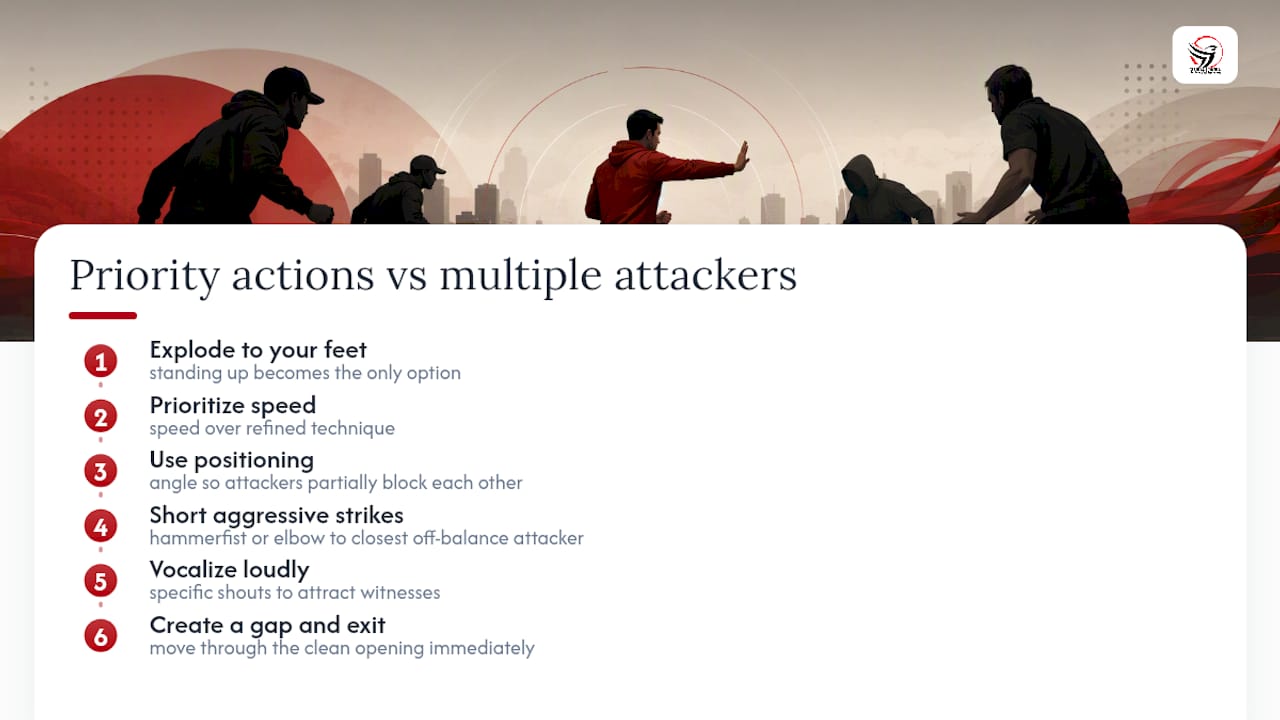
Ground defence against one attacker is already demanding. Against two or more, the calculation changes completely, and the priority shifts even harder toward speed over technique.
Getting to your feet stops being one option among several and becomes the only option. Every second spent on the ground with multiple attackers multiplies the risk, since you can only track and frame one direction at a time while a second or third person has a free line to strike or grab.
Positioning matters more than any single technique here. If you’re forced down, try to angle your body so at least one attacker is partially blocked by another, even briefly, rather than facing an open circle of threats. Short, aggressive strikes, a hammerfist or elbow, aimed at whichever attacker is closest and most off-balance, buy the fractional opening needed to explode into a stand-up.
Vocalization does more work in a multiple-attacker scenario than in a one-on-one encounter. Loud, specific shouts are more likely to pull in bystanders or witnesses precisely because the scene looks more alarming, and that outside attention can shift an attacker’s calculation faster than any strike you land. The realistic goal against multiple attackers is never to fight through all of them. It’s to create one clean gap and move through it immediately.
Moving from defence to offence while on the ground
There’s a specific moment in most ground encounters where the balance tips, usually right after a successful frame, bridge, or short strike creates an opening the attacker didn’t expect. Recognizing that moment matters as much as creating it.
The transition isn’t about switching into an aggressive mindset for its own sake. It’s about using the half-second of disruption you just created to finish the job of standing up, rather than staying down to press an advantage. If a hammerfist stuns an attacker’s grip, that’s the cue to shrimp and stand, not to attempt a second strike from the same compromised position.
Occasionally the safer move is a brief, controlled offensive action, like completing a joint lock that’s already working, specifically because it buys enough time to stand rather than because it wins the encounter outright. This is where the three-second rule earns its place again: a limb control attempt is a bridge to standing, not a destination. The moment it stalls, or the moment it succeeds enough to create distance, the plan reverts to getting upright and leaving.
Staying calm and deciding fast under ground attack
Fine motor skills and complex decision-making both degrade under the adrenaline of a real assault. That’s precisely why the priority sequence covered earlier, protect, create space, strike, stand, has to be simple enough to run on autopilot.
Tactical breathing helps more than most people expect. A slow exhale, even a single one, taken the instant you hit the ground, can counter the tunnel vision and time distortion that make three seconds feel like thirty or thirty feel like three. Coaches who run reality-based scenarios build this breath into the very first cue they teach, before any physical technique.
Decision fatigue is the real enemy, not lack of technique. Someone who has drilled the same four or five responses repeatedly doesn’t need to invent a plan mid-attack. They recognize the position (mount, side control, being stood over) and their body already knows the matching response. That recognition, built through repetition rather than memorized theory, is what separates a frozen reaction from a functional one, and it’s the entire reason scenario-based drilling matters more than reading about technique.
How to book practical ground-survival training with a self-defence training provider
Reading about frames, bridges, and technical stand-ups gets you partway there. Feeling a coach correct your hip angle mid-drill is what actually makes the movement stick, and that gap can be closed with mobile sessions delivered wherever your group already gathers.
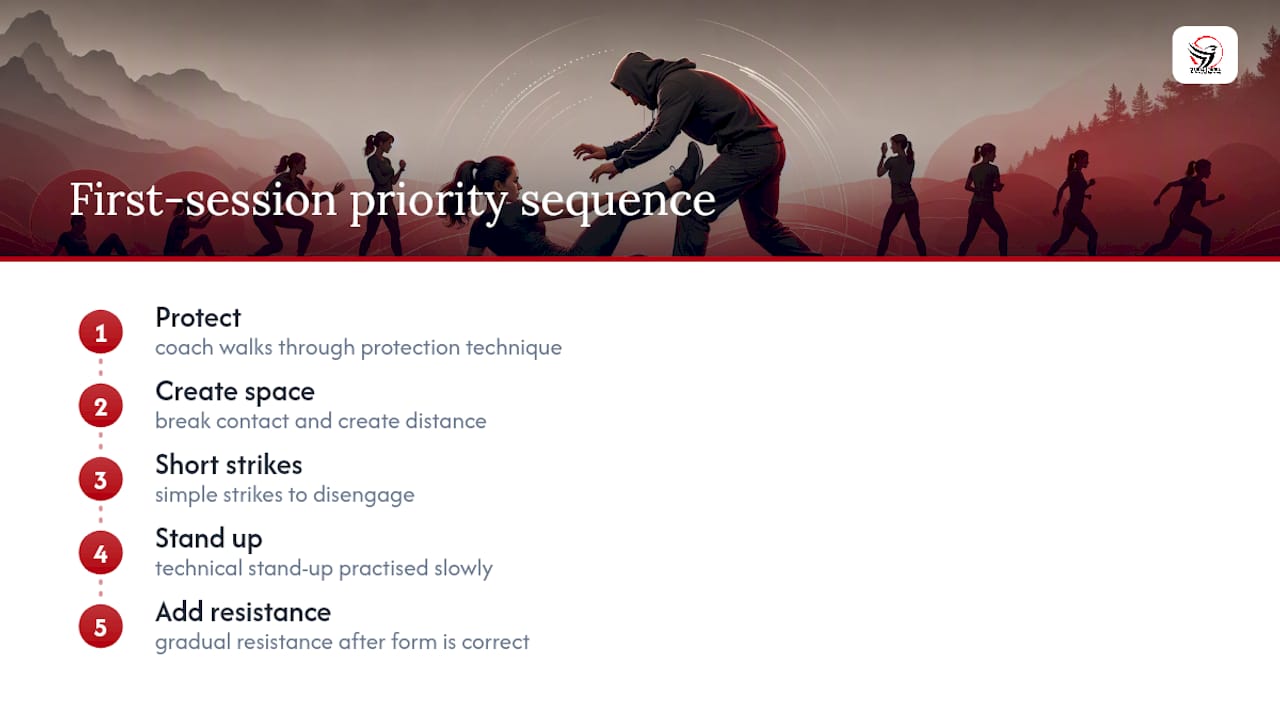
A first session typically starts with the priority sequence covered in this article: protect, create space, short strikes, stand up, walked through slowly before any resistance is added. From there, coaching adjusts to the room. Beginners get more repetition on the basics; groups with prior training move faster into scenario work. The mobile format means no commute to a studio and no gear to buy, just a coach arriving with a plan suited to whoever’s in the room, whether that’s a family, a workplace team, or a high school group.
Booking is straightforward: pick a format that fits your group size and goals, whether that’s a general safety session or something more targeted, like trauma-informed instruction for survivors or workplace-specific training for real estate professionals who meet strangers alone. If you’re ready to move past reading and into practising these reflexes with a coach who can correct your form in real time, book a session with Streetsafeselfdefence and start with the basics covered here.
The one habit that matters more than any single technique
The biggest misconception about ground defence isn’t about technique at all. It’s the belief that more moves equal more safety. In practice, the opposite tends to be true: five reflexes drilled until automatic beat thirty techniques half-remembered under stress, every time.
If you take one thing from this article, make it a daily five-minute drill of technical stand-ups and hip bridges. That single habit, repeated until it’s boring, does more for your actual safety than any amount of technique-collecting ever will. Pair it with real, supervised training when you can, because a coach watching your hip angle will catch mistakes no amount of solo practice ever will.
— Rob
Sources
- Five elements of self-defence for civilians: awareness, distance, escape, communication, and recovery – PREPARE Magazine
- 4 essential self-defence moves everyone should know — RealSimple
- Principles of the ground | Active Response Training
- Self-defence tips and escape moves — Healthline