

By Rob Andress and Beth Andress
Street Safe Self Defence Training Company
Canada’s Leader in Reality-Based Violence Prevention and Frontline Safety Education
By-Law Officers Are Being Asked To Do Difficult Work Without Reality-Based Training
Across Canada, By-Law
Officers are being asked to do jobs that didn’t exist twenty years ago.
Today, they are expected to manage:
- Encampments and homelessness.
- Mental health crises.
- Neighbour disputes.
- Property standards.
- Noise complaints.
- Aggressive animals.
- Public disorder.
- Illegal dumping.
- Trespassing.
- Hostile and emotionally charged citizens.
Yet despite these realities, most officers receive little education in violence prevention, human behaviour, close-quarter encounters, conflict management, or the realities of interpersonal violence.
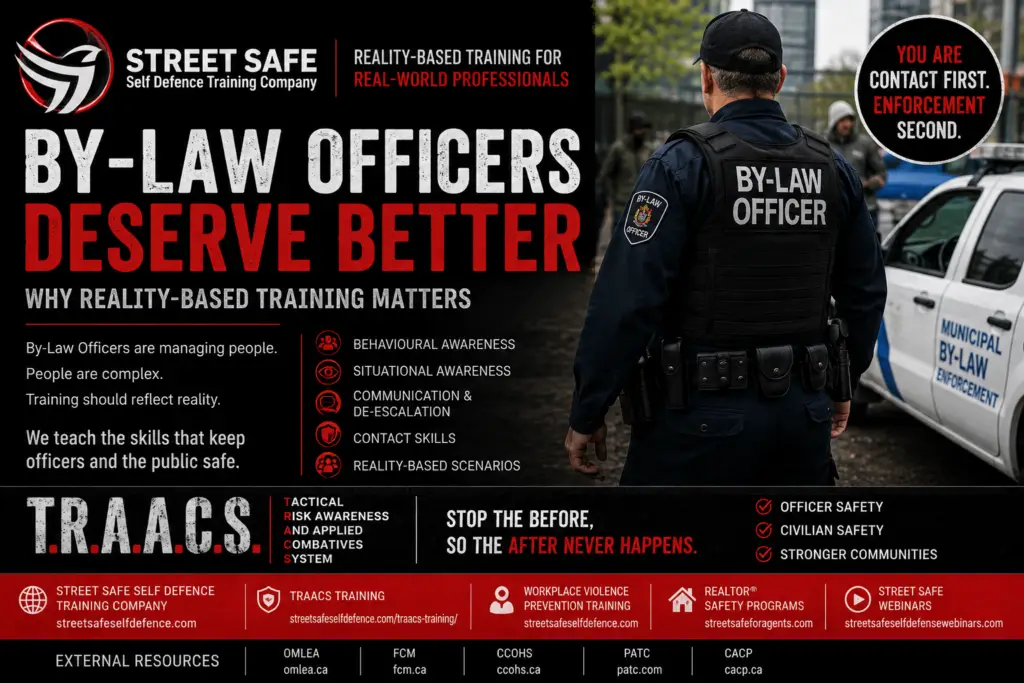
At Street Safe Self Defence Training Company, we believe they deserve better.
The Job Has Changed. Training Must Change Too.
The profession has evolved.
The expectations placed upon municipal officers have evolved.
But much of the training has remained focused on legislation and authorities.
While laws matter, authority does not create safety.
Understanding people creates safety.
Understanding behaviour creates safety.
Recognizing escalation creates safety.
Understanding the difference between contact and enforcement creates safety.
The New Doctrine: Contact First. Enforcement Second.
One of the most significant shifts occurring within frontline professions is understanding that:
You Are Contact First. Enforcement Second.
Most interactions begin as human encounters.
Not enforcement encounters.
The public experiences another person before they experience authority.
How officers communicate, position themselves, manage distance, recognize behavioural changes, and establish boundaries often determines whether
an encounter remains voluntary or becomes confrontational.
Understanding contact allows officers to avoid unnecessary enforcement.
And when enforcement becomes necessary, it is approached from a position of understanding rather than reaction.
This distinction improves:
- Officer safety.
- Civilian safety.
- Public trust.
- Professional confidence.
- Organizational liability.
Most Violence Is Predictable
Violence isn’t random.
Human beings are
patterned.
Escalation is patterned.
Behaviour is patterned.
Yet many officers have never been taught:
- Baseline and anomaly recognition.
- Social violence versus predatory violence.
- Space management.
- Emotional escalation.
- Resource protection.
- Human dynamics.
- Behavioural awareness.
- Environmental awareness.
Too often, professionals rely on experience and luck.
Luck is not a safety strategy.
Introducing T.R.A.A.C.S.
Tactical Risk Awareness And Applied Control System
Developed by Street Safe Self Defence Training Company, TRAACS was designed specifically for modern frontline professionals.
Not fighters.
Not martial artists.
Professionals.
TRAACS teaches:
Behavioural Awareness
Understanding intent.
Recognizing escalation.
Identifying anomalies.
Situational Awareness
Environmental awareness.
Space management.
Threat recognition.
Communication And De-Escalation
Professional presence.
Human dynamics.
Conflict management.
Contact Skills
Non striking protective responses.
Close quarter positioning.
Soft and Hard contact methods.
Stabilization and escape.
Reality-Based Scenarios
Because reality doesn’t happen in a dojo.
Reality happens:
- In parks.
- On sidewalks.
- At encampments.
- In apartment buildings.
- During noise complaints.
- At three feet.
- Sometimes alone.
- Sometimes with cameras recording.
Officer Safety And Civilian Safety Are Not Opposing Goals
For too long, officer safety and civilian safety have been treated as opposing priorities.
They are not.
Safer officers create safer interactions.
Safer interactions create safer communities.
The answer is not greater force.
The answer is greater understanding.
Recognize earlier.
Intervene smaller.
Resolve safer.
The Work Street Safe Is Doing Across Canada
Rob Andress and Beth Andress, founders of Street Safe Self Defence Training Company, have worked alongside municipalities, security teams, healthcare organizations, schools, and frontline professionals across Canada.
Through the Tactical Risk Awareness and Applied Control System (TRAACS), Street Safe has helped By-Law Officers and Security Teams better understand:
- Behavioural awareness.
- Situational awareness.
- Human dynamics.
- Conflict management.
- Violence prevention.
- Environmental awareness.
- Professional communication.
- Officer and civilian safety.
Because the reality is simple:
Most frontline professionals are expected to perform at a level they have never been educated for.
Training should reflect the realities they face, not the realities we wish existed.
About The Authors
Rob Andress and Beth Andress are the founders of Street Safe Self Defence Training Company, one of Canada’s leaders in reality-based violence prevention, situational awareness, behavioural awareness, and workplace safety education.
Through the TRAACS – Tactical Risk Awareness and Applied Control System, they work with municipalities, security teams, healthcare organizations, and frontline professionals across Canada.
“You Are Contact First. Enforcement Second.”
“Stop the Before, so the After Never Happens.”
Street Safe Self Defence Training Company
Learn More
Street Safe Self Defence Training Company
🌐 https://www.streetsafeselfdefence.com
TRAACS – Tactical Risk Awareness and Applied Combatives System
🌐 https://streetsafeselfdefence.com/traacs-training/
References
- Canadian Centre for Occupational Health and Safety (CCOHS)
https://www.ccohs.ca - Ontario Municipal Law Enforcement Association (OMLEA)
https://www.omlea.ca - Federation of Canadian Municipalities
https://fcm.ca - Public Agency Training Council
https://www.patc.com
Related Articles (Internal Links)
- Why Healthcare Needs Street Safe Self Defence Training Company
🔗 https://streetsafeselfdefence.com - High School Self Defence: Why Violence Prevention Matters More Than Fighting
🔗 https://streetsafeselfdefence.com - Micro Expressions: Understanding Human Behaviour
🔗 https://streetsafeselfdefence.com - The Real Estate Industry’s Misunderstanding of Violence
🔗 https://streetsafeselfdefence.com
