

If you witness harassment, discrimination, or violence, the safest first moves are usually to distract or delegate rather than confront directly. The 5Ds of bystander intervention (Distract, Delegate, Document, Delay, Direct) give you a practical toolkit for almost any situation.
Here are actions you can take right now:
- Distract: Spill something, ask for directions, or strike up a conversation with the person being targeted to break the aggressor’s focus.
- Delegate: Tell a transit worker, security guard, or nearby staff member what you saw and ask them to step in.
- Document: Record calmly from a safe distance if it is safe to do so, keeping the camera steady and staying out of the aggressor’s line of sight.
- Check in: After the incident, approach the targeted person and ask, “Are you okay? I saw what happened.”
- Call 9-1-1 if there is immediate physical danger or a weapon involved.
Table of Contents
- What bystander intervention means and where it applies
- Why bystander action changes outcomes
- The 5Ds explained with scripts you can use today
- How to choose the safest option before you act
- When to call police and what Canadian law says
- Why training makes you a more confident bystander
- Key takeaways
- The case for practising before you need it
- Ready to practise? Streetsafeselfdefence brings training to you
- Useful Canadian resources and further reading
What bystander intervention means and where it applies
Bystander intervention is the act of a witness taking safe, proactive steps to interrupt, discourage, or de-escalate a harmful situation and support the person being targeted. The goal is not to be a hero. It is to reduce harm, protect the target, and signal to everyone present that the behaviour is not acceptable.
Active bystandership applies across a wide range of settings:
- Public transit and streets
- Workplaces and offices
- Schools, campuses, and social events
- Online spaces, including social media and group chats
The 5Ds framework, endorsed by the Government of Canada’s Department of National Defence, is the central model used in Canadian training programmes. Right To Be, a leading bystander training organisation, developed and popularised the 5Ds as a structured, learnable approach to safe intervention.
Why bystander action changes outcomes
When a bystander steps in, the impact goes beyond the immediate moment. Intervening reduces harm to the targeted person, signals that the community does not tolerate the behaviour, and begins shifting social norms over time.
The challenge is a well-documented psychological phenomenon called the bystander effect. As the APA explains, people are less likely to act when others are present because of diffusion of responsibility (assuming someone else will handle it) and ambiguity (uncertainty about whether the situation is actually dangerous). The more witnesses there are, the stronger both forces become.
Training directly counters this. Research shows that bystander training increases self-efficacy, meaning people feel more capable and prepared to act when a real situation arises.
When bystanders do act, the outcomes include:
- Immediate reduction in harm to the targeted person
- Reduced trauma and isolation for the target
- A clear social signal that the behaviour is unacceptable
- Long-term shifts in group and community norms
- Greater confidence among others nearby to act as well
Small, consistent actions, such as calling out an inappropriate joke or checking on a colleague after a difficult meeting, accumulate into genuine cultural change.
The 5Ds explained with scripts you can use today
The 5Ds are the recommended toolkit for anyone who wants to be an active bystander. Each option fits different situations, risk levels, and relationships. The goal, as the Step UP! programme puts it, is to shift the energy of the situation and re-humanise the targeted person, not to escalate or “win” a confrontation.
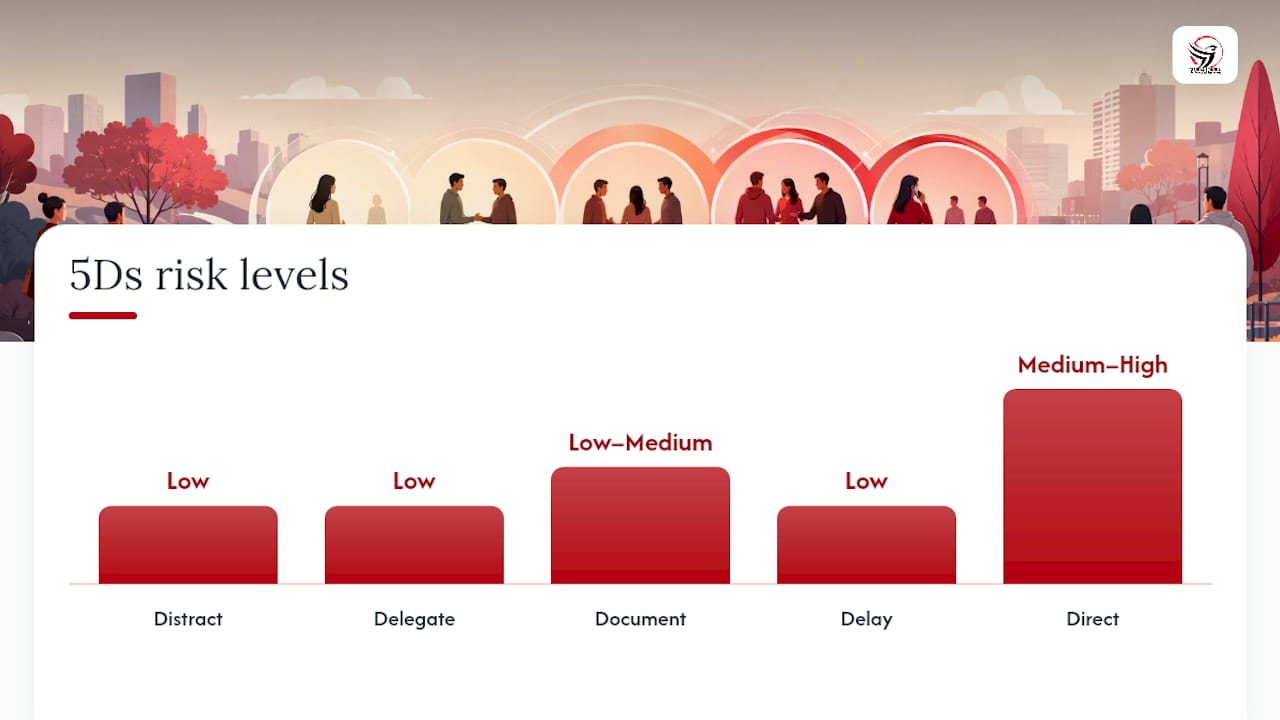
| D | Best situation | Risk level | Sample script |
|---|---|---|---|
| Distract | Aggressor is focused; target needs an exit | Low | “Hey, do you know where the nearest exit is?” |
| Delegate | You are alone or feel unsafe intervening | Low | “Excuse me, that person over there needs help.” |
| Document | Incident is ongoing; you cannot safely intervene | Low–Medium | Record calmly; do not narrate or confront |
| Delay | Incident has ended; target is alone | Low | “I saw what happened. Are you okay?” |
| Direct | Situation is lower-risk; you feel confident | Medium–High | “That’s not okay. Please stop.” |
Distract
Distraction breaks the aggressor’s focus without confrontation. It works best when the situation is escalating but not yet physical.
- “Sorry, I think I know you — didn’t we meet at the community centre?” (said to the target)
- “Excuse me, can you help me find platform 3?” (said to the aggressor)
- Drop something nearby to create a natural interruption.
In person: On a bus where someone is being verbally harassed, sit next to the target and start a friendly, unrelated conversation. The aggressor loses their audience.
Online: In a group chat where someone is being piled on, post a completely unrelated topic or a direct message to the targeted person saying, “Hey, ignore them. Want to talk?”
For more real-world scripts in street settings, the practical guide to stopping street harassment covers distraction tactics specific to Canadian public spaces.
Delegate
Delegation means handing the situation to someone with more authority or resources. It is the right choice when you feel unsafe, when you are alone, or when the aggressor is intoxicated or unpredictable.
- “There’s a situation happening near the north entrance. Can you check it out?”
- “I need you to call security right now.”
- Text a friend in the same space to come over and help.
In person: At a workplace event, find a manager or HR contact and describe exactly what you witnessed: who, what, where.
Online: Report the content using the platform’s reporting tools and flag it to a moderator or community admin.
Document
Documenting creates a record that the targeted person can use later. According to Right To Be, when you document, capture only objective facts (who, what, when, where) and never share recordings without the targeted person’s consent. The evidence belongs to them.
- Stay at a safe distance and record steadily.
- Note the time, location, and a description of the aggressor.
- After the incident, offer the recording to the target and ask what they want done with it.
In person: On a subway platform, record from behind a pillar if it is safe. Do not narrate or draw attention to yourself.
Online: Take screenshots of posts, comments, or messages before they are deleted, and share them only with the targeted person’s permission.
Delay
Delay is the check-in after the incident. It is often the most overlooked of the 5Ds, and one of the most powerful. The AFSC bystander toolkit emphasises that support after an event is as important as action during it.
- “I saw what happened. I’m sorry that occurred. Are you okay?”
- “Do you want me to walk with you, or is there someone I can call?”
- Simply sitting with someone in silence can reduce the sense of isolation.
In person: After a harassment incident on the street, follow at a respectful distance and check in once the aggressor has left.
Online: Send a private message to the targeted person: “I saw what was posted. That was wrong. I’m here if you want to talk.”
Direct
Direct intervention means speaking up clearly to the aggressor. It carries the highest escalation risk of the five options, so use it only when the situation is lower-risk and you feel confident. Keep it short, firm, and focused on the target, not on debating the aggressor.
- “That’s not okay. Please stop.”
- “Leave them alone.”
- Then immediately shift your attention to the target: “Are you alright?”
In person: If someone is making discriminatory comments at a social gathering, a calm, brief statement (“That’s not something we say here”) followed by redirecting the conversation is more effective than a prolonged argument.
Online: A short public reply (“This comment is harmful and I’m flagging it”) followed by a direct message to the target is often enough.
Pro Tip: Combining Ds is often the safest and most effective approach. Distract to create space, then Delegate to someone with authority, then Delay to check in with the target afterward. You do not have to choose just one.
How to choose the safest option before you act
Before intervening, run through this quick mental checklist:
- Is anyone armed or physically violent right now? If yes, do not approach. Call 9-1-1 and document from a safe distance.
- Is the aggressor intoxicated or highly agitated? Avoid direct confrontation. Delegate to security or staff.
- Is the target signalling you not to intervene? Respect that. Move to Delay and check in afterward.
- Are you alone? Delegate first, then document.
- Do you have a relationship with the aggressor? Direct intervention may be lower-risk. Still keep it brief.
Common barriers to acting include fear of making things worse, uncertainty about whether the situation is serious, and concern about social embarrassment. These are normal responses. The solution is not to wait for certainty but to choose the lowest-risk option available. Distract or Delegate almost always carries low personal risk and can still make a meaningful difference.
Red flags that mean you should not intervene directly:
- A weapon is visible or implied.
- The aggressor is physically much larger or there are multiple aggressors.
- The situation is already physical.
- You are in an isolated location with no one nearby to help.
Pro Tip: Before you are ever in a situation, identify two “delegate contacts” in the spaces you frequent: the security desk number at your workplace, the transit authority line, or a trusted colleague. Having those contacts ready removes the hesitation in the moment.
The Princeton BDI Community Guide recommends calm posture, centred breathing, and simple dignity phrases as physical and verbal anchors that help you stay grounded before and during an intervention.
When to call police and what Canadian law says
Call 9-1-1 when there is immediate physical danger, a weapon is involved, or someone has been seriously injured. For most other situations, delegation to security, venue staff, or a transit authority is safer and often more effective.
Scenarios that warrant calling emergency services:
- Physical assault in progress
- A weapon visible or threatened
- Someone is unconscious or seriously injured
- A person is being forcibly confined or trafficked
Scenarios better handled by delegation or delay:
- Verbal harassment on transit (notify the driver or transit authority)
- Workplace discrimination (report to HR or a union representative)
- Online harassment (use platform reporting tools; contact the Canadian Centre for Child Protection for child-related content)
A note on recording: in Canada, you may generally record in a public space, but sharing recordings without the targeted person’s consent raises serious privacy concerns. Always offer the recording to the target first and let them decide. The Government of Canada’s guidance on bystander intervention also notes that for marginalised communities, calling police may not always be the safest option. In those cases, community-based resources, campus support services, or organisations like Right To Be may be more appropriate first contacts.
This article provides general information, not legal advice. Confirm current rules with a qualified legal professional or the relevant Canadian authority.
Why training makes you a more confident bystander
Reading about the 5Ds is a start. Practising them under realistic conditions is what converts knowledge into confident action. The Government of Canada frames bystander intervention as a learnable skill, not an innate personality trait, and quality training programmes reflect that.
A strong bystander intervention training programme will include:
- Scenario-based practice with realistic situations (transit, workplace, social events)
- Trauma-informed coaching that accounts for the emotional weight of witnessing harm
- De-escalation techniques and physical positioning strategies
- Canadian legal context and when to involve authorities
- Cultural sensitivity training for diverse communities, including Indigenous communities and newcomers
- Scripts and language practice so responses feel natural under pressure
Streetsafeselfdefence offers mobile, reality-based training that comes directly to your workplace, school, or community group. The programmes cover workplace harassment prevention, scenario practice for real-world situations, and trauma-informed instruction designed for all ages and fitness levels. For high school students, the high school safety programme addresses peer-to-peer intervention and school-specific scenarios, building youth bystander skills in a structured, supportive environment.
Building a safer workplace culture starts with people who know what to do when something goes wrong. Training gives them that.
Pro Tip: After any training session, practise one script out loud with a colleague or friend. Saying “That’s not okay. Are you alright?” aloud even once makes it far easier to say in a real situation.
Key takeaways
The most effective approach to bystander intervention is choosing the lowest-risk option available, using the 5Ds as your guide, and always prioritising the targeted person’s safety and consent over any impulse to confront.
| Point | Details |
|---|---|
| Start with Distract or Delegate | These two options carry the lowest personal risk and work in most situations. |
| Document with consent | Record only objective facts and always offer the evidence to the targeted person first. |
| Delay is not inaction | Checking in after an incident reduces trauma and shows the target they are not alone. |
| Know your red flags | Avoid direct intervention when weapons, intoxication, or physical violence are present. |
| Streetsafeselfdefence builds real skills | Mobile, scenario-based training in Canada converts knowledge into confident, practised responses. |
The case for practising before you need it
Most people assume they will know what to do when a harmful situation unfolds in front of them. The research says otherwise. The bystander effect is not a character flaw; it is a predictable response to ambiguity and social pressure. What changes that response is not better intentions but practised habits.
There is a meaningful difference between knowing the 5Ds and having said them out loud in a realistic scenario. The moment of hesitation that costs someone support is almost always the gap between those two things. Calling out a discriminatory joke at a team meeting, checking on a colleague who was spoken to harshly, redirecting a conversation that is turning hostile: these are not dramatic acts. They are small, repeatable skills that accumulate into a safer community over time.
The communities that handle harmful incidents best are not the ones with the most rules. They are the ones where enough people have practised enough times that intervention feels normal rather than exceptional. That is what community trust looks like at the ground level, and it is built one practised response at a time.
Ready to practise? Streetsafeselfdefence brings training to you
Live practice builds confidence faster than reading alone. Streetsafeselfdefence delivers mobile, scenario-based bystander and self-defence training directly to your location across Canada, with no gym required and no prior experience needed. Sessions are trauma-informed, culturally sensitive, and designed to give participants real scripts and real decisions to practise under realistic conditions.
Whether you are an individual who wants to feel prepared, a school administrator looking for youth bystander skills training, or an HR manager building a safer workplace, Streetsafeselfdefence has a programme that fits. For those who prefer to start at home, self-defence training at home offers a practical, self-paced option to build foundational skills before joining a group session. Contact Streetsafeselfdefence to book a session or enquire about group rates.
Useful Canadian resources and further reading
A short annotated list of authoritative sources for readers who want to go deeper or arrange training:
- The 5Ds of Bystander Intervention – Right To Be
- Bystander intervention strategies – Canada.ca
- Bystander intervention tip sheet – APA
- Bystander intervention toolkit | American Friends Service Committee
- Active Bystander Intervention and De-Escalation (Princeton BDI community guide 2025)
- Step UP! Active bystander programme
Suggested next step: Memorise one distract script (“Excuse me, do you know where I can find…?”) and identify two delegate contacts in the spaces you use most often. Those two things alone put you ahead of most bystanders in any situation.
