

Six actions determine whether a workplace safety culture actually holds: visible leadership commitment, psychological safety and a just culture, proactive hazard identification, reality-based trauma-informed training, clear reporting and stop-work authority, and measurement using leading indicators. Organisations that apply all six consistently see lasting change. Those that treat safety as a campaign after an incident do not.

Your immediate checklist:
- Put a leader on the floor for a safety walk this week
- Simplify your near-miss reporting form to three fields
- Schedule a workplace violence risk assessment within 30 days
- Book a reality-based, trauma-informed training session (Streetsafeselfdefence delivers mobile options across Canada)
- Assign stop-work authority to every frontline supervisor in writing
- Set one leading indicator to review at your next team meeting
Resources from the Canadian Centre for Occupational Health and Safety (CCOHS) and WorkSafeBC provide the regulatory baseline. Streetsafeselfdefence provides the practical, on-site training layer that turns policy into skill.
Table of Contents
- How to improve safety culture in the workplace through leadership
- Does your team feel safe enough to report problems?
- How do you identify hazards before someone gets hurt?
- What training actually changes safety behaviour?
- Clear reporting rules and stop-work authority that people actually use
- Which indicators tell you your safety culture is actually improving?
- Your 30/90/180-day action plan
- Key takeaways
- Why mobile, reality-based training accelerates cultural change
- Streetsafeselfdefence: mobile workplace violence prevention training
- Useful sources for further reading
How to improve safety culture in the workplace through leadership
Leadership behaviour is the single most powerful determinant of safety culture. A policy document does not change behaviour. A manager who stops unsafe work in front of the team does.

Felt leadership means workers experience leadership commitment directly, not through a memo. That looks like executives joining safety briefings, line managers completing weekly site walkarounds, and supervisors closing out corrective actions on time.
Leadership checklist:
- Conduct at least one unannounced safety walk per week at the supervisor level
- Lead (do not just attend) one safety briefing per month
- Allocate a named budget line for safety training and hazard controls
- Stop unsafe work publicly and explain why, every time
- Include safety KPIs in every manager’s performance review
Pro Tip: Tie corrective-action completion rates to manager performance reviews. When safety follow-through affects compensation, it stops being optional.
Assign accountability by role: executives set the standard and resources; line managers model daily behaviour; supervisors enforce it in real time; safety champions carry the message peer-to-peer; union or worker representatives close the feedback loop. Safety culture must be treated as a long-term strategy, not as a short campaign after an incident.
Does your team feel safe enough to report problems?
Psychological safety and a just culture are prerequisites for honest reporting. Without them, near-misses stay invisible, hazards accumulate, and the first signal of a problem is an injury.
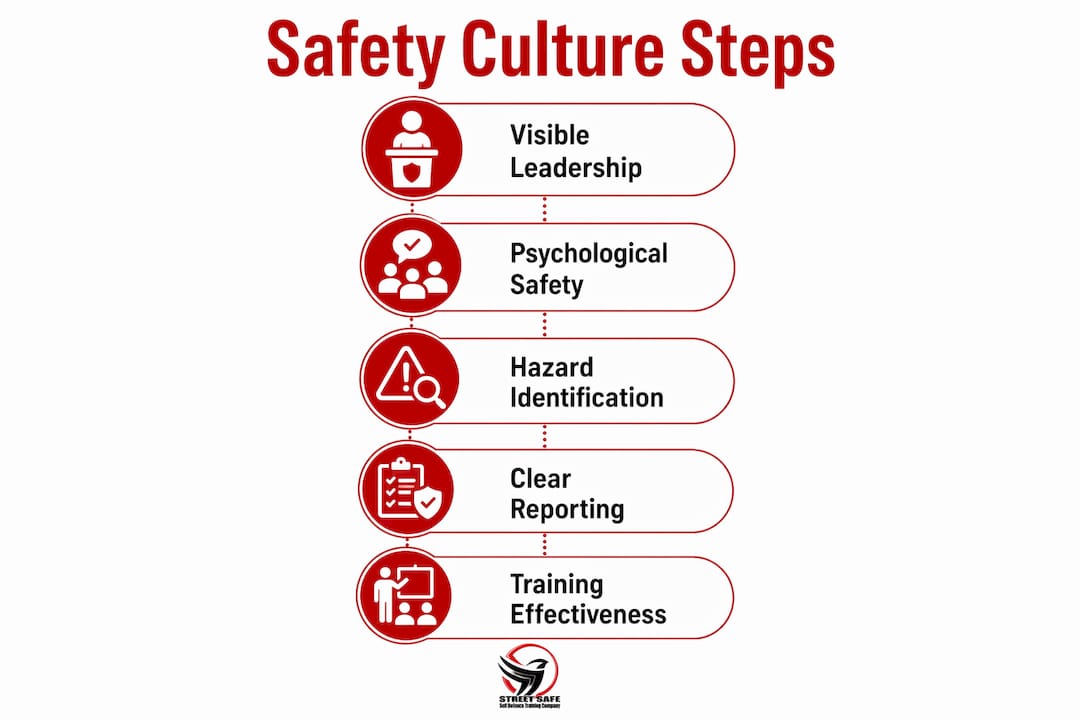
A just culture distinguishes between three categories: human error (the system failed the person), at-risk behaviour (the person took a shortcut without recognising the risk), and reckless behaviour (the person knowingly ignored a rule). Investigations that apply this continuum produce learning. Investigations that skip it produce blame and silence.
Practical steps to raise reporting rates:
- Reduce your reporting form to three fields: what happened, where, and what you did next
- Commit to acknowledging every report within 24 hours
- Offer anonymous reporting for sensitive concerns
- Publish a monthly summary of what was reported and what changed
Near-miss reporting is suppressed by blame cultures, complex forms, and absent feedback. Addressing all three simultaneously is what actually raises rates.
Behaviours leaders must stop:
- Asking “who did this?” before “what caused this?”
- Letting reports sit without visible follow-up
- Disciplining someone for reporting a near-miss they were involved in
- Treating silence as compliance
How do you identify hazards before someone gets hurt?
Proactive hazard identification prevents incidents and reduces costs, including workers’ compensation premiums. Reactive management, by contrast, waits for harm to happen and then responds.
A workplace violence risk assessment for a Canadian workplace follows this sequence:
- Review incident and near-miss records from the past 24 months
- Walk every work area with a frontline worker, not just a manager
- Interview workers in customer-facing, isolated, and high-stress roles
- Assess contractor and visitor access points
- Map trigger points: shift changes, cash handling, lone-worker situations, client-facing escalations
- Rate each hazard by likelihood and consequence, then prioritise controls
Capture in your assessment: existing controls, gaps, vulnerable groups (new workers, lone workers, workers in contact with the public), and environmental factors that raise risk.
Normalisation of deviance is a primary threat. Small shortcuts become accepted practice, then invisible risk. Stop-work authority reverses this: every worker has the right and responsibility to halt a task they believe is unsafe, without penalty.
Pro Tip: For distributed or mobile workforces, keep your assessment tool on a phone. A three-screen mobile checklist completed on-site beats a 40-field desktop form completed from memory later.
What training actually changes safety behaviour?
Reality-based, trauma-informed training with leadership participation produces faster cultural change than lecture-only approaches. Attendance is not competency.
Training formats and their best fit:
- Scenario-based on-site: highest transfer to real behaviour; suits frontline and customer-facing teams
- Mobile delivery: brings training to distributed workforces without travel cost; Streetsafeselfdefence specialises in this format across Canada
- Blended (on-site plus digital follow-up): reinforces skills between sessions; suits corporate teams with shift rotations
- Classroom: useful for policy orientation; limited behaviour change on its own
Core content for violence-prevention training: situational awareness, de-escalation scripts, trauma-aware language, bystander intervention, and digital risk awareness. Behaviour-based programmes that are well designed can reduce injury rates over time.
Competency measures to track:
- Observed skill performance in scenario assessments, not just quiz scores
- Supervisor observation of de-escalation behaviour on the floor
- Refresher training every 12 months minimum, or after a significant incident
Clear reporting rules and stop-work authority that people actually use
Clear, simple reporting processes and visible stop-work authority sustain safer choices under pressure. Complexity kills both.
Reporting and investigation flow:
- Worker submits report (three-field form, mobile or paper)
- Supervisor triages within 24 hours: immediate hazard or non-urgent
- Investigation team (manager plus worker representative) applies just-culture lens
- Corrective action assigned with a named owner and a deadline
- Outcome communicated to the reporting worker and the broader team
Stop-work authority policy snippet: Any worker who believes a task presents an imminent risk of harm may stop that work without penalty. The supervisor must respond within one hour. Work resumes only when the concern is resolved or documented.
Near-miss incentive snippet: Workers who submit near-miss reports are recognised at team meetings. No report will be used as the basis for discipline.
Supervisor checklist for closing the loop:
- Acknowledge the report to the worker directly, same day
- Assign a corrective action with a specific owner and date
- Update the worker when the action is complete
- Share a brief summary at the next team meeting
Which indicators tell you your safety culture is actually improving?
Leading indicators, such as near-miss report frequency and safety conversation counts, are more sensitive measures of culture change than incident rates. By the time injury rates move, the culture has already shifted, for better or worse.
| Indicator | What it shows | Target frequency | Owner |
|---|---|---|---|
| Near-miss reports submitted | Reporting confidence and hazard visibility | Weekly count | Safety champion |
| Safety conversations logged | Leadership engagement on the floor | Weekly count | Line manager |
| Corrective actions closed on time | Follow-through and accountability | Monthly % | Supervisor |
| Safety climate survey score | Overall culture baseline and trend | Annual | HR / Safety lead |
| Stop-work events recorded | Willingness to act on authority | Monthly count | Supervisor |
Run a monthly review of weekly indicators, a quarterly deep-dive on corrective-action trends, and an annual validated safety climate survey such as NOSACQ-50. When near-miss reports drop without a corresponding drop in hazards, that is a signal to investigate reporting barriers, not to celebrate.
Your 30/90/180-day action plan
A focused 30/90/180 plan turns strategy into habit and creates early wins that build momentum.
30 days:
- Conduct a leadership safety walk and document findings (Owner: Senior manager; Effort: 2 hours)
- Simplify near-miss reporting form to three fields (Owner: Safety lead; Effort: 4 hours)
- Brief all supervisors on stop-work authority in writing (Owner: HR; Effort: 2 hours)
- Complete a workplace violence risk assessment walkthrough (Owner: Safety champion + worker rep; Effort: 1 day)
90 days:
5. Deliver a half-day reality-based violence-prevention training session (Owner: Safety lead + external provider; Effort: 1 day)
6. Launch monthly safety indicator review meetings (Owner: Line managers; Effort: 1 hour/month)
7. Publish first near-miss summary to all staff (Owner: Safety champion; Effort: 1 hour)
180 days:
8. Run annual safety climate survey (Owner: HR; Effort: 1 week)
9. Complete a full corrective-action audit (Owner: Safety lead; Effort: 2 days)
10. Schedule refresher training and adjust content based on indicator trends (Owner: Safety lead; Effort: ongoing)
| Milestone | Owner | Estimated cost range (CAD) |
|---|---|---|
| Near-miss form redesign | Safety lead | — |
| Workplace violence risk assessment | Safety champion | — |
| Half-day mobile training session | External provider | — |
| Annual climate survey (NOSACQ-50) | HR | — |
| Leader safety coaching (quarterly) | External coach | — |
Proactive safety programmes reduce costs including workers’ compensation premiums. For small budgets, start with leadership walks, the near-miss reporting fix, and a single mobile training session. Those three actions alone shift culture faster than any policy rewrite.
Key takeaways
Strengthening workplace safety culture requires six consistent actions: visible leadership, psychological safety, proactive hazard identification, reality-based training, clear reporting rules, and leading-indicator measurement.
| Point | Details |
|---|---|
| Leadership drives culture | Visible, consistent leader behaviour changes what workers believe is expected and safe. |
| Just culture raises reporting | Removing blame and closing the feedback loop are the fastest ways to increase near-miss reports. |
| Proactive beats reactive | A workplace violence risk assessment before an incident costs far less than responding after one. |
| Training must build real skill | Scenario-based, trauma-informed delivery produces behaviour change; attendance alone does not. |
| Streetsafeselfdefence | Delivers mobile, reality-based violence-prevention training tailored to Canadian workplaces and workforce types. |
Put leadership walks and a near-miss reporting fix on your next executive meeting agenda. Those two items cost almost nothing and signal to every worker that safety culture is real here.
Why mobile, reality-based training accelerates cultural change
The most common mistake organisations make is treating training as a compliance checkbox. A one-hour online module about workplace violence does not prepare a healthcare worker, a real estate agent, or a municipal employee for an actual threatening encounter. It prepares them to pass a quiz.
What actually shifts behaviour is training that replicates the conditions workers face, delivered where they work, by instructors who understand trauma responses. When a participant physically practises a de-escalation script in a scenario that mirrors their real environment, the learning sticks. Trauma-informed instruction matters here because many workers have prior exposure to violence, and training that ignores that history can re-traumatise rather than prepare.
The organisations that see the fastest cultural change are those where leaders participate in the training alongside their teams. That single act communicates more about organisational values than any safety poster.
Streetsafeselfdefence: mobile workplace violence prevention training
Streetsafeselfdefence delivers trauma-informed, reality-based mobile training directly to your workplace, without requiring staff to travel or take a full day off-site. The programme is built for Canadian workplaces and aligns with CCOHS guidelines and provincial workers’ compensation board requirements.
Available formats include onsite half-day and full-day sessions, blended delivery with digital follow-up modules, and specialised programmes for corporate teams, healthcare workers, real estate professionals, and Indigenous communities. Training covers situational awareness, de-escalation, bystander intervention, and digital risk awareness, all in a single programme that fits a working team’s schedule.
To book a session or request a quote, visit Streetsafeselfdefence and connect directly with the training team.
This article provides general information about workplace safety culture and is not a substitute for legal or regulatory advice. Confirm your obligations with CCOHS, your provincial workers’ compensation board, or a qualified occupational health and safety professional.
Useful sources for further reading
- CCOHS: Policy templates, Canadian regulatory guidance, and workplace violence prevention resources
- WorkSafeBC: Measurement frameworks, incident investigation tools, and British Columbia-specific requirements
- OSHA Safety Management: Proactive hazard identification and continuous improvement frameworks (US-origin; principles apply broadly)
- NIOSH/CDC: Safety Culture Module: Just culture definitions and psychological safety guidance
- SmartQHSE: How to Build Safety Culture: Reporting system design, behaviour-based safety evidence, and survey tools including NOSACQ-50
- HSE Network: 10 Ways to Improve Safety Culture: Leading indicator frameworks and normalisation of deviance guidance
- Essential Practices for Process Safety Culture (CCPS-derived): Felt leadership principles and long-term culture change strategy
