

Teach your child three things first: an assertive verbal script, a safe way to create distance, and how to bring in a trusted adult. School-based programs reduce bullying and improve student mental health when they combine those elements, and bystander support is one of the fastest ways bullying stops. Bullying most often happens in poorly supervised spots like hallways and playgrounds, which is exactly why rehearsal and a clear escape plan matter more than fighting back.
Three things to do this week:
- Practise one short, firm phrase with your child until it feels natural, not scripted.
- Rehearse walking away toward an adult or a group of peers, with a friend if possible.
- Start writing down what happens: date, location, who was there, what was said or done.
For families who want guided practice rather than trial and error, a short trauma-informed workshop run by Streetsafeselfdefence gives kids a structured place to build these skills with real feedback.
Key Takeaways
Effective school bullying self defense combines assertive communication, safe escape technique, bystander support, and consistent documentation, with physical technique used only as a last resort.
| Point | Details |
|---|---|
| Lead with words, not fists | Assertive scripts and calm body language resolve most incidents before physical contact happens. |
| Practise escapes, not fights | Step-and-shield and wrist-release exist to create distance, not to win a confrontation. |
| Bystanders end incidents fast | Peer intervention, even a simple interruption, often stops bullying within seconds. |
| Match training to age | Elementary kids need assertiveness basics; teens can handle de-escalation and safe physical escapes. |
| Document everything | Dates, witnesses, and saved messages give schools what they need to act and support any later escalation. |
Table of Contents
- Safety-first techniques for school bullying self defense
- Why bystanders stop bullying faster than victims can
- When should kids start age-appropriate self-defence training?
- Documenting bullying and getting the school to act
- Why Streetsafeselfdefence fits busy parents’ timelines
- How bullying affects a child’s mental health long term
- What are a child’s legal rights around self-defense at school?
- Physical, verbal, and cyberbullying need different responses
- How communication skills help prevent bullying before it starts
- What the evidence actually tells parents to prioritize
- Frequently asked questions
- Sources
Safety-first techniques for school bullying self defense
The goal isn’t to win a fight. It’s to end the interaction fast and get your child somewhere safe. Clinical guidance on bullying consistently points to the same three moves: assertive language, controlled body positioning, and simple physical techniques that create distance rather than escalate contact, according to StatPearls.
Verbal scripts that actually land
Coach your child to speak in a flat, steady voice, not a shout and not a whisper. Volume draws attention, which is often the point.
- “Stop. I don’t like that.” (short, direct, no explanation needed)
- “Back off. I’m leaving.” (states the action they’re about to take)
- “That’s not okay. I’m telling a teacher.” (names the consequence plainly)
Stopbullying recommends being assertive without becoming aggressive, and using humour or a quick deflection when it’s safe to defuse tension. A joke can sometimes end a confrontation faster than a firm sentence, but it only works if the child feels calm enough to deliver it.
Body language and positioning
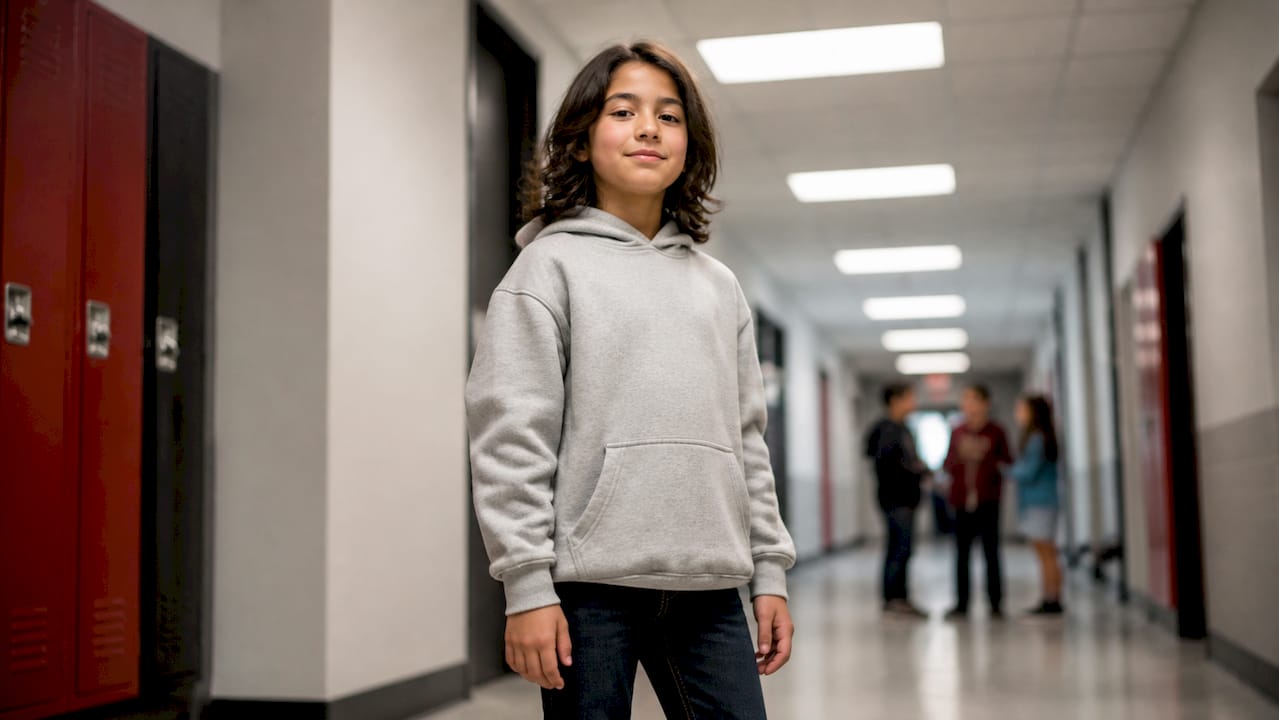
Standing at an angle rather than square to the other person feels less confrontational but keeps hands free. Teach your child to keep some distance, roughly an arm’s length plus a step, and to position themselves so a doorway, hallway, or group of classmates is behind them, not behind the other kid. That single habit, moving toward people rather than away from them, is one of the simplest ways to reduce risk.
Two escape moves worth practising
Step-and-shield: if someone grabs a wrist or arm, the child pivots their body sideways while pulling the arm down and in, using the turn (not arm strength) to break the grip. Smaller kids should focus entirely on the pivot; strength isn’t the deciding factor.
Wrist-release: rotate the trapped wrist toward the thumb side of the grabbing hand, where grip is naturally weakest, while stepping back. This works regardless of size difference, which is why instructors teach it early.
Both techniques exist for one purpose only: creating enough space to run toward an adult.
Pro Tip: Practise these moves in slow motion first, ten times each, before adding any speed. Muscle memory comes from repetition, not intensity.
A five-minute practice drill
- Stand facing your child at a comfortable distance.
- Have them say one verbal script out loud, three times, adjusting tone until it sounds calm and firm.
- Gently take their wrist (light grip only) and let them practise the wrist-release.
- Have them “escape” by walking to a specific spot in the room, representing a teacher or safe adult.
- Debrief: ask how it felt, not just how it looked.
Why bystanders stop bullying faster than victims can
Peers witness most bullying incidents, and their response matters more than most parents realize. Evidence reviewed by the Community Preventive Services Task Force shows that school programs including bystander mobilization outperform lessons taught in isolation. A single classmate who says “that’s not cool” or simply walks over often ends an incident within seconds.
Run these three scenarios at home with your child and a sibling or friend:
- Low-risk deflection: the bystander changes the subject loudly (“Hey, did you see the score?”) to break tension without confrontation.
- Safe interruption: the bystander states a simple fact (“Teachers are right there”) to signal witnesses exist.
- Exit-with-witness: the bystander invites the target to leave with them (“Come with me, let’s go”) rather than confronting anyone directly.
After each run, ask: What felt safe? What felt risky? Would you do this for a stranger, not just a friend? Coordinate with other parents or a teacher before practising at school, since safe bystander training works best with adult supervision and agreed-upon ground rules.
Pro Tip: Debrief emotions before technique. A child who feels heard about being scared will remember the script better than one who only hears “good job.”
When should kids start age-appropriate self-defence training?
Training goals should match developmental stage, not a generic curriculum. Elementary-age kids need assertiveness and basic escape awareness; middle-schoolers benefit from situational awareness and structured role-play; high schoolers can handle de-escalation strategy alongside safe physical technique, per scenario-based training methods.
A quality program should check these boxes:
- Trauma-informed instructors who explain why a technique works, not just drill it.
- Reality-based scenarios instead of formal martial-arts forms with no bullying context.
- Short, focused drills rather than hour-long sessions that lose younger attention spans.
- Visible adult supervision and a debrief built into every session.
- A parent-friendly guide explaining what was taught and why.
Walk away from any program that glorifies aggression, skips de-escalation entirely, or has no safeguarding policy for working with minors. A randomized study on karate-based training found measurable gains in resilience and self-efficacy after twelve weeks, which lines up with what many parents report anecdotally: kids often come home calmer, not more combative, after structured practice.
Documenting bullying and getting the school to act
Schools respond faster to specifics than to general complaints. Structured, multidisciplinary programs cut bullying rates by roughly 20% on average in meta-analysis data, but that only happens when a school actually implements one, and your documentation often triggers that response.
- Log every incident with date, time, location, names of those involved, and any witnesses.
- Save evidence, including screenshots of messages, photos of physical marks, or notes passed between classes.
- Request a meeting with the teacher and administrator, and bring a written summary rather than relying on memory.
- Ask for specifics: an investigation timeline, a follow-up date, and who is responsible for checking in.
- Escalate in writing to the school board if the first response is vague or nothing changes within the agreed timeline.
If the school still doesn’t act, a school bullying lawyer can outline what legal options exist in persistent cases. Teacher-facing resources can also help if staff need structured anti-bullying material to bring into the classroom.
Why Streetsafeselfdefence fits busy parents’ timelines
Most parents don’t have months to spare on a martial-arts belt system. Streetsafeselfdefence delivers reality-based, trauma-informed training in as little as five hours, and the mobile format means the instructor comes to your school, community centre, or home rather than the other way around.
- Sessions are built around realistic scenarios, not formal technique sequences.
- Instructors adapt drills by age, size, and confidence level.
- Training travels to schools, teams, and families directly.
- Testimonials from parents and students describe measurable gains in confidence and safety awareness after just one session.
Short, focused workshops that emphasize rehearsal and situational awareness deliver practical skills quickly, which matters for families juggling school schedules and after-school activities.
This approach suits school groups booking an assembly-style workshop, parents wanting a one-time at-home session, and teens who need drills that feel closer to a real hallway confrontation than a dojo routine. Explore self-defence training at home or the high-school program to see what a session actually covers before booking.
How bullying affects a child’s mental health long term
Bullying rarely stays contained to the incident itself. Kids who face repeated bullying often show increased anxiety, lower self-esteem, and in some cases symptoms that mirror trauma responses, which is why clinicians treating bullied children prioritize safety and emotional processing alongside physical skills, not physical skills alone, according to StatPearls.
Resilience isn’t something a child either has or lacks. It’s built through small, repeated wins: a script that worked, a friend who stood beside them, an adult who believed them the first time they spoke up. Programs combining classroom guidance with active practice showed measurable behavioural improvement in one intervention study, where the share of students demonstrating defensive self-defence behaviour rose from 12.5% to 77.5% after structured, game-based role-play.
Watch for signs that a child needs more support than scripts and drills can offer: withdrawal from friends, drop in grades, sleep changes, or reluctance to go to school. These signals point toward a school counsellor or mental health professional, not more self-defence practice. Confidence-building matters, but it works alongside emotional support, not as a replacement for it. A child who feels capable of handling a hallway confrontation but still dreads walking through the front doors needs both pieces addressed.
What are a child’s legal rights around self-defense at school?
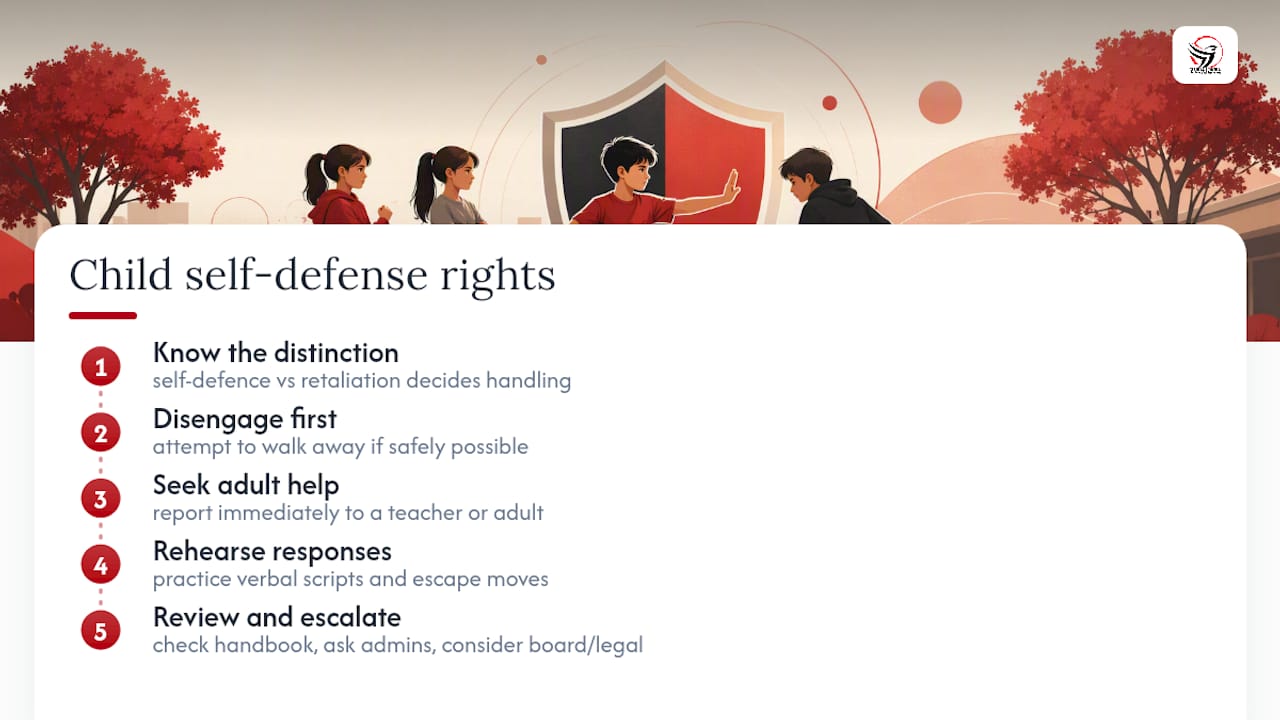
Most school jurisdictions distinguish clearly between self-defence and retaliation, and that distinction usually decides how an incident gets handled. A child who uses reasonable, proportionate action to escape an attack is generally treated differently under school codes of conduct than a child who continues an altercation after the threat has passed.
Schools set their own conduct policies, and those policies vary by district and province, so the specific consequences for a physical response depend on your child’s own school handbook, not a general rule. What stays consistent across most policies is the expectation that a student attempts to disengage and seek adult help before or instead of physical contact whenever it’s possible to do so safely.
This is exactly why rehearsing verbal scripts and escape moves matters as much as any physical technique: a child who can show they tried to walk away first is in a stronger position, both for their own safety and for how the school evaluates the incident afterward. If your child has faced disciplinary action after defending themselves, review the school’s code of conduct directly and ask administrators to explain how self-defence is distinguished from mutual conflict in their specific policy. When the response still feels unfair, that’s the point to raise it formally with the school board or seek outside legal guidance.
Physical, verbal, and cyberbullying need different responses
Not all bullying looks the same, and treating every incident with the same response often misses the mark. Verbal bullying is the most frequent form kids encounter, according to StatPearls, and it responds best to the assertive scripts covered earlier, paired with consistent reporting so a pattern gets documented even when no single comment seems serious enough on its own.
Physical bullying calls for the escape techniques already outlined: creating distance, breaking a grip, and moving toward adults or witnesses immediately. Never rely on physical technique as a first response when walking away is genuinely possible.
Cyberbullying needs its own playbook. Screenshots matter more than memory here, since messages get deleted quickly. Encourage your child to avoid responding directly online, since a reply often escalates rather than resolves things, and instead bring the evidence straight to you or a school staff member. StopBullying.gov’s guidance to document cyberbullying as it happens applies just as much to a group chat as it does to a public post.
Social bullying, the quieter form involving exclusion or rumour spreading, is often the hardest for parents to spot because it leaves no obvious mark. Ask specific questions (“Who did you sit with at lunch?”) rather than general ones (“How was school?”) to surface it earlier.
How communication skills help prevent bullying before it starts
Kids who can name their feelings and state a boundary clearly are less likely to be targeted repeatedly, and more likely to de-escalate a situation before it turns physical. This isn’t about raising a louder child. It’s about giving them language that sounds confident even when they don’t feel it yet.
Practise everyday assertiveness outside of bullying scenarios entirely, ordering food, asking a teacher a question, telling a sibling to stop. These small reps build the same muscle a hallway confrontation requires. A child who has never practised saying “no” clearly to a parent will struggle to say it clearly to a peer.
Active listening matters just as much as speaking up. A child who can read tone and body language often senses when a situation is escalating before it becomes physical, giving them time to walk away or find an adult. That awareness, paired with the scripts and drills covered earlier, is what turns a nervous kid into a prepared one. Communication isn’t a soft add-on to self-defence. It’s usually the first skill that gets used, and often the only one a child needs on a given day.
What the evidence actually tells parents to prioritize
Most advice on this topic leans too hard on either fighting technique or vague “just talk to the school” guidance, and both miss what the research actually supports. The strongest signal across clinical and school-based sources is sequencing: verbal assertiveness first, escape second, physical technique only as a last resort, with documentation running underneath all of it from the first incident.
What’s overrated is the belief that a martial-arts belt system builds bullying resilience faster than short, focused, scenario-based practice does. The evidence on structured, reality-based drills suggests the opposite: kids improve fastest with repetition of a few core moves tied to real scenarios, not slow progression through unrelated forms.
What parents should prioritize first isn’t a class booking. It’s five minutes of practice at home this week, one script, one escape move, one honest conversation about what’s actually happening at school. Training adds real skill on top of that foundation. It doesn’t replace it.
Frequently asked questions
What is the single best self-defence move to teach a bullied child?
There isn’t one universal move, but the wrist-release technique paired with a firm verbal script covers the most common grabbing scenarios and works regardless of size difference.
Should my child ever fight back physically?
Physical response should stay a last resort, used only to create distance and escape, never to continue a confrontation once space has opened up.
How do I know if a self-defence program is trauma-informed?
Ask directly whether instructors explain the reasoning behind techniques, include debrief time after drills, and have a documented safeguarding policy for working with minors.
What should I do if the school doesn’t respond to my report?
Escalate in writing to the school board with your documented timeline, and consider consulting a school bullying lawyer if the response remains inadequate after a reasonable follow-up period.
Sources
- Identifying and addressing bullying – StatPearls – NCBI Bookshelf
- School-based anti-bullying interventions (Community Preventive Services Task Force)
- The Implementation of Classical Guidance using the ‘Find Me’ Game to Enhance High School Students’ Self-defense Skills Against Bullying
- Stopbullying
