

Every security company works hard to win new contracts, but keeping them is what builds a lasting business. Whether a client renews often comes down to something they see every day: how well the officers on site are trained.
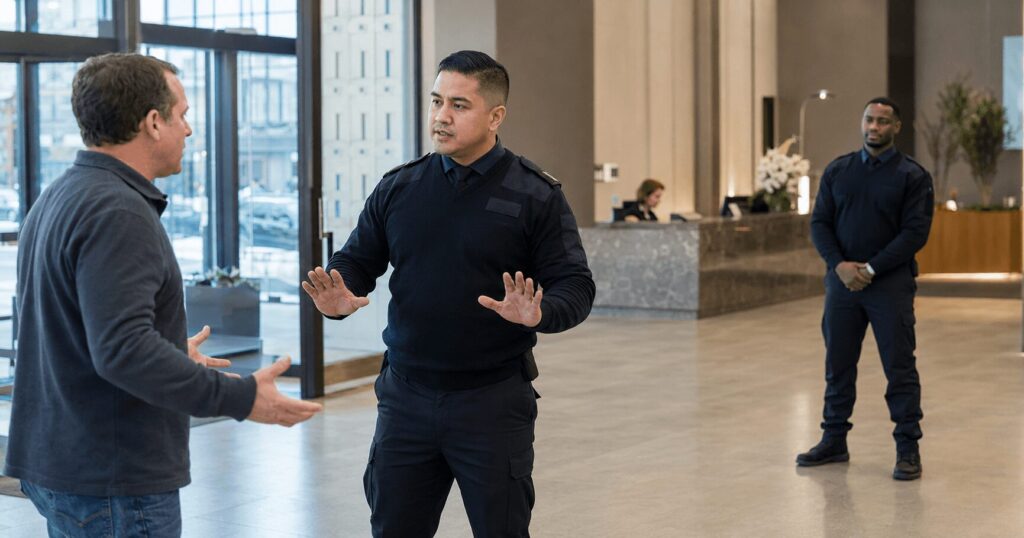
How Does Security Officer Training Improve Client Retention?
Security officer training improves client retention by preparing officers to recognize behavioural changes, communicate professionally, manage escalation and document incidents clearly. Security companies that invest in behaviour-based training create safer officers, more consistent service and stronger client confidence, the foundations of long-term security contracts.
Security companies rarely lose a client on the day the cancellation letter arrives.
They usually lost that client weeks or even months earlier.
It may have started with an officer who appeared disengaged, an incident that was handled poorly, a report that failed to explain what actually happened, or an employee who knew company policy but could not recognize when someone’s behaviour was beginning to change.
None of those things may have seemed serious enough to cancel a contract on their own, but together, they created doubt.
Eventually, the client began asking a very important question:
Is our security company genuinely protecting our people, property and reputation—or are they simply filling a position?
That is where the connection between security officer training and client retention begins.
How Does Security Officer Training Improve Client Retention?
Security officer training improves client retention by developing an officer’s ability to recognize behavioural changes, communicate professionally, make better decisions, manage escalating situations and document incidents properly.
Clients are more likely to retain a security provider when its officers consistently demonstrate competence, confidence and a clear understanding of workplace safety.
The client needs to see value in the service being provided, and that value must extend beyond having someone physically present at the location.
The Officer Becomes the Security Company
A security company can have excellent policies, professional management and an impressive website, but the client does not interact with those things every day.
The client interacts with the officer.
That officer becomes the face of the security company.
How the officer communicates, observes, responds and documents an incident shapes the client’s opinion of the entire organization.
When an officer appears uncertain, disengaged or unprepared, the client does not usually blame the individual officer. They question the company that placed the officer there.
The opposite is also true.
When an officer recognizes a problem early, communicates clearly and handles a difficult interaction professionally, the client remembers it. They begin to see the officer as an important part of their workplace safety culture rather than someone simply standing at the front desk.
Security is not just about having someone present.
It is about what that person recognizes, understands and is prepared to do.
More Policy Does Not Always Create Better Performance
I have worked with many security teams, and one thing continues to concern me.
Companies often respond to performance problems by adding another policy, another procedure or another page to the employee handbook.
Policy is important, but policy does not automatically create better decision-making.
An officer can memorize the rules and still be unable to recognize that someone’s behaviour is changing. They can know the reporting procedure and still freeze when an interaction becomes aggressive. They can repeat the company’s de-escalation model and still fail to recognize when de-escalation is no longer working.
The problem is not always a lack of information.
Sometimes, the officer has never been taught how human behaviour changes before violence occurs.
That is the gap Street Safe addresses.
Behaviour Must Be Recognized Before It Can Be Managed
Violence rarely begins with the first push, punch or threat.
There is usually a behavioural change before the physical action.
A person may begin closing distance. Their communication may change. Their attention may become fixed. Their movements may become more deliberate, or they may suddenly become unusually calm.
These details matter.
Security officers need to understand pre-attack indicators, escalation, emotional motivation, environmental positioning and the difference between social and a-social violence.
They must also recognize the difference between someone who is emotionally upset and someone who has already decided to become violent.
The earlier an officer identifies that behavioural change, the more options remain available. The longer they wait, the fewer safe options they have.
This is why we say:
You cannot de-escalate what you never recognized.
De-Escalation Is Important, but It Is Not a Guarantee
De-escalation is an important part of professional security work. It should be used when the circumstances allow it and when it remains safe to do so.
But de-escalation does not work 100 percent of the time.
That statement should not be controversial. It should be understood.
Some people do not want to be calmed down. Some are not capable of rational communication at that moment. Others may have already decided what they intend to do.
When de-escalation fails, the officer still needs a safe, responsible and legally defensible response.
Telling officers to continue talking without teaching them how to recognize when the conversation is no longer working does not make them safer. It can leave them standing too close, reacting too late and trying to solve a physical problem with words.
Professional training must prepare officers for the conversation and for the moment when the conversation is no longer enough.
Better Decisions Improve Officer Safety
Street Safe training is built around observation, communication and decision-making.
We want officers to understand what they are seeing, why it matters and what options remain available.
That understanding creates confidence, but not the kind of confidence that comes from ego.
It creates informed confidence.
The officer begins recognizing problems earlier. They position themselves more effectively, communicate with greater purpose and understand when to slow an interaction down, when to create distance and when to call for assistance.
They stop waiting for the situation to become obvious before responding.
That improves job performance, but more importantly, it improves officer safety.
Better Recognition Creates Better Reports
Better-trained officers also produce better incident reports because they understand what information matters.
Their reports move beyond simply stating that someone became aggressive. They can describe the behavioural changes they observed, the decisions that were made, the actions that followed and the reasons behind those actions.
This creates greater accountability and provides both the security company and the client with better information for preventing similar incidents in the future.
Officer Safety Is Also a Client-Retention Strategy
Client retention is not built through promises made during contract renewal.
It is built through the daily performance of the officers assigned to that location.
Clients notice when officers communicate professionally. They notice when problems are recognized early, difficult interactions are managed responsibly and reports clearly explain what occurred.
They also notice when employees trust the judgement of the security team.
That is when security becomes part of the workplace safety culture instead of simply being a contractual requirement.
A client who sees professionalism, preparedness and measurable value has fewer reasons to begin looking for another security provider.
This is why officer training should never be viewed as nothing more than an expense. Proper training protects the officer, strengthens the security company and reinforces the relationship with the client.
The Canadian Centre for Occupational Health and Safety identifies risk recognition, preventive measures and employee education as important parts of workplace violence prevention.
ASIS Security Management has also described training as a strategic pillar of security officer readiness and performance improvement. Clients expect training to be meaningful, relevant and connected to the environment their security officers are actually protecting.
T.R.A.A.C.S. Develops the Person Behind the Uniform
Street Safe’s Tactical Risk Awareness & Applied Combatives System—T.R.A.A.C.S.—was developed to improve the decisions employees make before, during and after an escalating interaction.
It is not designed to replace a security company’s policies or Use of Force training.
Its purpose is different.
T.R.A.A.C.S. focuses on human behaviour, early recognition, risk assessment, communication, de-escalation, positioning, close-quarter safety and responsible response.
It teaches officers to understand the situation before the situation begins controlling them.
The uniform may give an officer authority, but authority alone does not create awareness, judgement or competence.
Those qualities must be developed.
The Goal Is Prevention
The goal of T.R.A.A.C.S. is not to turn every interaction into a physical confrontation.
The goal is to prevent one whenever possible.
When prevention is no longer possible, the officer must have the knowledge and ability to make a responsible decision under pressure.
That is the difference between knowing a policy and being prepared to apply it in the real world.
Security Leaders Must Continue Learning
Officer development begins with leadership.
Security leaders must continue developing their own understanding of vigilance, operational performance and the realities faced by the people working on the front line.
For that reason, I recommend the work of Christopher DiNunzio, SRMP-C, SAS-AP®, a Security Turnaround Specialist, AI Strategist and author with more than 50,000 operational hours and 10,000 training hours.
Christopher’s books, Foundations of Vigilance and Earned & Learned, provide valuable insight for security professionals who want to better understand leadership, operational readiness, vigilance and the practical realities of security work.
Security leaders cannot expect frontline officers to continue developing if leadership has stopped learning.
Security Companies Are Selling More Than Hours
The strongest security companies are not simply selling hours.
They are selling competence, confidence and trust.
They are telling the client that the officer assigned to their workplace can recognize problems, communicate professionally and make responsible decisions when circumstances begin to change.
That promise must be supported by training.
Better-trained officers create safer workplaces.
Safer workplaces create stronger client relationships.
Stronger client relationships create long-term contracts.
The question for every security company is simple:
Are you training officers to fill a position—or are you developing security professionals your clients will not want to lose?
Your security officers deserve T.R.A.A.C.S.
Related Reading
- The first five seconds of an escalating interaction
- Workplace violence prevention for frontline professionals
- You cannot de-escalate what you never recognized
Frequently Asked Questions
How does security officer training improve client retention?
Security officer training improves client retention by creating more professional, confident and capable officers. Clients are more likely to renew contracts when security personnel recognize problems early, communicate effectively, manage incidents responsibly and demonstrate measurable value.
Why is behavioural training important for security officers?
Behavioural training helps security officers recognize changes that may indicate escalation, aggression or potential violence. Early recognition provides more time to communicate, create distance, request assistance and make a safer decision.
Does de-escalation work in every security incident?
No. De-escalation is an important option, but it is not guaranteed to work in every situation. Officers must be trained to recognize when communication is working, when it is failing and when a different response is required.
What is T.R.A.A.C.S. training?
T.R.A.A.C.S. stands for Tactical Risk Awareness & Applied Combatives System. It is Street Safe’s behaviour-driven workplace violence prevention system for security professionals, By-Law Officers, municipal employees and other frontline workers who face unpredictable human behaviour.
