

Book a single, trauma-informed onsite workshop that pairs situational awareness, de-escalation, and a lockdown walkthrough. That is the most direct answer to what Canadian school administrators need right now. The formal term for this kind of preparation is school safety assessment and violence-prevention training, and it sits at the intersection of provincial drill requirements, RCMP SAFE information sharing, and practical staff readiness. Threat assessment in schools, in this context, means building the skills your staff and students need before an incident, not after.
Three named anchors ground every decision you make:
- RCMP SAFE (School Action for Emergencies): the national information system that stores your site plans, contacts, and building features so frontline responders can act faster during a critical incident.
- Manitoba Safe Schools Regulation M.R. 77/2005: a concrete example of statutory drill obligations (at least one lockdown drill per term, ten fire drills per year where practicable, and an emergency plan review by October 31 annually).
- Streetsafeselfdefence: a mobile, trauma-informed provider that brings onsite school workshops directly to your building.
Your immediate next steps:
- Confirm your board’s lockdown drill schedule and reporting obligations with your superintendent.
- Gather current site plans, floor maps, and emergency contact lists.
- Reserve an onsite training date with a qualified provider before the next drill window.
Pro Tip: Book training at least three weeks before a scheduled drill so staff can practise the skills they just learned under realistic conditions.
Key takeaways
Onsite, trauma-informed school safety training is the most direct way to close the gap between a written emergency plan and a staff that can actually execute it under pressure.
| Point | Details |
|---|---|
| Book onsite training first | A single five-hour workshop covering awareness, de-escalation, and a lockdown walkthrough is the most practical starting point. |
| Confirm provincial drill obligations | Requirements vary by province; Manitoba mandates lockdown drills each term and an emergency plan review by October 31. |
| Register with RCMP SAFE | Submitting site plans and contacts to RCMP SAFE materially improves frontline response during a critical incident. |
| Vet providers on school-specific criteria | Require police record checks, trauma-informed protocols, school references, and a sample agenda before booking. |
| Streetsafeselfdefence | Mobile onsite workshops aligned with provincial requirements and RCMP SAFE, delivered across Canada in approximately five hours. |
Table of Contents
- What does a school safety workshop actually cover?
- How does training fit with Canadian provincial requirements?
- What can you expect from an onsite workshop?
- How do you vet a school safety training provider?
- How do you implement training and embed it in your emergency plan?
- Consent, inclusion, and wellbeing during school training
- How do you measure whether training actually worked?
- Why onsite, trauma-informed training produces better results
- What Streetsafeselfdefence offers Canadian schools
- Sources
What does a school safety workshop actually cover?
Effective threat-awareness training for schools is not a lecture. It is a structured, hands-on session built around the spaces your staff and students occupy every day.
A well-designed workshop covers these core components:
- Situational awareness and environmental scanning: staff learn to read classrooms, gyms, science labs, shop areas, and entry points for risk indicators before a situation escalates.
- De-escalation techniques and verbal safety scripts: practical language for staff and senior students to use with an agitated visitor, a distressed peer, or an unknown person at the door. When de-escalation fails, staff need a physical skill set to fall back on.
- Reality-based lockdown walkthroughs: exercises that test door-locking procedures, communication systems, and hold-and-secure protocols in your actual building, not a generic floor plan.
- Site-specific hazard identification: a guided walk of evacuation routes, blind spots, and physical vulnerabilities that a generic off-site course cannot replicate. The BC Emergency Management Guide identifies training, drills, and site-specific walkthroughs as core preparedness activities.
- Age-appropriate self-defence skills: a short, practical module scaled to the participant group, from senior secondary students to front office staff.
- Role-specific customisation: phys-ed teachers, shop instructors, science lab supervisors, and administrative staff each face different hazards. Onsite safety orientation for Canadian schools consistently tailors content to role-specific risks.
Pro Tip: Ask your provider to map the session agenda to your school’s actual floor plan before the training day. Generic walkthroughs miss the details that matter most.
How does training fit with Canadian provincial requirements?
Provincial obligations vary, but the structure is consistent: schools must hold regular drills, review emergency plans annually, report serious incidents up the chain, and document everything.
- Confirm drill frequencies locally. Manitoba’s Safe Schools Regulation M.R. 77/2005 requires at least one lockdown drill per term and ten fire drills per year where practicable, with the emergency plan reviewed by October 31. Ontario’s policy and program requirements set board-level reporting responsibilities for serious incidents. BC principals must hold regular emergency drills and confirm staff know the emergency management plan. Check your own board’s current guidance for the exact count.
- Know your reporting chain. Principals typically notify superintendents of serious incidents; boards notify police or the ministry depending on severity. The Halton Region police-school board protocol details mandatory reporting categories and outlines police-school cooperation for threat management, including police participation in training.
- Register with RCMP SAFE. Providing your site plans, contacts, and building features to RCMP SAFE materially improves frontline response times during a critical incident.
- Keep thorough documentation. Drill logs, training attendance records, site walkthrough notes, and incident reports are your compliance evidence. The CCOHS school workers health and safety guide reinforces the value of practical checklists and inspection records for school staff.
Provincial drill requirements set the minimum. Onsite, skills-based training is what closes the gap between knowing the plan and being able to act on it under pressure.
Pro Tip: Store drill logs and training attendance in the same folder as your emergency response plan so they are ready for a board audit or a police review.
What can you expect from an onsite workshop?
Most school workshops run in one of three formats:
- Half-day (3–4 hours): covers situational awareness, de-escalation, and a condensed lockdown walkthrough. Fits within a professional development morning.
- Full-day (5–6 hours): adds a complete site walkthrough, role-specific breakouts, a self-defence skills module, and a structured debrief. Streetsafeselfdefence delivers its full programme in approximately five hours.
- Modular two-session delivery: splits staff training and student training across separate days, which works well for larger schools.
A sample five-hour agenda:
- Site walkthrough and hazard identification (45 minutes)
- Situational awareness and environmental scanning (45 minutes)
- De-escalation practice and verbal safety scripts (60 minutes)
- Active threat survival and lockdown drill (60 minutes)
- Role-specific breakouts: phys-ed, shop, science, front office (45 minutes)
- Trauma-informed debrief and Q&A (45 minutes)
Logistics checklist for the training day:
- A clear, accessible room or gym for movement-based exercises
- Consent and liability forms collected at least one week in advance
- Medical and behavioural accommodation notes shared with the trainer beforehand
- A designated staff liaison who can open locked areas and explain the building layout
- Announced drill timing to reduce participant anxiety while still practising realistic responses
Pro Tip: Pre-announce the lockdown drill component to students and parents. Surprise drills in schools with trauma-affected students can cause real harm and undermine the training’s goals.
How do you vet a school safety training provider?
Credentials matter more here than in almost any other professional development context. You are bringing someone into a building with minors.
Essential credentials to require:
- Documented experience delivering to K–12 schools, not just corporate clients
- Police or EMS collaboration history, or active liaison with local law enforcement
- Current police record checks for all instructors working with minors
- Standard first aid certification
Questions to ask every provider:
- Can you share a sample lesson plan and your trauma-informed debrief protocol?
- How do you handle a student who becomes distressed during a drill or scenario?
- What is your process for parent communications and consent with minors?
- How do you customise content for different age groups and roles?
- Who do we contact if an incident occurs during training?
A provider who cannot share a sample agenda or a reference from a Canadian school is not ready to work in yours.
Bringing in specialised, reality-based mobile trainers enables scenario practice — agitated visitors, rapid de-escalation, classroom containment — that internal staff are often reluctant or unskilled to run themselves. The Halton Region protocol specifically recommends police participation in training and threat management processes.
Red flags: no school references, no mention of trauma-informed adaptations, unwillingness to share a sample agenda, or instructors without police record checks.
Pro Tip: Ask for the name of a principal or vice-principal at a previous school client. A five-minute reference call tells you more than any brochure.
How do you implement training and embed it in your emergency plan?
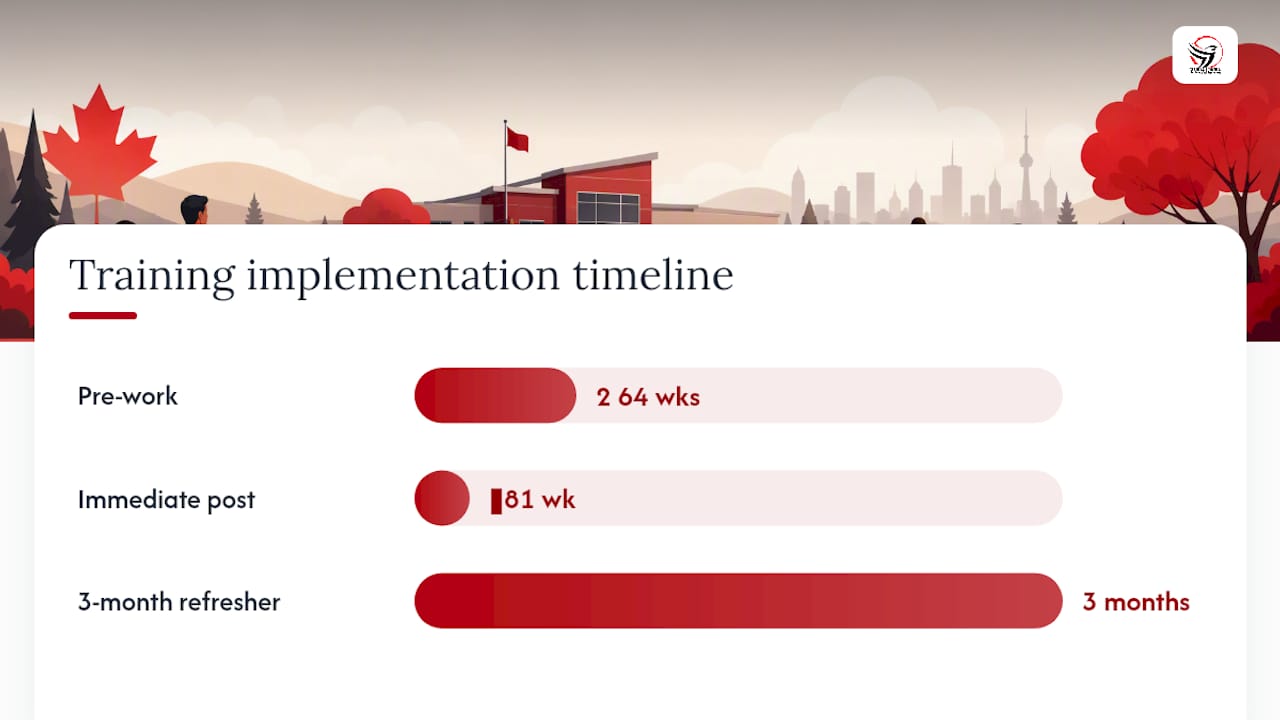
Implementation works best as a four-phase process.
- Pre-work (2–4 weeks out): gather site plans, update emergency contact lists, distribute consent forms, and brief the staff liaison. Submit site information to RCMP SAFE if you have not already done so.
- Training day: run the session, complete the lockdown drill, collect attendance, and document any accommodation notes or follow-up supports offered.
- Immediate post-training (within one week): update your emergency response plan to reflect anything the walkthrough revealed, assign updated roles, and send a summary to your superintendent.
- Three-month refresher: schedule a follow-up drill and collect staff feedback to measure retention and confidence.
Integration checklist:
- Add training attendance records to your emergency plan documentation folder
- Align drill logs with board reporting timelines
- Confirm custodial and office staff roles are reflected in the updated plan
- Communicate outcomes to parents in a brief, factual letter
Pairing orientation checklists with hands-on walkthroughs dramatically improves staff retention compared with paperwork review alone, a finding the BC Emergency Management Guide consistently supports.
Pro Tip: Assign one staff member as the “safety documentation lead” whose only job is keeping drill logs, attendance records, and the emergency plan current.
Consent, inclusion, and wellbeing during school training
Trauma-informed delivery is not optional. Schools serve students and staff with a wide range of lived experiences, and a poorly run drill can cause real harm.
Consent and opt-out protocols:
- Send parent and guardian notices at least two weeks before training
- Provide a clear opt-out option and an alternative learning activity for students who cannot participate
- Collect written consent for any physical self-defence components involving minors
Trauma-informed adaptations:
- Use calm, non-alarming language throughout the session
- Provide trigger warnings before any scenario involving simulated threat
- Designate a quiet space where distressed participants can go with a trusted adult
- Have a school counsellor or mental health worker on site or on call during the drill
Accessibility and cultural considerations:
- Follow Indigenous cultural protocols when delivering to First Nations, Métis, or Inuit communities. Streetsafeselfdefence offers Indigenous-specific training designed with cultural respect at its centre.
- Provide language supports for students or staff whose first language is not English or French
- Adjust physical components for participants with mobility or sensory needs
Trauma-informed training does not soften the content. It delivers the same practical skills with the care and pacing that allows every participant to actually absorb them.
Document every accommodation offered and any follow-up supports provided. This protects the school and demonstrates due diligence.
Pro Tip: Brief your school counsellor on the training agenda the day before so they can prepare for any students who may need support afterward.

How do you measure whether training actually worked?
Effectiveness is measurable. Track these metrics after every session:
- Staff confidence scores: a simple pre- and post-training survey (1–5 scale) on situational awareness, de-escalation, and lockdown procedures
- Drill completion times: how long it takes to secure all rooms and account for all students
- Communication reliability: whether the PA system, intercoms, and staff radios performed as expected during the drill
- Participation rates: percentage of staff and students who completed each component
- Debrief notes: specific gaps or confusion points identified during the post-drill discussion
A short post-training report should include: session objectives, attendance count, drill timeline, metric results, identified gaps, and a recommended refresh interval. Share it with your superintendent as part of your board reporting.
Routinely practising drills reduces anxiety and improves performance over time. The BC school and police safety guide recommends that training and drills be exercised regularly, with police and community agencies included where possible.
Recommended cadence: one full onsite training session per year, one lockdown drill per term (aligned with provincial requirements), and a brief refresher drill mid-year to maintain retention.
Pro Tip: Use drill completion time as your single clearest metric. If it improves term over term, your training is working.
Why onsite, trauma-informed training produces better results
Most schools already have an emergency binder. The gap is not information — it is practised, embodied skill. Staff who have walked their own hallways during a simulated lockdown respond differently than staff who have only read the protocol. The physical memory of locking a specific door, moving students to a specific corner, and communicating on a specific radio channel is what holds under pressure.
Slides and off-site courses cannot replicate that. A trainer standing in your gym, pointing at your exits, and running your staff through a scenario in your building produces retention that a webinar simply does not. The trauma-informed piece matters equally. Staff who feel safe during training engage more fully, retain more, and are far less likely to freeze or cause secondary harm to students during a real event.
The schools that get this right treat training as a living system: book it, practise it, measure it, and repeat.
What Streetsafeselfdefence offers Canadian schools
Streetsafeselfdefence brings mobile, trauma-informed school safety workshops directly to your building, anywhere in Canada. The full programme delivers situational awareness, de-escalation, reality-based lockdown walkthroughs, and age-appropriate self-defence skills in approximately five hours — fitting a single professional development day without disrupting the school week.
Every session is designed to align with RCMP SAFE requirements and provincial drill obligations, and includes post-training documentation your superintendent can use for board reporting. Instructors hold police record checks, bring school-specific experience, and adapt content for Indigenous communities, students with diverse needs, and staff in specialised roles.
Visit the high school safety programme page to review the curriculum and book a session, or contact Streetsafeselfdefence directly through the main booking page to request a quote for your school.
Sources
The following Canadian sources provide the policy and compliance detail that backs this article.
- BC Emergency Management Guide
- RCMP: School Action for Emergencies (SAFE)
- Safe schools regulation, M.R. 77/2005 (Manitoba)
- Police‑school board protocol (Halton Region)
- Ontario Schools: policy and program requirements — learning environment
Pro Tip: Download your province’s current emergency management guide and compare it against your school’s existing emergency response plan before booking training. The gaps you find are exactly what the training should address.
