


Every Canadian workplace needs a clear set of employee safety training topics in place before an incident forces the issue. The core list includes: workplace violence prevention, emergency response and evacuation, WHMIS/hazard communication, first aid and CPR, fire safety and extinguisher use, ergonomics and manual handling, task- and equipment-specific training, and mental health and wellness supports. Delivery happens in three phases: onboarding (before the first shift on a new task), annual refreshers, and targeted retraining after any equipment or process change. OHSE guidance frames these as two distinct categories: general safety topics every employee needs, and role-specific topics tied to actual hazard exposure. For violence prevention and trauma-informed content, Streetsafeselfdefence delivers mobile, reality-based training directly to your team.
Table of Contents
- Why do these topics matter in Canadian workplaces?
- How do you decide which topics apply to your workplace?
- Which delivery method works best for each topic?
- What do sample training modules look like?
- How do you measure whether training is actually working?
- What are the most common training pitfalls?
- Streetsafeselfdefence brings reality-based training to your team
- Key takeaways
- Why tailored, trauma-informed training matters
- Useful Canadian sources and further reading
Why do these topics matter in Canadian workplaces?
Provincial and territorial occupational health and safety legislation places a legal duty on employers to train workers before they are exposed to a hazard. That duty is not satisfied by handing someone a policy document. Canadian OH&S guidance is explicit: general safety orientation covers every worker, while role-specific training targets the hazards a person will actually encounter on the job.
Certain topics carry near-universal regulatory weight across jurisdictions:
- WHMIS (Workplace Hazardous Materials Information System) is federally mandated for any workplace where controlled products are present.
- First aid and CPR requirements vary by province, but most jurisdictions specify minimum first-aider ratios and certification standards.
- Equipment and task-specific competency training is required before an employee operates machinery, works at heights, or handles hazardous materials.
- Workplace violence prevention is legislated in every province, with written policies and worker training required in most.
Training cadence matters as much as content. Onboarding training must happen before exposure. Annual refreshers keep knowledge current. Retraining is required after any change in equipment, procedure, or workplace layout that introduces a new hazard.
According to one survey, 81% of workers feel more committed when they clearly understand their organisation’s safety initiatives. That figure alone makes the case for investing in well-structured, clearly communicated training rather than a compliance checkbox.
How do you decide which topics apply to your workplace?
Start with your hazard profile, not a generic topic list. The most practical selection framework uses five questions for each potential training topic:
- Role exposure: Which roles encounter this hazard regularly?
- Frequency: How often does the exposure occur?
- Severity: What is the worst realistic outcome if the hazard is not controlled?
- Legal requirement: Is training on this topic mandated by provincial legislation or a regulatory standard?
- Current competence: Do workers already demonstrate safe behaviour, or is there a documented gap?
Pull your near-miss reports and incident logs before you finalize the list. Topics that appear in your own incident data are higher priority than topics that are simply popular or widely recommended. Safety games and exercises should close identified gaps, not fill time.
| Priority tier | Trigger | Suggested timing | Format |
|---|---|---|---|
| Immediate | Legal mandate or recent incident | Before next shift on that task | In-person, competency |
| Short-term | Identified gap, moderate severity | Before the first shift | Blended or in-person |
| Planned | Awareness gap, lower severity | Quarterly or annual cycle | Lunch & Learn or e-learning |
Pro Tip: Run a one-hour pilot session with a small group before rolling out any new module. Collect feedback on clarity and relevance, then adjust the content before the full cohort attends. Scaling a flawed module wastes both budget and credibility.
For workplace wellbeing and mental health topics, a short awareness session is often the right starting point before committing to a longer programme.
Which delivery method works best for each topic?
Not every topic belongs in an e-learning module, and not every topic needs a full-day workshop. The format should match what the learner actually needs to do after training.
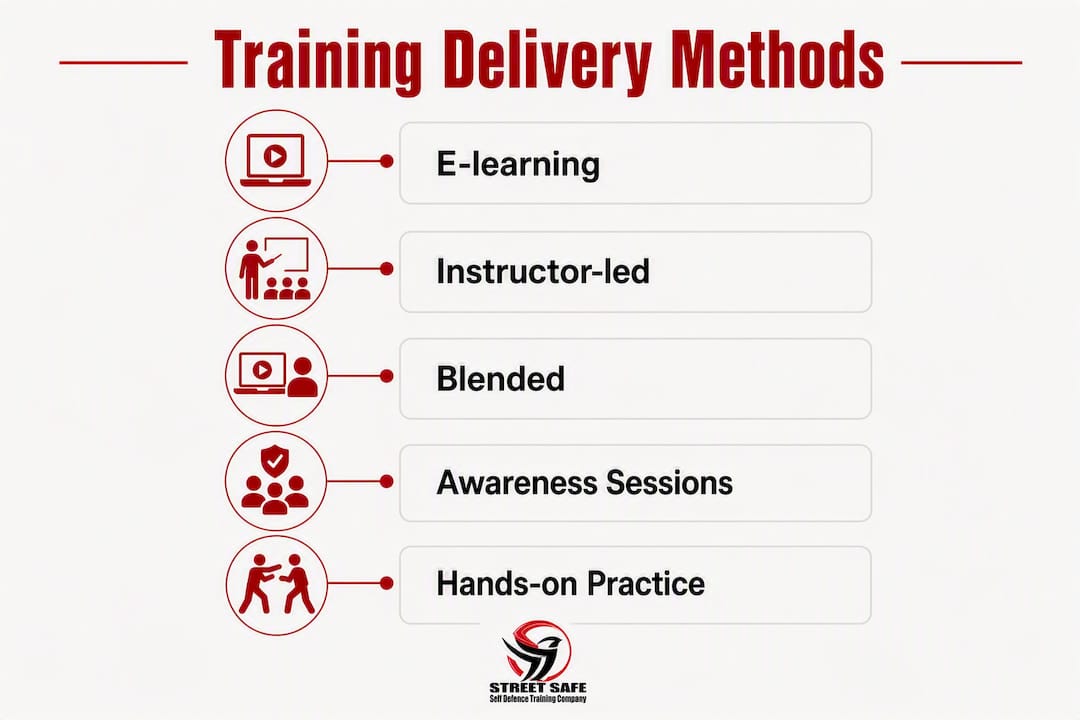
Asynchronous e-learning works well for WHMIS knowledge checks, policy awareness, fire safety theory, and mental health literacy. Learners can complete these at their own pace, and a learning management system (LMS) records completion automatically.
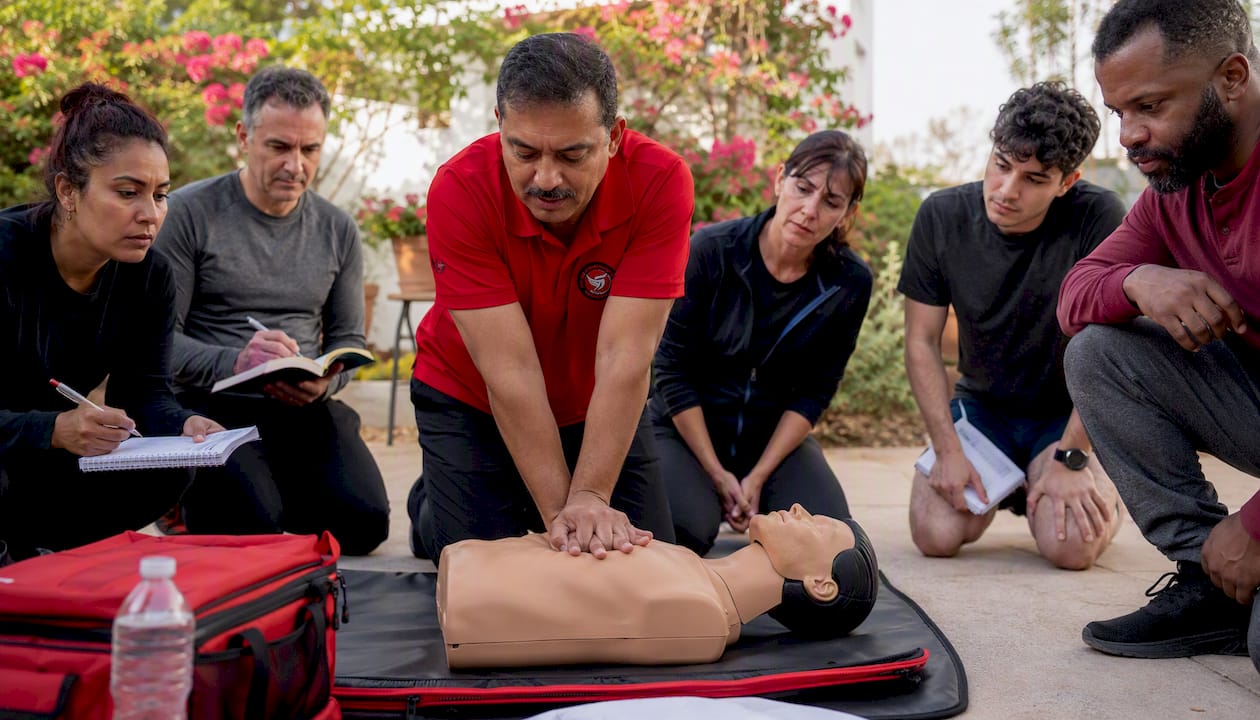
Instructor-led, in-person sessions are required for first aid and CPR (hands-on practice is non-negotiable), PPE fitting and inspection, equipment operation, and workplace violence prevention training. Trauma-informed content in particular needs a skilled, live facilitator who can read the room and respond to participant reactions.
Blended learning combines the two: a short e-module or pre-reading builds foundational knowledge, then an in-person session focuses entirely on practice and scenario work. OHSE guidance supports this approach as the most effective structure for complex skills.
| Topic | Recommended format | Typical duration |
|---|---|---|
| WHMIS awareness | E-learning | One hour |
| Fire safety theory | E-learning | Short session |
| First aid / CPR | In-person, hands-on | 4 hours |
| Workplace violence prevention | In-person, trauma-informed | 3–5 hours |
| PPE fitting and inspection | In-person, supervised | One hour |
| Ergonomics and manual handling | Blended | One hour |
| Equipment-specific competency | In-person, supervised | Several hours |
| Mental health awareness | Lunch & Learn or e-learning | Up to one hour |
Pro Tip: For violence prevention and trauma-informed content, bring in a mobile expert trainer rather than assigning the topic to an internal HR generalist. The difference in participant confidence and behavioural readiness is significant, and the liability exposure from poorly delivered trauma content is real.
What do sample training modules look like?
The table below gives ready-to-use module outlines. Modules marked A are awareness-level (suitable for a safety Lunch & Learn); those marked C require hands-on competency instruction.
| Module | Objective | Audience | Format | Duration | Level |
|---|---|---|---|---|---|
| Workplace violence awareness | Recognise warning signs and de-escalation options | All staff | Lunch & Learn | Less than an hour | A |
| Violence prevention practical | Apply physical and verbal strategies in realistic scenarios | All staff, high-risk roles | In-person, mobile trainer | 3–5 hours | C |
| First aid / CPR | Perform CPR and manage common injuries until EMS arrives | All staff | In-person, certified instructor | 4 hours | C |
| WHMIS awareness | Read SDS sheets and identify controlled product labels | All staff | E-learning | One hour | A |
| Ergonomics and manual handling | Use correct posture and lifting technique to prevent injury | Office and physical roles | Blended | One hour | A/C |
| Equipment-specific competency | Operate assigned equipment safely and within rated limits | Equipment operators | In-person, supervised | Several hours | C |
| Mental health and wellness | Identify stress signals and access support resources | All staff | Lunch & Learn | Up to one hour | A |
Practice-based learning produces higher retention than passive listening, which is why competency modules must include scenario work, not just slides. For role-specific examples, hotel and hospitality staff and real estate professionals each have distinct hazard profiles that warrant tailored modules.
How do you measure whether training is actually working?
Measurement does not need to be complicated. A short pre-test before a session and a post-test immediately after gives you a baseline knowledge gain score. Observed skill checks during competency modules confirm that participants can perform the task, not just describe it.
Track these indicators across three time points:
- Immediately after training: knowledge check scores, skill observation pass rates, participant satisfaction ratings.
- Three months out: near-miss reporting rates, supervisor observations of safe behaviour, any repeat incidents in trained areas.
- Six months out: incident frequency trends, refresher attendance rates, qualitative feedback from team leads.
Documentation and tracking via an LMS keeps certification records current and sends automatic refresher reminders, which removes the administrative burden from HR and reduces compliance gaps.
Engagement tactics that consistently improve participation include short microlearning modules between formal sessions, peer-led safety moments at team meetings, and scheduling training during paid work hours rather than asking employees to attend on their own time. Positioning safety training as professional development, not a compliance obligation, changes how employees receive it.
What are the most common training pitfalls?
One-size-fits-all content is the single most common mistake. A module built for warehouse workers rarely resonates with office staff, and vice versa. Tailor content to the actual hazards each role faces.
Using games as a substitute for competency training is a related error. Safety games are reinforcement tools, not replacements for regulated or hands-on instruction. A trivia game on WHMIS symbols is a useful refresher; it does not satisfy the legal training requirement.
Scheduling training outside work hours reliably reduces attendance and signals that safety is a low priority. Run sessions during the workday, even if it means staggering shifts.
Ignoring employee feedback means repeating the same ineffective content year after year. A two-question survey at the end of any session (“What was most useful?” and “What would you change?”) gives enough data to improve the next delivery.
Pro Tip: Before choosing your next training topic, pull the last 12 months of near-miss reports. The topics that appear most frequently in those reports are the ones your team actually needs, not the ones that look good on a training calendar.
Streetsafeselfdefence brings reality-based training to your team
Most corporate safety programmes cover the regulatory basics well. Where they fall short is on the topics that require a skilled, trauma-aware facilitator in the room: workplace violence prevention, personal safety awareness, and scenario-based de-escalation practice. Streetsafeselfdefence fills that gap directly.
The mobile training model means your team trains on-site, in their actual environment, without anyone needing to travel or book a venue. Sessions are designed for all fitness levels and experience backgrounds, from front-line staff to management. Specialised programmes are available for corporate teams, real estate professionals, healthcare workers, and school staff. For individuals or small groups who prefer a flexible option, self-defence training at home delivers the same reality-based curriculum in a format that fits any schedule.
To book a session or request a module outline for your workplace, visit Streetsafeselfdefence.
Key takeaways
A well-structured workplace safety programme covers both general and role-specific topics, delivers competency training in person, and measures outcomes at three points: immediately after, at three months, and at six months.
| Point | Details |
|---|---|
| Start with your hazard data | Use near-miss reports and incident logs to choose topics, not generic popularity. |
| Match format to learning need | Awareness topics suit e-learning or Lunch & Learn; competency topics require in-person, supervised instruction. |
| Train on the clock | Scheduling sessions during paid work hours improves attendance and signals that safety is a genuine priority. |
| Measure at three intervals | Check knowledge immediately after, observe behaviour at three months, and review incident trends at six months. |
| Streetsafeselfdefence for high-risk topics | Mobile, trauma-informed violence prevention training delivered on-site for corporate teams, schools, and professionals. |
Why tailored, trauma-informed training matters
Most safety training programmes are built around compliance. That is understandable. Regulators require documentation, and documentation requires a completed module. But compliance-first thinking produces training that employees sit through rather than absorb.
The topics that carry the highest real-world stakes, workplace violence, personal safety, and de-escalation, are also the ones most likely to be delivered by someone without specialist training in trauma-informed instruction. A facilitator who does not understand how trauma affects learning can inadvertently re-traumatise participants or produce a session that feels performative rather than practical. That outcome is worse than no training at all, because it creates a false sense of preparedness.
Reality-based training, the kind Streetsafeselfdefence delivers, is built around what actually happens in Canadian workplaces. Scenarios are drawn from real incident patterns. Instruction is paced to accommodate participants across fitness levels, ages, and prior experience. The goal is not a certificate; it is a measurable change in how participants think and respond when a threat is present.
Building a genuine safety culture requires that kind of depth. Compliance gets you to the starting line. Trauma-informed, reality-based instruction is what takes your team the rest of the way.
Useful Canadian sources and further reading
Use these resources to verify regulatory requirements and deepen your training programme. For jurisdiction-specific rules, always confirm with your provincial OH&S office.
Regulatory and compliance guidance:
- 12 steps to a successful workplace safety training program (OHSE) — best starting point for cadence, documentation, and category structure under Canadian guidance.
- 25 ways to make safety training more engaging (OHSE) — practical engagement tactics including microlearning and simulation formats.
Practical training ideas and tools:
- Top 10 workplace safety games (HSE Blog) — reinforcement activities with guidance on pairing games with pre/post assessments.
- Engaging employees in safety training (Techclass) — interactive strategies and the commitment data behind them.
- Lunch and Learn awareness programmes (FAST Rescue) — Canadian provider with structured short-format awareness sessions.
Role-specific and targeted resources:
- Corporate self-defence programmes (Streetsafeselfdefence) — mobile, on-site violence prevention for corporate teams.
- Trauma-informed self-defence guide (Streetsafeselfdefence) — specialised delivery for survivors and sensitive groups.
- Preventing harassment in the workplace (Streetsafeselfdefence) — guidance on harassment prevention as part of a broader safety curriculum.
For jurisdiction-specific first aid ratios, WHMIS requirements, and violence prevention legislation, contact your provincial or territorial OH&S authority directly. Requirements vary meaningfully between provinces, and a national guide cannot substitute for a jurisdiction-specific review.