

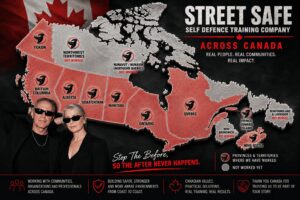
What More Than Two Decades of Teaching Violence Prevention Across Canada Has Taught Me
By Rob Andress
Violence Prevention Specialist / Self Defence Expert
Street Safe Self Defence Training Company
Dear Canada,
People often ask me what it’s like travelling across this country teaching violence prevention.
My answer usually surprises them.
I don’t remember every hotel, I don’t remember every flight, I don’t remember every highway Beth and I have driven.
What I remember are the conversations.
The woman who told me she ignored her instincts because she didn’t want to offend someone.
The healthcare worker who believed being assaulted was simply part of the job.
The REALTOR® who admitted they had been taking unnecessary risks because “that’s how everyone does business.”
The municipal employee who realized situational awareness wasn’t a skill for police officers—it was a skill for everyone.
Those conversations stay with you.
Over the past two decades, Beth and I have had the privilege of working across Canada. We’ve trained healthcare professionals, municipal workers, airport security personnel, corporations, REALTORS®, educators, non-profit organizations, By-Law Officers, unions, policy makers and Indigenous communities. Every organization invited us for a different reason, but almost every conversation ended the same way.
People wanted to know how to recognize violence before it happened.
That’s what Street Safe Self Defence Training Company has always been about.
Not teaching people how to fight.
Teaching people how to understand violence.
I think that’s where the self-defence industry has gone wrong.
We’ve convinced people that self-defence begins with a punch.
In my experience, it doesn’t.
It begins with behaviour.
Violence leaves clues.
People leave clues.
The question isn’t whether those clues exist.
The question is whether we’ve been taught to recognize them.
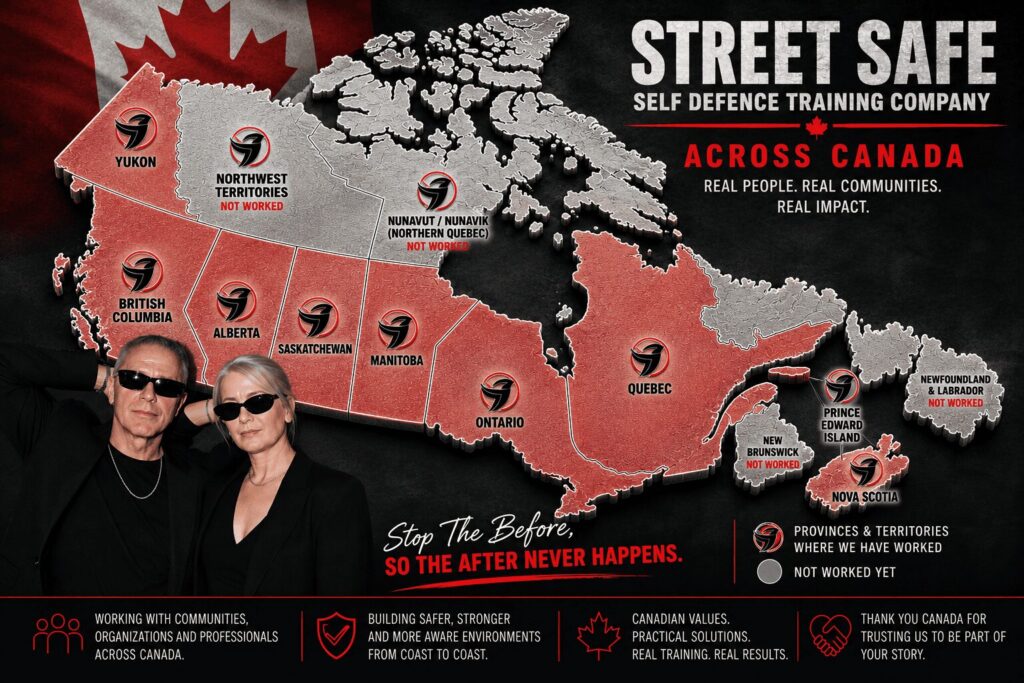
As Beth and I travelled from the Yukon to British Columbia, across the Prairies, throughout Ontario, into Nunavik and Atlantic Canada, one lesson kept repeating itself.
Communities are different.
People aren’t.
Human behaviour is remarkably consistent.
Predators rely on predictable patterns.
Fear influences decision-making in predictable ways.
Good people explain away warning signs far more often than they should.
And those lessons don’t change because you’ve crossed a provincial border.
This isn’t a story about where Street Safe has worked.
It’s a story about what Canadians have taught me after more than years of listening, learning and having the privilege of standing in front of thousands of people who trusted us enough to ask one simple question. “Can you help keep us safe?”
I’d like to share what I’ve learned.
The Yukon
Confidence Isn’t the Absence of Fear. It’s Understanding It.
The first lesson Canada taught me came from the Yukon.
When most people think about violence, they think about big cities. They think about crowded streets, high crime rates and places they’ve seen on the evening news.
That’s not what I found.
I found women who wanted exactly what every woman in Canada wants. To feel safe.
Beth and I had the privilege of working with non-profit organizations in Whitehorse, delivering Reality Women’s Self Defence programs. Before the first class even started, I remember thinking something that has stayed with me ever since.
Fear doesn’t have a postal code.
It doesn’t matter whether someone lives in Whitehorse, Toronto or Halifax. If they’ve experienced violence, if they’ve been threatened, or if they’ve spent years doubting their own instincts, they carry those experiences with them.
What impressed me wasn’t the courage it took to attend the course.
It was the willingness to challenge years of social conditioning.
Many of the women we met had spent their lives being told to be polite.
Don’t overreact.
Don’t embarrass someone.
Don’t make a scene.
Sound familiar?
Those messages are often well intentioned, but they can become dangerous when they teach someone to ignore the very instincts designed to protect them.
That’s one of the first things we talk about in every Street Safe program.
Your intuition isn’t something to be apologized for. It’s information.
It doesn’t always tell you exactly what’s wrong, but it tells you to pay attention.
I’ve said for years that violence doesn’t usually arrive unannounced.
It sends signals first.
Changes in behaviour.
Boundary testing.
Controlling language.
Unwanted attention.
Attempts to isolate.
The problem isn’t that those warning signs don’t exist.
The problem is that many good people have been taught to explain them away.
That’s what struck me about our time in the Yukon.
The women weren’t looking to become fighters.
They were looking for permission to trust themselves again.
That’s a very different objective.
When the program finished, several participants told us they no longer looked at uncomfortable situations the same way.
Not because they felt stronger physically.
Because they understood behaviour differently.
To me, that’s confidence.
Confidence isn’t believing you can win every fight.
Confidence is recognizing a situation early enough that the fight never has to happen.
The response to the program was overwhelming, and we were honoured to be invited back.
I don’t believe that happened because we taught better techniques.
I believe it happened because we respected the intelligence of the people sitting in front of us.
We didn’t tell them what to think.
We gave them a different way to look at violence.
That’s the lesson the Yukon gave me.
Confidence isn’t created by teaching someone how to throw a punch.
It’s created by helping them understand themselves, trust their instincts, and recognize human behaviour before violence has the opportunity to take control.
It’s a lesson that has stayed with me ever since.
And as you’ll see throughout this letter, it was only the beginning.
British Columbia
Safety Isn’t a Policy. It’s a Culture.
British Columbia taught me something I’ve believed for years.
Policies don’t prevent violence.
People do.
That might sound like an odd statement coming from someone who regularly works with organizations reviewing safety programs and workplace violence prevention, but I’ve never believed a written policy alone has ever stopped an assault.
A policy tells people what they’re supposed to do.
Education helps them understand why.
Those are two very different things.
Beth and I had the privilege of working with the British Columbia Real Estate Association as conversations around REALTOR® safety continued to evolve. Like every profession that works directly with the public, REALTORS® face unique risks. They meet complete strangers. They enter vacant properties. They work alone. They often know very little about the person they’re about to meet.
Yet many accepted those risks as simply part of the profession.
I’ve heard that sentence in every province.
“It’s just part of the job.”
Healthcare workers have said it.
Teachers have said it.
Municipal employees have said it.
Security professionals have said it.
REALTORS® have certainly said it.
Whenever I hear those words, I ask myself the same question.
Who decided that?
When did society begin accepting that violence, intimidation, harassment or threats were simply something people should tolerate because of the career they chose?
I’ve never accepted that idea.
No one should have to accept violence as a condition of employment.
What impressed me most about the conversations in British Columbia wasn’t simply the willingness to improve safety. It was the willingness to ask difficult questions.
Are we teaching people enough?
Are we preparing them for the behaviours they’ll actually encounter?
Do our policies reflect the realities of today’s workplace?
Those are important questions because violence prevention is never static.
Human behaviour changes.
Technology changes.
How people communicate changes.
The tactics used by criminals change.
If our education doesn’t evolve with those changes, we eventually find ourselves solving yesterday’s problems while tomorrow’s threats are already developing.
That’s why Beth and I constantly review research, behavioural science, criminal trends and real-world incidents from across Canada.
Not because we want to make people afraid.
Because we have a responsibility to remain current.
The best violence prevention programs don’t become successful because they’re repeated year after year without change.
They become successful because they’re willing to change as human behaviour changes.
British Columbia reminded me that organizations don’t become safer because they write better policies.
They become safer when leadership creates a culture where safety is discussed openly, concerns are taken seriously, and education becomes an ongoing commitment rather than a one-time event.
That’s the difference between compliance and culture.
Compliance says people attended the training.
Culture is what happens when they begin thinking differently long after the training ends.
That’s always been our goal.
Not to deliver another course.
To change the way people see risk for the rest of their lives.
British Columbia reinforced something I’ve believed throughout my career.
Violence prevention isn’t a document sitting on a shelf.
It’s a conversation that should never stop.
And that’s a lesson every Canadian organization can learn from.
Alberta
Real Change Happens When Organizations Choose Prevention
If British Columbia reminded me that safety is a culture, Alberta showed me something just as important.
Prevention works.
Not in theory.
Not in a research paper.
In the real world.
Over the years, Beth and I have had the privilege of working extensively throughout Alberta, and one relationship has been particularly meaningful to me, the REALTORS® Association of Edmonton.
I’ve always believed that the success of a violence prevention program shouldn’t be measured by how many people attended the course. It should be measured by what happens after everyone goes back to work.
That’s the real test.
Can people recognize risk sooner?
Do they make different decisions?
Are they setting better boundaries?
Are fewer people finding themselves in dangerous situations?
Those are the outcomes that matter.
When we first began working with Edmonton REALTORS®, we weren’t trying to teach them how to fight.
We were trying to help them understand the profession they had chosen.
Real estate is unlike almost any other occupation.
You’re expected to build trust quickly with complete strangers.
You meet people in empty homes.
You work evenings.
You travel alone.
You often know very little about the individual waiting behind the next front door.
Most people outside the profession never think about that.
Predators do.
That’s why our conversations in Alberta were never centered around fear.
They were centered around awareness.
We talked about behavioural baselines.
Boundary testing.
The transparency effect.
Pre-attack indicators.
Victim selection.
How to slow an interaction down without creating conflict.
How to recognize when something simply doesn’t feel right.
Most importantly, we talked about giving yourself permission to leave.
That may be one of the hardest lessons we teach.
Professionals often feel obligated to continue a meeting because they don’t want to appear rude.
They don’t want to lose a client.
They don’t want to offend someone.
Predators understand that social pressure.
Good people often underestimate it.
One of the things that has encouraged me most over the years is watching organizations embrace prevention instead of waiting for something serious to happen before taking action.
That’s leadership.
Leadership isn’t responding well after an incident.
Leadership is reducing the likelihood that the incident occurs in the first place.
Throughout our work in Alberta, we’ve watched safety become part of the professional conversation.
People ask better questions.
They challenge assumptions.
They share experiences with colleagues.
They recognize behaviours they might once have dismissed.
That’s how culture changes.
One conversation at a time.
One decision at a time.
One professional deciding that their personal safety deserves the same attention as every other part of their career.
I’ve often said that violence prevention isn’t about making people suspicious of everyone they meet.
It’s about helping them become better observers.
There’s a tremendous difference.
Observation creates confidence.
Suspicion creates fear.
The goal has never been to make Canadians fearful.
The goal has always been to make them aware.
Alberta reminded me that when organizations commit to education, when leaders support that commitment, and when people are encouraged to trust both their training and their instincts, remarkable things begin to happen.
Not because violence disappears.
Because opportunities for violence become fewer.
To me, that’s what success looks like.
Not the confrontations that happened.
The ones that never did.
That lesson has stayed with me every time I’ve returned to Alberta, and I suspect it always will.
Saskatchewan
The Strength of a Community Isn’t Measured by Its Size
One of the things I enjoy most about travelling across Canada is discovering how different every community is.
Some are built around major cities.
Others are built around a single main street where everyone knows everyone else.
Saskatchewan reminded me that neither is better.
They’re simply different.
In smaller communities, relationships matter.
Reputation matters.
People know your family, your neighbours and often your entire history before they know your last name.
There’s a comfort in that.
But there can also be challenges.
When you work in a close knit community, it’s often harder to separate your professional life from your personal one. The person upset with you at work may be standing behind you in the grocery store that evening. The difficult conversation you had this afternoon doesn’t always end when you lock the office door.
That creates a different kind of pressure.
It’s one that isn’t always discussed in violence prevention.
Over the years, I’ve learned that personal safety isn’t only about recognizing dangerous people. It’s also about managing difficult relationships professionally, setting healthy boundaries, and understanding that being approachable doesn’t require being available to everyone all the time.
Saskatchewan reinforced something I’ve come to admire about Canadians.
People genuinely care about their communities.
They volunteer.
They coach.
They serve on committees.
They look after one another.
Those qualities make communities stronger.
They can also make people reluctant to have uncomfortable conversations when someone’s behaviour begins affecting others.
I’ve always believed that respect includes accountability.
Sometimes the most respectful thing we can do is address behaviour before it becomes a bigger problem.
That’s true in families.
It’s true in workplaces.
And it’s certainly true in violence prevention.
One of the things Beth and I appreciated most during our time in Saskatchewan was the willingness of people to have honest conversations. Not the polished conversations people think they’re supposed to have—but the real ones.
The conversations that begin with, “Can I tell you what actually happened?”
Those are the moments that stay with me.
Not because they confirm what I already know.
Because they teach me something I didn’t.
Every province has shaped the way I think about violence prevention.
Saskatchewan reminded me that some of the most valuable lessons don’t come from standing at the front of the room.
They come from listening to the people sitting in it.
For that, I’ll always be grateful.
Manitoba
Resilience Doesn’t Always Make the News
Manitoba taught me to stop measuring strength by how loud it is.
Some of the strongest people I’ve met don’t wear a uniform, stand behind a podium, or have letters after their name.
They’re the people who quietly show up every day because someone has to.
Over the years, I’ve learned that resilience isn’t something you can always see.
Sometimes it’s the receptionist who calmly greets a person she knows has threatened staff before.
Sometimes it’s the male REALTOR who was beaten and robbed after a showing.
Sometimes it’s the housing worker who continues treating people with dignity despite being yelled at the day before.
Sometimes it’s the healthcare professional who walks back onto the unit after dealing with an aggressive patient because there are still people who need care.
Those moments rarely make the news.
They don’t receive awards.
Most people never see them. But I do.
When Beth and I travel across Canada, we spend far more time talking to people during coffee breaks than we do standing at the front of the room.
That’s where the real conversations happen.
Someone will quietly walk over and say, “Can I tell you something that happened last month?”
Those words have introduced me to hundreds of stories over the years.
Some were frightening.
Some were heartbreaking.
Some were frustrating.
But almost every one of them ended the same way.
“I didn’t think anyone would understand.”
I always find that interesting.
Violence has a way of making people feel isolated, even when they’re surrounded by colleagues who’ve experienced something remarkably similar.
One of the greatest gifts education can provide isn’t just knowledge.
It’s the realization that you’re not the only one.
I’ve watched complete strangers begin talking to one another after a session, sharing experiences they’d never discussed before.
Not because we asked them to.
Because someone finally created an environment where those conversations felt safe.
That may be one of the things I’m proudest of.
Not the presentations.
The conversations they create afterward.
Manitoba reminded me that people don’t always need someone to solve every problem.
Sometimes they simply need someone willing to listen without judgment.
I’ve tried to remember that throughout my career.
I may stand at the front of the room, but I don’t pretend to have every answer.
Every community teaches me something.
Every organization sees challenges I haven’t seen.
Every participant brings experiences that broaden my own understanding of violence, conflict and human behaviour.
That’s one of the reasons Beth and I still enjoy this work after all these years.
We’re still learning.
And I hope we never stop.
Looking back, I don’t remember Manitoba for a single event or a single presentation.
I remember it for the people who reminded me that resilience isn’t measured by how much someone can endure.
It’s measured by their willingness to keep caring in a world that sometimes makes caring difficult.
That’s a lesson I’ll carry with me wherever this road leads next.
Ontario
Sometimes the Biggest Change Is the Question We Start Asking
Ontario has taught me that real progress doesn’t always happen because we discover new answers.
Sometimes it happens because we finally start asking better questions.
I’ve been fortunate to work throughout this province for many years, and because of that I’ve had the opportunity to watch something change that gives me a great deal of hope.
When I first began teaching violence prevention, most organizations wanted to know one thing.
“Can you teach our staff how to protect themselves?”
It was a fair question.
But over time, I noticed that question beginning to evolve.
Today, more organizations ask something very different.
“How do we reduce the likelihood that this happens at all?”
Those two questions may sound similar.
They aren’t.
One prepares people for violence, the other challenges us to prevent it.
That shift tells me something important.
We’re beginning to understand that safety isn’t just about responding well under pressure.
It’s about creating environments where fewer people ever experience that pressure in the first place.
I’ve seen that change in hospitals.
I’ve seen it in municipalities.
I’ve seen it in schools.
I’ve seen it in airports.
I’ve seen it in boardrooms where leaders genuinely wanted to understand what their employees were experiencing, not because legislation required them to ask, but because they cared about the people sitting around the table.
Those conversations have always meant more to me than any standing ovation after a presentation.
When a leader quietly says, “I don’t think we’ve been looking at this the right way,” that’s the beginning of meaningful change.
It takes humility to admit there might be a better approach.
It takes courage to act on it.
One of the things Ontario has shown me is that innovation doesn’t always involve new technology.
Sometimes innovation is simply giving people permission to think differently.
I remember years ago when discussing intuition in a workplace was often dismissed as being too subjective.
Today, organizations are far more interested in understanding human factors.
How do people make decisions under stress?
Why do some situations escalate while others don’t?
How do we recognize behavioural changes before conflict becomes a crisis?
Those conversations weren’t nearly as common when I started.
They are becoming much more common today.
That gives me hope.
It tells me we’re beginning to appreciate something I’ve believed throughout my career.
People aren’t the most unpredictable part of violence.
They’re the most understandable part.
The more we learn about behaviour, communication, stress and decision-making, the better equipped we become to protect one another.
Ontario has also reminded me that no profession owns the issue of workplace violence.
I’ve had the privilege of speaking with nurses, physicians, municipal leaders, teachers, airport personnel, social service agencies, REALTORS®, executives, security professionals and countless others.
On paper, their careers couldn’t be more different.
Yet when you sit down and listen to them, you quickly realize they’re all asking for the same thing.
They want to go home safely.
Not because they’re afraid of their work.
Because the people waiting for them at home matter.
A spouse.
A partner.
Children.
Parents.
Friends.
Pets who still run to the door every evening.
Work is important.
But it’s never more important than getting home.
Ontario reinforced something I hope never changes in this country.
The best organizations never stop learning.
They never assume they’ve figured everything out.
They remain curious.
They ask difficult questions.
They challenge long-held assumptions.
And they’re willing to change when the evidence tells them there’s a better way.
As an educator, that’s inspiring to witness.
As a Canadian, it’s reassuring.
Because progress isn’t measured by how much we already know.
It’s measured by our willingness to keep learning.
Ontario has taught me that lesson over and over again.
And every time I return, I find another reason to believe we’re moving in the right direction.
Nunavik, Quebec
You Cannot Understand a Community Until You Listen to It
There are places in Canada that stay with you long after you’ve returned home. Nunavik is one of those places.
Before Beth and I first travelled north, I spent time preparing the way I always do. I read. I researched. I tried to understand the communities we would be visiting, their history, and some of the challenges they face.
I thought I was prepared. I wasn’t!
Not because the information was wrong.
Because information and understanding are two different things.
There is something profoundly humbling about standing in a community that has existed for generations and realizing that you are the one who has just arrived.
It changes your perspective.
You stop thinking about what you’re going to teach.
You start thinking about what you need to learn.
That shift made all the difference.
One of the greatest mistakes any educator can make is believing that expertise gives them all the answers.
I’ve never believed that.
Every community has its own history.
Its own strengths.
Its own hardships.
Its own way of seeing the world.
If you ignore that, it doesn’t matter how much knowledge you bring with you.
People know when they’re being talked at.
They also know when they’re being listened to.
The women we met in Nunavik didn’t need someone arriving from Southern Ontario to explain what resilience looked like.
They were already living it.
They understood challenges most Canadians will never experience.
They understood the importance of family.
Community.
Responsibility.
Looking after one another.
What Beth and I hoped to contribute wasn’t a different culture.
It was another layer of knowledge that could support the strength that already existed.
That distinction mattered to us.
I’ve often said that education should never begin with the assumption that people know nothing.
It should begin with the assumption that they know something you don’t.
That’s how real learning happens.
Some of my favourite moments in Nunavik had nothing to do with standing in front of a classroom.
They happened afterwards.
Over coffee.
Walking through the community.
Listening to stories.
Answering questions.
Learning about everyday life in a place that many Canadians will never have the opportunity to visit.
Those conversations reminded me that violence prevention can never be separated from culture.
The principles of human behaviour may be remarkably consistent, but how communities experience, respond to and heal from violence is deeply personal.
If we fail to understand that, we risk teaching information without creating understanding.
Nunavik taught me something I’ll never forget.
Respect isn’t demonstrated by arriving with the answers.
It’s demonstrated by arriving with enough humility to ask better questions.
The first time I left Northern Quebec, I was feeling grateful, not simply because we had the opportunity to share our work.
Because an extraordinary group of people had shared a part of their lives with us.
That trust is something I have never taken for granted.
When I think about Nunavik today, I don’t first remember the flights, the landscape or the distance from home.
I remember the people.
And I remember leaving with the realization that the best educators are always students first.
For that lesson, I will always be thankful. We have had the opportunity of working in every community in Norther Quebec, and we look forward to the continuing changes and education we bring to the Inuit Women in these remote locations.
Nova Scotia
Trust Is Earned One Conversation at a Time
Nova Scotia taught me something that took years to fully appreciate.
People don’t remember every word you say.
They remember how you made them feel.
When Beth and I first began travelling across Canada, I probably spent too much time worrying about whether every slide was perfect, every statistic was current, and every program flowed exactly the way I had planned.
Those things matter.
Professionalism matters.
Preparation matters.
But they aren’t what people talk about months later.
What they remember is whether they felt heard.
Whether they felt respected.
Whether someone understood the realities of their work without pretending to have lived their experience.
That’s something the people of Nova Scotia reinforced for me.
I’ve always enjoyed the conversations that happen after the presentation is over.
The room begins to empty.
People gather their coats.
Someone walks over and says, “Do you have a minute?”
I’ve learned that those four words are often the beginning of the most important conversation of the day.
Sometimes it’s a question about workplace violence.
Sometimes it’s about a family member.
Sometimes it’s about an incident that happened years ago that they’ve never really spoken about.
And sometimes they simply want to say thank you.
Not because we solved a problem.
Because they felt understood.
Those moments have always humbled me.
You quickly realize that standing at the front of a room carries a responsibility that extends far beyond delivering information.
People don’t always remember the lesson.
They remember whether they trusted the person teaching it.
Trust has never been something I’ve expected.
It’s something I’ve tried to earn.
One honest conversation at a time.
One handshake at a time.
One promise kept at a time.
Over the years, I’ve discovered that credibility isn’t built by telling people how much you know.
It’s built by being honest about what you don’t know.
I’ve never been afraid to say, “That’s a great question. I don’t know the answer.”
Ironically, I think people trust you more when you’re willing to admit that.
No one has all the answers.
Certainly not me.
What we can offer is experience.
Perspective.
A willingness to listen.
And a commitment to keep learning.
Nova Scotia reminded me that education is, at its heart, a relationship.
It isn’t a transaction.
People aren’t buying information.
They’re placing trust in someone they hope will respect their experiences and leave them better prepared than they were yesterday.
I’ve never forgotten that.
It’s why Beth and I continue to answer emails long after a course has ended.
It’s why we’ll pick up the phone when someone calls with a question months later.
It’s why we’ve always believed that our relationship with an organization begins after the training—not when it ends.
Knowledge can be shared in a single afternoon.
Trust takes much longer.
Looking back, that’s the lesson Nova Scotia left with me.
If people trust you enough to tell you their stories, treat that trust like the privilege it is.
It can never be taken for granted.
And it should never be forgotten.
Prince Edward Island
Never Measure the Importance of a Community by Its Population
Prince Edward Island reminded me of something I wish more people understood.
Big ideas don’t need big cities.
Over the years, I’ve spoken in convention centres filled with hundreds of people.
I’ve also spoken in rooms where every chair could have fit around a family dining room table.
If you asked me which audience mattered more, I couldn’t answer you.
Because they all mattered.
Some of the most meaningful conversations I’ve ever had happened after presentations attended by fewer than twenty people.
No stage.
No bright lights.
No elaborate production.
Just people sitting together, asking honest questions and sharing real experiences.
There’s something refreshing about that.
Without realizing it, we sometimes equate size with importance.
Larger cities.
Larger organizations.
Larger audiences.
We assume that’s where the greatest influence exists.
I’ve never found that to be true.
Influence isn’t measured by the number of people in the room.
It’s measured by what those people do after they leave it.
One person changes the way they approach a difficult conversation with a client.
Another goes back to work and introduces a new safety practice.
A manager begins asking different questions during staff meetings.
A parent starts having conversations with their children they hadn’t thought to have before.
Those changes don’t make national headlines.
But they ripple outward in ways we’ll probably never see.
I’ve often wondered how many people are safer today because someone who attended one of our programs shared an idea with a colleague, a friend, or a member of their family.
I’ll never know.
And that’s perfectly alright.
Not every meaningful contribution needs to be measured.
Sometimes it’s enough to know that the conversation continued after you left.
Prince Edward Island also reminded me that people value authenticity.
In smaller communities, people tend to know one another.
They have a remarkable ability to recognize when someone is genuine and when someone is simply delivering a polished presentation.
I’ve always believed people deserve the real me.
Not the version standing behind a microphone.
The same person who enjoys sitting around a kitchen table with a cup of coffee is the person you’ll find teaching one of our programs.
I’ve never wanted to be the smartest person in the room.
I’ve wanted to be the most approachable.
Because if people don’t feel comfortable asking questions, then education becomes a lecture instead of a conversation.
I’ve never been interested in lectures.
I’ve always been interested in conversations.
Prince Edward Island reinforced something I hope I never forget.
Every community matters.
Every story matters.
Every person who chooses to spend a day learning with us deserves exactly the same respect, whether they’re one of fifteen participants or one of five hundred.
That’s never changed.
And it never will.
When I think back on Prince Edward Island, I don’t remember how many people were in the room.
I remember the conversations.
After all these years, I’ve come to believe that’s the only number that really matters.
What Canada Gave Me
People sometimes ask Beth and me what our favourite province is.
I never know how to answer.
It would feel like choosing a favourite chapter in a book.
Every province has given me something different.
The Yukon reminded me that courage often begins with giving yourself permission to trust your instincts.
British Columbia showed me that the safest organizations don’t simply write policies. They build cultures where people look out for one another.
Alberta demonstrated that prevention isn’t wishful thinking. When leaders commit to it, lives quietly become safer.
Saskatchewan reminded me that strong communities are built on honest conversations, mutual respect and people willing to care for one another.
Manitoba showed me that resilience isn’t loud. It’s found in ordinary people who quietly keep showing up, even when their work is difficult.
Ontario taught me that progress begins the moment we stop asking yesterday’s questions and become curious enough to ask better ones.
Nunavik reminded me that no amount of education replaces the humility of listening before you speak.
Nova Scotia reinforced that trust is never demanded. It’s earned, one conversation at a time.
Prince Edward Island proved that the size of a room has absolutely nothing to do with the importance of what happens inside it.
Those lessons didn’t come from textbooks.
They came from Canadians.
From the woman who quietly stayed behind after a program because she wanted to tell us about something she’d carried for years.
From the supervisor trying to protect a team they genuinely cared about.
From the teacher who wanted to better understand a student whose behaviour everyone else had already judged.
From the nurse who admitted she was tired of hearing that being assaulted was simply part of the profession.
From the REALTOR® who finally realized they didn’t owe anyone access to them simply because they were trying to earn a living.
From the municipal employee who discovered that professionalism and personal safety are not competing priorities.
Those people probably have no idea how much they’ve influenced my thinking.
Every conversation added another piece to a puzzle I’ve been trying to understand for more than two decades.
Not how violence happens.
How people prevent it.
Because that’s what has fascinated me throughout my career.
Not the crisis.
The choice that prevented the crisis.
The decision to leave.
The uncomfortable question someone finally asked.
The boundary someone finally enforced.
The phone call someone decided not to make alone.
The meeting someone chose to reschedule.
The instinct someone trusted instead of explaining away.
Those decisions rarely receive recognition.
Nobody applauds them.
Nobody writes newspaper articles about the confrontation that never happened.
But perhaps they should.
I’ve come to believe that some of the greatest victories in violence prevention are completely invisible.
They’re invisible because nothing happened.
Someone went home safely.
Someone arrived home for dinner.
Someone tucked their children into bed that night.
Someone kissed their husband.
Someone hugged their wife.
Someone threw a tennis ball for their dog.
Someone woke up the next morning and never realized how close they may have come to making a very different memory.
Those moments don’t appear in statistics.
But they’re the moments that matter most.
After more than two decades, that’s become my definition of success.
Not teaching someone how to survive violence.
Helping them avoid becoming part of it.
If I’ve learned anything from travelling across this incredible country, it’s this.
Canadians are remarkably kind people.
We care deeply about one another.
We believe in fairness.
We believe in community.
Sometimes we simply need permission to believe in ourselves with that same level of commitment.
Maybe that’s what Beth and I have really been teaching all these years.
Not self-defence.
Not even violence prevention.
Permission.
Permission to leave uncertainty.
Permission to trust your instincts.
Permission to establish healthy boundaries.
Permission to say no without feeling guilty.
Permission to believe that your personal safety is never an overreaction.
If that’s true…
Then perhaps Canada has been teaching me exactly the same lesson all along, and I thank every person I have met and help create a safer job, and safer life.
Dear Canada
As I sit here finishing this letter, I find myself thinking about the thousands of kilometres behind us and the thousands that still lie ahead.
People often assume that after more than two decades of travelling across Canada, what I’ll remember most are the places.
They’re wrong.
I’ll remember the people.
I’ll remember the woman who quietly thanked Beth after finding the confidence to trust herself again.
I’ll remember the frontline worker who finally realized that being threatened should never be accepted as “just part of the job.”
I’ll remember the REALTOR® who decided no commission was ever worth ignoring their instincts.
I’ll remember the teacher who began seeing behaviour through the eyes of understanding instead of frustration.
I’ll remember the healthcare professional who reminded me that compassion and personal safety can, and must, exist together.
I’ll remember the By-Law Officer, the airport security professional, the municipal employee, the union representative, the executive, the volunteer, the parent, the student, and the countless others who welcomed Beth and me into their workplaces, their communities and, in many cases, into some of the most personal conversations of their lives.
Those conversations changed me.
More than you’ll ever know.
People sometimes thank us for what we’ve taught them.
The truth is, I owe Canada a thank you.
Thank you for trusting us.
Thank you for challenging us to become better educators.
Thank you for asking difficult questions instead of settling for easy answers.
Thank you for reminding me that every profession deserves to feel safe, every community deserves to be heard, and every person deserves to go home at the end of the day.
You’ve reinforced my belief that violence prevention is about far more than responding to danger.
It’s about protecting possibility.
It’s about making sure a young woman arrives safely at university.
A healthcare worker returns home to their family after a difficult shift.
A REALTOR® finishes another showing without becoming tomorrow’s headline.
A municipal employee can serve their community without fearing intimidation.
A teacher can focus on changing lives instead of worrying about their own safety.
Those aren’t extraordinary expectations.
They should be ordinary ones.
If Beth and I have accomplished anything over these past two decades, I hope it isn’t that we’ve taught people how to defend themselves.
I hope we’ve helped them see themselves differently.
More confident.
More aware.
More willing to trust their judgment.
More willing to establish healthy boundaries.
More willing to believe that their safety matters.
Because once someone truly believes they deserve to be safe, something remarkable happens.
They begin making decisions that quietly change the course of their lives.
Those decisions will never make the evening news.
No reporter will ever tell the story of the meeting that was cancelled, the situation that was avoided, or the warning sign that was recognized in time.
Yet I believe those untold stories are the greatest measure of our work.
They’re the reason Beth and I continue getting on airplanes, loading the car, and driving to the next community.
Not because we think we have all the answers.
Because we still believe every conversation matters.
As long as Canadians continue inviting us into their communities, we’ll continue showing up.
We’ll continue listening.
We’ll continue learning.
And we’ll continue sharing everything we’ve learned in the hope that someone, somewhere, will make one decision that keeps them safe.
That’s a journey worth taking.
So, from the bottom of my heart…
Thank you, Canada.
Thank you for your trust.
Thank you for your kindness.
Thank you for allowing Beth and me to become a small part of your story.
The truth is, you’ve become a much bigger part of ours.
I’ll never take that privilege for granted.
Until we meet again, stay aware, trust yourself, look after one another, and never underestimate the power of one good decision made at the right time.
Because the safest communities are built one person at a time.
With sincere gratitude,
Rob Andress
Violence Prevention Specialist / Self Defence Expert
Street Safe Self Defence Training Company
“Stop the Before, So the After Never Happens.”
Corner Stone Article
- Self-Defence Is NOT Martial Arts
- Who Is Qualified to Teach Self Defence?
- Self Defence Is a Profession
- TRAACS
- By-Law Deserves Better Training
- High School Violence Prevention
- REALTOR® Safety
- Reality Women’s Self Defence
- Street Safe Learning
- Street Safe Webinars
- Street Safe Academy
Government of Canada – Workplace Violence Prevention
