

What Do I Do IF Someone Blocks My Way?
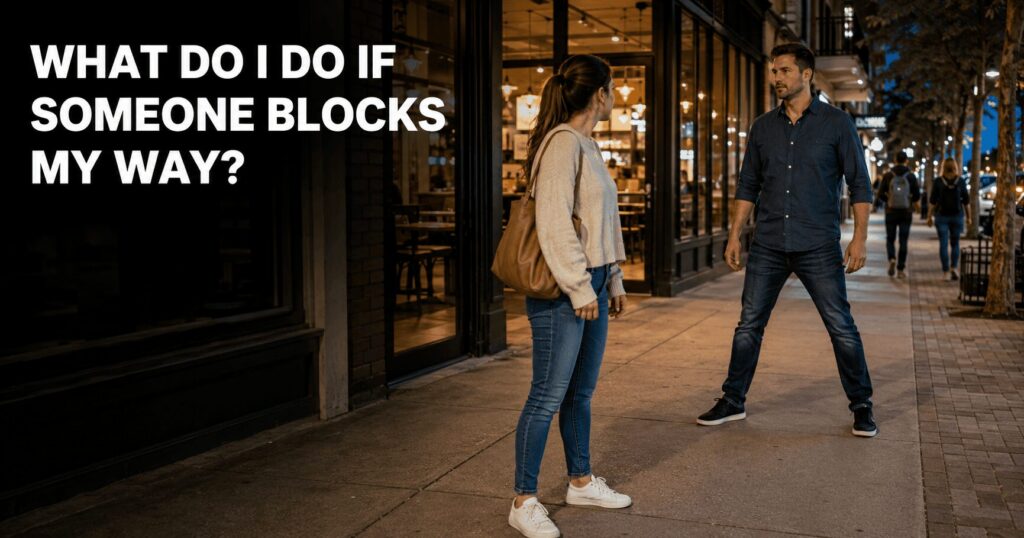
Someone steps in front of you.
You move to the side. They move with you.
You try to walk around them. They block you again.
At this point, stop treating it like an accident.
One obstruction may be nothing. Repeatedly blocking your movement is a behavioural shift. The person has made a deliberate decision to interfere with your ability to leave.
That does not automatically mean they intend to attack you.
It does mean you need to pay attention.
Understanding this change in behaviour is part of real violence-prevention training. The earlier you recognize the change, the more options you have.
What should I do if someone deliberately blocks my way?
Create distance, move toward safety, use a clear verbal boundary and do not allow the person to move you somewhere more isolated.
Your first objective is not to win an argument.
It is not to prove that you are tough.
It is not to stand your ground over something that does not matter.
Your objective is to protect your movement, maintain access to an exit and leave before the situation becomes physical.
That is the foundation of reality-based self-defence. It begins with recognition and decision-making—not fighting.
Do not move closer to get past them
One of the most common mistakes people make is continuing forward because they do not want to appear rude, frightened or confrontational.
They squeeze past.
They turn sideways.
They allow the person within touching distance.
They give up space because social conditioning tells them not to make a scene.
Stop doing that.
If someone deliberately blocks your way, do not keep walking into their space. Stop outside their immediate reach and create more distance if you can.
Distance gives you time.
Time gives you options.
Options keep you safer.
The goal was never to win a fight. The goal was always to get home.
Use a clear verbal boundary
This is not the time for a nervous smile.
Do not laugh it off.
Do not ask ten questions.
Do not get trapped trying to understand why they are doing it.
Use a direct statement:
“Move.”
“Step back.”
“Do not block me.”
“Let me pass.”
Your voice should be loud enough to attract attention without becoming emotionally uncontrolled.
You are not trying to dominate them. You are telling them, and everyone around you, that the contact is unwanted and that you intend to leave.
That verbal boundary also gives you information.
Do they apologize and move?
Do they ignore you?
Do they become angry?
Do they move closer?
Do they start looking around?
Do they reach toward you?
Their reaction will tell you far more than their words.
This is why I have always said: You cannot de-escalate what you never recognized.
Watch the hands, distance and environment
Do not become so focused on the person’s face that you miss everything else.
Watch their hands.
Are the hands visible?
Are they reaching into a pocket or waistband?
Are they holding something?
Are they positioning their body to conceal one hand?
Pay attention to distance.
Are they closing the space after being told to stop?
Are they trying to move beside you rather than remain in front of you?
Are they attempting to guide you toward a doorway, vehicle, stairwell or isolated area?
Look at the environment.
Where is your safest exit?
Where are the other people?
Is there a business, front desk, occupied home, security station or locked door you can move toward?
Is another person approaching from behind or beside you?
Do not let one person consume all your attention.
Our Principles of Protection are built around simple decisions that can be recalled under stress. Complicated techniques and memorized routines will not replace recognizing what is happening around you.
Move toward people, light and controlled space
If the person continues blocking you, change your destination.
Move toward a populated and visible area.
Enter an open business.
Approach a group of people.
Move behind a counter or controlled-access door if one is available.
Call someone and clearly state your location.
If necessary, point directly at a specific person and say:
“You in the blue jacket, call 911. This person will not let me leave.”
Do not simply yell, “Someone help me.”
Give one identifiable person a clear job.
In an urgent or life-threatening situation, the Government of Canada advises people to call 911 or their local police emergency number.
Do not let them move you
This is critical.
A person who wants you to move to another location is not trying to improve your safety.
Do not walk toward their vehicle.
Do not go around the corner to “talk privately.”
Do not enter a stairwell, alley, room or secluded area because they promise to explain themselves.
Do not surrender a safer public position for a more isolated one.
Your safest opportunity may exist exactly where you are.
The location change benefits them, not you.
For women, recognizing attempts to control movement, distance and location is an important part of women’s violence-prevention and self-defence training. The objective is to recognize the behaviour before physical control is established.
What if they say they only want to talk?
They can talk from where they are.
They do not need to block your movement.
They do not need to close the distance.
They do not need to touch you.
They do not need to force you into a private location.
“I only want to talk” does not excuse the behaviour.
Pay attention to what the person is doing, not just what they are saying.
Their words may sound social.
Their behaviour may not be.
What if the person becomes aggressive?
If the person threatens you, reaches for you, displays a weapon or continues closing distance after being clearly told to stop, the situation has changed.
Your response must change with it.
Move immediately toward your safest available exit.
Make noise.
Call 911 when you can do so safely.
Use physical force only when it is necessary to protect yourself or create the opportunity to escape.
The goal is not to exchange techniques.
The goal is not to remain and fight.
The goal is to disrupt what is happening, create an opening and leave.
Closest weapon. Closest target.
Keep it simple.
Then get out.
That is the difference between practical self-defence training in Canada and martial-arts training built around controlled competition.
What if someone blocks me while I am in my car?
Keep the doors locked and the windows up.
Do not get out to confront them.
Do not lower the window enough for them to reach inside.
Use the horn to attract attention.
Call 911 if you believe you are being threatened or prevented from leaving safely.
If you can drive away without striking someone or creating a greater danger, leave the area and move toward a police station, fire station or populated public location.
Do not drive home if you believe someone may be following you.
The person does not need to know where you live.
What if this happens during a real estate appointment?
A REALTOR® may encounter this behaviour during an open house, private showing, property inspection or meeting with an unknown prospect.
Someone may stand between you and the exit.
They may move deeper into the property while expecting you to follow.
They may try to separate you from the front door or position themselves between you and your vehicle.
Do not ignore the change because the person presented themselves as a client.
A prospect can become a predator.
Maintain access to an exit, avoid allowing the person behind you and leave the property when their behaviour creates concern. Our REALTOR® Safety training was developed from decades of experience within the real estate industry and working directly with professionals who have experienced violence.
A panic button may help summon assistance, but it cannot replace recognizing danger before contact. That is why REALTORS® need more than safety apps and panic buttons.
What if this happens at work?
A blocked doorway, trapped position or deliberate interference with an employee’s movement should not be dismissed as “just a difficult customer.”
Document what happened.
Record the person’s words, actions, location, proximity and reaction to being told to move.
Report the incident according to your workplace procedures.
A person does not need to throw a punch before their behaviour becomes a safety concern.
Violence does not begin with the punch.
It begins with intent, behaviour, choices and access.
Effective corporate violence-prevention training should teach employees how to recognize these changes before the situation reaches physical contact.
For municipal enforcement, security and other frontline professionals, TRAACS training connects threat recognition, situational awareness, de-escalation and close-quarter response within one behaviour-based system.
Trust the behaviour
You do not have to know exactly what someone intends before you act to protect yourself.
You do not need to wait until they touch you.
You do not need their permission to leave.
If someone deliberately blocks your way, recognize the behaviour, protect your distance, state your boundary and move toward safety.
Do not negotiate away your movement.
Do not allow yourself to be relocated.
Do not stay because you are afraid of appearing rude.
Your movement is an option.
Protect it.
The Street Safe answer
If someone blocks your way:
- Stop outside their reach.
- Move laterally and determine whether the obstruction was deliberate.
- Create distance.
- Use a direct verbal boundary.
- Watch the hands and the surrounding environment.
- Move toward people, light and controlled space.
- Do not allow the person to relocate you.
- Call for help when the behaviour becomes threatening.
- If physical contact becomes unavoidable, create an opportunity to escape.
- Leave immediately when it is safe.
You are not trying to win the encounter.
You are trying to prevent the person from controlling what happens next.
Stop the Before, so the After Never Happens.
Frequently Asked Questions
Is blocking someone’s path a warning sign?
It can be. One accidental obstruction may mean nothing. Repeatedly matching your movement and preventing you from leaving is deliberate behaviour that should be recognized and addressed.
Should I push past someone who is blocking me?
Not if another safe exit is available. Moving close enough to push past may place you within grabbing or striking distance. Create space and move toward a safer route whenever possible.
What should I say to someone blocking my way?
Use a short, direct boundary such as “Move,” “Step back,” “Do not block me” or “Let me pass.” Avoid lengthy arguments or explanations.
Should I yell for help?
If the person refuses to let you leave, threatens you or closes the distance, attract attention. Direct your request toward a specific person and give them a clear instruction to call 911.
What if I am worried about appearing rude?
Your safety is more important than a stranger’s opinion of your manners.
A reasonable person will move when told they are blocking you.
A person who becomes angry because you established a boundary has given you more information about their intent.
When should I call 911?
Call 911 when the situation is urgent or life-threatening, including when you believe you are in immediate danger. Move toward safety while calling if you can do so safely.
About the author
Rob Andress is the founder of Street Safe Self Defence Training Company and one of Canada’s leading violence-prevention specialists.
Alongside Beth Andress, Rob provides reality-based violence prevention, situational awareness, behavioural threat recognition, de-escalation and practical self-defence training across Canada.
Street Safe’s training begins before physical contact—because violence is patterned, predictable and often preventable.
