

Indigenous women violence prevention requires more than martial arts—it requires culturally informed awareness, prevention, and practical safety training.
Indigenous Women’s Violence Prevention, Not Martial Arts
By Rob Andress and Beth Andress
Street Safe Self Defence Training Company
Canada’s Leader in Reality-Based Violence Prevention
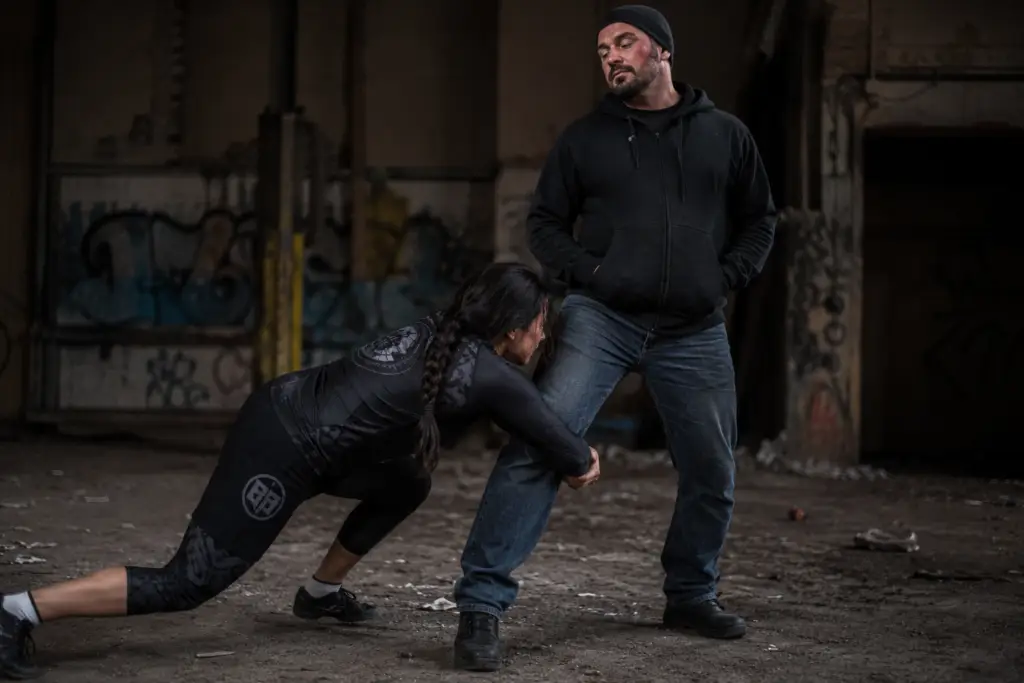
Organizations across Canada are increasingly seeking self-defence programs for Indigenous women and girls. While many communities partner with martial arts instructors, Brazilian Jiu-Jitsu practitioners, or combat sport organizations, an important question must be asked:
Does teaching combat skills address the realities of violence faced by Indigenous women?
Research and lived experience suggest that violence prevention, behavioural awareness, relationship safety, and trauma-informed education may provide greater real-world benefit than systems primarily designed around athletic competition.
At Street Safe Self Defence Training Company, founders Rob Andress and Beth Andress have worked with Indigenous communities and Inuit women throughout Northern Quebec and Canada. Their approach is based on a simple principle:
Violence is patterned, predictable, and often preventable.
What Is Indigenous Women’s Self Defence?
Indigenous women’s self-defence should be understood as:
- Violence prevention education.
- Behavioural awareness.
- Relationship safety.
- Recognition of coercive control.
- Understanding social violence versus predatory violence.
- Escape and disruption strategies.
- Trauma-informed responses.
- Environmental awareness.
- Digital safety.
- Personal boundary development.
Self-defence is not synonymous with martial arts.
Is Brazilian Jiu-Jitsu Effective for Women’s Self Defence?
Brazilian Jiu-Jitsu (BJJ) is an outstanding combat sport and develops:
- Physical fitness.
- Confidence.
- Discipline.
- Athletic ability.
- Competitive skills.
However, real-world violence rarely resembles a sporting environment.
Most assaults against women involve:
- Someone known to the victim.
- Surprise.
- Emotional manipulation.
- Intimate partner violence.
- Size and strength disparities.
- Multiple environmental variables.
- Alcohol or drug involvement.
- Trauma and fear responses.
These factors are largely absent in competitive martial arts settings.
Biology Matters: The Physical Reality
Scientific literature consistently demonstrates physiological differences between men and women.
Research shows men possess:
- Greater upper-body strength.
- Higher grip strength.
- Faster acceleration.
- Greater muscle mass.
- Larger skeletal structure.
Upper-body force production has been measured at approximately 168–186% greater in males compared to females.
These biological differences do not imply weakness.
They simply recognize reality.
Self-defence systems based primarily on strength, leverage, prolonged grappling, or positional dominance may become increasingly difficult when facing larger and stronger attackers.
The Myth That Technique Always Defeats Strength
A common statement heard in martial arts is:
“Technique beats strength.”
Technique certainly matters.
But violence is not a controlled sporting contest.
Violence includes:
- Surprise.
- Fear.
- Adrenaline.
- Environmental hazards.
- Weapons.
- Multiple attackers.
- Emotional relationships.
- Intoxication.
- Ambush.
The question should not be:
“Can a woman defeat a man?”
The question should be:
“How can women avoid, recognize, interrupt, and escape violence?”
Those are very different objectives.
The Myth That Technique Always Defeats Strength
A common statement heard in martial arts is:
“Technique beats strength.”
Technique certainly matters.
But violence is not a controlled sporting contest.
Violence includes:
- Surprise.
- Fear.
- Adrenaline.
- Environmental hazards.
- Weapons.
- Multiple attackers.
- Emotional relationships.
- Intoxication.
- Ambush.
The question should not be:
“Can a woman defeat a man?”
The question should be:
“How can women avoid, recognize, interrupt, and escape violence?”
Those are very different objectives.
Violence Against Indigenous Women Requires Specialized Education
Indigenous women in Canada continue to experience disproportionately high rates of violence.
According to the National Inquiry into Missing and Murdered Indigenous Women and Girls (MMIWG), violence is influenced by:
- Intergenerational trauma.
- Social inequities.
- Intimate partner violence.
- Isolation.
- Substance abuse.
- Historical systemic issues.
- Relationship dynamics.
These realities require education beyond physical techniques.
Programs should include:
Safe Relationships
Understanding healthy versus unhealthy attachment.
Coercive Control
Recognizing manipulation before violence occurs.
Social Violence vs Predatory Violence
Understanding why ego-driven violence differs from criminal violence.
Behavioural Awareness
Recognizing anomalies and pre-attack indicators.
Environmental Awareness
Understanding location, isolation, and escape options.
Digital Safety
Recognizing online grooming, sextortion, and exploitation.
Trauma-Informed Responses
Teaching survivors without re-traumatization.
Why Punching Pads Does Not Equal Safety
Many organizations measure program success by:
- Attendance.
- Photos.
- Social media engagement.
- Number of techniques taught.
- Fitness outcomes.
But the better question is:
Did participants become safer?
Did they learn:
- What abuse looks like?
- How grooming occurs?
- What coercive control feels like?
- How predators select victims?
- How to establish boundaries?
- How to recognize danger sooner?
Safety should be measured by prevention, not by athletic performance.
Community Leaders, Martial Arts Coaches… Understand the risk you’re placing women in by offering this type of sport training.
What Makes Reality-Based Violence Prevention Different?
Reality-based violence prevention focuses on:
Human behaviour.
Pattern recognition.
Situational awareness.
Relationship awareness.
Environmental awareness.
Trauma-informed learning.
Escape rather than domination.
Nervous-system disruption rather than strength.
Prevention before physical engagement.
This approach is designed for:
- Indigenous women.
- Teen girls.
- Mothers.
- Grandmothers.
- Survivors of violence.
- Individuals with no athletic background.
Because survival should not depend on years of training.
Street Safe Self Defence Training Company
Street Safe Self Defence Training Company is one of Canada’s leaders in reality-based violence prevention and behavioural awareness.
Founded by Rob Andress and Beth Andress, Street Safe has delivered programs throughout Canada and worked with Indigenous communities and Inuit women in Northern Quebec, and across Canada.
Street Safe’s philosophy is:
Stop the Before, So the After Never Happens.
Programs focus on:
- Violence prevention.
- Situational awareness.
- Behavioural awareness.
- Social violence versus predatory violence.
- Relationship safety.
- Trauma-informed education.
- Women’s violence prevention.
- Youth safety.
- Indigenous community safety.
Website:
👉 https://www.streetsafeselfdefence.com
Frequently Asked Questions
Is Brazilian Jiu-Jitsu good for women?
Yes. BJJ offers fitness, confidence, and athletic development. However, self-defence should also include violence prevention, behavioural awareness, and relationship safety.
Does technique overcome strength?
Technique helps, but biological differences, surprise, fear, and environmental factors mean strength and intent still matter.
What type of self-defence works best for Indigenous women?
Programs that combine awareness, relationship safety, trauma-informed education, escape strategies, and violence prevention provide broader real-world applicability.
Is self-defence the same as martial arts?
No. Martial arts are systems of physical skill. Self-defence is a broader study of recognizing, avoiding, interrupting, and surviving violence.
Why is violence prevention important?
Because most violence begins long before physical contact. Recognizing patterns early creates opportunities to avoid harm altogether.
References
National Inquiry into Missing and Murdered Indigenous Women and Girls
Statistics Canada
Public Health Agency of Canada
https://www.canada.ca/en/public-health.html
