


By Rob Andress
Violence Prevention Specialist
Street Safe Self Defence Training Company
Canada’s Leader in Reality Violence Prevention Education for Today’s Real Estate Professional
I want to start with something that was said to me years ago.
“We’ve never had a report of that in our Board.”
It wasn’t said to dismiss me. It wasn’t said with bad intentions. In fact, I think the person genuinely believed they were describing a safe environment.
But I’ve never forgotten those words.
Not because they were offensive.
Because they revealed something much bigger about how we think about safety in real estate.
For years, we’ve measured risk by asking one question.
“Has anything happened?”
The problem is, that’s often the wrong question.
The better question is this:
“How would we know if it had?”
Safety Doesn’t Depend on Headlines
I’ve spent years teaching violence prevention to REALTORS®, healthcare professionals, municipal workers, security teams and law enforcement across Canada.
One thing all of those professions have in common is this:
They understand that violence doesn’t begin with an assault.
It begins with behaviour.
Healthcare doesn’t wait for a nurse to be assaulted before talking about aggression.
Police don’t wait for an officer to be attacked before teaching threat assessment.
Airports don’t wait for an incident before training personnel to recognize behavioural anomalies.
They understand that prevention happens before violence.
Real estate has historically approached it differently.
For many years, safety conversations often started only after a high-profile tragedy.
That isn’t a criticism of the industry. It’s an observation of how the profession evolved.
Why REALTORS® Are Different
Real estate is unlike almost any other profession.
Every day, REALTORS® agree to meet complete strangers.
They enter vacant homes.
They work alone.
They often travel to isolated locations.
Their income depends on building trust quickly.
Those aren’t failures of the profession.
They’re simply realities of the job.
Ironically, those same realities can make it harder to recognize risk.
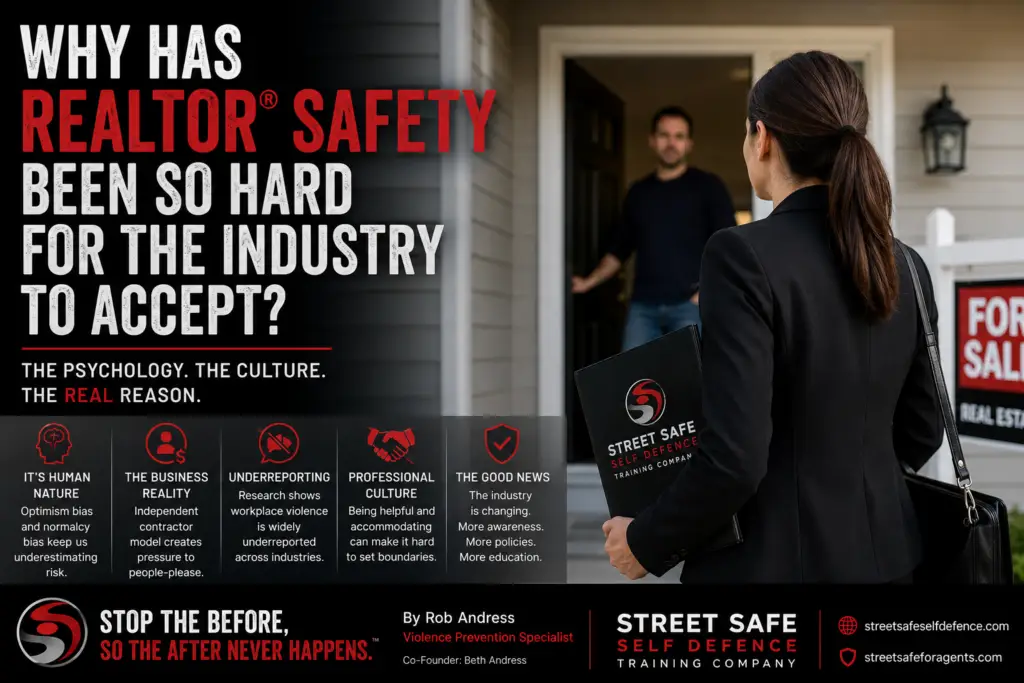
The Psychology Behind It
Behavioural science gives us several explanations for why safety is often underestimated.
One is optimism bias—our natural tendency to believe that serious events are more likely to happen to someone else than to us.
Another is normalcy bias. When we’ve never experienced a serious event ourselves, we assume the future will look like the past.
Neither of these biases makes someone careless.
They’re normal human thinking.
Unfortunately, predators don’t think that way.
They look for opportunity, access and vulnerability.
“We’ve Never Had a Report”
This is where I think the conversation often goes off track.
A lack of reports is not the same thing as a lack of incidents.
Occupational safety researchers have documented for years that workplace violence and harassment are frequently underreported across many sectors. People may stay silent because they believe the incident wasn’t serious enough, don’t expect anything to change, worry about embarrassment, or fear professional consequences.
I’ve heard similar comments from REALTORS® in classrooms across Canada.
“I didn’t want to overreact.”
“I just left.”
“I didn’t think anyone would care.”
“I finished the showing and hoped I’d never hear from them again.”
None of those situations resulted in a police investigation.
But every one of them represented a safety decision.
The Business Model Creates Unique Challenges
Most REALTORS® are independent contractors whose livelihood depends on relationships.
That creates a unique tension.
When your income depends on clients, setting boundaries can feel risky.
Asking for identification.
Refusing to meet alone.
Ending an uncomfortable appointment.
Walking away from a potential sale.
Those decisions are professionally responsible.
But they can feel commercially uncomfortable.
That isn’t a character flaw.
It’s human behaviour.
The Industry Is Changing
To be fair, this story is changing.
Across Canada, more brokerages, associations and regulators are recognizing that REALTOR® safety deserves the same attention as every other workplace safety issue.
I’ve had the privilege of working with organizations that have made safety a priority, including the REALTORS® Association of Edmonton and the British Columbia Real Estate Association.
I’ve watched boards introduce reporting systems, strengthen policies and invest in education.
Those are meaningful steps.
The conversation today is far different than it was even five years ago.
That’s progress.
Safety Is About Behaviour, Not Fear
People sometimes assume violence prevention training is about teaching someone to fight.
It isn’t.
At Street Safe Self Defence Training Company, Beth and I teach people to understand human behaviour before violence begins.
Recognize boundary testing.
Understand isolation.
Identify manipulation.
Trust behavioural information instead of social pressure.
The goal isn’t to win an assault.
The goal is to recognize the conditions that make an assault more likely and change those conditions before violence has a chance to occur.
That’s what prevention looks like.
My Perspective
After teaching thousands of REALTORS® across Canada, I don’t believe the profession ignored safety because it didn’t care.
I think the profession underestimated risk because the risk was often invisible.
No headline.
No police report.
No injury.
Just an uncomfortable feeling that someone carried home and never told anyone about.
The absence of a report is not proof that everyone was safe.
Sometimes it’s simply proof that nobody felt there was a reason—or a place—to report what happened.
If we want to build a safer profession, we have to stop measuring safety by the number of tragedies we can count.
We have to start measuring it by the number of tragedies we prevent.
Because that’s what real violence prevention has always been about.
Stop the Before, So the After Never Happens.
References
- Canadian Centre for Occupational Health and Safety (CCOHS). Violence in the Workplace. https://www.ccohs.ca/topics/health-safety/violence/
- Canadian Centre for Occupational Health and Safety (CCOHS). Violence Prevention. https://www.ccohs.ca
- Occupational Safety and Health Administration (OSHA). Workplace Violence Prevention. https://www.osha.gov/workplace-violence
- National Institute for Occupational Safety and Health (NIOSH). Workplace Violence Prevention. https://www.cdc.gov/niosh/topics/violence
- Daniel Kahneman. Thinking, Fast and Slow. Farrar, Straus and Giroux, 2011. (Discussion of cognitive biases, including optimism-related decision-making.)
- British Columbia Real Estate Association (BCREA). REALTOR® workplace safety initiatives and professional guidance.
- Canadian Real Estate Association (CREA). REALTOR® safety resources.
