

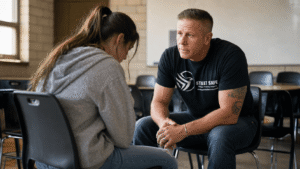
A Little Girl’s Story
I have worked with more than 40,000 high school students over the years. I wish I could tell you that I remember every name, but I don’t. After that many classrooms, schools and conversations, names begin to disappear.
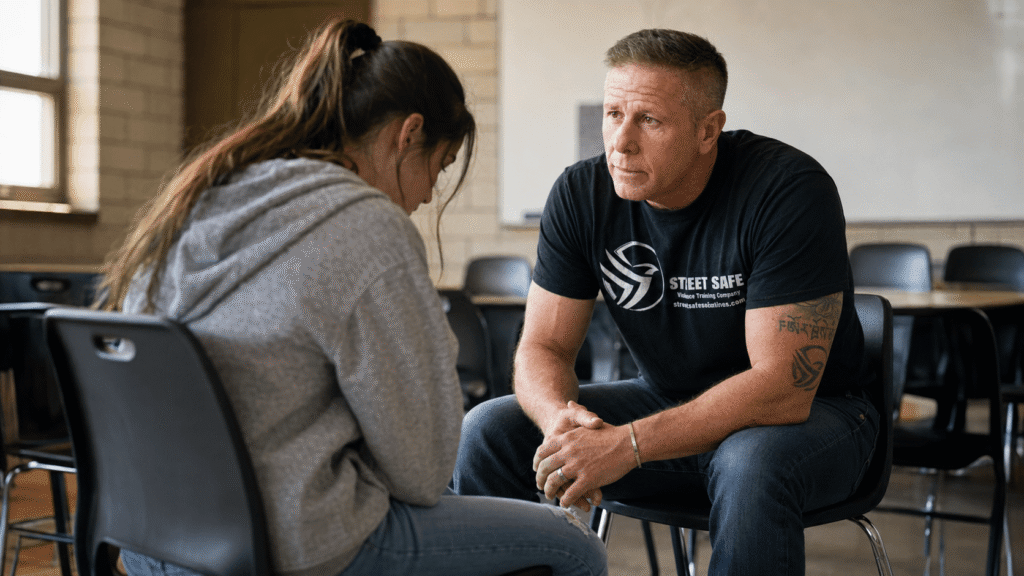
The faces are different, but the faces of survivors stay with me.
I want to share a story about that face! She was 15 years old, in Grade 10, attending a high school in Western Ontario.
I do not remember her name, but I remember the way she stared at the floor.
“Her face has stayed.”
Our High School Work Is Not About Fighting
Our work in high schools is not built around physical self-defence. We teach physical skills because they are a necessary and realistic part of violence prevention, but fighting is never the foundation of our program.
The most important skills are learned before anyone is grabbed, struck or physically controlled.
We teach young people how to recognize behaviour. We help them understand how trust can be manipulated, how boundaries are tested and how someone may slowly create access to them.
We teach them that fear does not always arrive as panic. Sometimes, it begins as a quiet feeling that something is not right.
Most importantly, we teach them that the person who may hurt them will not always look dangerous.
Parents Are Still Looking for the Stranger
When moms and dads think about violence against their daughters, they often picture a stranger.
They picture the man hiding behind a bush, the suspicious person walking toward her on the street or someone following her through a dark parking lot.
For generations, we have called this “stranger danger.”
We taught children to fear the person they did not know, but we did not spend nearly enough time teaching them how to recognize dangerous behaviour from someone they already trusted.
What if the person harming your daughter is not hiding behind a bush?
What if he has sat at your dinner table?
What if you have laughed with him, trusted him and welcomed him into your home?
What if your daughter has been told to hug him because he is family?
Canadian evidence tells us that most victims of police-reported sexual assault know the person accused. The person may be a family member, family friend, intimate partner, acquaintance, coach or someone else who was given legitimate access to the victim.
That is the part of this conversation many parents do not want to face.
Sometimes, the greatest threat is not the stranger standing outside the family home. It is the familiar person who has already been invited inside.
The Moment of Truth
During our high school program, we have a discussion about A-Social Violence. I explain how predatory people may create access, build trust, test boundaries and use manipulation before violence ever occurs.
At the end of that discussion, the room often becomes quiet.
Not the ordinary quiet of students waiting for the next subject. This silence feels different.
I call it the moment of truth.
It is the moment when some young women begin looking back at their own experiences with a new understanding.
One may begin to realize that an uncle touching or rubbing against her in a way that makes her uncomfortable is not normal.
Another may recognize that her father’s friend repeatedly commenting on her body, appearance or clothing is not harmless when it feels sexual or crosses a boundary.
Another may begin questioning the older friend who started buying her a phone, giving her new clothes or offering to pay to have her hair done.
A compliment is not automatically predatory, and a gift is not automatically grooming. But when the attention becomes excessive, boundaries are tested, secrecy is encouraged and generosity begins creating a sense of debt or obligation, those behaviours need to be recognized.
You can see the moment a young woman begins connecting the pieces.
Her posture changes. Her eyes move toward the floor. Something she has been trying to explain to herself suddenly has a name.
Something is wrong.
More importantly, she begins to understand that what happened was not her fault.
I Saw Something in Her
That day, I noticed a young woman while I was speaking.
She appeared guarded. She was fidgeting, avoiding eye contact and staring at the floor. None of those behaviours, on their own, prove that someone has experienced abuse. But after years of working with survivors, you begin to recognize when someone may be carrying something they do not know how to talks about.
Some people might call it a sixth sense.
It is not. It is pattern recognition developed through years of watching people carry pain in silence.
When the session ended, she did not leave with everyone else. She waited, then began walking toward me slowly.
I remember watching her approach. Every step appeared to require a decision.
Should I tell him?
Will he believe me?
What will happen if I say it out loud?
She had not spoken a word, but I could see that she was carrying something.
I did not yet understand how heavy it was.
“I Need Help”
When she reached me, she told me why she had stayed behind.
Her words, as closely as I remember them, were:
“My uncle has assaulted me more than once. I tried to tell my mom, but she won’t believe me.
“The first time happened at his house. I stayed there when my mom and dad went away. Then it happened again.
“When he comes to our house, he smiles, hugs me and whispers in my ear how much he loves me.
“My mom and dad punished me for talking about it.
“I need help.”
There are moments in this work when the room around you disappears.
The noise disappears. The other people disappear. For a few seconds, nothing exists except the young person standing in front of you.
She was 15 years old.
She had been assaulted by someone she had been taught to trust. She had found the courage to tell her mother, and she had done exactly what adults tell children to do.
Tell someone.
Do not keep it a secret.
Ask for help.
But when she finally spoke, she was not protected.
She was punished.
The Assault Was Not Her Only Wound
Think about what happens inside a child when she tells her parents that someone has harmed her and they refuse to believe her.
She begins to think that the comfort of the family matters more than her pain. She learns that the reputation of an adult may be more valuable than her safety. She begins to believe that speaking the truth can cost her the love of her parents.
Her uncle had already violated her trust.
Now, the people who were supposed to protect her were teaching her that she would have to carry that violation alone.
The assault was not her only wound.
Being disbelieved became another.
Being punished for asking for help became another.
Being forced to see this man enter her home, smile at her parents, hug her and whisper in her ear became another.
Imagine being 15 years old and knowing that the person who assaulted you can walk freely into your home while you are treated as the problem.
Home is supposed to be where a child runs for protection.
For this young woman, home had become another place where she was not safe.
Parents, Your Child Did Not Cause This
Parents, if your child tells you something you do not want to hear, your discomfort does not make what they are saying false.
The disclosure may damage a relationship. It may change the way you see someone you have known for years. It may create conflict within your family and force you to face a reality you never imagined possible.
None of that gives you the right to emotionally destroy your child for speaking.
Your child did not damage the family by telling you what happened.
The person who harmed your child created that damage.
Do not ask your child to remain silent to protect the family. Do not ask them to protect an uncle, family friend, coach, neighbour or anyone else whose reputation has suddenly become uncomfortable to question.
Do not punish your child because accepting the disclosure is painful for you.
They may have rehearsed those words a hundred times before saying them. They may have stood outside your bedroom door and walked away. They may have typed a message and deleted it. They may have spent weeks or months wondering whether you would believe them.
When they finally find the courage to speak, do not make them regret telling you.
What Your Child Needs to Hear
You do not have to solve everything in that first moment. You are not expected to conduct an investigation or determine every fact while your child is standing in front of you.
You do need to listen.
Remain as calm as you can. Take what your child is telling you seriously. Do not blame them, interrogate them or ask questions that sound as though you are searching for a reason not to believe them.
Tell your child:
“I hear you.”
“This is not your fault.”
“You did the right thing by telling me.”
“I am going to help you.”
Then take the necessary steps to protect your child and involve the appropriate child-protection, law-enforcement and professional supports.
Your first responsibility is not to confront the accused.
Your first responsibility is not to protect the family name.
Your first responsibility is your child.
Her Face Has Never Left Me
People may look at a 15-year-old and see a teenager who should know what to do.
That day, I saw a little girl.
I saw a little girl who had been harmed by someone she trusted.
I saw a little girl who had gone to her mother for protection.
I saw a little girl who had been punished for telling the truth.
I saw a little girl who eventually stood in front of someone she barely knew and quietly said:
“I need help.”
I do not remember her name, and that truth bothers me.
But I remember her face.
I remember her eyes fixed on the floor. I remember the way she approached me and the courage it took for her to say those words.
Most of all, I remember knowing that the adults who should have protected her had left her searching for protection somewhere else.
Parents, when your child tells you something that breaks your heart, do not break theirs in return.
Listen to them.
Take them seriously.
Protect them.
Be the person they believed you were when they finally found the courage to tell you.
Rob Andress
Violence Prevention Consultant, SAS-AP
Close Quarter Combative Instructor
Pure & Applied Debilitation Instructor
Active Threat Survival Trainer (A.L.I.V.E.)
Street Safe Self Defence Training Company
Statistics Canada recent trends in sexual assault
Canadian Centre for Child Protection: Understanding Child Sexual Abuse
Justice Canada: Family violence and laws protecting children
High School Self Defence Program
Violence prevention begins before anything becomes physical
By Rob Andress, Violence Prevention Consultant and High School Self-Defence Educator
